

JUST ADD WATER
Filming underwater demands specialist cinematographers. Here, top professionals share insights on how to light the depths for compelling and controlled images.
Lighting underwater is a distinct craft that requires more than simply adapting land-based practices. From light loss and colour shift to bubbles, murkiness and safety, every underwater scene presents a unique set of visual and technical challenges.
Multi-award-winning cinematographer Ian Seabrook (Last Breath, Jungle Cruise) explains that underwater filming is often underestimated. “Even a single shot requires planning, safety procedures and lighting design,” he says. For Last Breath, which recreates a real-life diving accident at 100 metres, Seabrook worked in Malta’s open-air tank at night, designing an overhead lighting rig supported from the surface. “High winds ruled out flying lights,” he recalls. “We submerged DMX-controlled lights to shape the environment. Surface conditions were brutal, but it stayed calm below. The Alexa 35 and Panavision G Series anamorphics gave us incredible images.”
Lighting deep water scenes convincingly also means simulating the rapid loss of colour with depth. “After about 15 metres, red light is gone,” says Gail Jenkinson (Gold Rush: White Water). “You have to restore colour in grading. But with good lenses and lighting, you capture the right information in-camera.”
Cinematographer Kjetil C. Astrup (The Devil’s Star) adds that even at the surface, several stops of light are lost. “The water acts as a filter, altering light depending on angle, clarity and movement. You compensate with reflected light and artificial sources. We use HydroFlex lights deployed like topside units. A colour checker always comes with me to aid post.” Astrup also builds custom LUTs for specific depths. “Flat profiles help when lighting is limited, and RAW is essential. The key is to capture as much as possible on the day.”
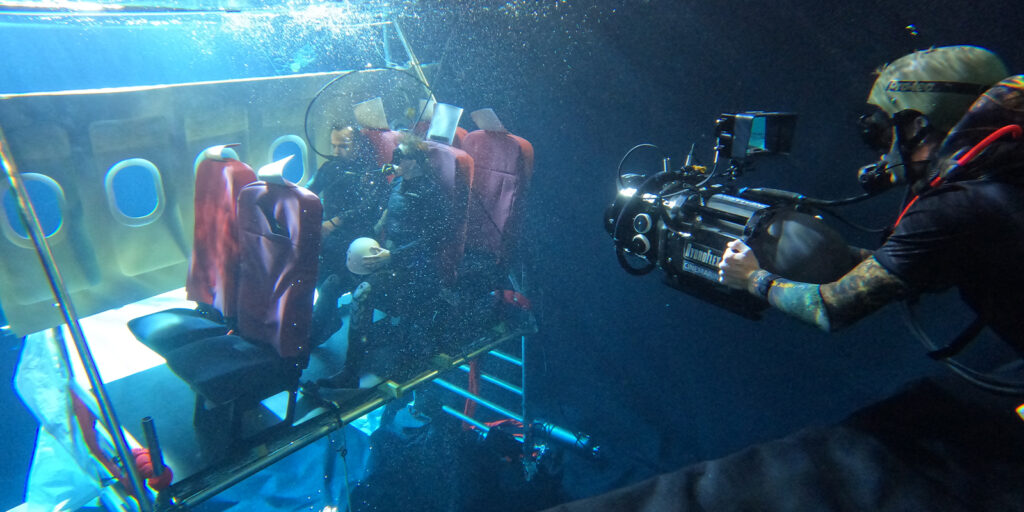
Vance Burberry ASC ACS, who blends land and underwater techniques, stresses the value of control. “Water is a challenging medium,” he says. “Bubbles can blow highlights. A neutrally buoyant, well-trimmed camera helps. I hold it like a Steadicam.”
Under control
For Vancouver-based cinematographer Braden Haggerty (Surface), tanks offer a lighting advantage. “In controlled settings, we have full command of lighting,” she says. “Most light comes from above the surface, supplemented by underwater sources—PARS or LEDs. I use LED panels from Better Way Lighting to lift ambient light without creating hotspots.”
But tanks come with their own challenges, particularly space. “We often work in tanks far smaller than ideal,” Haggerty says. “We black out the pool walls with Cinemattex and add murkiness to suggest endless depth. Sometimes we pull an actor across the tank just below the surface to simulate sinking. It works even for kids.”
Wim Michiels, founder of the purpose-built Lites Water Stage at Lites Studios in Brussels, designed his facility to offer total lighting control and flexibility. “We work at a steady 32°C underwater and use warm water for effects,” he says. “We’ve created full-red tanks for Netflix’s Under Paris and restored clarity within hours, thanks to our powerful filtration system.”
Michiels also stresses actor training. “Technology’s no use if the actor isn’t comfortable. We run training sessions under real conditions. It improves performance and reduces risk.”
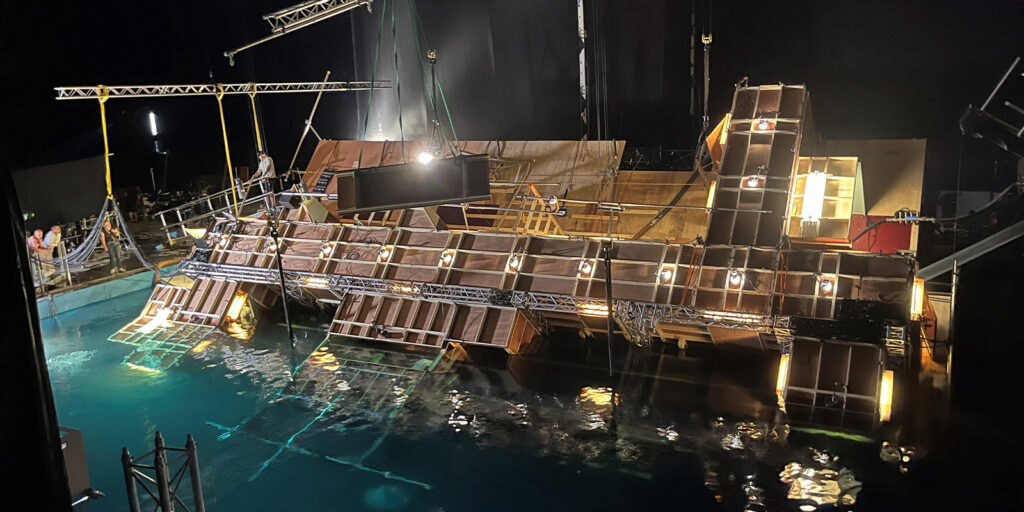
Safety is crucial when working with powerful lights near water. Burberry reminds that “everything must run on GFIs, and the crew must be experienced in underwater protocols.” Temperature, too, plays a role. “Water should stay above 90°F to prevent hypothermia.”
Ultimately, lighting underwater is about more than visibility. “It’s storytelling,” says Seabrook. “Shape, direction, colour loss, motion—all of it can support the narrative. You just need to understand how light behaves below the surface.”
Words: Robert Shepherd