

TECHNIQUES TO CREATE TERROR
Provoking the audience to quake in their seats dates all the way back to the Lumières’ L’Arrivée d’un train en gare de La Ciotat. Stories of viewers leaping aside as the train approaches may be apocryphal, but the idea of making audiences jump is almost as old as cinema.
Cinematographer Sevdije Kastrati-Dill ASC relates her work in the field to some very personal life experiences.
“I’m originally from Kosovo, and I got involved in film right after the war. It was with documentary – I got to document my experience. I lost my mother and sister during the war. There was an organisation I was working with as a translator which created a film project and brought in a director from the United States. We talked about the war, and the story, he insisted I join this group. I’d never thought about camera or cinematography, but I thought ‘Okay, I’ll do it.’
“I worked in Kosovo, and got involved in narrative and in 2009 I moved to Los Angeles to study at AFI. Now I work between the US and Kosovo. It’s quite different because Kosovo is a small industry but the stories from there are things I’ve lived through, and it’s just different to tell those kinds of stories.”
Perhaps understandably, Kastrati-Dill takes a phlegmatic attitude to the scariness of the everyday. “I personally think that there’s horror in everything. I’m not someone who thinks ‘this is a horror film and this is how you light it.’ In Zana, which is a movie my sister directed in Kosovo, there are scenes which are horror. Rosemary’s Baby was an influence for it – the horror is real life and the character has nightmares.”
Kastrati-Dill describes her approach as mostly character-centric, beginning with a thorough reading of the script – “many times, to understand what is happening with the characters. For me lighting is about the story, and the character’s world – taking into consideration what the world looks like and feels like to the characters, and how the audiences will experience it.”
Communicating those ideas to a director at a stage long before any visuals exist, Kastrati-Dill goes on, is essential, but “always tricky, because you don’t know what the director is going for. I search around for images, paintings and photography. And it does take a lot of work, because you might not get the project, but I like to be very prepared going in for the first meeting. I am trying to describe how I see the visual language of the film—a lot of the time, the directors haven’t put that into words, yet.”
A look book might apply to any production, but creating something designed to unsettle will very often mean visuals which look somewhat out of the ordinary – a challenge when shooting in an ordinary world. “Most of the movies I’ve done have been on location,” Kastrati-Dill points out. “There are things we can do to it, but also it’s what we have, and we can’t change it completely. If more budget needs to go to production design, I’m good with it because that’s the world. And that takes a lot of collaboration.”
That sort of interdepartmental generosity, Kastrati-Dill emphasises, pays dividends. “In general with movie-making, but especially this kind of world, we’re talking [a lot with] the production designer. On Perpetrator we had the house painted in dark colours. It was an apartment building in Chicago, and we were lucky because that location was going to be destroyed and rebuilt afterwards, so we could do anything we wanted to it.”
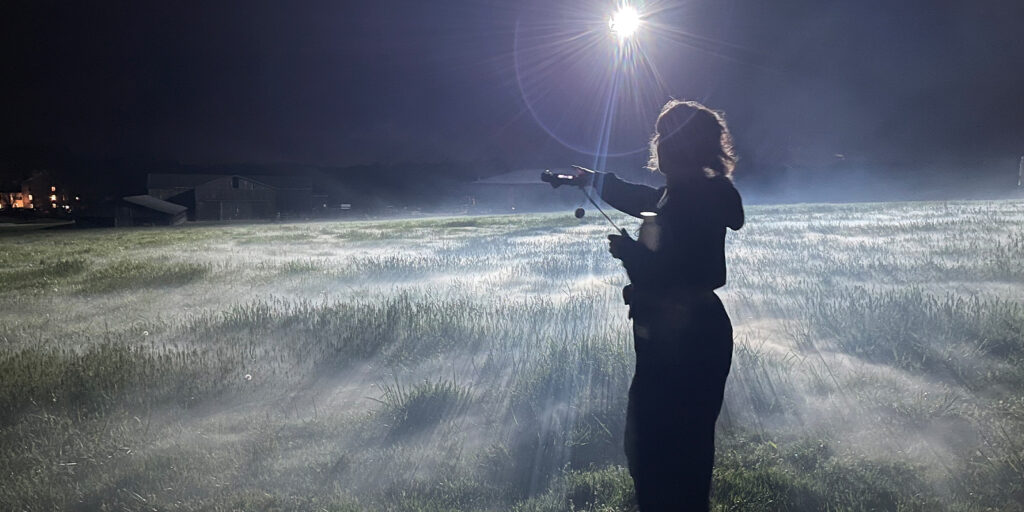
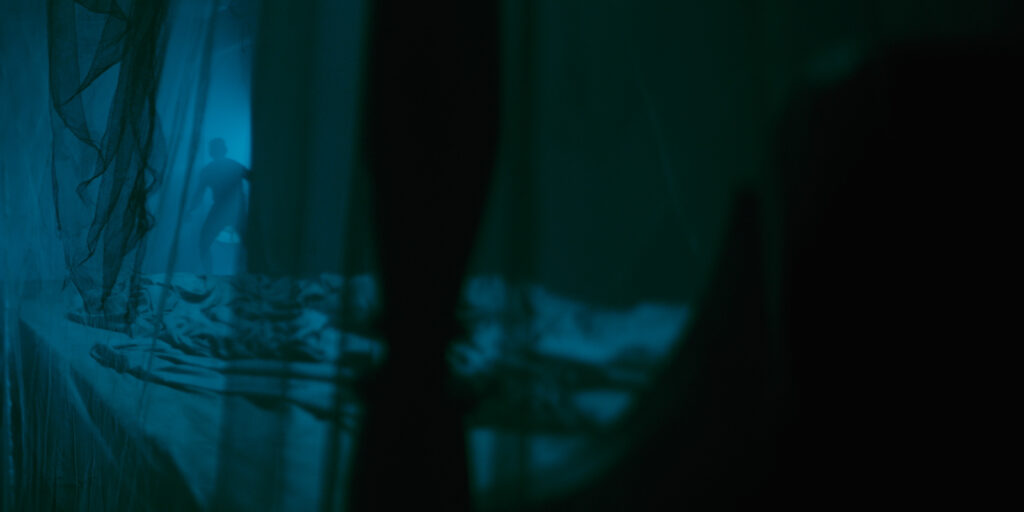
Creating that sort of chiaroscuro takes deliberate effort when reality prefers things to be evenly lit. “At the end of the movie we go into the perpetrator’s world. It’s pretty much a guy who takes these young women and uses them in different ways. That world the guy has created in a basement could look like anything, so we found this location with freezers – and they were all white. I was thinking ‘this environment is very different from the rest of the movie. It should be very unwelcoming and ominous, that you really don’t want to be there, that there’s bad things there.’”
Kastrati-Dill addressed that thought with a combination of techniques. “We went with this green-cyan colour, with really deep shadows. A lot of times we see the perpetrator as a silhouette. I used tilt-shift lenses for this part of the film, so it was a very different world, and the colours were very different. When we had moonlight it was normally a little more blue, but this was the green and cyan. Atmosphere plays a big part as well.”
Time and place
Exteriors – especially on productions lacking the resources to set up the largest modifiers – rely on the right choice of time, as well as the right choice of place. “I try to go to locations at different times of day,” Kastrati-Dill points out. “In Perpetrator, One of the day exteriors is a cemetery, so you already have something spooky going on, but it’s also about picking the time of day. Working around dawn or sunset, you still get shadows. You don’t want to be shooting in the middle of the day. I’m hoping in the future there’ll be some kind of app where AI can take a photo of a location and show it to you at different times of the day!”
Filmmaking often demands that specific things be visible for story reasons, and Kastrati-Dill cites a related issue that is of great importance to a certain kind of production. “One thing to consider is if there’s a lot of blood in the film. There was something specific in Zana where I worked with the special effects makeup artist – a scene where we have to see a face in a dream, the face of one of the young girls who was killed during the war. It was important for them to know the lighting that would be used because it impacted their SFX make up colours.”
At the same time, the most exquisite skill of a filmmaker has always been to direct the audience’s imagination to create things the production could not, and the most disturbing art has often taken great pride in what it does not show. “There was a moment in Zana where the girl had to be against a window and be a silhouette,” Kastrati-Dill remembers. “We’re not supposed to see her face until the end of the movie, and that can be difficult because of all the light bouncing around in the room. You have to block all that light in order to create the silhouette. It took longer than you’d think.”
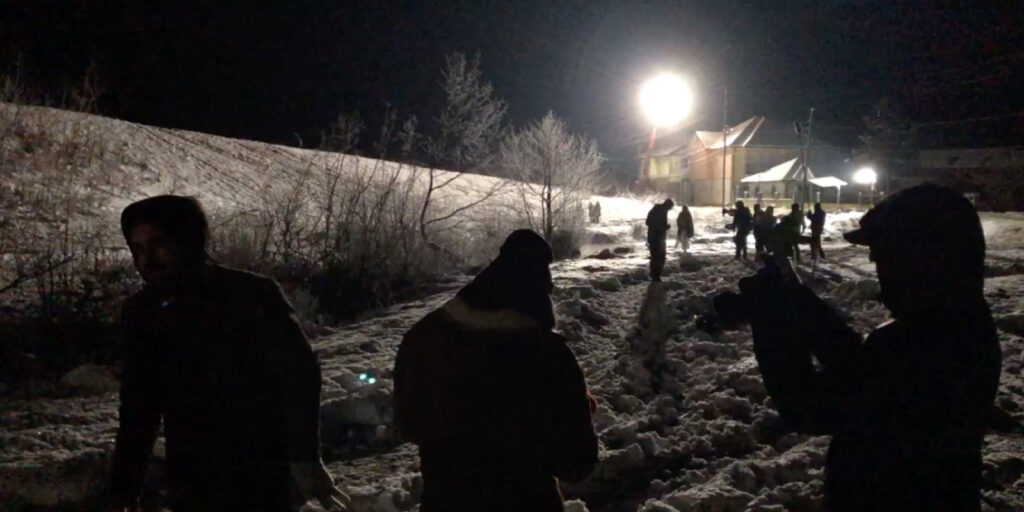
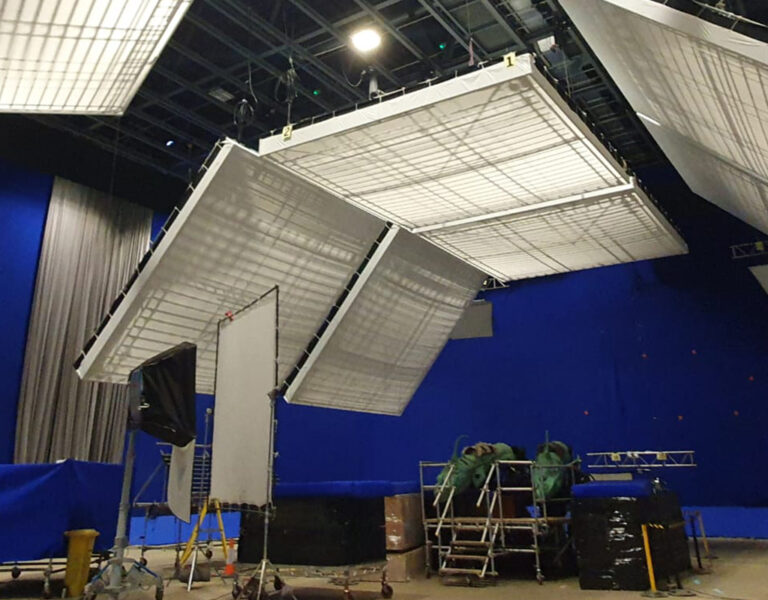
Kastrati-Dill confirms that her approach often keeps the lighting crew busy. “I like the light hitting the faces to feel directional. I like to control it even if that means getting a lot of grip equipment out. I don’t use a lot of units of light, but I use a lot of grip. I’ve had key grips call me ‘old school’ because most of the stands and grip equipment was out. Even if it’s a soft source, you can control it, but it’s a lot more equipment.”
Leveraging technology in pursuit of a suitably unsettling unreality, Kastrati-Dill says, is an indirect route to putting the audience in the characters’ world. “We create environments which are not real, and so long as it works for the character that’s what we want. That’s the beauty of filmmaking. You make it believable enough that the audience is not questioning those things, they’re with the characters.”
Words: Phil Rhodes