

NATURAL BEAUTY
The film industry’s desire for attractive light is part of the reason southern California attracted filmmakers in the first place. Ever since, they have sought ways to conveniently simulate natural illumination – but for both technical and artistic reasons, the sun has often remained the filmmaker’s favourite key light.
John Christian Rosenlund FNF embraced natural light on The Emigrants, a 2021 period piece depicting people moving from Sweden to the United States in the mid-nineteenth century. “We shot ninety-five per cent of the movie in daylight,” Rosenlund begins. “It gave us a lot of freedom to shoot almost anywhere, and we could go from interior to exterior without seeing a lot of HMIs outside the windows.”
Inevitably, that creative decision had consequences, particularly around geography. “The main location was a farm,” Rosenlund recalls. “I knew that if I could find a place to orient the farm correctly to the sun, I would have much better control over my daylight. It wasn’t something that I could come up with – it had to be a collaboration between the team, and especially the production designer Karl Júlíusson.”
Timing, Rosenlund emphasises, is a key consideration. “The film was moved almost two months later, to a period where there were very few hours of daylight. We shot some of the film in Romania on a western town backlot – but it was late in the year, and it was getting darker. You have to have your first assistant director on board to understand the challenge, so you can do morning stuff in the morning and afternoon stuff in the afternoon. You can’t force it. We were lucky to have 1st AD Mike Lundin on-board. His smart planning was essential.”
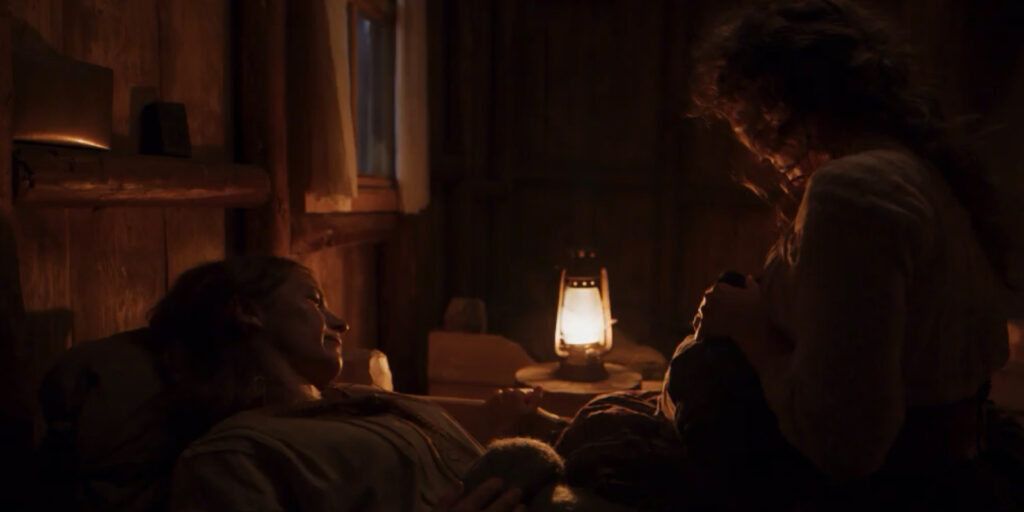
Rosenlund points out that director Erik Poppe’s willingness to block accordingly was crucial. “Where the people can be in the room is limited if you want to have light on their faces. With lights you can decide where to put the people, then put the lights. With this you had the freedom of saying ‘okay, if people are moving around, sometimes they’re in the dark.’”
Nonetheless, Rosenlund relied on some adventurous stop-pulls. “You have to deal with exposure. I was sitting with the remote controls for the T-stop. When we went from the inside, maybe at T2.2, I went to T22 when we went outside. I’m normally not the guy who likes T22. I seldom stay over a 5.6. But on this show, going T22 was part of the premise to make this kind of shot happen. We had other solutions we could also use – variable NDs to help that stop not go too wild.”
Embracing imperfection
Historic films, and history itself, often involves flame-based light sources, and Rosenlund took care to make them as realistic as the real daylight. “We ended up using some lamps, because we had to. At that time, they lit the room with candlelight and oil lamps, which are nice, but when you’re on a boat in a storm with twenty people, you can’t use oil lamps – or you can, but it can be disastrous.”
Some twenty-five years ago, Rosenlund had founded a company to service situations just like this. “The old way is to use a tungsten bulb and dim it. You get a really nice colour, but you need a cable. If you use a battery, you have fifteen minutes. I realised there were no LEDs that could [simulate] flame. I started a company called Softlights, for people who need a very specialised light. What we landed on was four LEDs that had four different colours, so we got a colour that was well-matched to the face.”
Back outdoors, in the fading daylight, Rosenlund found himself embracing imperfection as a refreshing route to verisimilitude. “Having done this for more than forty years, my biggest enemy is perfection. You learn the tools so well, you know that you can be perfect, but nobody wants to look at something perfect. You want to look at something real. But it takes two to tango. I admire directors like Erik Poppe who pushed me to the limits of what was possible.”
Words: Phil Rhodes