

RESTORATIVE POWER
The BFI, a global leader in film preservation and restoration, offers a rare look inside its National Archive, led by head of conservation Kieron Webb.
Fresh off the back of the second instalment of the successful BFI Film on Film Festival, British Cinematographer made the trip to Berkhamsted to see where the magic happens. The Hertfordshire facility was erected in 1987 with the support of John Paul Getty Jr., marking it as the first time the BFI National Archive had a purpose-built location for its activities.
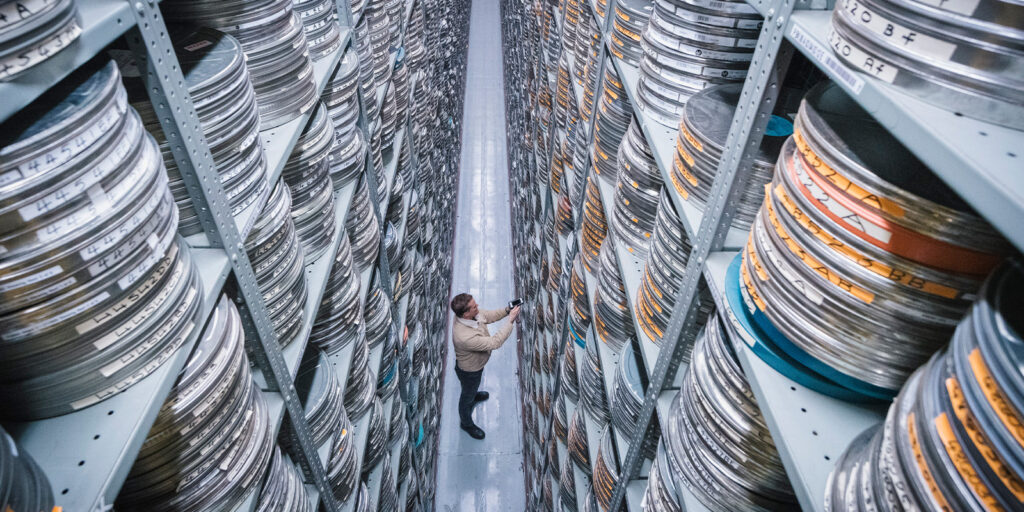
A cornerstone of the BFI, the BFI National Archive was founded in 1935, celebrating its 90th anniversary in 2025. It houses one of the world’s largest and most significant collections of film, television and moving image with over 175,000 films, more than 2.1 million television programmes (including off-air recordings) and a total of over eight million items.
There’s enough film in the vaults to go around the world three times with digitised collections equating to over 260 years of streaming Netflix at its highest (ultra 4K) quality.
Head of conservation Kieron Webb’s involvement started at the turn of the century, joining the BFI in 2000. His journey into film more generally arose, as it does for most, from going to the movies, “A lot of good memories were formed from being at some rowdy screenings in my youth, I think Flash Gordon was one that particularly stood out – a raucous event for sure.”
Another landmark event in shaping Webb’s career came from shooting with a Super 8 camera at a similar time, “mucking about with that when I was younger was probably formative, these things are never completely out of the blue. I think my interest crystalised around that time, working with film material physically.” This joyful, tangible interaction with celluloid proved to be pivotal in signposting a career for Webb, leading him to read film studies at the University of Kent before moving into restoration at the BFI National Archive in 2003, three years into his tenure there.
“The lab was not digital back then, so I’ve lived through interesting times. I feel glad that I began before digital emerged and blossomed properly.” Webb fondly recalls handling the first of a trilogy of films by Bill Douglas in this pre-digital time. “I hand cleaned it with a solvent that isn’t even in use anymore and it was one of the first jobs I did. I remember watching the check print and the feeling of having that irreplaceable camera negative in your hands, there’s nowhere to hide. It sticks with me because we were working on a real masterpiece there.”
Webb has had the privilege of seeing the digital revolution before his eyes, witnessing the rise in technology and capabilities of digital film restoration such as the work he did on Hitchcock’s The Pleasure Garden. “In a particular sequence, an important segment came from a nitrate copy from the Netherlands archive, but it had terrible mould. To see that cleaned off in the digital version was incredible. That is something that you couldn’t do before.”
Although less hands-on in his current role now, Webb detailed the skills needed in research, data extraction and dexterity to work in restoration at the BFI National Archive daily. He cites the “ability to know when to stop as you never want to attempt to over repair something” as one of the most important decisions faced by a conservationist.
Reel authenticity
There’s a need for authenticity as you seek to restore a film to its former glory and by over correcting you could damage the film forever. Authenticity for the BFI National Archive team often means they are looking to restore the first print of the material, normally the first British release, which can be complicated if dealing with many different prints within a restoration. “With I Know Where I’m Going! by Powell and Pressburger we had a print we could date to the year of release, but it has sequences that didn’t appear in other copies of the same time. So, we studied all of this and shared it with The Film Foundation, with whom we were working on the restoration and personally with Thelma Schoonmaker and Martin Scorsese to get their knowledge. It’s not quite as simple as just image restoration, there are always judgements and decisions to be made.”
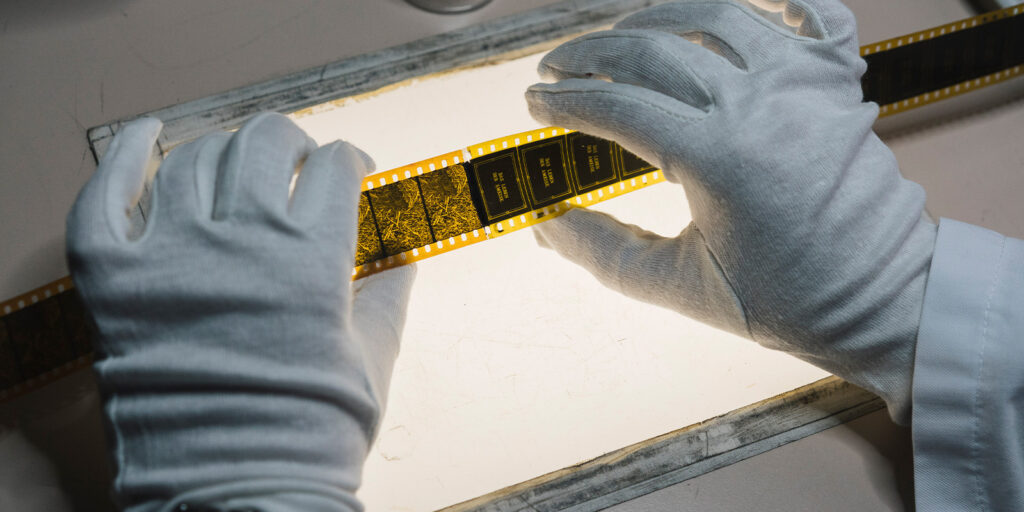
The BFI’s Film on Film Festival has been a particular source of pride for Webb, he fondly recalls starting out at the BFI and witnessing ‘The Last Nitrate Picture Show’ (a programme presented by the International Federation of Film Archives (FIAF) of nitrate screenings and symposium hosted by the BFI Southbank in 2000 in front of an international congress of film archivists) which, as the name suggests, could well have been the end of nitrate projection in the UK. Happily, two decades on and people of all ages are cramming into BFI Southbank to witness the gorgeous spectacle of nitrate projection.
“The Film on Film Festival has been heartening, encouraging and in a lot of ways confirming.” One particular element of the festival that has inspired Webb was the sheer amountof young celluloid-fanatics that attended the festival. “During Amadeus, it was full of young people and they were just enjoying the movie so much. We actually found one of our young conservators, it sounds like a fairytale, but it is true, using a film winding bench at the festival!”
A bright future for film
Webb and the BFI National Archive team are keen to inspire the next generation and have subsequently launched, with the help of a National Lottery grant, 18-month traineeships in film conservation and archive technology “which is what underpins everything we do.”
The future is indeed looking bright for the BFI National Archive and for the continuing preservation of film. An exciting development is the BFI being awarded a £1m grant from the UKRI Arts and Humanities Research Council’s UKRI Infrastructure Fund to build a state-of-the-art moving image conservation research laboratory at the National Archive, the first of its kind. This is huge for the BFI. “It’s daunting, exciting and I cried when we got that grant,” says Webb, who believes it will be groundbreaking for film preservationists across the globe.
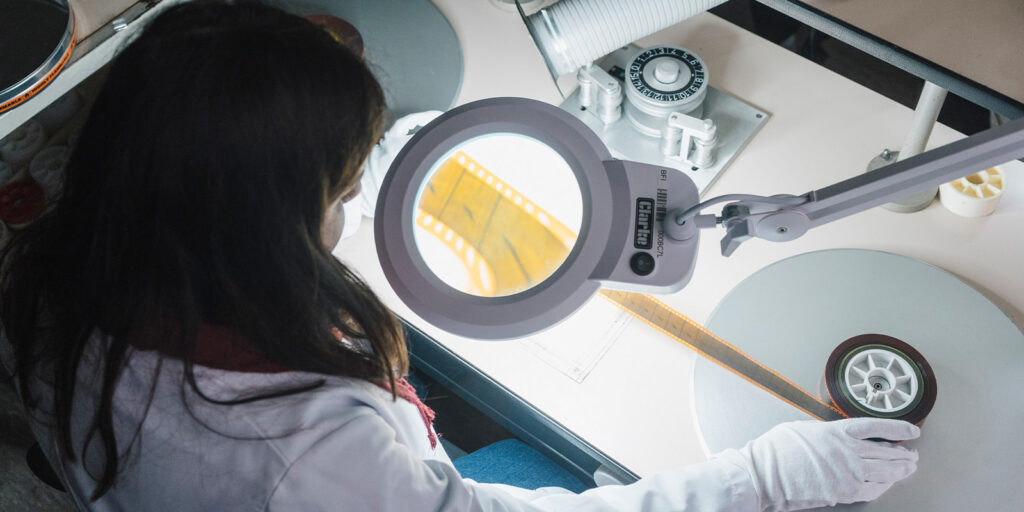
“In the last 15 years I’m always meeting heritage scientists from other sectors and museums, the V&A, Tate and more. I thought ‘this is all brilliant what they do with paintings, coins, bones…why doesn’t someone point this stuff at film and video?!’”
To have such capabilities would be groundbreaking. For example, researchers could identify the exact chemical composition of celluloid dating back to the early 1900s, learning what colours and chemicals were used to dye black-and-white film from 100 years ago. “To have a facility dedicated to this and hosting it ourselves so researchers from around the world can visit it, that is such an important path to go down. We’ve learnt so much about how to care for film and restore it but there’s still so much we don’t know.”
When asked ‘Why conserve?’, Webb’s answer is impassioned and poignant: “If I stop to think about it, if we want to know ourselves, understanding the stories and history of how we got here and the stories that continue to be made, that’s how we do it, by preserving them.
“There’s nothing else like the moving image. We can have very complex reactions to what we see presented, it won’t always be a cuddly feeling when we recognise ourselves but that’s what it’s all about.”
Words: Tom Williams