

COMMUNICATION IS KEY
Filmmaking has often been called a team sport. Finding the right balance between keeping a crew informed and herding cats, meanwhile, involves a compromise that technology has long helped to mitigate.
Gaffer David Sinfield prefers, in any event, to talk rather than email. “In any job, there’s a million emails shared between massive groups of people. If the art department, special effects, camera or production people have a question, I tend to say ‘Let’s have a chat.’ We stand over a plan or a model and come up with a solution there and then. I was talking to an art director on our show yesterday – ‘I want to speak to you about this spaceship we’re building.’ I said ‘I’ll come and see you, and you’ll get the answer straight away.’”
Tellingly, Sinfield’s earliest experiences were on productions involving a lot of people. “My first job was on one of the Harry Potter films, then I was lucky enough to work with some very experienced gaffers. My first opportunity to gaffer a movie was with a DP called George Richmond [now a BSC member], who was just starting out. We did a movie called Blood, and I haven’t looked back.”
“You never want to be in a situation where you’re standing on a set with someone saying ‘I didn’t know you were going to do that!’” Sinfield reflects. At the same time, oversize committees inevitably become inefficient, and the selectivity of headset communications becomes key: “Sometimes, a meeting with fifty people becomes a bit problematic. We’ve all got radio headsets for our individual departments.”
It’s good to talk (quietly)
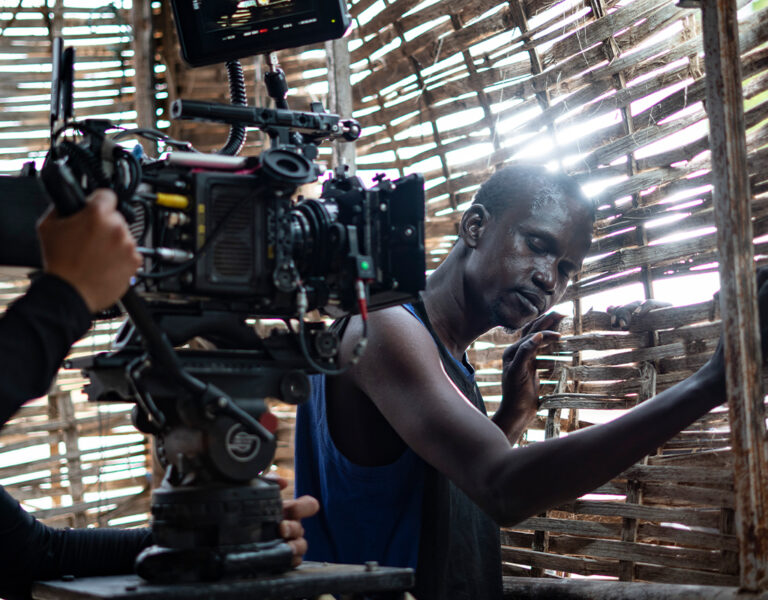
Conversing without interrupting the general flow is essential setiquette, as Sinfield goes on. “The gaffer, focus puller, key grip and first assistant can have a conversation on headsets that nobody else is distracted by. It’s a good way of keeping the set really quiet, having a chat quietly and talking creatively about stuff. Certain people are listening, and you can relay it to other people. You have eight people having that conversation rather than having thirty people, and you can bring in other people when you need to.”
As so often, expediency is the watchword. “In the first half hour of a day,” Sinfield points out, “if the director is trying to block out a scene with the artists, the cinematographer can be in the room, and the operator and grip, all saying ‘I want to start here, the dolly track is here, the lights here,’ and we can quietly start relaying the information to our crew to start doing stuff – and the director can continue blocking.”
The specifics of that, Sinfield goes on, are hugely dependent on circumstance. “Different cinematographers may want different people on comms. Their key collaborator may be the special effects supervisor because they’re maintaining the atmos, and they may want to stay on that to maintain consistency. There’s a reason to bring more people in, but it needs managing.”
Something else that needs managing is radio spectrum space: “On every film set, we operate all our lighting… on an iPad. There’s so many frequencies between camera, grip, sound and the DIT that it does become a problem. We try to get the IT department involved so everyone can have their own channels and people don’t lose [anything] through the day.”
“Film sets seem to work really well when they’re fluid,” Sinfield concludes. “Lights, cameras props… everyone can work quickly. It’s the key to everything. I’m lucky that I work with a lot of cinematographers who have become friends and I have a good relationship with them. Communication from prep down to the last day of shooting – not just between the cinematographer and the camera department, but all the positions on the movie.”
Words: Phil Rhodes