
TIME FOR REFLECTION
At one time, reflectors might have seemed like a straightforward field, with innovation mostly limited to a better class of polyboard clamp. Gaffer Carolina Schmidtholstein has watched the field advance to the point where sufficiently clever setups can avoid the need for lifting machines.
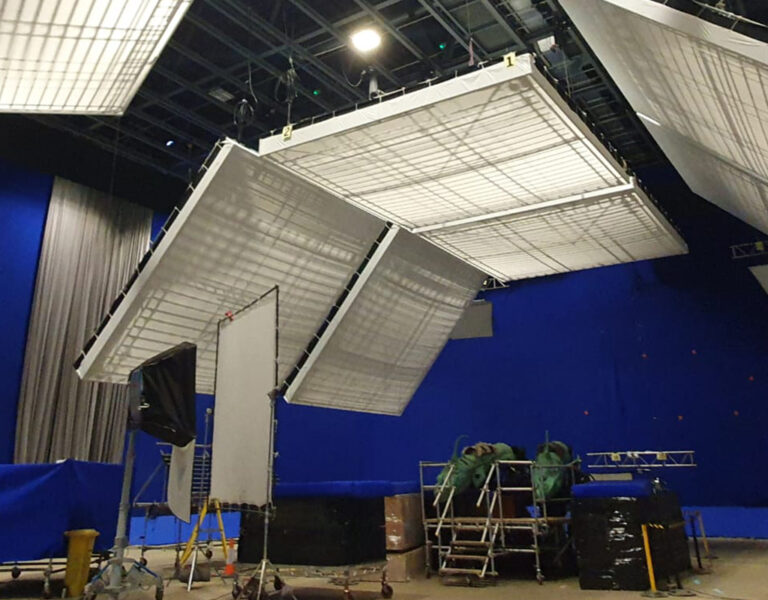
“When I came to England it was 1999,” gaffer Carolina Schmidtholstein remembers. “I was already in the gaffer world for small things, working my way up as a spark and best boy. Reflectors are not anything new, really. There are two new things – the [reflector systems] and the lights. CRLS is Lightbridge’s, and there’s also Lightstream from Dedolight. They took the idea of mirrors and made them in graduation of different strengths.”
Schmidtholstein compares these developments to independent ideas of the early 2010s. “I remember possibly fifteen years ago there was a Belgian gaffer who was into that. He was showing me examples of how he’d be using one source and sending it round corners on mirrors.” The value of more directional, more distant lighting, and the resulting reduced rate of falloff, is clear: “It allows the light source to be twenty metres away before it even [leaves the stand], which is what makes it so amazing – working against the inverse square law.”
Much as these techniques were effective with existing light sources, designs intended specifically for reflector setups have improved things still further. “The [Dedolight] PB70 light is the key,” Schmidtholstein says. “You can put the light so close to the window, on the floor, shining upward. Because it’s such a beam, there’s no stray light. You aim it into the reflector which you can hide outside a window so easily. You’re so close to the window, you can make a very steep light, throw it into a really tricky corner.”
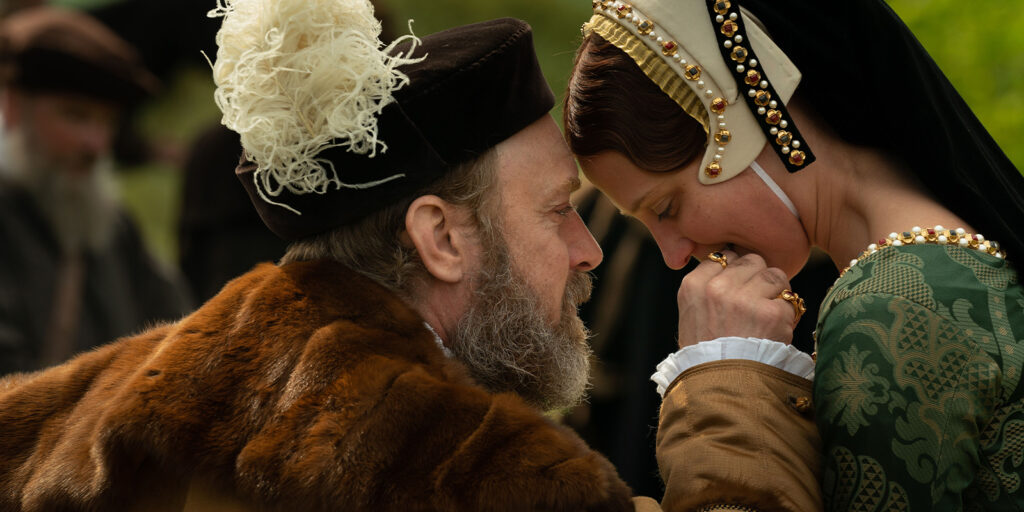
The usefulness of that was highlighted on Firebrand, a production set in early sixteenth century England with significant work at Haddon Hall in Derbyshire. “We wanted light that was going steeply into the windows so it bounced off the floor. It was surrounded by precious gardens, and there was no option to get machines into the garden. We built a scaffolding platform all along those four or six windows and we had four of these units, four reflectors and goalposts as close as possible.”
The light weight of reflectors makes for easy rigging options, as Schmidtholstein found on a recent commercial. “You can lift out a two-by-two suspended ceiling tile, and use a scissor clip. We hung the 25cm reflector, so it wasn’t carrying a heavy weight, put a Source Four hiding on the floor, out of shot. The camera was not seeing any stand and the light was just shining into the reflector so you were able to aim it precisely onto the object or person. So, I use the small ones as well.”
The relative efficiency of these approaches, Schmidtholstein notes, helps both financially and environmentally. “You’re getting a lot of intensity out of the 1.2kW HMI in this case. On some films I didn’t use a generator at all. We had these modern battery packs and we powered that 1.2 for hours on a 5kW battery.”
The controlled gain of modern reflectors, Schmidtholstein says, has even begun to replace the traditional approach. “Even if you want a little bit of a lift, you don’t use a polyboard anymore. You use that reflector, adding hampshire on it or something. There’s a number-four which I hardly use because it’s so diffuse – even less than a polyboard, I think, but as a beauty dish or something it’s great. I had it in handheld situations where you are walking along with a camera and a small reflector. You can achieve some great results with it.”
Words: Phil Rhodes