

DP Sheldon Chau speaks to British Cinematographer about shooting the epic myth Kannappa—from Alexa 35s in wild New Zealand weather to shaping light like Andrew Lesnie ACS ASC.
BC: What is the film about and how did you get involved with the production?
SC: Kannappa is about an atheist hunter in 2nd century India who must defend his village from an invading army and then faces steep challenges to his true character as he ultimately becomes Lord Shiva’s greatest devotee. The story of how Kannappa commits himself to utmost devotion is a story that is now legendary, and there is even a renowned temple dedicated to him in South India.
I had shot a previous film for this production company before the pandemic, and made a positive impression as the producers wanted me back for this next bigger venture. They credited my unique eye as well as my speed, adaptability, and tendency to use fewer lighting units and love for shaping natural light. The producer called and said he wanted to do his version of The Lord of the Rings with horses and action and wirework in the vast canvas of New Zealand landscapes. After the global success of RRR, the Telugu film industry in India was booming, and I was excited to find myself delving deep into this style of filmmaking once again.
BC: Which cameras and lenses did you use and what informed that decision?
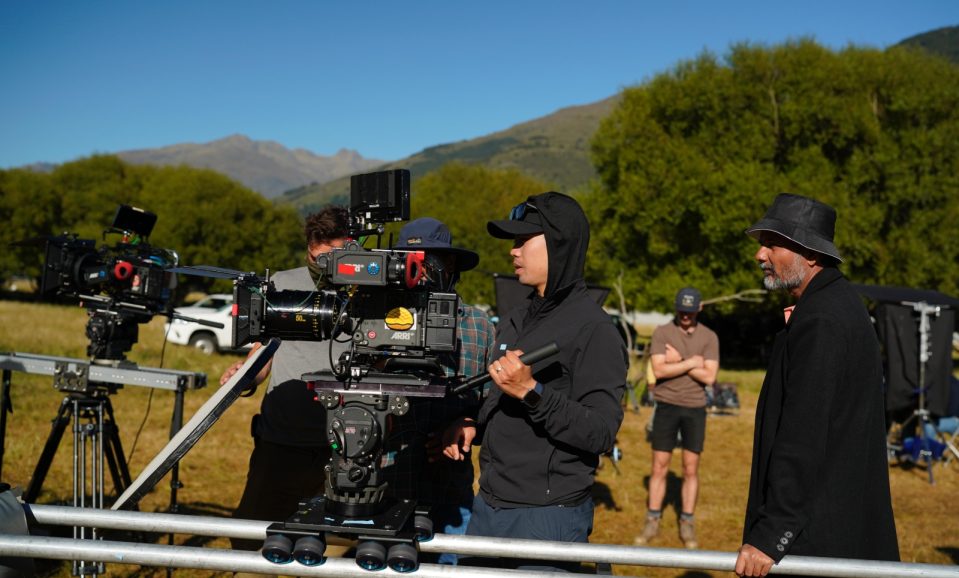
SC: We primarily shot with two Alexa 35 cameras and Cooke S7 lenses. When choosing cameras, I conferred with my mentor Larry Fong, ASC to figure out what cameras would best suit this epic style of filmmaking. He helped me come to the conclusion that the Alexa 35 was the best choice – with its top-notch colour science and proper dynamic range required to handle the four-seasons-in-a-day New Zealand weather. We went with Cooke lenses for its soft, clean, and flawless look. We worked with Stephen Baker at Imagezone NZ when specialty lenses were needed for specific scenes – such as Atlas Orion anamorphics and the vintage Century Swing Shifts. We also had my personal Sony FX3 for more dynamic action angles, a DJI Inspire 3 drone, a DJI Ember, and also an Alura 45-250mm zoom and a set of Zeiss Ultra Primes.
BC: What was the biggest challenge for you on this film and how did you overcome it?
SC: My biggest challenge was definitely adapting to an entirely new way of running a set, covering a scene, and balancing various creative heads. I will elaborate more on this in the next question. In addition to the cultural differences, I was faced with a grueling start-and-stop schedule that spanned over eight months between New Zealand and India in which the shooting pace was extremely fast. Being away from family for that long was tough. In New Zealand, although the scenery is gorgeous, the weather is another story. We shot entirely exteriors, and often had to deal with a cold and cloudy morning, an unrelenting harsh sun during the day, sudden rain that drops in along with dark clouds, and then sometimes crazy winds; it was temperamental to say the least! In India, my challenge was to light up a large blue screen stage in a way that required ridiculously fast turnarounds for different scenes in order to accommodate the superstar actors who came in for cameo parts. This is where Larry Fong, ASC once again came in clutch to my assistance; his guidance helped me construct my lighting approach – and you can say my lighting design was a simplified version of what he did on 300 or what he was doing on A24’s Death of a Unicorn.
BC: Where in Asia is it set and did you have to negotiate any cultural differences (eg work different hours, not have a common language?
SC: The film is set in 2nd century India in pristine nature – which contributed to our producer’s decision to film in the stunning natural landscapes of New Zealand. The native language of the crew and the production is Telugu. I had a great time learning some of the language and gaining the respect of the cast and crew as I made it a personal goal of mine to learn as much of the culture as possible to be a better collaborator. In doing so, I can earn their trust, and also become a better person by staying curious and absorbing new knowledge. Global exchange of creativity and ideas is what makes this world a better place, and we need more of it.
With that said, one of my biggest challenges was to adapt to the shooting style of my director Mukesh Kumar Singh (who is from the Mumbai film industry) and the hero culture of Indian cinema. It definitely took me several weeks to get comfortable with the type of coverage we were capturing – for instance, in our case, we rarely filmed a master shot in which dialogue is spoken and hardly ran dialogue scenes all the way through, and instead, each angle would be synced to certain lines without additional coverage for it. In a way, it limits the options in the edit, but at the same time, guarantees what the director wants. It differs drastically from the traditional Western way of covering a scene, but once I watched early edits, I understood Mukesh’s specific vision, and eventually embraced this new method of working in order to sync myself to my director (though I admit it wasn’t easy!). Another factor was when I had to adapt on the fly to different working styles of directors who came in for certain sequences – such as when Prabhudeva or Brinda came in to choreograph dance sequences, or when Kecha came in for stunts, and essentially called the shots for those days. Sometimes, Mukesh is with the second unit at the same time, so I had to account for that and ensure that the visual language stayed consistent on all fronts. The hero culture is also a beast of its own – especially seeing how the crew behaves around a prominent producer or lead actor, such as Vishnu Manchu (who plays the titular role of Kannappa) or A-list stars like Prabhas, Akshay Kumar, and Mohanlal. Many times the lead actors and actresses are addressed as “hero” and “heroine” and that pretty much becomes their name for the entire schedule. I’ve also never filmed this much high frame rate (slow-motion) in my career!
As for adapting to the food, the production brought in Indian caterers so it was authentic Indian home cooking for months – I have no problem at all with that! I also loved the chai tea on set.

BC: How did you light it and why and which lights did you use?
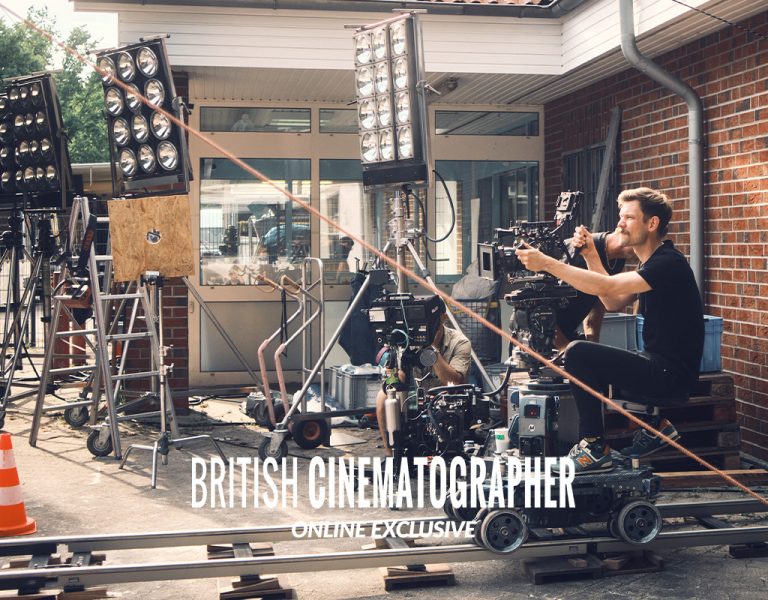
SC: In New Zealand, I mainly shaped the natural light, and used a lot of negative fill. For the sake of continuity, my gaffer Zac Beckett-Knight was frequently next to me staring up at the sky to tell me how long I had sunlight for before another cloud would obscure it. The biggest lights were two ARRI M90s that we brought in specifically for a key action scene in the forest that needed more punch. Otherwise, we carried Astera tubes, some basic Aputure units, Creamsource Vortex units, and an ARRI M40 – sourced from Zac’s company out of Christchurch named ‘Late Knight’. I was also inspired by Andrew Lesnie’s exquisite work on The Lord of the Rings and how he customized a special eye light for Cate Blanchett as Galadriel, and so I had my gaffer design a special white-and-silver beadboard to use for an eye light bounce on our heroine (played by the stunning and rising Tamil actress Preity Mukhundhan) and also an Astera tube for the sorceress character’s eyes to make her feel more snake-like and otherworldly.
In India, we shot at the famous Ramoji Film City (where RRR and Bahubali were filmed) in Hyderabad. My lighting consisted of an array of ARRI Skypanels hung overhead as base daylight ambience, and then an ARRIMAX 18/12K as the hot source for sun. On the ground, we had some M18s to provide fill or a highlight kick. The Indian lighting, jib, and grip teams at Ramoji were fantastic; they worked tirelessly and efficiently (shout out to Mosin, Ramkumar, Sai). Same for the camera and lighting team in New Zealand (much love to Sage, Zac, Simeon, Daz, Matt, and Charlie). And also my second unit DOP Siddharth Ramaswamy, and superstar of a gimbal operator Suresh!
BC: Can you give an example of a scene or sequence you are particularly proud of and why?
SC: There is a mythical scene that is essentially a battle between two Godly warriors filmed at the epic location of Mount Tarawera on North Island that I am particularly proud of. It’s one of the most beautiful places I’ve ever been, let alone film a movie. There is a considerable hike up the slope to get the best views, and I’m happy that I pushed the creative heads to go the extra step and not settle with the most convenient option. There was even a blanketing fog that rolled in that we managed to embrace. The result is a scene that maximizes the location and looks quite striking on the big screen. This location is the site of the mighty volcanic eruption of 1886 that wiped out the entire area; there is a lot of history, stories, and Māori legends that belong to this place, so having the permission to film here was extra special and truly a privilege. I do want to mention that collaborating with the New Zealand locals, particularly the Māori people, was one of the highlights of the shoot. The Māori culture is so grounded to the land, and they have such a beautiful way of seeing life, that I yearn to hear and see more of their stories reach the rest of the world.