

WALKING WITH DINOSAURS
Shooting on 35mm in Thai jungles and Maltese tanks, John Mathieson BSC embraced old-school methods for Gareth Edwards’ Jurassic World Rebirth—despite modern pressures.
When John Mathieson BSC was approached to make Jurassic World Rebirth, he was immediately excited by the prospect of working with director Gareth Edwards. “I just like Gareth’s films,” he says, a body of work that includes Godzilla (2014) and Star Wars spin-off Rogue One (2016). “One of the first things he said was, ‘Would you shoot it on film?’ I said, ‘Yeah,’” adds Mathieson, the Academy Award-nominated cinematographer behind Gladiator and The Phantom of the Opera. “I hadn’t shot film for a while.”
The last time he did was 2019’s Pokémon: Detective Pikachu, but Mathieson was all too aware that such chances are getting less frequent, with budget-conscious studios increasingly nervous about using celluloid. Edwards’ decision to shoot on 35mm Kodak film, largely to emulate the look and feel of the original 1993 Steven Spielberg-directed Jurassic Park, “was met with a lot of resistance”, says Mathieson. “We had to prove that the shooting ratio wouldn’t be outrageous, and they put us in for 22,000 feet a day, which is four hours – which is stupid.”
As Mathieson notes, digital filmmaking means that directors lean towards shooting more than they ever used to on film. “Even the more disciplined filmmakers like Ridley Scott and James Mangold, when they shoot digital, they shoot more – more than an hour more than they used to.” Not only did he need to convince the studio that they would be careful, “I had to convince Gareth as well that we cannot just switch on his Sony FX3 and run about.” With Mathieson vigilant, the shooting ratio dropped, impressively. “It went down to about 7 or 8,000 feet a day, sometimes less, rather than 22,000.”
THE JUNGLE LOOK
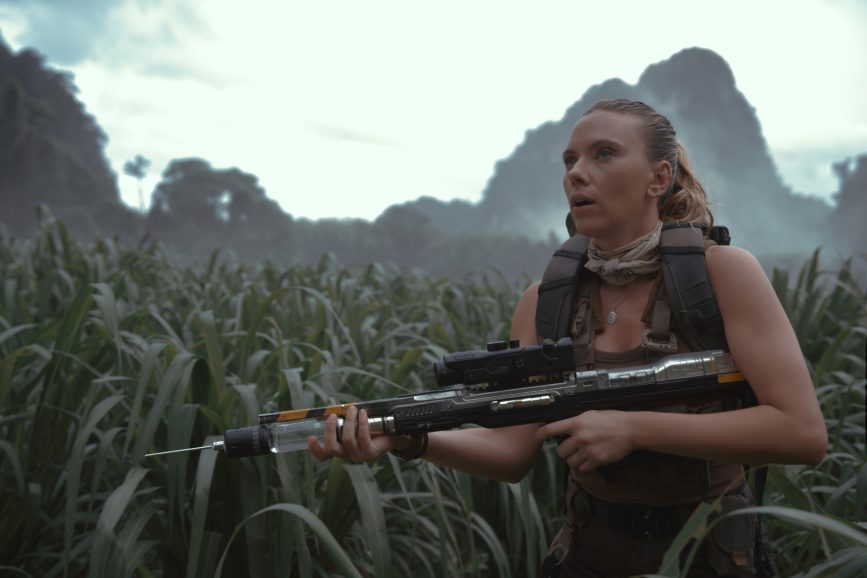
The start of a new trilogy, with all new characters, Rebirth is set on the fictional tropical island of Ile Saint-Hubert, where capable operative Zora Bennett (Scarlett Johansson) arrives to obtain blood samples from three dinosaurs for medical advancement. With such a setting, the decision was made to film on location. “Gareth was promising adventure,” says Mathieson – and shooting out of season in the jungles of Thailand was exactly that. “It’s more fun than driving to Leavesden and Shepperton and parking in your spot that says ‘John Mathieson’ and going and looking at blue screen.”
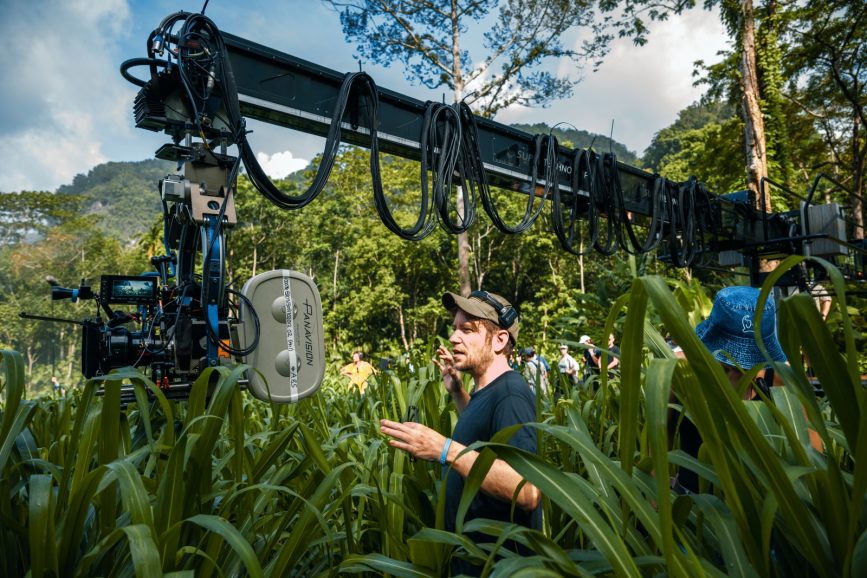
Filming with the Panaflex Millenium XL2, one of the major of advantages of using this Panavision camera was its sheer durability. “Thailand was a hundred percent humid and wet and digital cameras do not like that,” says Mathieson. “You have to cover them up. The fans put in moisture, and they get wet, then they overheat, or worse still you drop them in the water and they’re kaput. You can drop a Panavision camera in the water…it’s kind of okay. The film doesn’t mind getting wet…you close that door up and it’s airtight, watertight. That’s it. It’s done. You drop a digital camera in the water, it’s gone.”
Again, harking back to the way Jurassic Park was shot, Edwards was also keen to use Panavision anamorphic lenses – the E series, C Series and MAP 55mm Macro. “He likes the Cs a lot. I like the Es because they’re just a bit more versatile,” says the cinematographer. Mathieson was familiar with the C series, “but they don’t perform in every situation”, he notes. “They don’t handle backlight too well. If you can control it, which you can in a studio, that’s fine. But when you’re out in the jungle, you want something to hold the highlights…Cs can go muddy quite quickly. So you know you need to light it more.”
SWEATING IT OUT
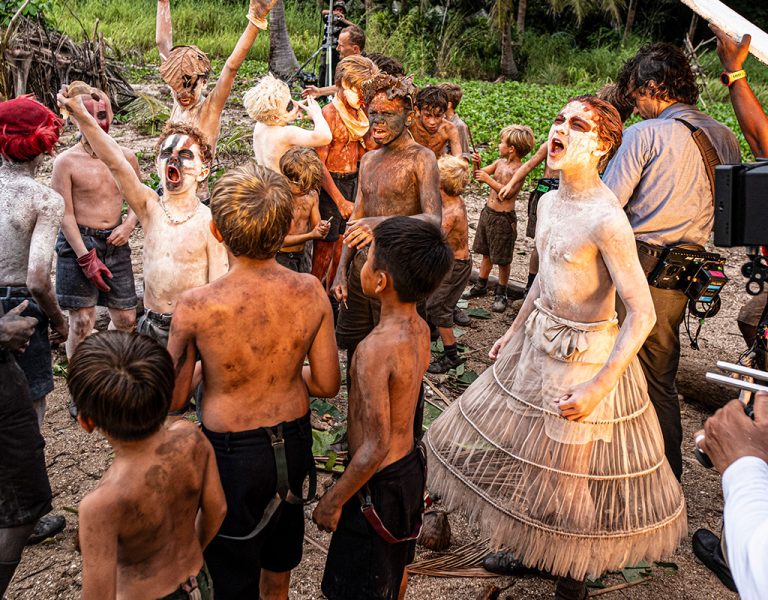
Filming began in Thailand in June 2024, a hugely challenging experience. “Nothing was ever dry. You try and dry your boots out, and you’re always getting into wet gear,” says Mathieson. “We had five grips in intensive care one day. Dengue fever, yellow fever, cholera, malaria. We had the whole lot. And the cameras just kept going.” The production even employed a snake wrangler to help keep the set clear of any particularly big slithery creatures, although coping with Mother Nature wasn’t the only issue faced by the team.
Mathieson’s specialist lighting equipment was delayed when the Iran-backed Houthi rebels attacked commercial ships in the Red Sea and Gulf of Aden, blocking the Suez Canal.
“They got stuck in the Gulf of Aden, being shot at by rockets. So, they turned around and had to go a long way around the horn of Africa, and therefore didn’t turn up.” Needing lighting gear to help produce shimmering effects on water, Mathieson turned to old-school techniques, such as broken mirrors. “When something goes wrong – you lose a location or someone gets sick – you just carry on,” he shrugs.
With Edwards preferring a one-camera set-up, Mathieson didn’t favour mounting the XL2 on a Steadicam. “There wasn’t too much Steadicam at all. It was just sticks, dollies, a lot of cranes. All the cranes in the jungle were all fixed-arm cranes.” But given the difficulties of humping heavy equipment through mangrove swamps – despite the “fantastic”, hard-working Thai crew – Mathieson’s team was forever looking to find flat ground to lay a dolly track on.
“Unfortunately, any flat piece of ground in the jungle is usually the riverbed. So, the grips were forever laying track in the mud and their feet just were rotting!”
Mathieson calls it filmmaking “the old-style way”. “This whole film was a bit of an old-style film, waiting for dailies for five days,” he says. The dailies were shipped from Krabi, Thailand, to Bangkok and then London to be developed – a five-day process. As the film’s executive producer Denis Stewart comments, “It was five days of wondering if that film was going to get there okay, wondering if we could move on and strike the set and let an actor leave or if we were going to need to reshoot a scene or let it go. But not a single problem arose.”
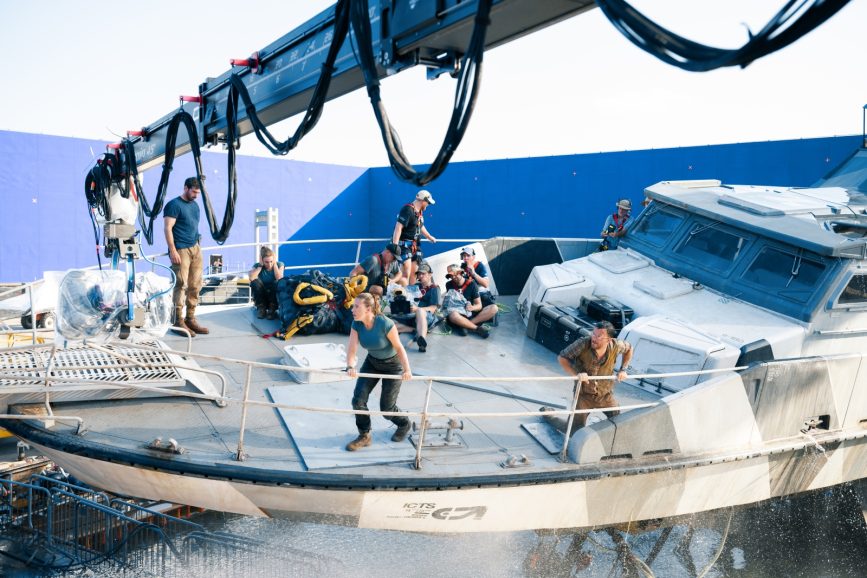
In July, the production moved to Malta, where The Essex – the boat captained by Zora’s teammate Duncan Kincaid (Mahershala Ali) – was built, with hydraulics, on an outdoor water tank at Malta Film Studios. “I mean, it wasn’t really the best decision, I have to say,” sighs Mathieson. “Because the boat was always on the move. And those tanks, big though they are, they were made for models.” The tank was dry – water was added digitally later on. “Of course, we didn’t use water in there, because the water is wrong. You put yourself in a tank, it’s like putting a Ferrari in a parking lot. There’s nothing moving outside it. Where’s the moving road?”
Some elements for the sequence were shot in the searing heat off the coast of Malta, where they were able to film a more azure-blue sea than it was possible to get in Thailand. As so many have discovered over the years, filming at sea is anything but easy. “Shooting things on water is a pain. It’s really difficult,” says Mathieson. “You can’t put anything down. If you put something down and you frame it up, even if you’re in a tank, the slightest breeze and things drift, you’ve got to tie them down, but then you don’t want them to tie down the boat. They’ve got to float and bounce.”
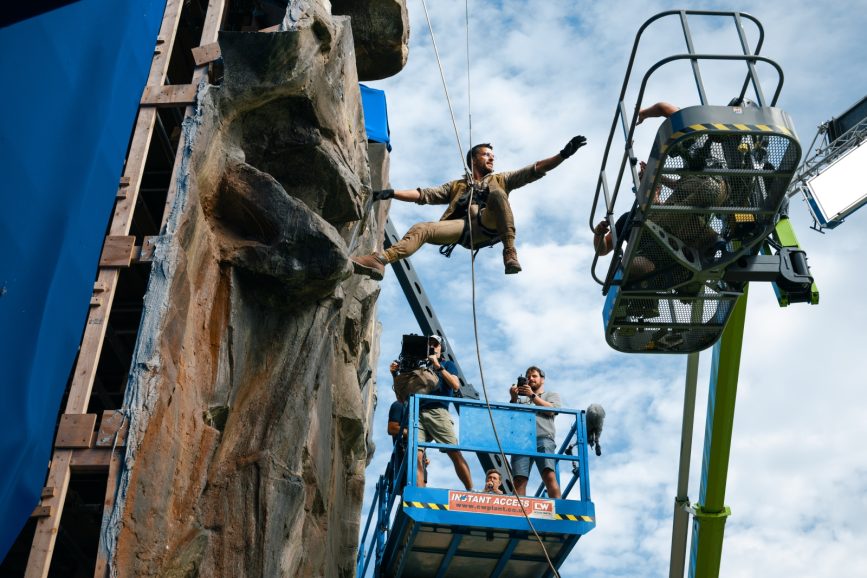
After Malta, the production moved to the UK, and to Sky Studios Elstree, where various elements were shot, including the bridge of Kincaid’s boat. An oversized cabin was built to accommodate the camera, with this interior mounted on a gimbal to simulate the rocking of the boat, when the aquatic beast, the Mosasaur, comes roaring past. Also shot at Elstree were scenes on Ile Saint-Hubert, including laboratories, underground tunnels, a gas station mini-mart and an ancient temple where a giant Quetzalcoatlus has made its nest. A 70-foot cliff wall set was also built for scenes of Zora and her team abseiling down to the temple.
Edwards and Mathieson used a mixture of drone cameras and 75-foot cranes to capture that vertiginous sequence. “If you are on location, you can’t always get where you want to be, so you tend to be further away from the action than you would be if you’re in a studio,” explains Mathieson. “You’ve got to treat it a bit rough and ready, like the rest of the film. Get away from it. Go get a deep dish lens. Yes, it’s topped up in post and CGI. But shoot the element you need at a distance that would feel like, ‘Oh my God, there’s a guy up on a wall over there, and he’s a long way up. That’s as close as we can get.’ So you’ve got to think of it in real terms.”
CLAWS AND EFFECTS
With nearly all the dinosaurs – bar one tiny animatronic creature – created via visual effects, it still meant filming elements for real, including the moment a T-rex chases the Delgado family, also stranded on the island, down a river. Partly filmed in a flooded quarry in Thailand, the sequence was completed at the Lee Valley White Water Centre in Hertfordshire. Shot in the autumn – in stark contrast to the steamy temperatures of Thailand and Malta – it was a test for the cast, especially young Audrina Miranda, who plays Isabella. “She was terrific,” remarks Mathieson.
For the grading, Mathieson turned to experienced colourist Paul Ensby. “He’s a traditional Technicolor man. And I’ve been with him for years,” comments the cinematographer, citing their collaboration on Ridley Scott’s 2005 Crusades epic Kingdom of Heaven – a film Edwards was a big fan of. “Gareth was very into what Paul was saying. You’ve got to stick to the rule book of grading: red, green, blue, or yellow, cyan, magenta, up, down. Not too much fancy stuff. You just let shots be.” It felt like the perfect bookend to a blockbuster that adhered to the traditional principles of filmmaking. Spielberg, you suspect, will be delighted.