
A COMPLEX OPERATION
Charlie Painter runs through his approach to lensing Second World War film Operation Dynamo – with which he has a very close connection.
Eighty-six years ago today, my great-great-uncle, Jack, was fighting for his life in Dunkirk.
Operation Dynamo is a true account of his escape, and how the selfless sacrifice of an unknown French soldier made it possible.
To this day, we have no idea what happened to him, or who he was – other than that his bravery saved Jack’s life. His family are out there somewhere, likely with no idea this ever happened.
Dynamo is a story of two worlds, and the visual language is distinctly separated between them. The first, Jack’s escape from Dunkirk, and the second, his struggle to adapt back to civilian life in the years following the war.
For the Dunkirk sequences, I took inspiration from the work of Sgt. Richard Taylor, the WWII cameraman who shot footage of the D-Day landings on Omaha Beach.
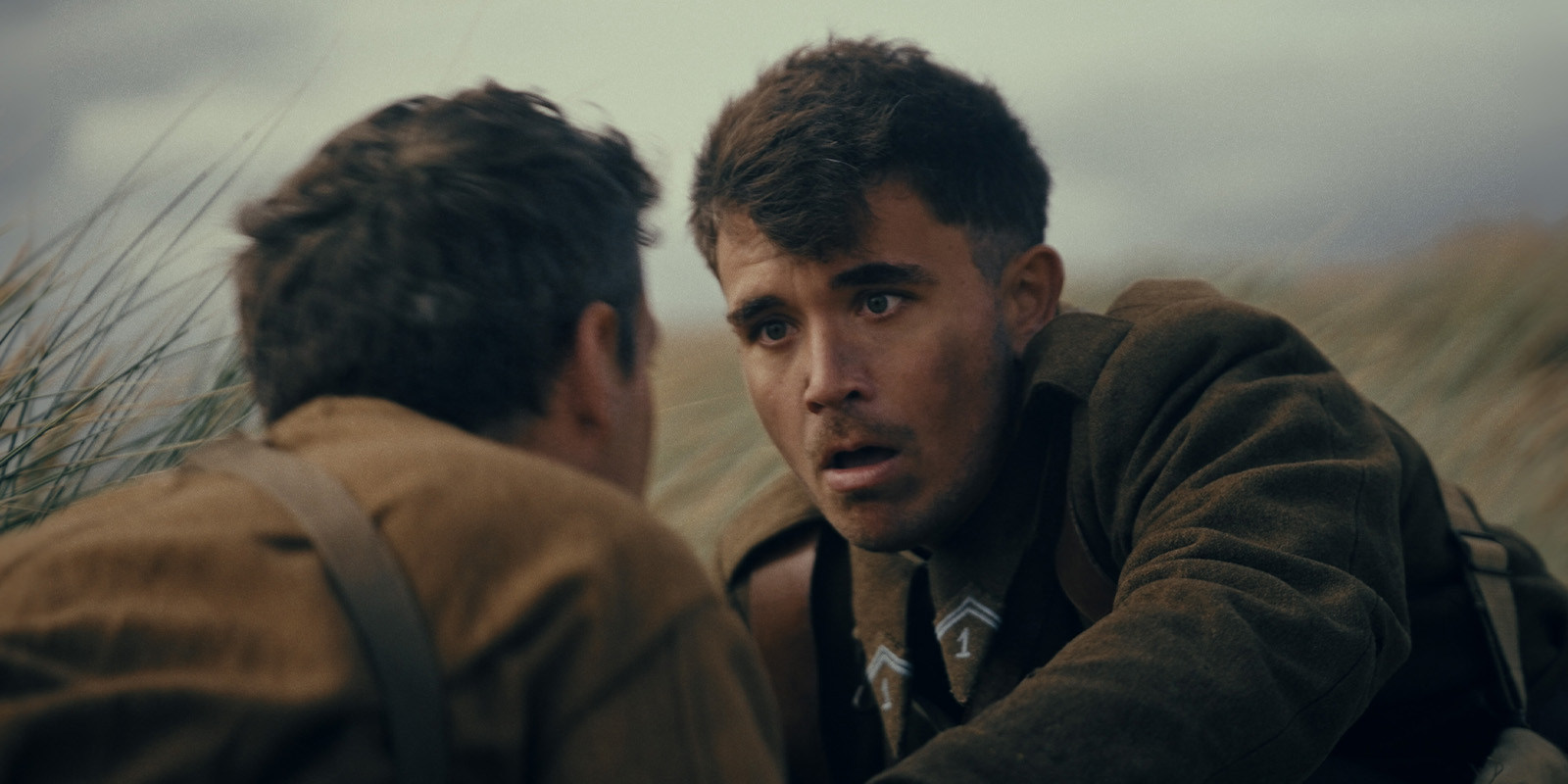
I shot exclusively from the shoulder, and the operating is rough, reactive. I wanted viewers to feel as if they are scrabbling around on the sand with them; we’re deprived of the safety of being a neutral observer.
In terms of the technical specifications, the film uses a variety of different cameras and lenses, for both practical and stylistic reasons – but maintains a consistent 1.90:1 aspect ratio. I chose the VistaVision frame as I feel it is the perfect balance between the objectivity and truth of 16:9, and the theatricality of Scope – making something truly immersive.
At first I considered using the Academy ratio of Sgt. Taylor’s work. Although, after some test shoots, I found that since we are so used to 16:9 footage for factual events in the modern day, it felt like too much stylistic flair, on top of visuals that are meant to feel grounded.
I almost always land on the RED Raptor for narrative work, as the ability to window the sensor lets me do something that so far I’m yet to see anyone else do, and has become a regular technique of mine. I don’t know if I just have messed up eyes, but I don’t see with edge-to-edge sharpness, and it’s always something I want to replicate in my work. By windowing the sensor, and using lenses not designed for VistaVision, I can force out an image extraction that utilises the rough edges of the lens that we were never meant to see.
The Cooke S4’s and Super Speeds MKIII’s are particularly good for this, and it gives the image this wonderful out-of-focus fringing around the edges (similar to an anamorphic lens) – which, for me, feels more like how my weird eyes see the world.
Feeling trapped
However, for the beach scenes I opted for the FX6, paired with the DZOFilm Catta Zoom 35-80. As much as I would’ve loved to use the Raptor for everything, the low weight and electronic ND’s of the FX6 gave me the speed and nimbleness I needed to get everything we needed. (Especially as we had to shoot in between groups of dog walkers on a few cold October days in Camber Sands.)
At first I was cautious about blending so many different colour sciences and lens styles (as we also used an FX3 for running shots) – but my brilliant colourist Alex Berry was able to match everything. He also created a custom effect for the post-war scenes, managing to digitally replicate the effect of a classic Vaseline lens on the actors’ skin. But crucially without having to actually use one on set and risk losing contrast in the image overall.
While filming the Dunkirk scenes, the rule I set for myself was that every shot must be from the perspective of someone on the ground. If I wanted a high angle shot, I could climb a hill. But we never get the luxury of escaping to an overhead drone shot – we feel as trapped as they do.
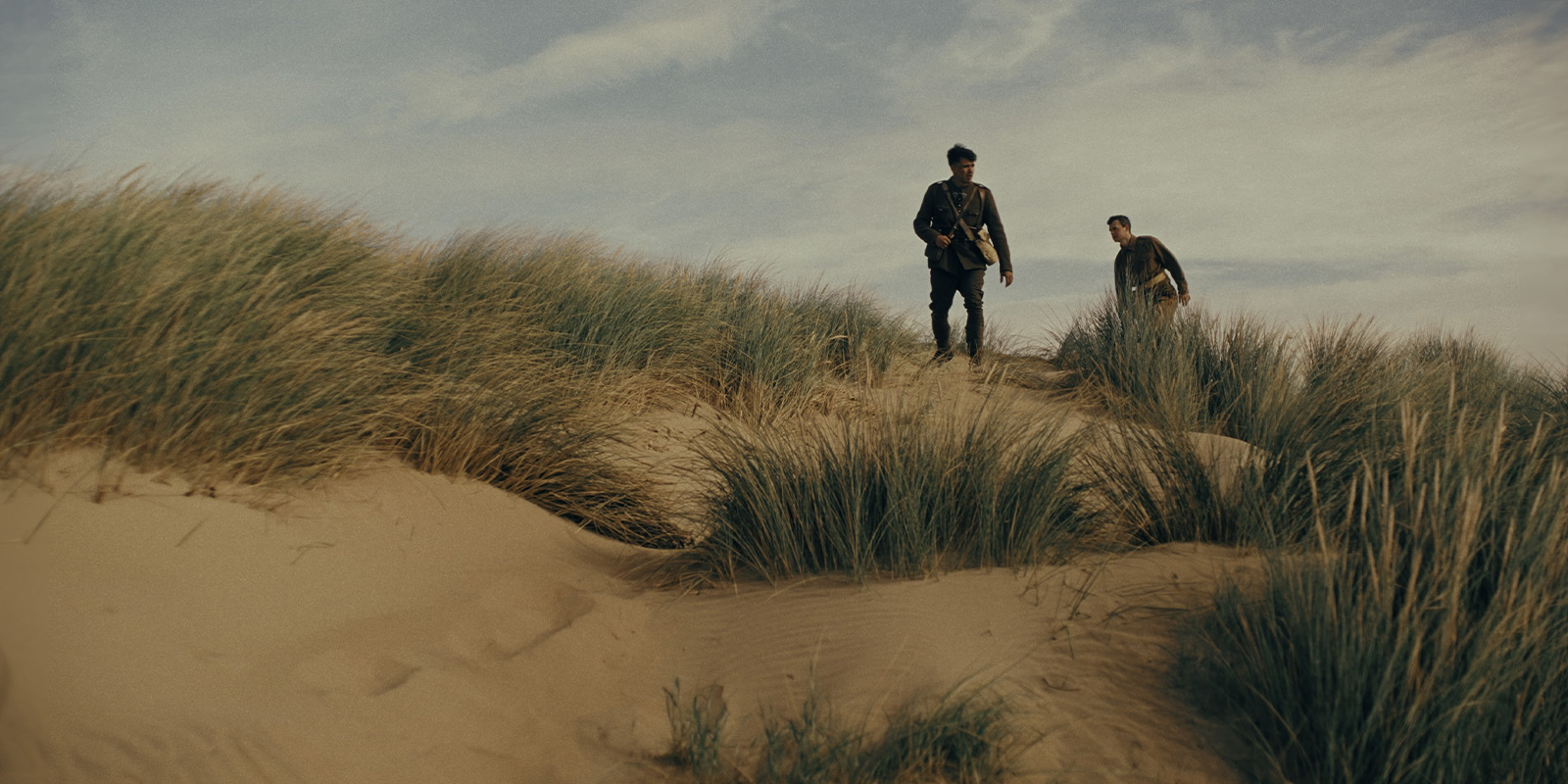
Throughout prep I was clear with the actors that whenever we blocked scenes, it was never to tell them exactly where they should go, it was only to define the walls of their sandbox. Once we rolled, the space was theirs and I would react to them. This meant that, like Sgt. Taylor, I would sometimes miss the start of an action, or the shot would go slightly soft – but I think the immersiveness and authenticity this brought to the camera and performances was far more important.
Both having done a lot of theatre work, it was a style they relished – the freedom to move as their character would, reacting instinctively and in the moment to their scene partner.
Shooting on location was such a key part of capturing the realism of the film, as well as using available light wherever possible. Aside from some bounces, neg and Aputure MC’s for our ‘fire’ – the Dunkirk sequences are entirely naturally lit, and scheduled depending on the light quality and tone I wanted for each scene. By using such a great location, with meticulously accurate period costumes and props (sourced by our costume designer Savannah Blum, and production designer Olavo Abrantes), such a huge amount of my work was done for me.
The last important point about the Dunkirk sequences, for me, was that the violence is always off screen. The film is in no way a heroic portrayal of war – it’s a story of two terrified boys, trying to save their own lives, and I wanted to make sure that always came across.
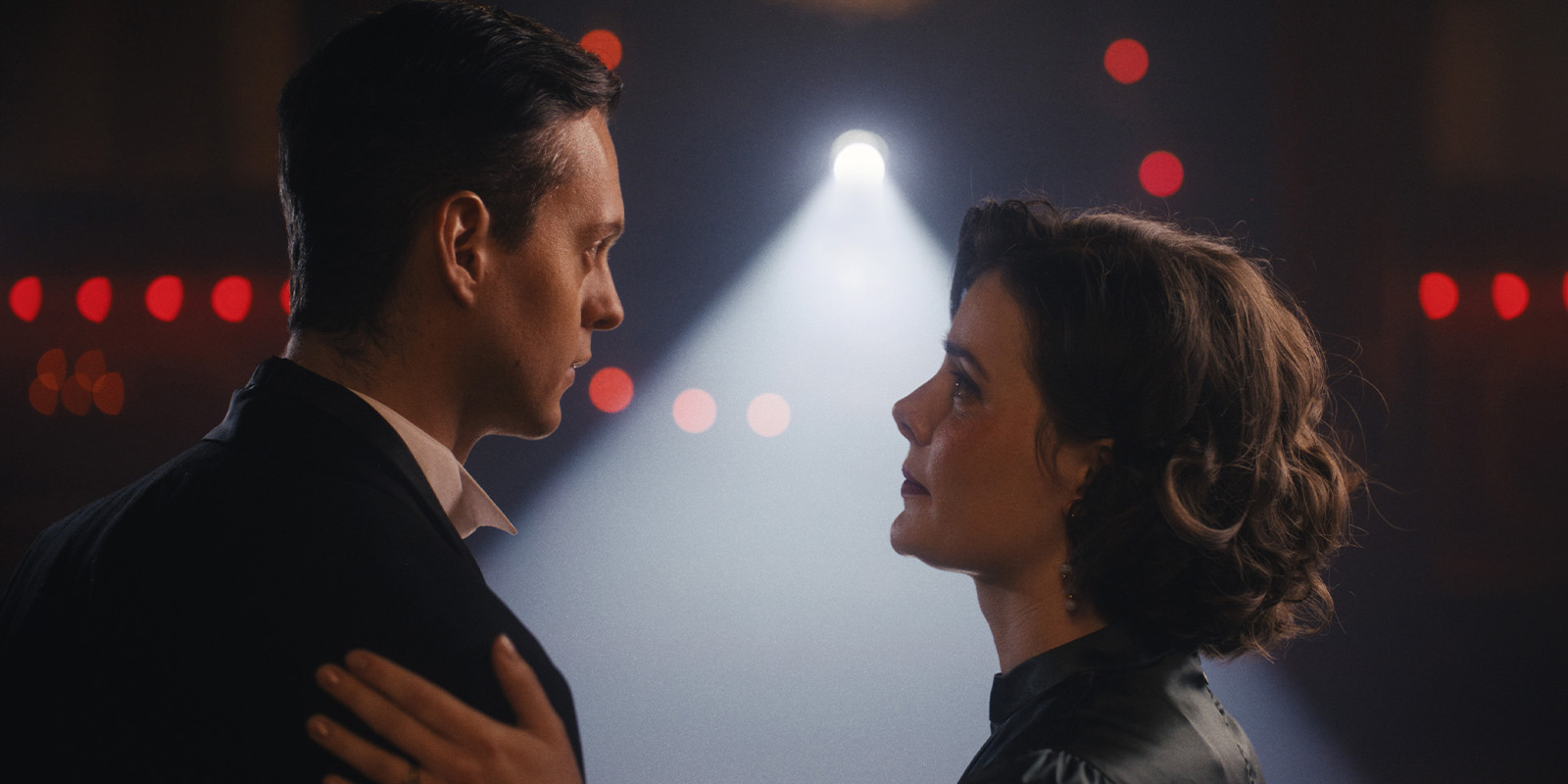
The other half of the story, told non-linearly, is set in the ballroom of 1946. Years later, Jack is struggling with survivor’s guilt, fearing he’ll never be the same again, and that some part of him will always be on that beach. In these sequences, the story is told exclusively through locked off shots, to give the silence and stillness of the room a physical presence. We feel it, and how out of place Jack feels in a world that’s exploding with colour and life, desperate to move on. This came from research with a lot of veterans who said that the silence is the most unnerving part. Trying to reconcile your permanent sense of fight or flight, with the apparent safety and calm of your surroundings.
The Rivoli Ballroom was lit beautifully by my gaffer Will Fleming, using period-accurate fixtures – all sourced by the production designer of the 1946 scenes, Matheus Bianchi. We leant into a fairly theatrical style for the lighting, to visually distinguish it from the Dunkirk sequences, and give the scene a more subjective tone. Whilst it is a true event, this scene is also a metaphor for how Vi loved and supported Jack his entire life, helping bring him back to the world. So I felt the style should be that of a classic ’60s Hollywood romance.
Operation Dynamo is available to watch on the OmeletoYouTube channel.