
LIGHTING WITH IMAGES
Any light with more than one pixel – from the two zones of a SkyPanel, to the high resolution of an LED wall – can potentially be driven by a video source to create an authentic lighting effect.
“Highly sensitive digital sensors and RGB LED fixtures have already given us enormous freedom, and I believe image-based lighting pushes that freedom a step further,” says DP Nelisa Alcalde. “It lets us chase the natural realism: instead of faking the flicker of a candle or the glow of a television, we record the real source and export a file, map it to the fixtures and let the LEDs reproduce the exact effect. The result is light that behaves exactly as the eye expects, with the same micro-fluctuations and colour shifts.”
Alcalde notes that there is a risk of the same stock videos being used to light multiple projects, removing the individuality. “I am a romantic, nostalgic cinematographer and still value the human hand that rolls a dimmer by feel, so I would not want the craft to become robotic.”
Jana Laemmerer found that human hands in combination with technology gave the most convincing results when she was shooting virtual production driving scenes. “We were in a very small studio in Ingolstadt, and had one LED wall,” explains the DP. The background footage was also front-projected onto an 8×8’ screen, providing both reflections and dynamic lighting.
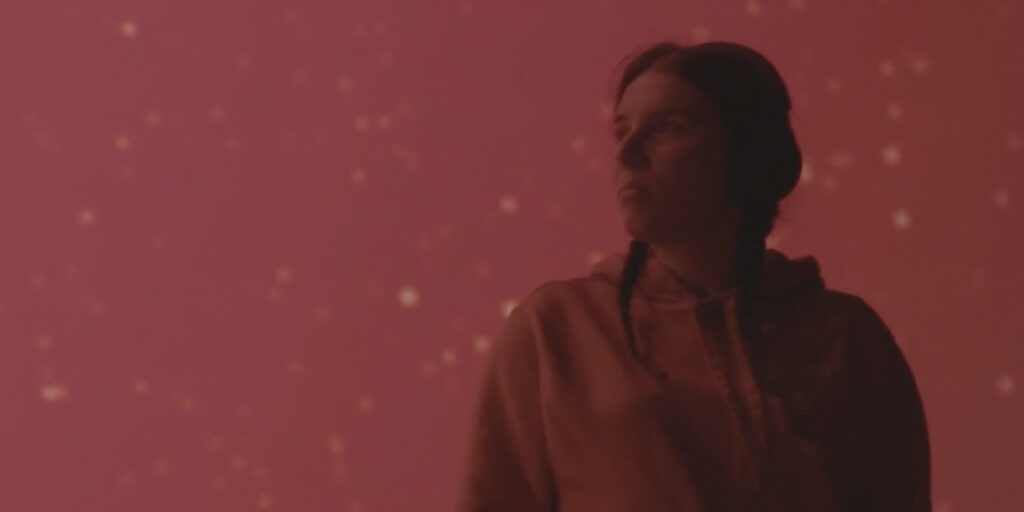
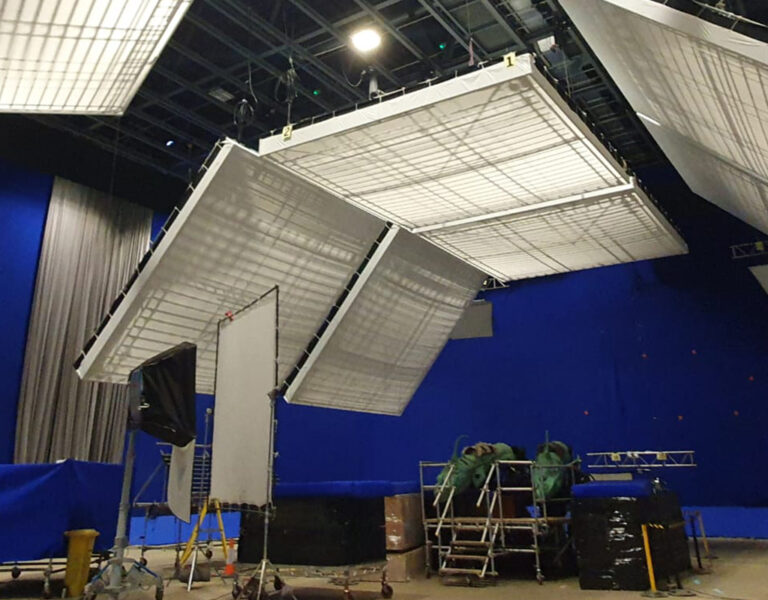
Laemmerer and gaffer Stepan Novotny supplemented the image-based sources with LED fixtures bounced off 12×12’ textiles or poly-board, but discovered that dynamics were the key to authenticity – even for scenes on an open country road. “Even if [the source] should mimic the sky in front of the windshield, which feels kind of static,” Laemmerer explains, “it was much more realistic when we moved, for example, a hand in and out of the beam that then was bounced on the subject… When you’re sitting in the car driving in the countryside, you wouldn’t think that there’s so much going on, but this was the trick to really integrate it into the surrounding.”
Precision and programming
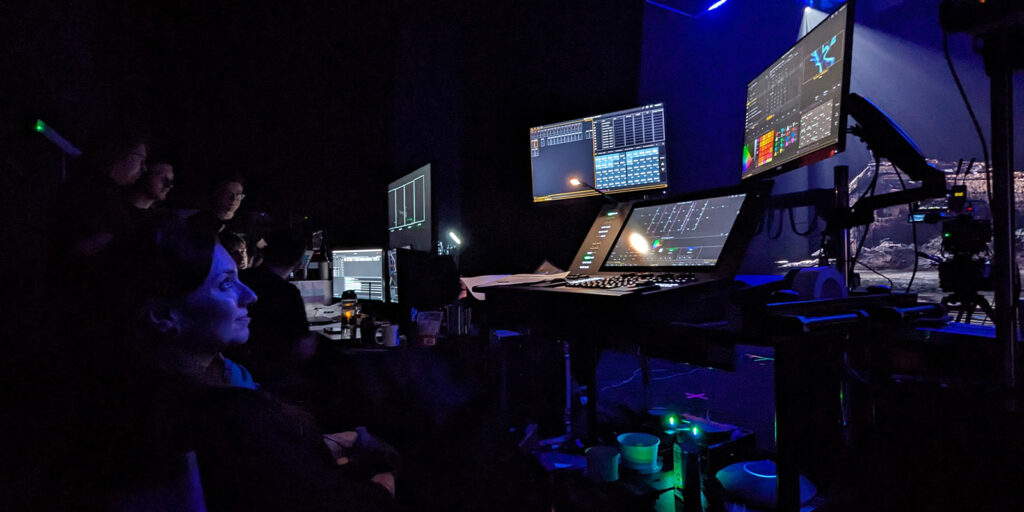
Gaffer Cullum Ross switched methodologies during the volume pre-light for a Titanic documentary. The production used a Lidar scan of the actual shipwreck as its virtual environment against which historians were filmed. “The brief of that job was to create a sort of mysterious, ethereal, miles-under-the-sea type of look,” says Ross, “where, quite frankly, there isn’t any light, as we know. Originally we started with lots of soft panels, with controllable pixel mapping. We later realised actually less was more in that particular environment, and we needed a much more focused controllable effect.”
Ross turned to high-CRI, high-output moving heads with built-in electronic shutters – “very, very precise – and it could be programmed to be in any position you like with any effect you like.” Ambience was supplied by an overhead rig of Astera Hyperion tubes, chosen because their form factor would not block too many of the tracking markers on the volume’s ceiling. “We built a specialised rig which we could pitch and tilt up and down, and we were able to play back the video through the lights.”
Associate BSC member Robert Hollingworth recalls shooting an episode of Colour: The Spectrum of Science featuring fireflies. He filmed the real creatures in the Appalachian mountains and then used that footage as a virtual background. “The green of a firefly is a rather specific green, quite hard to get that right,” he notes. “One of the things we did for a close-up was we put the video on an iPhone – because it has an OLED screen – and then we held the iPhone in just next to the lens, so that the light coming off the screen would reflect in the eyes of the frog that we were filming. And it worked brilliantly.”
Words: Neil Oseman