

From One Battle After Another to Frankenstein, Mark London Williams takes a look at some of the recent big-screen outings that have gotten everyone talking – and spotlights the incredible work of the cinematographers behind them.
“The scale and scope is larger than (anything) I’ve taken on before.” Sometimes, that feels like each column during a new award season – especially as we try to give due diligence to the many worthy contenders vying for nomination slots in the array of congratulatory ceremonies about to unfurl, once again, after the new year.
To say nothing about any new series making their debuts on various channels and streaming platforms, still eligible themselves for post (or is that “pre”?) Emmy award considerations from the various craft guilds, the Globes and Indie Spirits, etc. (Though as a potential takeover of Warner Bros. Discovery rumbles toward a conclusion in that same new year – by either another studio and/or billionaire clan or perhaps the world’s largest streamer – the word “various” is used in an increasingly provisional way.)
The words on scale and scope, however, were spoken by a DP very much in the current kudos hunt, namely One Battle After Another’s Michael Bauman, who was there for “One Frame After Another”, a chat held in an upstairs room at the San Vicente Bungalows, sponsored by the Portrait Creative Network (along with Shotdeck, Greenslate and others). DP Oren Soffer, who mostly recently shot the AI-themed The Creator, moderated, talking with both Bauman and producer Sara Murphy.

Of the Paul Thomas Anderson culture-war-gone-hot opus, which riffs off author Thomas Pynchon’s similarly themed Vineland, Bauman talked of his long association with the director, going back to being a “chief lighting technician” on 2012’s The Master and 2014’s Inherent Vice (also from a Pynchon novel) and then “lighting cameraman” for 2017’s Phantom Thread, respectively. For the latter, Anderson himself was the uncredited DP. Meanwhile, Bauman moved fully into the cinematographer’s chair for the LA-in-the-’70s-set Licorice Pizza, and returns again for Battle.
Which brought its own, well, if not battles, then certainly challenges, shooting with VistaVision cameras on locations “all the way down through the state”, as Murphy said, starting with the lush, almost-Oregon scenery of Eureka, to the desert roads east of San Diego.
Bauman said that while certain ‘70s films, like The Last Detail and The French Connection, “resonated with me” in how he approached the work, Anderson was clear that he “didn’t want to shoot this as a studio movie”, despite it being the director’s biggest budget, and in many senses, his widest canvas, to date. There was only “an intimate group of people on the set,” according to Murphy, and they were all treated to cameras that were, as Bauman phrased it, “basically like having a lawnmower on set.”

But it was also a set devoid of monitors, so Anderson ran dailies, which Murphy called “a great privilege”, and where they could look at the “happy accidents” along the way – such as a scene where Leonardo DiCaprio’s lapsed revolutionary, Bob, is being hidden by Benicio del Toro’s Sensei Sergio, as troops unleashed by Sean Penn’s relentless Col. Lockjaw close in. In the small room where the scene is set – as Bob desperately tries to recharge his phone while also escaping – some curtains, which were “rigged like shit”, as Bauman says, “fell down” as DiCaprio touched them. “We went with it,” given the subtext it added to Bob’s hapless circumstance – all part of a philosophy to “be open to mistakes – good things come from (them).”
Exploring similar “on the run” themes, but set decidedly in the ‘70s, as opposed to evoking it, comes Brazil’s official entry for the Best International Feature Oscar. From Cannes-winning writer/director Kleber Mendonça Filho, The Secret Agent tells the story of Armando, played by Wagner Moura as a university professor on the run from not only his country’s dictatorship, intelligence services, and corrupt cops, but also private sector hitmen, who are there to help the government’s corporate allies mop up anyone or anything deemed an impediment to their bustling plans for profit. Moura also nabbed an acting trophy at Cannes for his work, and would seem to be in the thick of the nomination hunt with the likes of DiCaprio and Penn (and perhaps Jacob Elordi as Frankenstein’s monster – stay tuned!)
It’s set in the director’s (and character’s) hometown of Recife, on the northeastern edge of Brazil, as Armando seeks to put not only literal, but cultural, distance between himself and his pursuers in the south.
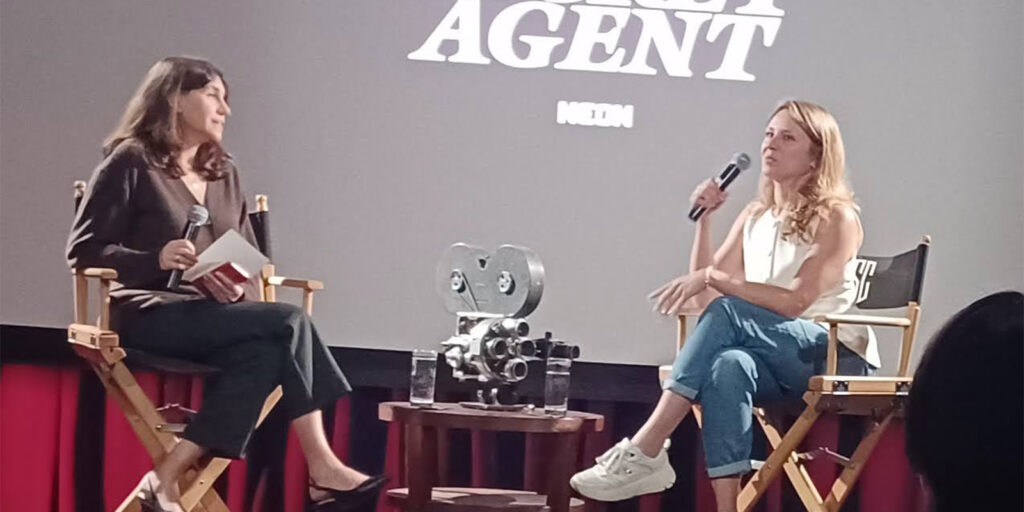
Cinematographer Evgenia Alexandrova AFC also put some considerable distance between her current hometown of Paris to not only to shoot the film on location in Brazil, but later, for some FYC events in the US, including a recent screening at the ASC clubhouse, where she did a Q&A after.
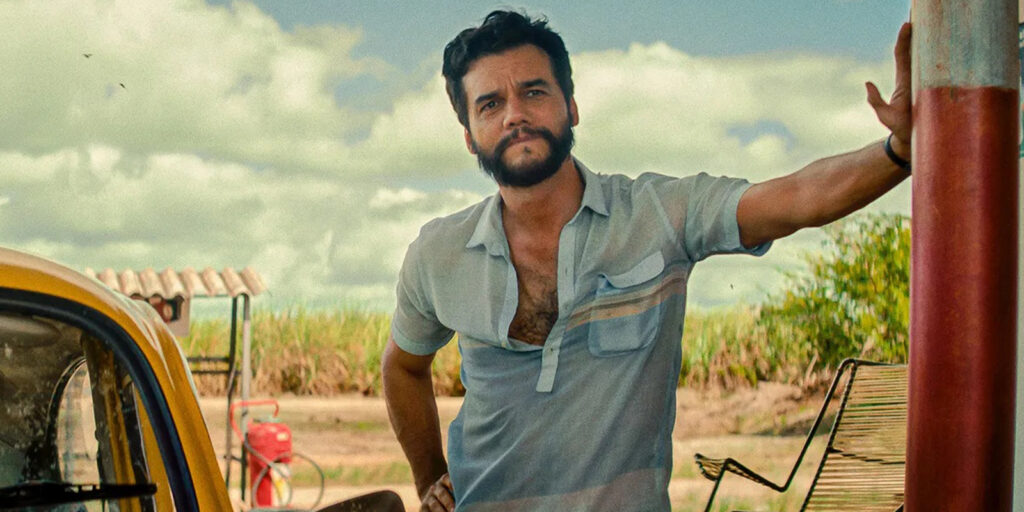
There she mentioned also using “an eclectic selection of references”, like Close Encounters, and Three Days of the Condor – films with a contemporaneous look, featuring “a lot of dolly shots, and a lot of zooms” that she and Filho looked at, along with pictures the director provided, from the era, and from Recife, which initially prompted them to give the film a “sightly sepia, more reddish” look – which they later changed in the final grading.
A grading that became easier to do, despite shooting on an Alexa 35, with Panavision B anamorphic lenses – she’s a particular fan of the camera’s “amazing dynamic range” – as they didn’t use any of the built-in textures. “The problem is you can’t erase them if you change your mind.”
We picked up the conversation some days later, when Alexandrova had returned to her Paris apartment, the day before she was to begin shooting her next feature. Returning to the theme of colours, they were what sparked Filho to contact her, after seeing her earlier, Brazil-set Heartless, which his company produced. “He really liked the colours of the film,” she said. “How they were fresh for Brazil. So he sent me the script, and I read it quickly and fell in love with it.”
Filho came to France so they could further discuss how they’d approach the story, and “Kleber asked me which scenes were crucial to me.” For her, it was a fantasy sequence – or perhaps what one might term a “sequence from the id” – where a severed leg (sharks, and Jaws, along with other films discussed and seen by the characters, like The Omen and The Exorcist, also play a role in the story) is attacking and beating gay men in the local park.
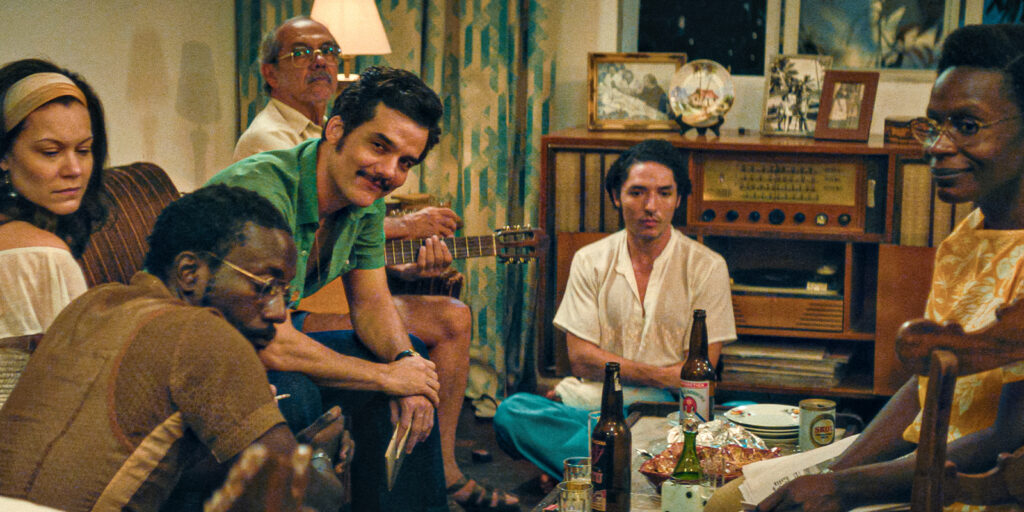
Or at least, that’s how it’s breathlessly reported in the local news, which, under a dictatorship, is indistinguishable from the tabloids. Something that was familiar to Alexandrova, who said that having been born in the Soviet Union, she was well aware of how repression works in a society, and thus felt the scene “summarises the whole story” in terms of how that repression diffuses and becomes internalised. Conversely, though, the errant, brutalising leg – standing in, as it were, for the police – is also a clear symbol for how “people [can] avoid censorship through metaphor”.
The limb at the centre of this particular metaphor, however, rampaging through the frames, was going to be added in post – created with stop-motion (to give it a hyper-real look) – so the leg’s own POV journey through the park at night was captured by Alexandrova, who does her own operating. “That’s how it’s done in France,” she notes. But rarely with the aim of imitating the herky-jerky movement of a severed leg.
“Hopefully I’ll work with Kleber again,” she says, citing the filmmaker’s own breadth of imagination, and his collaborative approach. Meanwhile, she was ready to start her new feature “here in France, in a studio” done “Cabaret-style” and set in France in the ‘50s. “That’s what I like about my job,” Alexandrova adds. Always shooting in a single style – severed limb sequences notwithstanding – “is so boring”.
Though, as Steve Yedlin ASC tells us, even a career-long collaboration with the same director, marked by returns to chronicling the sleuthing adventures of the same character, can steadily “evolve”, as that director – Rian Johnson – “keeps getting better and better at his own stuff”.
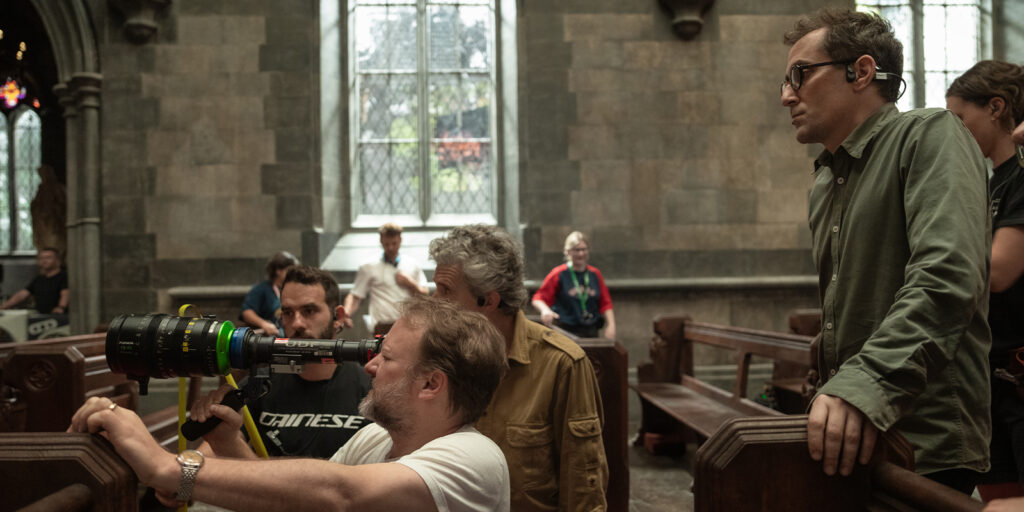
The same might be said of Yedlin, too, of course, who has known Johnson since Yedlin was a senior in high school, though shortly they were “eventually both at ‘SC” in film school together. Yedlin shot Johnson’s first feature, the “YA noir” Brick, and they’ve been collaborating ever since, including on the Knives Out series, featuring Daniel Craig enjoying his retirement from the travails of the Double 0 section, to instead cracking seemingly uncrackable mysteries as southern super-sleuth Benoit Blanc.
In the third instalment, Wake Up Dead Man – the lack of punctuation allows you to read the line in different ways, a few of which are applicable at different points in the story – a hardline, reactionary Monsignor, Jefferson Wicks, played by Josh Brolin, has been killed in a seemingly impossible way, with his assistant, repentant boxer-turned-cleric, Fr. Jud Duplenticy – a compelling Josh O’Connor – the main suspect.
The characters and cast, of course, feature an Orient Express’s worth of possible suspects, but one of the biggest surprises was the film’s sharp commentaries on our present moment – with the fundamental cleaving of institutions once taken for granted, the corrosive effects of “influencers” in a time when connections in the “real” world continue to erode, and more. Along with, of course, the series’ trademarked humor, and in this case, a diegetic syllabus of further mysteries to read, fashioned with the same general construct as the story at hand.
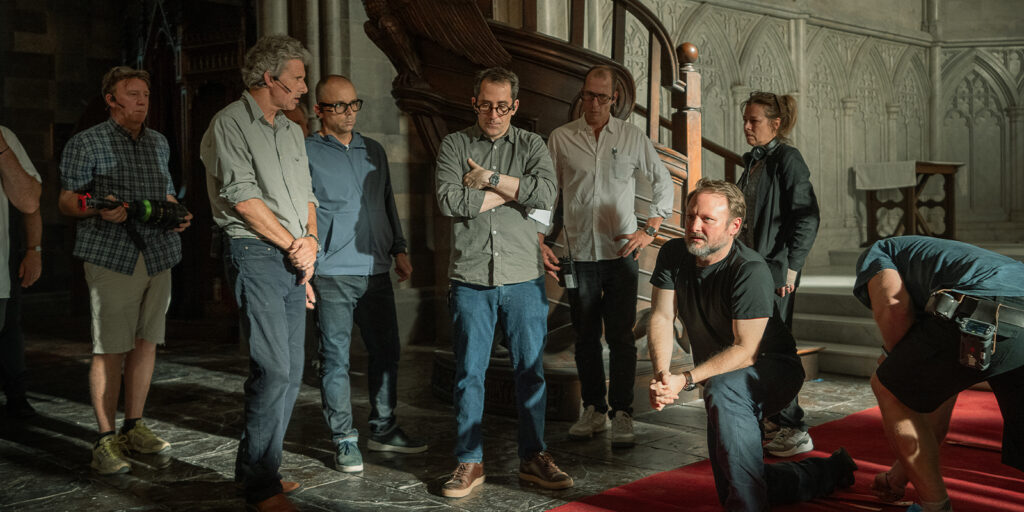
With “construct” being a key word here.
In another bit of sleight-of-hand though, despite the story’s mostly upstate New York setting, “all of the principal photography was in London,” Yedlin says, while “most of the interiors were on stages at (Warner Bros. Studios) Leavesden.”
Where he worked with other long-standing Johnson collaborators such as costumer Jenny Eagan, and production designer Rick Heinrichs. Of the latter, Yedlin says, “I’ve told Rick this – that main church set is my favorite set of any kind I’ve shot in. It’s so shootable – he knocked it out of the park in that thing.” Yedlin praises its “logistics”, and the relative ease with which they could light for “day, night, dusk, and dawn,” along with a key flashback sequence “that is none of those.” Johnson, he says, “knows exactly what he needs out of things,” and Heinrichs responds with work that “is not just artfully beautiful, but logistically fantastic.”
And those logistics were key in defining spaces for what is, essentially, a proverbial locked room mystery (or perhaps two of them). As for Yedlin’s own logistics as a DP, he says he doesn’t “kneejerk change cameras all the time” because the look they want “comes from how we process the camera’s uninterpreted photometric data.” That data came from an Alexa 35, which Yedlin says was indeed a new camera for him, chosen for a pragmatic reason: a framing area that could be covered by traditional lenses, while meeting Netflix’s contractual 4K requirements.
Their “main set of lenses” – Zeiss Supreme Primes – “covers a main sensor,” and are also “a pragmatic decision more than a creative one,” he maintains. The kind of artistic pragmatism that has also led to him favouring LEDs on set. “We do everything we can with (them),” he says “because of the ability to finesse it. Other technologies don’t have the colour control […] We can do super-fine increments of warm and cool […] We’ll kind of set the cue,” and whether it’s sunlight, muzzle flash, or something else, he finds himself “adjusting the actual lighting” as the scene unfolds.
Which in turn led to use of a decidedly non-digital technology as he “worked with the art department (to create) two stage backings” in the main church set. Think of them as matte paintings with depth between them, something akin to how Disney added dimension to his animation in the ‘50s, with paintings on separated glass panels. A technique which allowed Yedlin his own further “finessing,” as by moving them, he could “get all these different looks,” whether “a dusk or night scene [or] bright day.”
A sleight of hand that might even have Benoit Blanc pausing, albeit briefly, to wonder how it was done.
Joining the latest iteration of Knives Out in making the relatively short journey from theatrical release to its more permanent home on Netflix is the latest iteration of Mary Shelley’s Frankenstein, surely the greatest golem tale – certainly the most far-reaching – in our literary canon.

This version – sumptuously, gothically overflowing – from Guillermo del Toro, has been on the horror master’s mind for some years, according to his own long time DP, Dan Laustsen ASC FSF. “The first time I heard Guillermo wanted to do Frankenstein,” he told us, “it might have been on Crimson Peak.” That would put the idea circa 2014 or so, but of course there were a couple other projects in-between, such as Nightmare Alley, and the Oscar-winning The Shape of Water.
As for The Modern Prometheus, as Shelley subtitled her work, Laustsen “read the book” as they got closer to the long-time dream project. “It’s pretty cool – then I read it again and then I read the screenplay. The [script] is totally different.”
Starting, perhaps, with del Toro structuring his tale so that it’s told twice, once from the perspective of Dr. Frankenstein, played with a mix of mania, dissolution, and perhaps, finally, resignation and acceptance, by Oscar Isaac. And then again from the viewpoint of his monster, the aforementioned Mr. Elordi as much more of a “leading man” style monster than we’re used to seeing, whose own sense of despair and rage also leads him to the same broken acceptance, finally intersecting with the doctor’s on the ice-locked tundra where the story also opens, and providing unexpected grace notes this version’s overarching (yet, after nearly a century of film versions, still clearly compelling) bleakness.
“We wanted to do a period movie, of course,” he says, “but shoot as if it was a modern movie.” Laustsen says both he, and del Toro, are “big fan(s) of large format filming.” And on this one, compared to previous films like Nightmare Alley, where they moved between an Alexa LF and an Arri Alexa 65, they wanted to stick with the latter “all the way through.”

Though he also checked with Steadicam operator James Frater about the extra weight, especially on the longer takes. “Is this okay?” While they were shooting a lot on a 45-foot crane, everything was “on a remote head or Steadicam. We never used a dolly. A lot of times we shot a big wide shot and come into a close-up in the same scene.”
But not close-ups “like crazy wide angles – but we wanted to see the sets.” And the work of production designer Tamara Deverell – a previous collaborator on Nightmare Alley, the director’s Cabinet of Curiosities series (as well as his earlier The Strain) are something to behold, in their shadow-dripped, oppressive ornateness, slowly (or sometimes, not-so-slowly!) yielding to decay.
There was “single source lighting outside the windows” to achieve the look. “The moonlight (coming in) is steel blue,” he recounts, provided by the “20ks – big heavy lights, outside the windows.” But they also used “a lot of fire FX (to) colour balance between the steel blue and the orange – that was a big thing for us.”
So there’d be a flare box in the fireplaces, akin to the torchlight on the ship and tundra scenes, with the light “moving around – moving a little bit around,” with the whole “set working like a gobo, getting much more dramatic.”
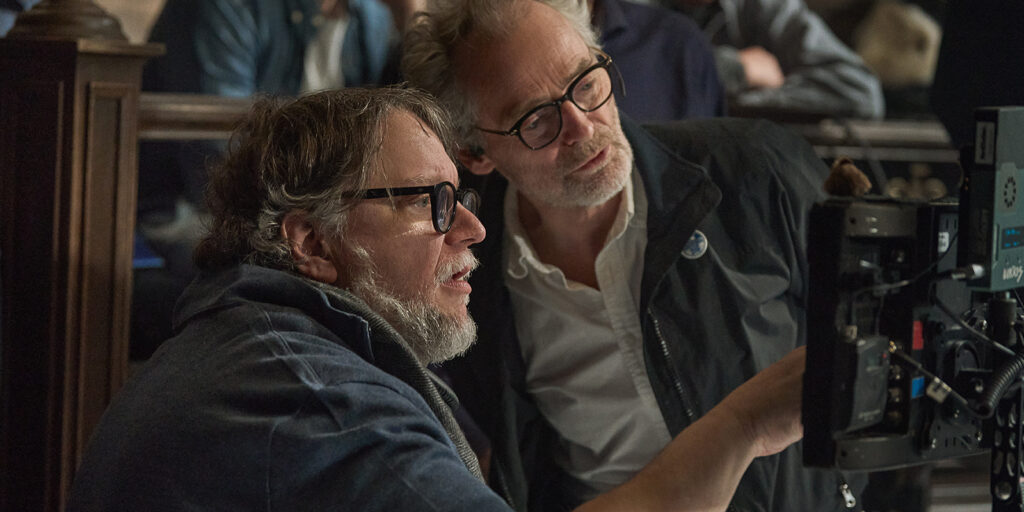
He had help from VFX supervisor – and fellow del Toro stalwart – Dennis Berardi, whose crew he describes as “just fantastic – they painted a lot of light out from fireplaces,” but not the room, in order to keep the blue and orange interplay, and the gobo-like shadows all “moving a little bit. I think that’s the whole approach to shooting this movie.”
Though even outside the shadows, in broad, perhaps paradisical, sunlight, you have to keep moving too. That was the experience of Matthew Chuang ACS on Chief of War, the recent Apple TV+ series that reminds us that most of history is every bit as bloody as anything you might find in a gothic horror tale.
A passion project of star, producer, and finale director Jason Momoa, who co-created the historical drama with Thomas Paʻa Sibbett, Momoa plays Ka’iana, a warrior chief of Kauaʻi who ultimately, and ill-fatedly, resists what is, in a sense, the “internal colonisation” of the islands by King Kamehameha I, who forcibly united O’ahu, Maui, Moloka’i and Lānaʻi into the Kingdom of Hawai’i in the late 18th and early 19th centuries. This lasted about a century, as a bulwark against the ever-intruding west, which finally overwhelmed the islands when they became a US territory first, and then the last American state in 1959.
Ka’iana himself was described in suitable Momoa-n terms by one visiting captain as “near six feet five inches in stature, and the muscular form of his limbs was of a Herculean appearance.” The Herculean breadth of the show takes in wrenching battles, extended sequences on and in the water, flame-lit caves, and an endless array of tropical exteriors, with filming split between Hawaii itself and New Zealand.
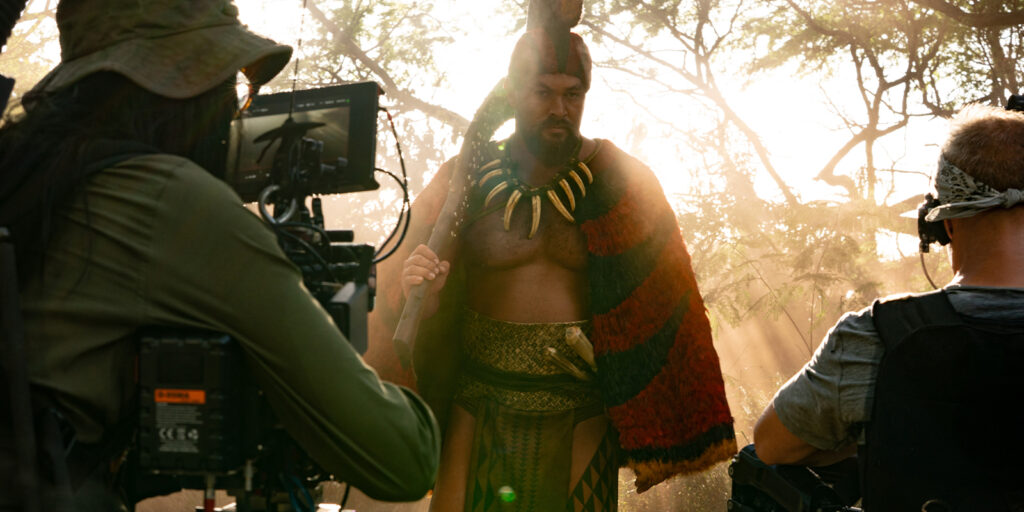
Which is why they ultimately “embraced the sun (and) worked with it in scheduling,” as Chuang recounts. “The way we were shooting with a moving camera – we couldn’t diffuse the space that we had, and had to work with the sun and the natural light.” But the show’s “directors knew about the lighting, the requirements, and how to use that – (which) direction for wide stuff,” and then when to come in for close-ups.
The director for the first two episodes was Justin Chon, with whom Chuang worked on his now timely-all-over-again 2021 feature Blue Bayou, about a Korean-American facing deportation – and separation from his family – at the hands of ICE.
Chon was living in Hawaii at the time the series began to come together, and “thought I would suit Chief of War (and we could) build on what we started with Blue Bayou.” Though it “took some convincing to have the producers look at me,” it clearly worked out, and Chuang shot not only Chon’s first two episodes, setting the tone for the series, but six of the total nine, including the climatic battle episode, directed by Momoa, where both Ka’iana, and Hawaiian history, meet their fates.
The undertaking was “a historical epic on a huge scale,” Chuang says, and one of their inspirations was the work of cinematographer John Toll ASC, particularly his own epic-sized films like The Last Samurai and Braveheart (and perhaps Terrence Malick’s The Thin Red Line).
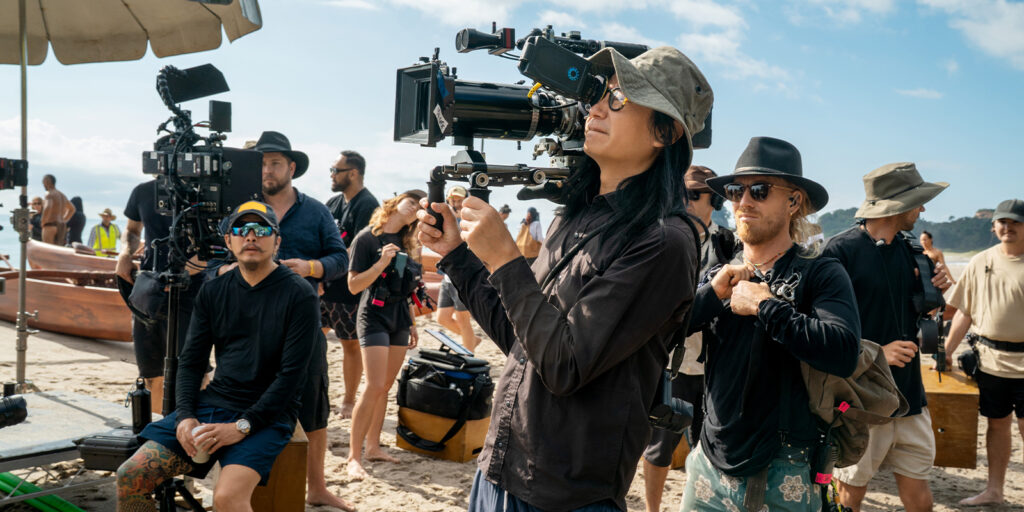
They also wanted an epic-sized aspect ratio of 2.39:1, making it feel “natural to push for Panavision anamorphics” to shoot, though they “had to get that approved by Apple,” since that particular ratio “is not something they do on a lot of TV shows.” But happily, “it made sense to them as well,” with the caveat that it still “needed to be 4k when it was squeezed.”
An Alexa 35, then, “wouldn’t meet Apple requirements,” and Panavision, from whom they were getting T-series lenses modified to look like anamorphic flare-friendly C-series glass, suggested “we use a Mini LF,” which would deliver the squeeze-friendly 4k.
They finally wound up with “modified multiple sets (of lenses) – the look was something that was kind of unique, as well as the size of the units itself, which allowed us to mount on different rigs.”
Which was handy, because ultimately the show wound up being shot with RED V Raptors. The reason? “Jason really likes REDs.”
Which is something you can insist on when you’re not merely Chief of War, but star and executive producer, too.
On which note, we come to the end of our last column for the year! Thank you for taking the time to read along with our journeys and chats about defining, capturing, and even creating shadow and light, over this past 12 months, including this bonus-sized finale. That journey will resume when we see you early in the Brave New Year of 2026(!). Stay well, and warm, ‘til then. The lights, and the hurlyburly of awards, will be waiting. Along, of course, with those shadows.
@TricksterInk / [email protected]