

As the awards race kicks into full gear, Mark London Williams highlights a range of stunning films to keep an eye on – from The Testament of Ann Lee to Sound of Falling – and explains why Hollywood is striking a tone of resilience during its “kudos season”.
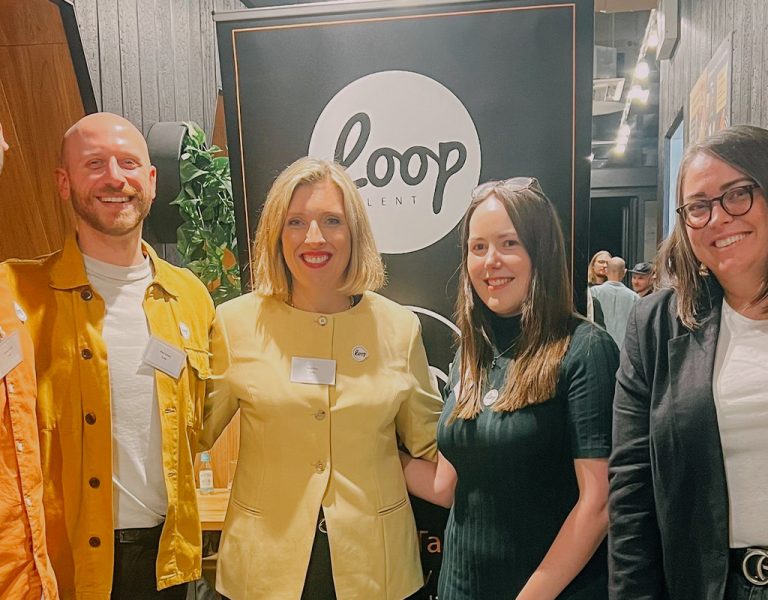
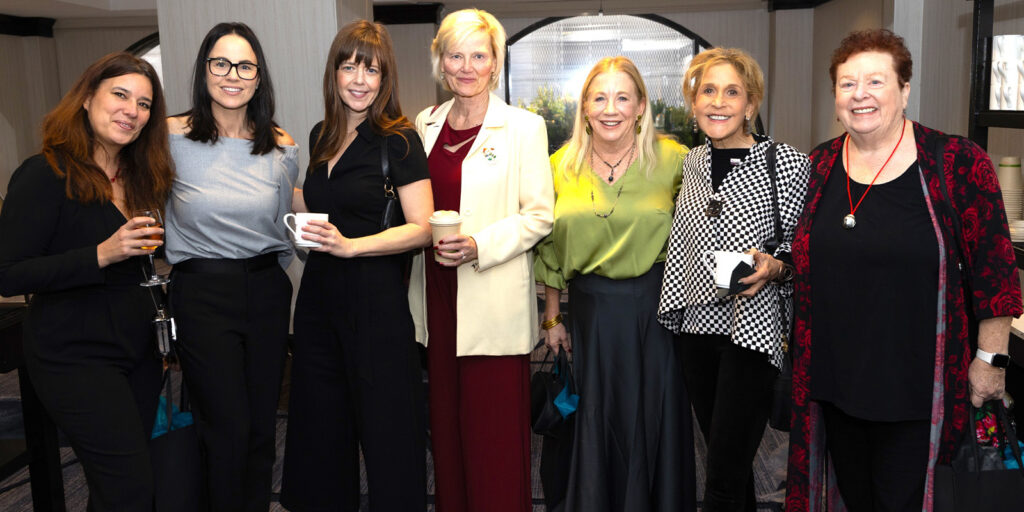
“The uncertainty is palpable,” said Women in Media’s executive director Tema Staig, as she welcomed people to the group’s annual Holiday Toast, way back last year, a whole month ago. Or do we mean a whole month that already feels like a year ago?
Held once again at Beverly Hills’ Hotel Sofitel, the gathering increasingly serves as a herald for the two celebratory seasons – uncertainty and all – ahead of it. Not only those gatherings of light-in-winter celebrated by folks everywhere, but those particular to an industry she also called the “fanciest, artsiest blue-collar industry on the planet,” still primarily based “in the smallest big town in the world.”
In that small big town, “kudos season” is just now just getting underway in earnest, with winter’s slew of nominations, award shows, and film festivals – still-recognisable rituals even as the Oscars move online to streaming, a streaming giant is buying Warner Bros., AI keeps insinuating itself where it isn’t even asked for, and all of this in a world where the spoken and unspoken rules of economies and governments, through which “Hollywood” became global, are being upended by the day. If not the hour.
And yet, the feeling at the toast was still one of resilience, occasionally even touching on a kind of optimism. After all, almost everyone there was essentially a freelancer of one sort or another “already used to shifting and hustling”, as Ashley Nicole Black said. The Emmy-winning writer/producer was one of three Holiday Toast Honorees, the two others being best boy and matrix head tech Krystina Figg, and none other than current ASC president Mandy Walker AM ASC ACS.
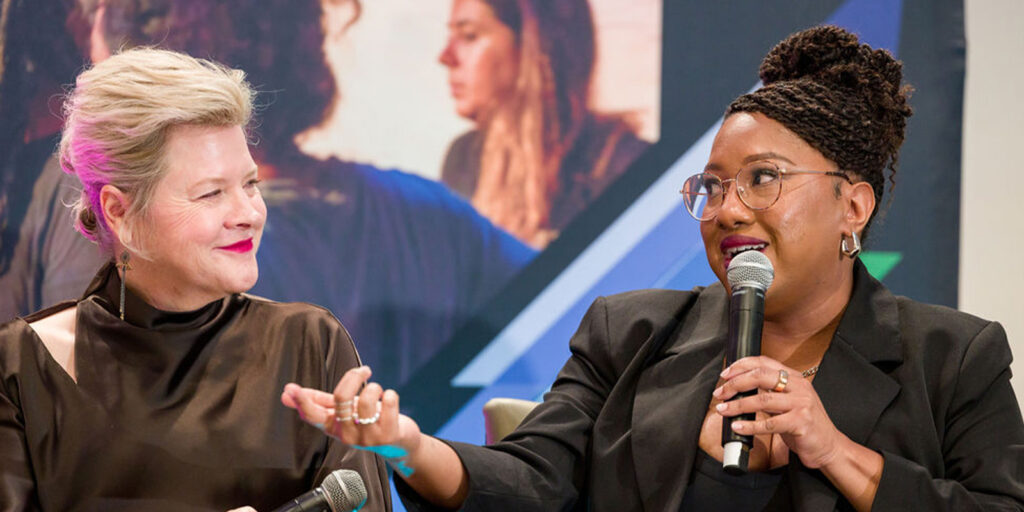
Black was musing that that same kind of spirit would find a way to keep adapting to an industry that is “shifting” rapidly through technological changes and social upheavals – strikes and all (with more expiring contracts ahead this year!) – and where one of the positive notes she sees is a “renaissance” of indie work, both in film and TV. The hope, of course, is that that work will be able to find audiences, too.
Walker recounted her personal journey, being told while visiting a TV station at the age of 15 that “women don’t do this job”, as she dreamt about her own future in cinematography, which would of course become quite illustrious, as she praised the ASC’s “great staff and amazing education programmes”, along with its vision committee, making sure that literal vision – a “visual language that’s coherent” – remains something that can be easily shared in “collaborations with other departments”.
Departments whose members increasingly become “family”, she put it, over the years and the projects. That was something that Figg – as she’s usually known on-set – touched on as well, when she spoke of her own journey to being a best boy (the very title inferring the challenges in making it a gender-diverse position), when she realised “these guys are building forts for a living!” The kind of “forts”, she later noted, that were “an extension of the eye”, or that same coherent visual language that Walker referred to.
A bit later, as the gathering wrapped up, the panel was asked about their wishes and prognostications for the new year. Walker said she hoped “more people would go back to the cinema”, to see movies there.
And though there are a lot of factors involved – many of them outside the purview of the industry – in whether people are willing to be pulled away from their home screens, certainly a lack of interesting and engaging projects – including those indies – isn’t one of them. As this month’s chat with current and prospective nominees reveals.
Bounding into awards season
One batch of nominees has already come from the Independent Spirit Awards, which generally announce in early December, around the time the Toast is getting underway. Though as we write, the Critics Choice Awards have already been handed out (continued momentum for One Battle After Another), the Golden Globes will be underway soon, and an upcoming slew of nominations, for the ASC, Oscars, and more. We caught up with Nicole Hirsch Whitaker ASC for her work on Dust Bunny, and who finds herself among their cinematographer nods with likely Oscar nominee, Critics Choice winner and freshly-minted ASC Award nominee, Adolpho Veloso ABC AIP, for his work on Train Dreams.
If the latter’s visuals are often ruminative, even pensive, Dust Bunny’s are almost the opposite – hyperbolic, often chaotic. Though deliberately so.
The gangsterland fantasy, wherein a young girl, Aurora (a terrific Sophie Sloan), asks Mads Mikkelsen’s hitman to dispatch the monster under her bed, which has in turn already dispatched a few sets of foster parents, also retains a certain dream-like tone of its own. And not always the descending-into-nightmare kind, given the humour laced throughout. It’s also the kind of film where characters like Mikkelsen’s are only known as “Intriguing Neighbor”, so archetypes – not just monsters – abound, as does a kind of paper lanterns-on-smoky-nights visual aesthetic.
We swapped emails with Whitaker, who’s already off shooting another project, to find out how she came aboard on this first collaboration with producer/writer/director Bryan Fuller, who, despite being a longstanding TV veteran, now also finds himself nominated for “Best First Feature” at those same Indie Spirits.
Whitaker “was introduced to Bryan by another director, Christopher Byrne, who I had worked with on a show called Jupiter‘s Legacy. He had also worked with Bryan on Hannibal, American Gods and Star Trek,” with Fuller going back as far as the Voyager/Deep Space Nine era of the stalwart franchise.
She felt an “instant connection” as they talked not only about the script, but “movies we loved, photography and shows”, though, post-connection, still “had to wait for the film to actually be greenlit, but once it was, we took off for Budapest and started three months of prep.”
Among the films they referenced were Amelie, City of Lost Children and Pan’s Labyrinth, and “I also loved the light in Seven and Fight Club. Again, references from Darius Khondji ASC AFC, Bruno Delbonnel ASC AFC and Jeff Cronenweth ASC. All DPs I admire so much.”
Fuller had his own pronounced sense of how colour would be used, with “a very specific [..] idea for each room in Aurora‘s apartment, and we were able to take those and go even further with them once we started location scouting. It was great to be together to do all of that as a team […] The office was lined with photos and references for art and costumes and lighting. It was so much fun to walk around and look at them for inspiration every day.”
Additional inspiration came from Greig Fraser ASC ACS, “after seeing The Batman”, and asking about the ARRI Alpha anamorphic lenses he used. She and Fuller “fell in love with the Alphas” they wanted to pair with the Mini LF they were using, but “once we got to Europe and looked at the set (of lenses) that Greig had used, we were nervous that we would need something sharper to hold at least two or three people left or right, so we got another set that was less detuned. We were so grateful to ARRI for this as we could only afford one set, but they graciously gave us two!”
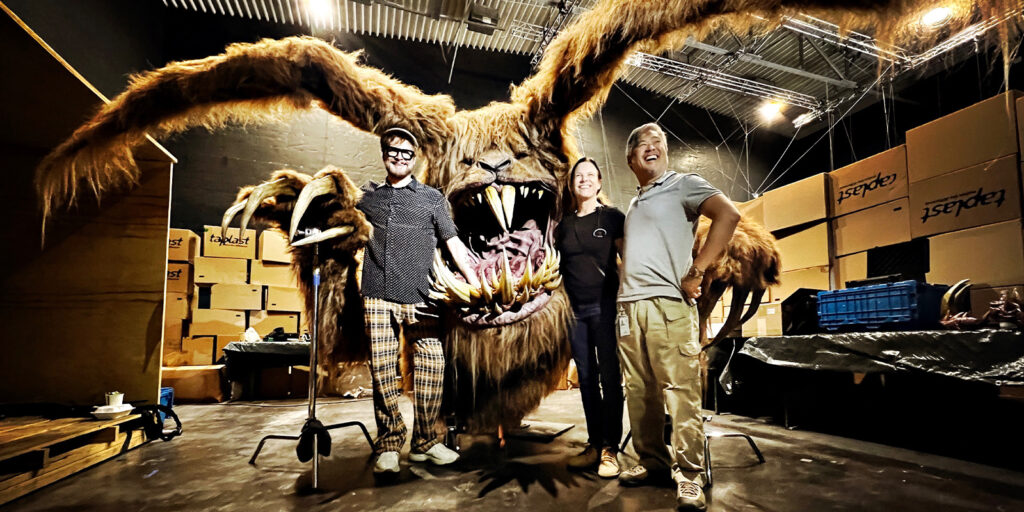
That breadth of glass, as it were, also gave them the “chance to develop the language that we loved for the film, which made you feel like you were a part of Aurora’s world when the edges fell off more. The 3:1 aspect ratio gave us the opportunity to play with that as well.”
The connection she felt with Fuller was manifest throughout the camera department too, as she’s quick to thank “my incredible CLT, Helmet Prein”, who helped light a Chinatown street sequence in Budapest with an introduction to “Rodlights from Germany… these are incredible units as they are so light, [and] rig very quickly to go up and down, which we needed to do once we started doing our drone work.”
Thanks also flow to “an incredible first AC, Chris Summers, who worked with me from the very beginning to make sure that these lenses would perform for us […] on top of being large format and anamorphic they were also incredibly detuned. […] also, my key grip, Ferenc ‘Feri’ Kramil, operators Marton Miklauzic and Imre Juhász, DIT David Vessey and our VFX supervisor Craig Lyn, who was there with us from day one and gave me so much support [… and] David Hussey, our DI colourist at Company 3 in Los Angeles, who helped us create our beautiful LUT.”
Additional praise goes to the costume and editing departments, corroborating the sense Whitaker had when having “to turn down a few other wonderful projects, while waiting for this to get greenlit, but I knew in my heart that this would be such a special project and it was so worth the wait!”
Memory in motion
Another kind of “waiting” was part of the process for cinematographer Fabian Gamper, whose work shooting Germany’s shortlisted Oscar offering, Sound of Falling, also won a Silver Frog at Camerimage, with the film as a whole winning a Jury Prize at Cannes. Its director and co-writer, Mascha Schilinski, mulled and gestated the film for a long time – through Covid – and Gamper was there for most of the process… since he’s married to her.

“The big benefit,” he good-humouredly replied to our question about being married to your director, “is that we can share ideas at a very early stage.”
Schilinski co-wrote the film with Louise Peter, and Gamper makes clear he’s “not officially working with them when they write the screenplay”. Still, “in the evenings, or at the breakfast table, we talk. For Mascha, she’s very much a visual thinker. She’s not just writing […] a set of dialogue, but [has] planned a whole piece [which] includes visuals and also audio.”
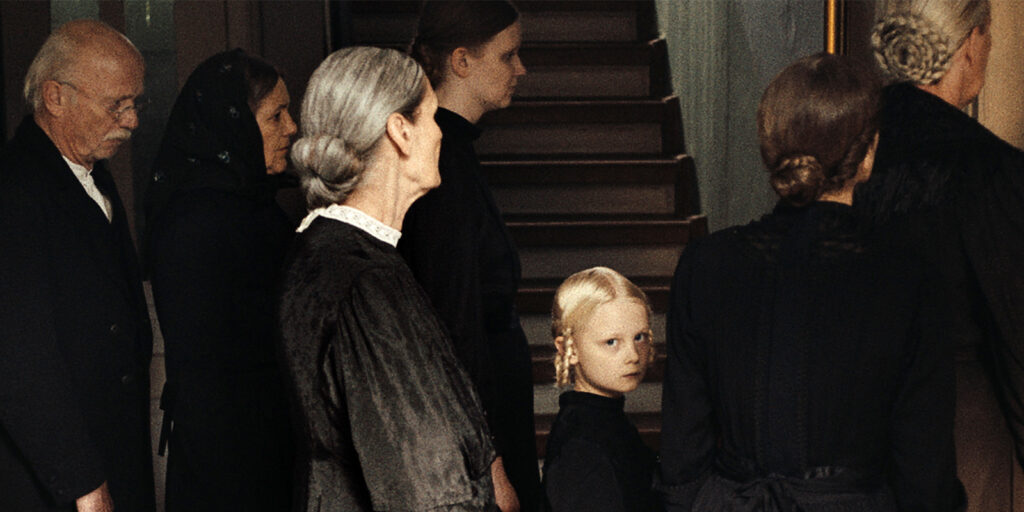
That “whole piece” spans a haunting, haunted multi-generational tale of a family in a remote farmhouse, which manages to stay intact through world wars, and the partitioning of the country, among other upheavals, large and small.
The story came when Schilinski and Peter “had this opportunity to stay at this abandoned farmhouse”, originally to work on another script. But then, the location started to assert itself – as it also does through the eyes of the women through whom the story unfolds, as we also see not only what they do, but also how they are seen – by partners, children, workers and, finally, themselves.
“The location was the key element to make this film possible on this budget we had,” Gamper says. They had “the huge benefit of lots of time [for] what we couldn’t afford money-wise”. One example, he says, came from being able to “study natural light [there and] when it comes in at times of the day”.
The combination of natural lighting from the setting, along with a couple generations’ worth of hazy memories from a time with sparse electrification, originally had Gamper thinking, “It’s clear we want to shoot this on 16mm – it should be grainy and film-like.” But “financing was very limited,” so it also became clear that “we can’t afford to shoot on film.”
They wound primarily using an Alexa Mini, with Cooke Speed Panchros, adding “film elements in post […] the grain, halation” and a softer focus to match what the 16mm might have looked like, creating “images that feel like memories [which are] not that clear, inside your head. Even the face of a person you loved, [after] the first moment you don’t remember the facial details correctly. We were looking to find some techniques or effects that would get this feeling of memory.”
Not all techniques were saved for post. Gamper took inspiration from Sir Roger Deakins CBE ASC BSC and his “Deakinizer” lenses created with the great – and as of this past fall, sadly, late – Otto Nemenz.
[As an aside, we have been meaning to get to a tribute to Otto, since his passing in November, but remain up against space requirements in an ever-busier award season. Instead, we refer you to our write-up of a rather lovely visit to Otto’s Pacific Palisades home – in a neighborhood since obliterated by wildfire – where he recounted the journey, often literal, frequently over water, that led him to becoming one of Hollywood’s celebrated innovators – and founding an equally celebrated gear house. Where, of course, he would collaborate on the invention of things like The Deakinizer. Travel well Otto, wherever that journey finds you now.]
Deakins’ work with Nemenz came on The Assassination of Jesse James by the Coward Robert Ford, to create the kind of haze and soft imagery of older, contemporaneous photography. Gamper specifically cites the film as one of his inspirations, and on set found himself doing things like “just putting a pinhole in front of a sensor. That was the first test footage I showed to Mascha.”
The other on-set effect came with “an old photography lens, where I could turn the elements around,” and it’s this, in particular, he likens to Sir Roger’s earlier work, though here it wasn’t simply to emulate the feel of old photographs, but to create diegetic ones from the video imagery, as the pictures form a key part of the narrative, with subsequent generations finding doppelgangers in earlier family poses and vanished relatives already appearing “ghostlike” in portraits.
Then there was the recreated “post-mortem photography… which was a thing to do in the countryside. [Because] it was so expensive to hire a photographer, when someone died, you dressed this person up,” and, as the film shows, propped them up too, posing with them as a kind of “horrifying” keepsake.
But as the film is so good at recounting, there is a very thin line between life’s daily horrors and its epiphanies, and the constant “falling” across one side of the line and back, as our own lives unfold.
Testament to talent
Epiphanies are also the business of The Testament of Ann Lee, the new film from director Mona Fastvold, who co-wrote with her own life and creative partner, Brady Corbet, with whom she partnered last year as co-writer on the heavily lauded film The Brutalist (which also won last year’s cinematography Oscar for Lol Crawley ASC BSC).

Ann Lee also examines immigrants fleeing to America, for experiences both better and worse, except nearly a century and a half prior to The Brutalist’s post-WWII setting. It tells the story of the titular “Mother Ann”, who came to America from England, and founded the Shaker movement here – contributing both a spare functional design aesthetic and a lot of spare-yet-moving music (such as the later Simple Gifts) to the culture. It was often that music to which they’d “shake”, dance, or simply move, in ecstatic fashion.
There are so many of these spontaneous bursts-into-song that the film is, in some places, almost structured like a musical. But whether showing perilous sea journeys, brutal backlash to religious divergence (something the world evidently refuses to outgrow), or the founding of new communities by European arrivees on what is, for them, a new frontier, the performances throughout are generally fearless, particularly Amanda Seyfried’s as Lee herself.
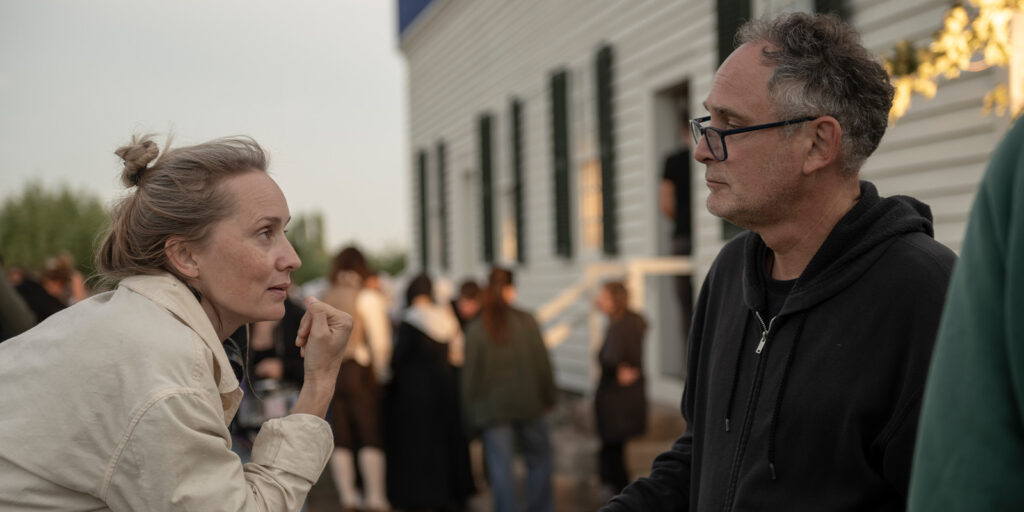
We caught up with cinematographer William Rexer ASC about coming on board the project which is already accumulating some seasonal accolades of its own, including a Golden Globe nomination for Seyfried, and a best editing nod for Sofía Subercaseaux at the Indie Spirits.
He recounts first meeting “Mona and Brady on the Apple series The Crowded Room [and] had the good fortune to work with both of them.” Seyfried was one of the stars, as she was on Peacock’s police drama The Long Bright River, for which Rexer shot three of its eight episodes. “Having done two series together and becoming good friends creates an invaluable shorthand,” he notes, though conversations with Fastvold and Corbet about Ann Lee had already begun after The Crowded Room.
Crawley famously shot The Brutalist in a VistaVision format, and Rexer allows that “the quality and character of film is certainly a preference for me when telling the type of stories Mona and Brady are writing. Mona and I discussed shooting in multiple formats: 16mm for Ann’s childhood and 35mm for the boat sequences and then VistaVision for the new world. We decided to shoot 3-perf 35mm, wide screen, spherical because we wanted flexibility, and a lighter, quieter camera that could be close to an actor and record live singing. We chose the Arricam ST and LT cameras for our main unit. We tested many sets of lenses and selected Sigma Cine and Classics [which] had the right character and handled the out-of- focus candles […] We shot on Kodak 5219 and 5207 primarily, enjoying the grain and skin tones [while] the choreography demanded that we shoot 2.39 :1 aspect ratio.”
Rexer also loves the demands, or at least the “habits”, that “come with [shooting on film]; there is a sense of respect, of preciousness, of expertise, of seriousness […] We ask the camera operator and first assistant if they got the shot (giving them the respect and authority to answer), and we take the time in between magazine changes to have the director give real notes.”
He also mentions the fruitful collaboration with Subercaseaux, who he calls “amazing”. After one of her assemblies, they filmed “additional days in New York and Massachusetts […] the shoot was always planned but certainly shaped by the edit.”
Singing our praises
Another fruitful collaboration between director, cinematographer and editor – one even more longstanding – is behind Song Sung Blue, a film accruing some surprise award buzz of its own, including a Golden Globes nomination and current BAFTA long-list for Kate Hudson’s performance as Claire Sardina, half of the real-life “Lightning and Thunder” Neil Diamond tribute act with her late husband Mike, who together ignited not only their own hopes and dreams as a musical novelty sensation around their native Milwaukee, but now with theater-goers everywhere, as the movie provides a sweet, ingenuous salve in what otherwise feels like a much darker time in the world at large.
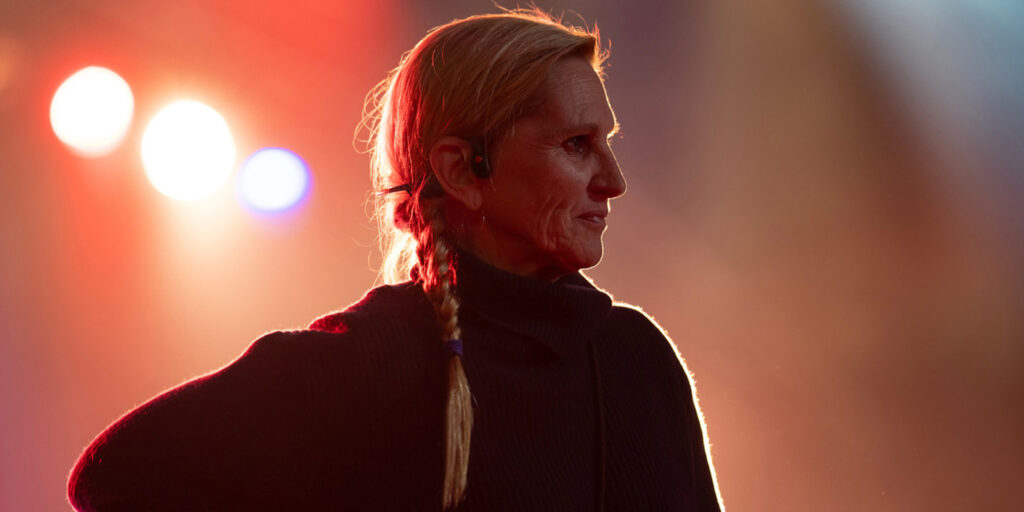
ASC pioneer Amy Vincent ASC here collaborates with long-standing partner Craig Brewer, the writer/director with whom she’s worked on productions including Hustle & Flow and 2005’s Black Snake Moan. In a couple of chats over the holidays, Vincent described the partnership as “20 years of a brother/sister collaboration – and all that kind of stuff. Hustle & Flow was significant – early in each of our careers [and] set a certain amount of our tastes [on how] we collaborate together.”
“All of Craig’s movies,” she continues, “have a significant musicality to them [but] the voice of the artist is the common thread of all of those,” with Blue being a story – as she quotes Brewer – of “people dreaming beyond their means.”
Vincent describes the “aspirational trajectory” of the real-life locations as well – with a series of New Jersey locales convincingly doubling for their often-wintery Wisconsin counterparts – as the pair, with their band, originally play state fairs and bars, then “move to bigger performance spaces”, including a culminating, sold-out theatre performance as a counter-programme to an actual Neil Diamond concert elsewhere in town.
“We stuck with period-correct fixtures for the early ‘90s,” Vincent said, using par cans, gels, and, despite shooting on a Sony Venice 2 – or perhaps precisely because of it – “return[ing] to photochemical discipline within colour temperature,” to more closely mimic the period’s look, as well as the visuals from the Greg Kohs documentary on which the story is based, with Vincent calling it a “privilege” having it as a reference.
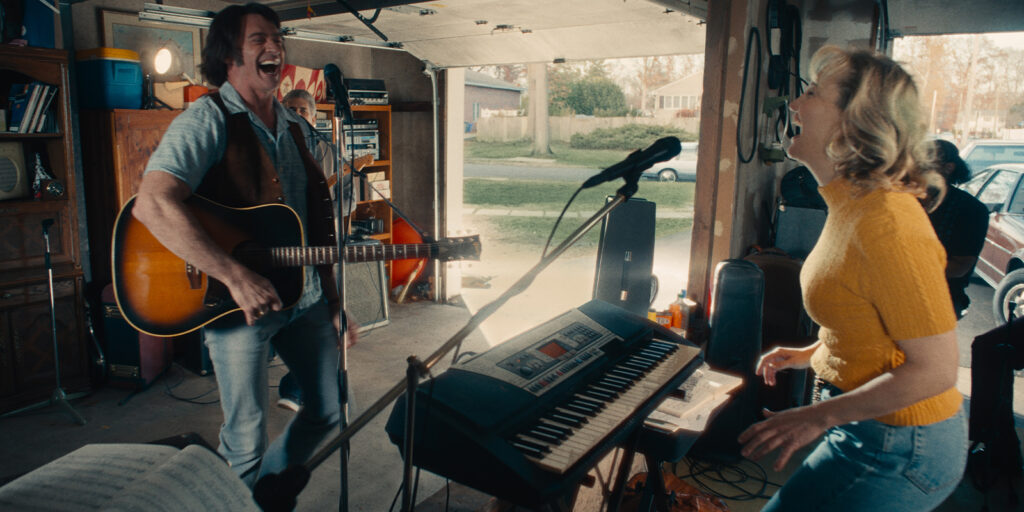
The sense of collaboration extended to her own crew, to whom she gave “the freedom to use their own musicality and the interpretation of the music” in finding shots, particularly during performance sequences, citing Steadicam operator Dave Thompson SOC, B camera’s Julian Delacruz, and Henry Cline on C camera, who’s been with her since her own breakout work on Eve’s Bayou.
The “photochemical discipline”, meanwhile, was also a factor in the choice to use “period” cameras for in-universe footage, which including Sony DVW-700ws for contemporaneous TV and broadcast sequences, along with a Sony Hi8 camera for the footage that Mike’s stepson Dana, played by Hudson Hensley, records, about his family and their music. Thompson “work[ed] closely with Hudson, showing him the zoom controls and all that stuff”, channeling his own inner “10-year-old cameraman” and watching it rub off on the increasingly assured Hensley as the young documentarian.
Those are touches, Vincent says, “you can’t replicate” artificially in post, and even her approach to using the Venice was distinguished with the use of Leitz Hugo Primes for the dramatic sequences and Fujinon Premistas for the musical performances.
This “attention [to] every aspect of the movie” permeated the film, she continues, citing all the departments and “the rest of the crafts”, including editor Billy Fox, who collaborated on some montage sequences – another member of the creative coterie going back to Hustle, and prompting her to say “it’s almost like we grew up together”. That journey, and attention, is already paying off as Vincent finds herself on the Oscar shortlist for best cinematography.
“Making the short list is like an extra special treat on top of everything else,” she says, but also unhesitatingly adds, “I got the gold already.”
We’ll be back with more coverage of that seasonal gold – including coverage of the ASC nominees, who’ll be announced around the time this column also goes live – when we’re back in February.
Until then, keep your new year’s as happy as you can. @Tricksterink/[email protected].