

FLUID PERSPECTIVES
Filming underwater demands specialist crews and cinematographers. Here, those who do it with aplomb share their tips for capturing compelling, controlled images below the surface.
Underwater cinematography was once the preserve of Hollywood features and BBC wildlife crews, reliant on expensive, complex equipment and highly specialised teams. Today, advances in digital cameras and lighting are making it increasingly accessible to indie films, commercials and scripted drama. Projects like My Octopus Teacher (2020) show how this once niche craft is enriching storytelling across indie films, commercials, and television drama.
Of course, “underwater” is a broad term—it can refer to anything from oceans and seas to lakes, rivers, bays, lagoons, or even controlled environments like aquariums and swimming pools. Whatever the setting,even the simplest-looking sequence shouldn’t beattempted without proper knowledge and experience.
Ian Seabrook (Last Breath, Jungle Cruise, Indiana Jones and the Dial of Destiny) is a multi-award-winning director of photography and underwater cinematographer working across film, TV and documentaries. He says “the common misconception regarding underwater cinematography is anyone can simply jump in the water with a camera and do it” and that it requires no skill set. It demands a highly specialised skill set, especially when it comes to handling equipment and following appropriate health and safety protocols.
He explains that underwater cinematography is often underestimated — some might think, “if it’s just one shot, why do we need all this equipment?” But even a single shot requires a specific skill set, along with careful planning around gear and health and safety protocols. He mentions how underwater cinematography is, above all, an extension of visual storytelling, not just a technical challenge. “Every shot requires creative intention, an underrating of how the underwater environment and situation can contribute to the narrative. The underwater work on a project should be an ingredient to the final product and when integrated early in the production process, they can enhance the cinematic language of the project. Seabrook’s Last Breath follows the incredible true story of commercial diver Chris Lemons’ accident at the bottom of the North Sea while working on a subsea structure. To create the environment Lemons and fellow diver Dave Yuasa were working on at 100m beneath the surface, a large space capable of containing both the diving bell, which took the divers to the work site and the manifold structure the divers were working on was required. Malta was ultimately selected for its largest exterior tank in Europe and largest square footage to be able to accomodate the sets, making it an ideal choice to bring the story to life.
“Given the sequences take place on the sea floor, the only comparable film was The Abyss, but on a smaller scale than Deepcore,” says Seabrook. “Lighting the manifold required practicals on the structure and an overhead source for shape. Since the story is set at 100m and Malta’s deep tank is uncovered, we had to shoot on a night schedule. High winds ruled out lifted lights, so we designed submerged, surface-supported overhead lighting, all DMX controlled. Storms battered surface crews on floating docks, though it remained calm below. I built a 10-hour shooting window around cast limits, with breaks and media changes. The Alexa 35 and Panavision G Series anamorphics in my custom housing delivered beautiful results.”
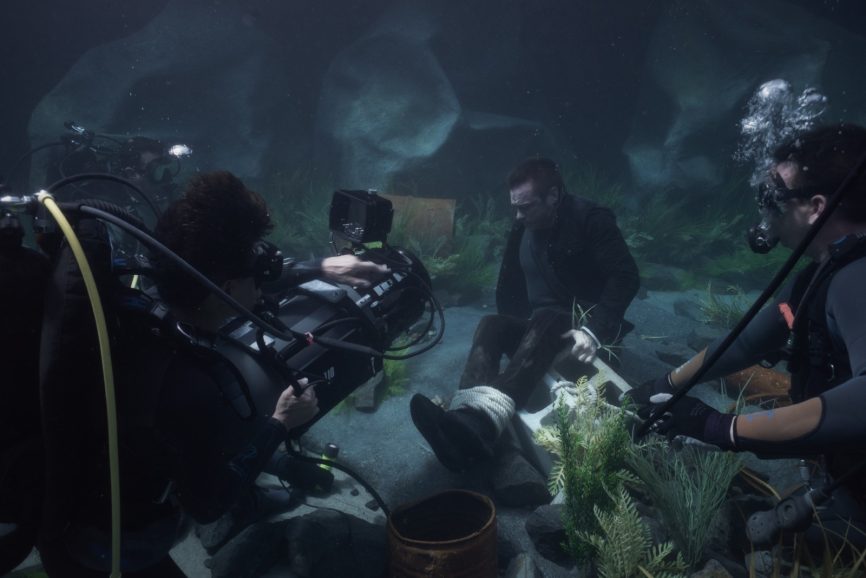
Vance Burberry ASC ACS is a land cinematographer who also specialises in underwater work. He believes bringing land-based lighting and shooting techniques underwater adds real value. “Water is a challenging environment for many reasons and working with the camera is certainly one of them,” he says.
“There are many tools—remote heads on a Chapman Hydrascope telescopic crane, underwater rigs and handheld options. A well-trimmed camera is key—it should sit level and neutral underwater, neither sinking nor floating. I hold it lightly, like a Steadicam.
Gail Jenkinson (Gold Rush: White Water) explains how during filming, cameras can record in low light when visibility is poor or colours are affected by depth. The right lens also helps capture fast-moving animals in their natural habitat.
“After about 15 metres of depth, you rapidly lose channels of light, starting with the red channel,” she says. “During colour grading, excellent work can be done to replace those colours and the blacks, ensuring the scene can be broadcast as naturally as possible.”
Kjetil C. Astrup (The Devil’s Star, La Palma, Human Playground) notes that lighting underwater is uniquely challenging due to the dense, light-absorbing environment.
“Even at the surface, several stops of light are lost depending on angle, clarity and movement,” he says. “The surface can act as a dynamic aqua filter, altering light behaviour. Light bounces more underwater and bubbles can cause sudden overexposure that requires fast compensation. With depth, both light and colour fade—red disappears around 10 metres. We compensate with lighting, reflection and grading, aiming to capture as much as possible in-camera, since underwater VFX and grading remain niche.”
Astrup has created LUTs for different depths and water types to match the head DP’s intended look. “Flat profiles help in wide shots where lighting is limited and RAW recording is essential,” he adds. “I always carry a Macbeth colour checker for grading reference. Underwater lights, like those from Hydroflex, are deployed much like topside units, with sparks and a gaffer ensuring safe setup.”
Thankfully, cast and crew no longer have to film in the most treacherous waters, as advanced underwater tanks provide a much safer and more controlled environment for shooting underwater scenes.
Controlled environments
Underwater cinematographer Wim Michiels, founder of Lites Water Stage & Film Studios in Brussels, noticed a recurring issue: too much time lost waiting around or in the pool just to get water effects right.
“I saw directors saying, ‘Is that it?’ and I thought, okay, this has to be better,” he says. “That’s why we started the water stage, which has now been open for six years. I’d worked on water stages across Europe and always came across the same issues — poor water quality, difficult sets, exterior pools with cold weather, diesel cranes — everyone was improvising, reinventing the wheel every time. It didn’t make sense. So I built something where everything is there, tested and ready: a very advanced, purpose-built water stage.”
One memorable project he cites is Heweluisz, a Polish Netflix series about a passenger ship that capsizes — the team filmed for five weeks, with ship parts, drowning scenes, rocking and tilting platforms.
“We have systems for floating platforms that rise, tilt and move safely, all in-house,” Michiels continues. “That level of control is why people come to us. Underwater filming is cold and harsh outside — we always work at 32°C underwater and just above 30°C for surface work. Even our water effects use warm water. It’s important that actors stay warm and comfortable. But the most critical thing is actor training. You can have all the tech in the world, but if the actor can’t do the scene, it doesn’t work. So we train them. My partner Karen handles early sessions, sometimes abroad, then final sessions happen in the actual tank, with real conditions. It saves time, improves performance and helps actors focus on acting instead of survival. Everyone on the technical dive team — including me — has a professional HSE scuba licence. It’s a UK standard that sets clear rules for working underwater. It means everyone knows the same safety protocols. Right now, I do about 90% of the shoots myself. Occasionally another underwater DP comes in, but I know this stage better than anyone. I know all the techniques, how to get the most from every element.”
The Brussels studio holds up to seven million litres of water and can create 1.8-metre waves. It accommodates 25-tonne yachts and offers four setups, from deep dives to surface waves and horizon backdrops.
“We’ve done shoots where we colour the whole pool,” Michiels says. “For Under Paris, a Netflix shark movie, we dyed the entire tank red using a product that mimics blood. Within a few hours, we had it back to clear — thanks to our oversized filtration system. That’s something else that’s unique: the ability to make the tank dirty, red, cloudy — and then have it pristine again in two to three days. We can even work with animals — rats, dogs, horses — but no fish, because of the chlorine. For fish, it’s all VFX or mechanical. We’ve done mechanical sharks, underwater fire scenes — and we’re ready for whatever’s next.”
Braden Haggerty (Surface) says “in a tank setting, lighting is easier as it is controlled” especially if its indoors as it allows the team “has to have complete control over the lights” which is helpful in most situations. “Most of the projects we work on have some sort of budget so a larger lighting kit is part of the package,” she continues. “Most sets have the majority of lighting coming from above water. We do sometimes supplement that with underwater light sources, either pars (HydroFlex has a variety of options) for specific lighting or LED panels to bring up the ambient light level in general without feeling as directional. I like to use these LEDs from a company called Better Way Lighting, which is based in my home town of Vancouver, BC.”
Little room to manoeuvre
Of course, working in a controlled space like a tank still has its limitations compared to open water.
Haggerty says DPs are often in “spaces much smaller than ideal” due to budget constraints, so creativity is key.
“What we mostly have to do is try to expand the space by blacking out the pool walls and floor and keeping the light off of that black material called Cinemattex from a company called Best Films in Vancouver. Then we and add a bit of murkiness to create the feeling of a vast expanse of nothing,” she continues. “Another technique is to shoot across the tank to give the feeling of sinking,” she continues. “Often the idea will be of a character to sink into the abyss. The tanks are only so deep as well as the complications of actually sinking to depth, so we will pull someone across a tank away from camera instead, just a few feet below the surface of the water. This has been a very successful way of doing shots like that as well as being able to do them with the actual actors, including kids.”
Safety
Safety is understandably a major concern, as some factors pertaining to water can be hazardous or even life-threatening.
“Electricity and water clearly don’t go together, which is why the entire electrical system must run on GFIs,” says Burberry. “It’s essential to work with a G&E crew experienced in this environment. The same goes for the water team—just having a scuba C-card isn’t enough. You need people who understand the demands of underwater production.”
“Heating and filtration are also critical. When talent is in the water for extended periods, it needs to be maintained at 90 degrees or higher to prevent hypothermia. And above all, a dedicated safety team is vital. Having the right people in place makes all the difference. I’m a NAUI Instructor Trainer and have been diving for over 35 years—I monitor everything from a safety standpoint.”
Jenkinson says that when filming underwater, “your diving skills and those of the entire team need to be second to none”, as this will be the biggest safety risk to everyone involved. “Having a culture of knowledge-sharing is paramount,” she says. “Documenting near misses, close calls and malfunctions may seem time-consuming in the field, but sharing this information with our peers—who are part of a relatively small community of filmmakers and scientists—can save lives. Communication is key. Detailed risk assessments, along with a crew ready to act on them when needed, are essential. While it’s a challenge, especially in remote, extreme and occasionally hostile environments, a clear system must be in place.”
Burberry agrees, emphasising that dive skills—like maintaining neutral buoyancy and full control in the water column—are crucial.
“That takes time, breath control and good fin technique,” he adds. “I’ve been testing a new system called Avelo that’s a game changer—it lets me move from 60ft to 20ft depth without adjusting buoyancy or letting go of the camera. That’s a big deal.”
And then, of course, there’s nature’s own challenge: the creatures.
“The most difficult shoot I’ve done was in the Bahamas where ripping currents and apex sharks are frequent conditions,” says underwater and topside cinematographer Natalie Turner-Blackman (Find the Light).
“Working around apex predators takes years of knowledge and experience which I have built on over the last 10 years. Working alongside a crew that knows the area and sharks on an individual level also gives you the confidence and preparation needed for such dives.”
Jenkinson notes that cinematographers often shoot without a director in the water, so understanding the story helps them adapt in risky moments. As always, clear communication is key.
“Animals mostly give signals—non-verbal communication, if you like—and ignoring these signals would be a risk,” she continues. “Expert research, sensitive shooting, observing from a distance and gradually closing the gap will help you avoid trouble and enable you to film natural behaviour. We learn something new every time with different animals and again, from our peers. For example, if sharks in a particular location are displaying unusual behaviour, we share this knowledge and try to identify what might be contributing to a confrontation. Boat movements and all interactions need to be considerate.”
Kit maintenance
There’s a saying that “boats don’t like water,” and if that’s true even for vessels specifically designed to float and function on it, then what chance do delicate pieces of kit have when exposed to the harsh, unpredictable underwater environment?
“Regular maintenance is essential to keeping any equipment in working order,” Seabrook says. “I ensure the potential damage the sea or other conditions have thrust upon the gear is monitored throughout the shoot and make amends when required. Saltwater can and will create havoc on your equipment, so ensuring a fresh water supply for rinsing upon completion is essential. Salt water also has a higher density than fresh water, so propulsion considerations are also important.”
Astrup concurs, noting that lens fogging and condensation are also issues and camera crews must be prepared even when working near water.
“After being in water, we rinse with warm freshwater to remove salt, then dry everything in shade,” he says. “Buttons are pushed under running water to flush salt. To prevent fogging, we acclimate gear gradually when moving between temperatures. Before sealing the housing, we use dry scuba tank air to clear humidity. In very humid areas, we add a silica gel bag inside. Some splashbags like the HydroFlex have internal spray systems to manage condensation during shooting.”
Throwing a lifeline
No matter how skilled a diver you are, there comes a point when the challenges of the water require relying on technology to ensure both safety and success.
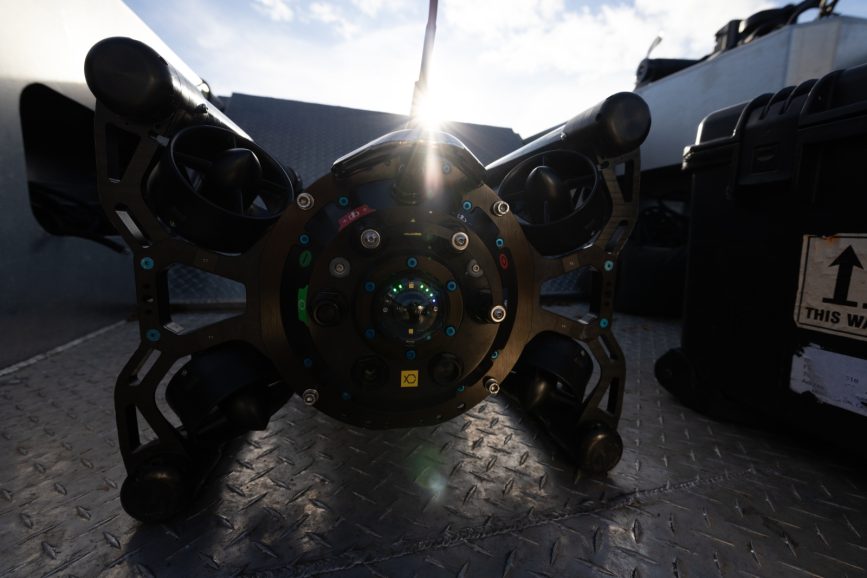
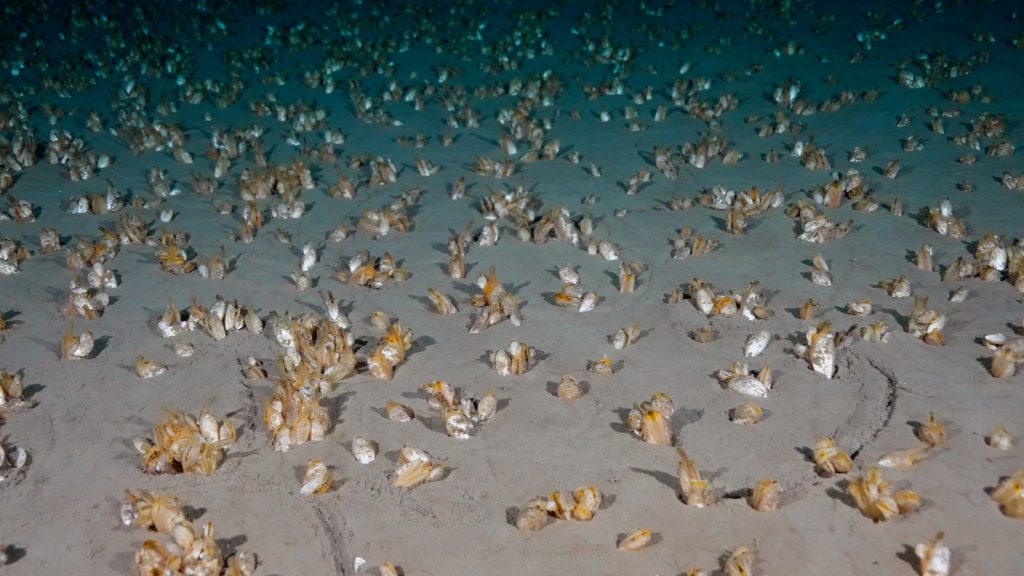
Husband-and-wife filmmakers Zach Melnick and Yvonne Drebert used cutting-edge underwater drones on All Too Clear to capture an invasive species reshaping the Great Lakes over 150 days of immersive filming.
“We wanted to show they are being transformed by quadrillions of invasive quagga mussels,” Melnick says. “These critters thrive down to 250 metres/ 820 feet deep, which is dangerous if not impossible for divers to reach. So we really had no choice but to consider the use of underwater drones or ROVs (remotely operated vehicles). There is only one ROV system out there with a camera good enough for4k broadcast use, that can be purchased by mere mortals (we do not have millions of dollars) and that’s the Luna from Boxfish Robotics in New Zealand.”
More cost-effective than divers, the crew operates for hours and executes complex moves, Melnick says.
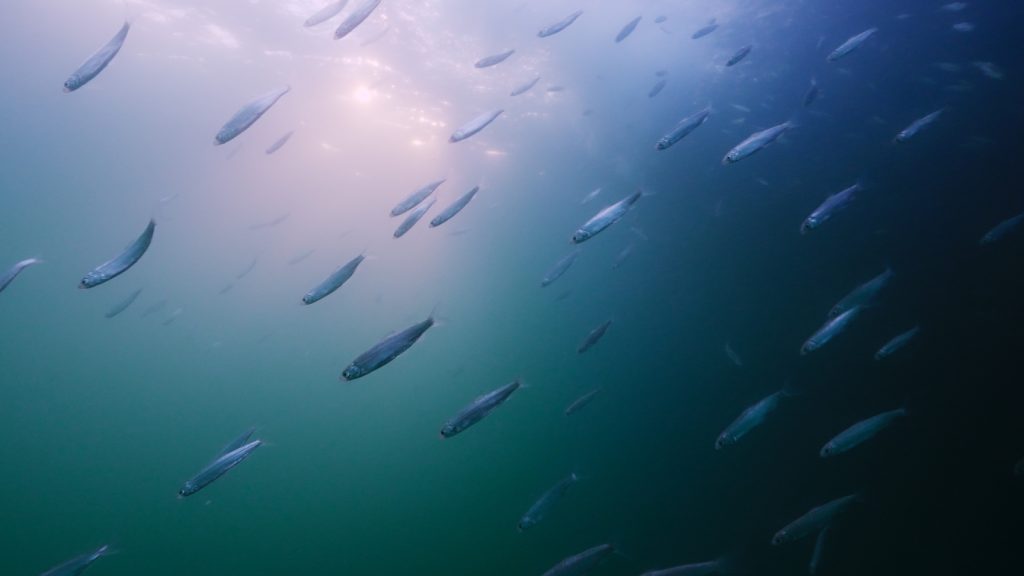
“We are able to move ‘like a fish’, getting inside schools and following them for up to two hours,” he adds. “We’ve also done a few jobs for other directors and what they love is the ability to see in 4K, real-time uncompressed images up on the surface, so we can decide together (ROV operator and director) what to shoot, as opposed to the ”hope and pray” model that directors usually employ with underwater camera people.”
The Boxfish Luna can use a few different cameras, so Melnick and Drebert opted for the Sony A7s III, “because our primary goal was to film as deep as we could without lights”.
Using the Sony 24 1.4 GM lens, they were able to get a good image down to 100 metres of water without lights. “The footage at that depth is shocking for people to see - it’s an eerie world that people literally have never seen before,” he says. “We also used a Sony 16-35 2.8 GM lens and a Sony 50mm macro for shallower water filming. We record in ProRes Raw on an Atomos Ninja hooked up to the ROV control console for the highest quality image, but we also record on the camera itself for backup for use in stabilisation later in the post workflow.”
Melnick and Drebert were named fellows of the Royal Canadian Geographical Society in recognition of their pioneering work with ROVs.
Choice of kit
“I often use ARRI and the Sony Venice, mostly because of their dynamic range and intuitive design,” says Astrup, who served as the underwater DP on the feature film The Snow Sister. “Having built-in ND filters is a big plus—meaning it’s quick to adjust and helps a lot when shooting with a shallow depth of field.”
He adds that he’s often hired onto projects where the lead DP has already made key visual decisions, including camera and lens choices. “They’ve usually spent months developing the look, so it’s important we work with what they’ve selected,” he says. “Luckily, the HydroFlex housing can accommodate almost any camera system—whether it’s prime, zoom, anamorphic, high-speed, or even film. For VFX-heavy scenes, we sometimes lean towards sharp, fast lenses like the Zeiss Master Primes or Leitz Summilux.”
Safe as housing
Astrup says that when filming motion pictures, he mainly use the HydroFlex RAC Mk5 housing. Both because it’s available in Scandinavia and also because it doesn’t limit the camera and lens choices from the head DP and director. The housing comes with direct access to the camera so the 1st AC can still get camera access through a tethered cable. No camera signals are working while in water, so we connect both power, video and lens/camera control to make the on-set situation as normal as possible tech-wise. In the end, we only need to go up with the camera for lens change or a card swap. When I’m filming wildlife, there’s a greater array of underwater housings choices, specialised for the operator to have complete camera control with all button access. I’m using Gates and Nauticam a lot, both for normal operating freediving or scuba diving, but also for polecam and tripod situations.”
Diving challenges
Turner-Blackman says one key challenge in underwater cinematography is being limited to the lens and setup taken on each dive — unlike topside, where swaps can happen more freely.
“This can be overcome by taking multiple setups down with me i.e. a macro and wide angle option this allows me to adapt to the animal behaviour, sea and light conditions without having to abort the dive,” she says. “It is even more important in underwater cinematography to review rushes and pick behaviour/sequences that are missing as an aim for the next shooting day.”
She adds that underwater lighting can vary, but she mainly usea Keldans or Gates lights. “The Keldans come in varying lumens and have a temperature of daylight (5600K). I usually either use my buddy to help light the scene and this way they can be mobile to follow behaviour,” she adds. “Another great option if doing benthic work is to take down a light stand so that more permanent lighting locations can be established. I always try to stick around the camera’s native ISO to reduce grain. Planning ahead for dives and picking cameras that are better suited to low light such as the RED Gemini or A7s III are a great way to ensure you have good dynamic range.”
Jenkinson says that clear conditions mean the light can penetrate better through the water column, but one will still lose the channels at relatively shallow depths. “Best practices remain the same for all filming conditions, though there may be a little less work required in grading and fortunately, a better shooting environment,” she adds.
For Seabrook, the primary considerations are the conditions, be they current, temperature, environment (cave, poor visibility). “Prior to shooting I usually do a recce dive and confer with any proficient locals who often times have an understanding of the surroundings,” he says. “Knowing the environment and the potential risks makes one more prepared. On Indiana Jones and the Dial of Destiny we were at one point shooting in a chasm in one body of water, whereby the currents picked up considerably in early afternoon, which shortened our shooting window, I made dive plans to work around that hazard and right on cue, as we were nearly finished, the current picked up, forcing us to wrap that shot. Having the time to do recce dives and plan accordingly was invaluable.”
The future
Technology is advancing at the speed of knots — pardon the pun — rapidly transforming the way filmmakers approach underwater storytelling, from previsualisation and lighting to camera rigs and post-production.
Haggerty says “one innovation that has been hugely helpful” has been this material used to black the tanks out with, called Cinemattex from a company based here in Vancouver called Best Films. The fabric comes in black, two types of blue screen and green screen.
“In the old days, we used to use black poly (Polyethylene) this plastic garbage bag material like stuff,” she says. “It was really difficult to manage and was crazy shiny. Then we stopped that and would use fabrics (Duvetyne or matt black) but they would tend to decay in the chlorine. In 2018 or so Best Film offered up this Cinemattex material. It is so easy to use we can work very fast with it as it is relatively easy to manipulate in the water. It also will hold up in the chlorinated water for months as we tested one season on a show called Siren. It lasted in the tank for 4 months. Digital has vastly sped up the process. The whole having to take the camera out of the water every four minutes of shooting time was a big setback.
Astrup says he is “excited about camera tech updates for low-light and wider dynamic range”—sensor innovation is key. “Underwater lighting is advancing too, though high-end options with good CRI and solid hardware are still rare,” he says. “I’m keen to see a durable LED panel for 6m depths or two bar pressure. VR/360/immersive filming is also evolving fast. We’ve shot 180°, 270°, VR, 3D, 4DX and dome projections with custom rigs in Norway. I’m currently testing a new setup in the Arctic for immersive screens.”
With these innovations making waves every day, underwater filmmaking is truly diving into a new era — proving there’s no depth to how far creativity can sink or swim.