

AT THE CUTTING EDGE
By creating the world’s first wheelchair-based camera system, Caerus, Chris Lynch is helping disabled filmmakers realise their creative visions. But, as he highlights, the sophisticated tool can benefit a wide range of productions.
Placing craft and innovation at the centre of everything he does, Chris Lynch has set out to create systems that opens up possibilities for filmmakers and elevate productions. As well as developing the world’s first wheelchair-based camera system, Lynch has built up a number of successful businesses including Diverse Made Media, a disabled-led production house with a technology arm.
“I crafted my life around self-employment because much of my career has had to revolve around my health condition, brittle bone disease. As a child, I was in hospital quite a lot which dictated what I did in regards to education, career and socially activities,” says Lynch. “My education stopped at an early stage because when I got a driving licence I wanted to see the world and get my freedom and independence.”
Lynch’s career began in graphic and web design, setting up one of the first digital agencies in Northern Ireland in 2007. He later collaborated with business partner, Robert Hood, who ran an ad agency in Belfast to create a boutique agency focusing on commercials, digital video and podcasts. That kickstarted his career in film as he moved into the indie and factual worlds, collaborating with Belfast production company, Triplevision, and working on BBC documentaries.
“But shooting was always a problem for me being a wheelchair user. I always say, you need four arms: two arms to push yourself and two arms to hold the camera,” says Lynch.
A turning point came in 2020 when working on documentary The Disability Paradox with Triplevision as part of the True North series. “It was a first for the BBC in Northern Ireland and quite a brave move for the BBC because they gave us the opportunity to look at disability in a raw and unfiltered way,” he says. “Up until then disability was portrayed from a polarised view; either you were destitute and on benefits, or a superhuman Paralympian – a narrative driven around the 2012 Olympics when Channel Four developed the superhuman narrative.”
The documentary marked Lynch’s first step into network TV, exec producing and presenting. Off the back of the film’s success, he set up set up One in Five, the first disabled-led production company in Northern Ireland with Triplevision’s Eamonn Devlin and Gerard Stratton.
“We set it up as a social enterprise, adjacent to their production company and mine, producing content and telling stories that typically hadn’t been told, not only looking at how to drive more inclusion in front of the camera, but for the first time, behind the camera too,” he says. “It was plagued with challenges because trying to raise funding and get traction in Northern Ireland was problematic, largely due to the economy being quite bad. It was hard to promote anything with regards to D&I initiatives and social impact and I quickly realised I had to be in London to progress my career and develop that initiative.”
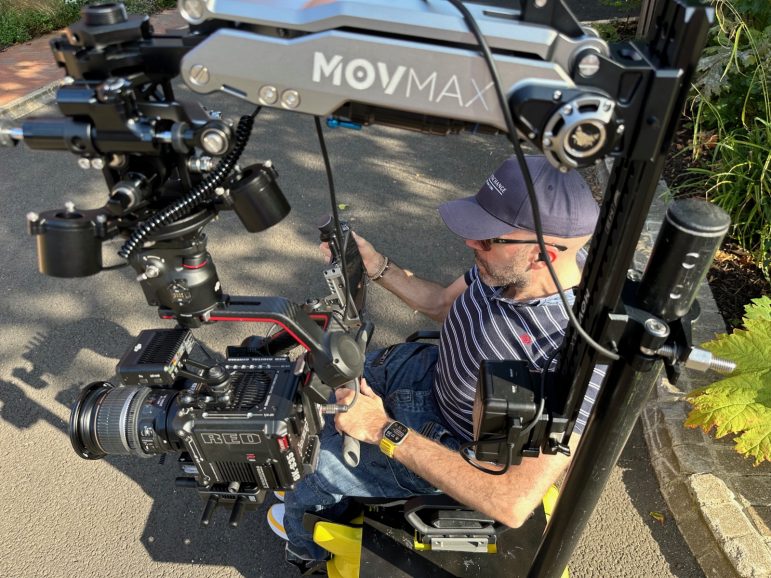
Lynch left Northern Ireland three years ago, handing over the reins to the team who continue to run One in Five, working with BBC Northern Ireland and on a variety of events and projects. He set up Diverse Made Media in the UK – a disabled-led production house with a technology arm developing wheelchair camera systems.
“On the production side, I wanted to expand the mission of One in Five because I firmly believe that to look at equality properly, you can’t do it effectively when isolating one community. That’s why we’ve set out to promote gender, race, sexuality, religion and age equality and develop a strong roster of skilled crew spanning every community.”
A creative lens
Whilst the business developed, Lynch worked on what is now called Caerus – the world’s first wheelchair-based camera system. The first iteration he developed in Belfast, was based on Omeo, a self-balancing, hands-free chair Kevin Halsall in New Zealand made. “There’s an optional joystick, but essentially you lean to steer, move forward or stop. I thought it was a tool I could use to be a camera operator; potentially a game changer.”
Experimenting with different cameras, he teamed up with engineering and rigging company Media Mechanical Services in Belfast. “We took a Steadicam and they fabricated a mount welded onto the chair. Unfortunately, it didn’t offer the flexibility and range of movement needed to control the camera but it was a great starting point,” he adds.
Despite not being connected with many riggers and experts in grip at the time to help him understand what the next iteration would be, when Lynch came to London he partnered with other innovative companies to realise his vision such as the team behind Genny – an electric wheelchair combining Swiss ingenuity and Italian manufacturing excellence, CVP and engineering company Feral.
“They offered to do the work for free, only charging for materials, and were so helpful and generous with their knowledge and expertise, quickly understanding what was possible and what wasn’t.”
The first working prototype launched at 2024’s Cannes Lions and partners such as DJI provided equipment and RED loaned kit for testing. “Industry support has increased over time, helping refine the system, and how best to adapt equipment to create a safe and best in class system,” he says.
“I knew from the outset to take this into the industry as something credible and recognised, there was no point in putting together a half-baked system with a cheap camera. This needed to integrate into a number of workflows, productions and be versatile, making it possible to use different cameras and be familiar to ACs. Ultimately, my aim is for people with disabilities to be able to use it.”
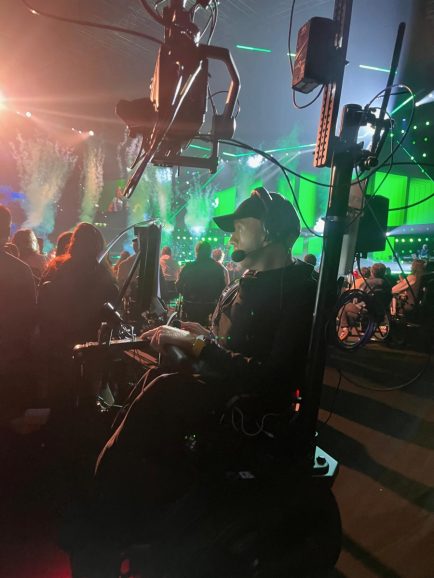
The system needed to be modular and flexible so a single operator could use it. “But if you didn’t have the ability to control everything yourself, elements of the functionality could be handed off to ACs,” adds Lynch. “The prototype we built was a solution using the DJI ecosystem, with the DJI transmission system, so when you use the Ronin RS 3 Pro or RS 4 Pro and move the screen, you can move the gimbal instantly which is great for fast-paced action like sport.”
Diverse Made Media — which currently has 20 cinematographers and five camera ops on the roster — recently supplied crew and used the Caerus system to shoot behind-the-scenes footage of a film Motability’s production company Corner Shop worked on. “For projects like that we look at our roster, whether it’s for the disabled, Black or LGBTQ+ community, and make sure there’s the correct representation behind the camera, it’s authentic and we represent the production the right way.”
Lynch’s other projects include directing a film with Allianz and the International Paralympic Committee (IPC) which brought together one of the largest contingents of disabled crew behind the camera for a three-day shoot in London Film Studios. “We had about 45 people on set, 20 of those from our crew were from the disabled community which was fantastic and that film went on to be huge,” says Lynch. It was a training series called Move Now — encouraging young people with disabilities into sport which has been viewed more than 166 million times and scooped a Clio Award for social purpose.
“From that production, we brought in a number of amazing crew to our roster including Kiff McManus who has a prosthetic arm and uses a hook to boom audio. He’s had an amazing career, working for 15 years on Top Gear and on many features and other projects. It’s people like that we’ve worked hard to find who are talented and represent their community in a unique way.”
Endless possibilities
Caerus evolved further when Lynch met Australian company Ignite Digi which created Control Deck to control the entire DJI ecosystem of products. “It’s like a PTZ-style controller with a joystick and focus, all in one unit,” says Lynch. “That took us to the next level because it could bolt onto the chair to offer joystick control of the gimbal and functionality because one challenge using the DJI gimbals is you have to go into the menu to make changes. Having that all there with tactile knobs to change settings transformed the prototype.”
Other control interfaces were integrated including inertia wheels used for jibs and cranes. “The DJI Master Wheels fit perfectly within that ecosystem and Nodo Wheels are another type of inertia wheel product that can be used with the control deck and DJI ecosystem,” adds Lynch.
In January, the Caerus prototype was demoed at Sky Studios and used by their camera operators, producers, line producers, and directors. “It was seamless which is thanks to the support of our partners who donated kit such as CVP who lent us the DJI Master Wheels. We’ve needed to self-fund as we received no grants, despite applying.”
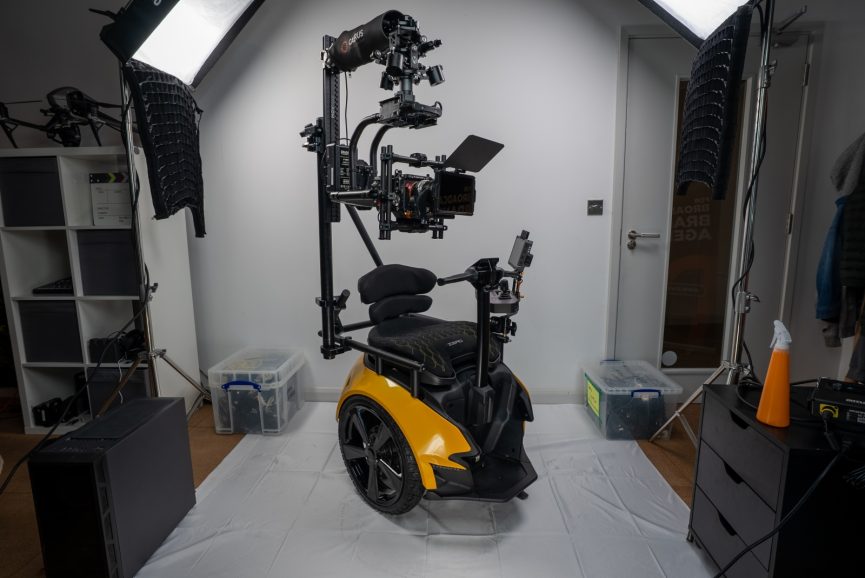
As the Genny chair was replaced by the Genny Zero, Diverse Made Media also engineered a new plate design to work with new payload limits and how the chair operated. Feral had become too busy to help, so I was referred to Ronford Baker who were incredible, turning it around in two weeks. I was blown away by their production process. The new Caerus system which is shown in a bright yellow design, can quickly change to black in seconds should it need to be more stealth like. It really is amazing, even down to the finish and now also boasts a more powerful gimbal, meaning more productions can consider a wider range of camera packages.”
The new-look chair is the “cornerstone of the whole system” which, in combination with the rig and parts that have been “beautifully fabricated and finished by Ronford Baker, looks so professional and slick” that going into future demos with broadcaster or studios, Lynch is confident it will impress.
Limitless lensing
“Ultimately now we are focusing on getting people to buy and integrate it into their productions, so we’re putting in place a road show and touring studios and broadcasters to get in front of people, and then look at scaling up, focusing on the UK market at first and then overseas.
“As a small company, it’s going to take a lot longer to grow organically, but having some association with or being ingested by a bigger player will give us access into new territories,” adds Lynch, who created a model to invest money from sales back into the business to continue to grow.
Other ambitions for Caerus are for it to be used on large-scale production, in turn demonstrating to the wider industry how it works. “So many people have said to me the system will be something everyone wants to use, and we don’t want to limit that,” he adds.
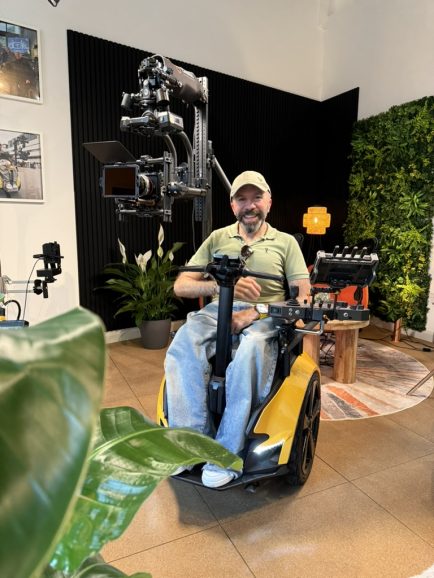
Whilst the platform will help create job opportunities for people with disabilities, Lynch believes the whole industry will want to use it because of its “speed, flexibility, and the creative shots it can capture”. “You can set it up as an instant dolly, capture orbiting shots, all these creative moves are achievable and that’s what we’ll demonstrate over the coming months through marketing collateral. Using the system in reverse, you could put the camera behind you and travel at speed, tracking someone running or even cars at slow speed.”
Diverse Made Media also collaborated with camera support company BlkBrd who developed Mantis which makes it possible to put vertical or horizontal mounts onto the chair so it can be used in handheld mode. “We want to enable people, not limit them, so if this system limited you from doing a shot, you have the option to go handheld.”
Most importantly, when a team is considering using the system, Lynch does not want them to view it from a social impact perspective. “I want them to look at it through a creative lens and see how amazing the platform is and the value it will add to the production, rather than just ticking a box because it’s a good cause and it’s the right thing to do. Caerus is an excellent tool that will benefit your production and that’s what I want to hit home.”