

GLAMOUR MEETS PRECARITY
The results of the Behind the Lens study on living conditions and working conditions of camera crews in Europe are sobering. Kurt Brazda, chair of the IMAGO Working Conditions Committee, highlights the fundamental transformation of the labour market the study reveals.
After one and a half years of intensive work, and with the invaluable support of Dr. Cristina Busch, an expert in European labour law and copyright law, the IMAGO Working Conditions Committee in cooperation with the IMAGO Committee for Inclusion and Diversity has published the Behind the Lens study on living conditions and working conditions of camera crews in Europe. In November we successfully introduced it to the European Parliament and the European Commission.
This study has long been the wish of those who, day after day, carry our industry on their shoulders with professionalism, creativity and dedication. Yet they are increasingly confronted with unbearable working conditions. The glamourous image of the audiovisual world perfectly conceals the fact that behind it, work is becoming ever more precarious and, in many cases, undignified.
The results of Behind the Lens, are sobering – and they stand in stark contrast to the 20 Principles of the European Pillar of Social Rights.
A remarkable aspect of this study is how it came into being. Without any public funding, it was financed through a unique act of solidarity by IMAGO and numerous European professional associations. The authentic experiences of those affected flowed directly into the data long before it was scientifically evaluated by the renowned FORBA Institute in Vienna.
The profession of cinematographers is of crucial importance for Europe’s cultural identity and its international image. With our images, we evoke emotions and shape attitudes.
In a global climate where audiovisual media is increasingly used to undermine European democracy, filmmakers bear a high social and political responsibility. We are ready to carrythis responsibility — but we also expect to work in an environment based on respect and dignity.
New world of work
The findings we present in Behind the Lens clearly reveal a fundamental transformation of the labour market. Traditional employment is constantly decreasing, while the number of self-employed freelancers is growing. This means that millions of people, with almost no labour protection, must survive in the work reality of the 21st century. The audiovisual industry has become the blueprint for this new world of work. Solutions found here may become groundbreaking for many other sectors.
The European Commission has taken an important step with its forward-looking guideline “Collective Bargaining for the Self-Employed.” It clearly states that bargaining minimumfees for solo freelancers does not violate competition law. The reason is simple: solo freelancers are not traditional entrepreneurs — in reality, they are often far more dependent on clients than employees are on their employers.
However, this guideline has not been taken up by most chambers and trade unions in Europe. To this day, solo freelancers, despite their obvious need for protection, are not represented by trade unions that act merely for employees. This is a serious mistake. If trade unions refuse to represent a growing majority of the future workforce, they risk losing political relevance. And yet, strong trade unions are one of the few effective correctives against the excesses of turbo-capitalism.
If we fail to develop legal frameworks that correspond to this new labour reality, we will further expand the “digital underclass” that already exists across Europe — countless young people clicking desperately for precarious jobs on their computers at home.
AI has already transformed our working world into ways that would have been unthinkable just a few years ago. Social and labour regulations, still rooted in the last century, can no longer keep pace with this rapid acceleration. Our study shows clearly that so many people are being left behind—economically and in terms of their health.
As a convinced European, it pains me deeply to see how much trust in the EU has eroded among many citizens. But especially in times of global instability, we need Europe as a strong defender of liberal democracy. And we must never forget: a humane working environment is a fundamental prerequisite for a stable democracy.
Taking action
The presentation of Behind the Lens at the European Parliament met with strong interest from the high-ranking representatives of Parliament and the European Commission, because until now it was unimaginable that such precarious working conditions could prevail in an industry considered one of Europe’s leading lights.
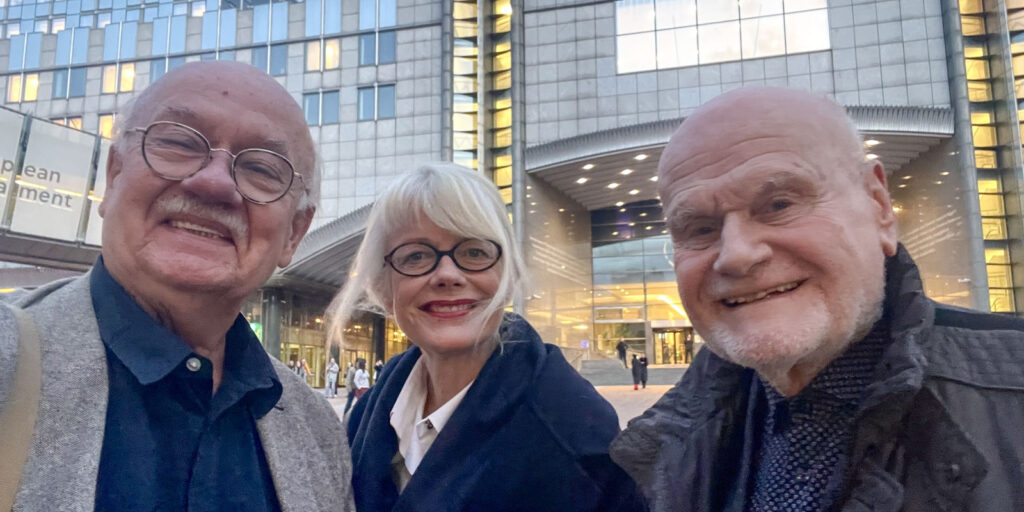
Therefore the representatives present expressed a clear and strong willingness to pursue concrete actions, including:
– proposing an EU directive to the Parliament for better working conditions for creatives (it was a perfect and lucky coincidence that the day after such an important initiative has been discussed in the commission and our study gave valuable input to it)
– connecting EU film production funding with the fulfilment of these standards and
– incorporating recognition through the EU LUX Audience Award (formerly LUX Film Prize)
We have been invited to continue working closely with them on how to start and implement these actions
Former president of the European Parliament, Evelyn Regner, who attended the presentation, once said: “Europe will be social, or it will not be at all.” She is right. If democracy is to succeed once again in Europe, we urgently need a European Union with real social policy competencies. Our study can contribute to encouraging deeper engagement with the rapidly changing European world of work — under the motto:
Democracy can only survive if people feel valued!
To download the full Behind the Lens report, visit the IMAGO website.