

THE LION’S DEN
Family drama Father Mother Sister Brother claims the Golden Lion at Venice, beating the bookies’ favourite, a film that left critics in tears.
The 82nd Venice Film Festival had many talking points, but the most wildly debated was surely reserved for the finale, when jury president Alexander Payne announced the winner of the Golden Lion. Jim Jarmusch’s quietly meditative triptych about familial relations, Father Mother Sister Brother, was a film – to be fair – few had predicted would walk away with the top prize. It meant, at least, that two esteemed cinematographers could share in the glory.
Veteran American Frederick Elmes ASC, whose work with Jarmusch stretches right back to 1991’s Night on Earth, another multi-story movie, shot the ‘Father’ segment, starring Tom Waits as the titular patriarch. The equally acclaimed French cinematographer Yorick Le Saux AFC, who previously worked with Jarmusch on 2013’s vampire-centric Only Lovers Left Alive, filmed the Dublin-set ‘Mother’, featuring Charlotte Rampling, and the Paris-set ‘Sister-Brother’, with Indya Moore and Luka Sabbat.
Le Saux, a long-time collaborator with Olivier Assayas, was also in competition with the French director’s The Wizard of the Kremlin, a semi-fictionalised look at Russian politics and the rise of Vladimir Putin (played by Jude Law). But while that film walked away empty-handed from the prize-giving, the aforementioned debate came when Tunisian filmmaker Kaouther Ben Hania’s unabashedly political The Voice of Hind Rajab played on the second Wednesday of the festival. Critics were in tears at the press screening, whilst the premiere saw a record-setting 24-minute standing ovation.
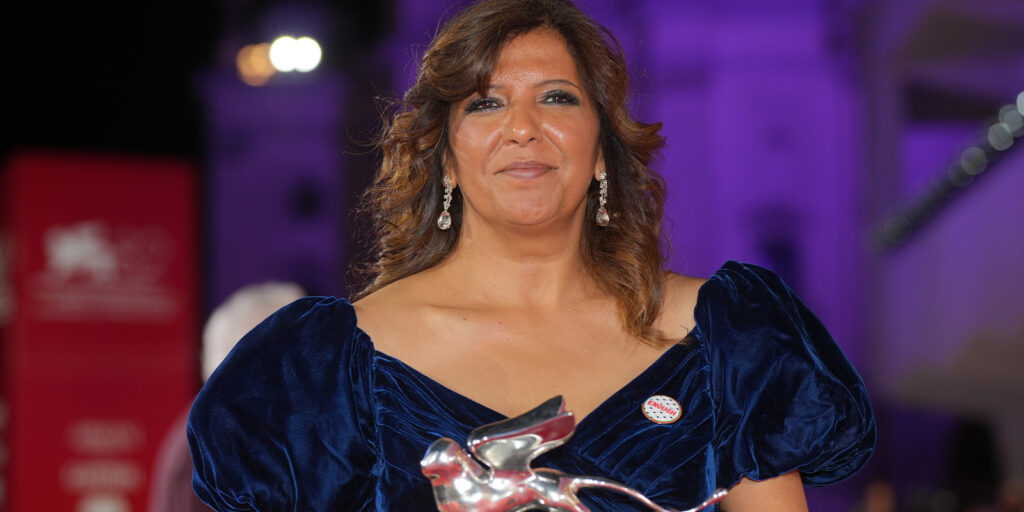
Entirely set in a Red Crescent Emergency Centre, the harrowing film uses actors playing the volunteers manning the phones, but real audio of a six-year-old Palestinian girl, begging to be rescued from a stationary car as Israeli forces attack the Gaza Strip. The film took second prize, the Silver Lion Grand Jury Prize, though many felt it deserved more. Certainly, the spotlight will deservedly fall on Colombian-born cinematographer Juan Sarmiento G. ADFC BVK, whose tightly-framed visuals lent the story a nervy claustrophobia.
Past and present
This year, Julian Schnabel won the annual Glory to the Filmmaker Award, a prize for contributions to cinema that’s been bestowed since 2006 when Japan’s Takeshi Kitano was rewarded. The artist-turned-director was also on hand to present In The Hand of Dante, a somewhat wild, wayward film that continued Schnabel’s obsessions with artists, poets and writers. Here, the focus was Italy’s Dante Alighieri and strangely, Nick Tosches, the acclaimed American journalist, upon whose 2002 novel this was based.
With both men played by Oscar Isaac, albeit a highly fictionalised version of Tosches, who gets embroiled with New York mobsters to steal an original manuscript of Dante’s epic poem The Divine Comedy, the mix of violence and earnest protestations of love didn’t exactly play well. But the era-switching visuals captured by Russian director of photography Roman Vasyanov ASC RGC (who was behind Kirill Serebrennikov’s Limonov: The Ballad, a film that deserved far more exposure than it got) were distinct enough to spirit audiences from 14th-century Italy to 21st-century New York.
Other honourees at this year’s Venice included Gus Van Sant, who was given the Campari Passion For Film Award. The American filmmaker was there with out of competition Dead Man’s Wire, easily one of the most enjoyable movies at the festival. Set in 1977, it told the true story of an Indianapolis businessman (Bill Skarsgård) who kidnaps a mortgage broker, Richard (Dacre Montgomery) after a deal goes sour. Arnaud Poitier AFC teamed up with Van Sant for the first time, shooting in Kentucky over just 19 days – and crafting an indelible work that immediately brought to mind Sidney Lumet’s 1975 bank robbery tale Dog Day Afternoon.
Golden girl
There was also a genuine legend, perhaps the last left from the Golden Age of Hollywood, given a Golden Lion Lifetime Achievement Award: Kim Novak. The 92-year-old, famed for her appearance in Alfred Hitchcock’s Vertigo, was presented her award at a glitzy ceremony, with filmmaker Guillermo del Toro leading the tributes. The actress also had a more personal tribute, in the shape of Alexandre O. Philippe’s intimate documentary portrait Kim Novak’s Vertigo, playing in the festival. On stage she called Philippe “an incredible filmmaker…he was able to get into the diary of my life.”
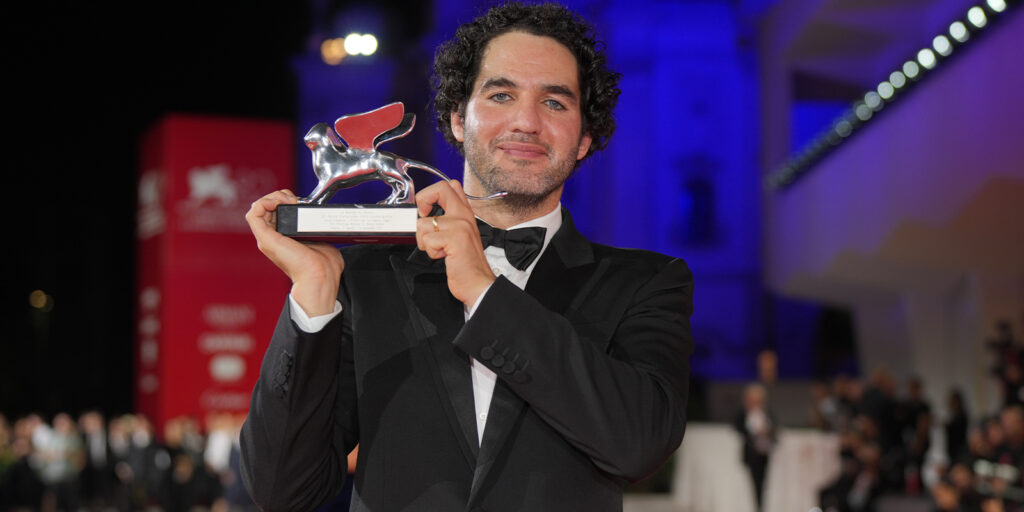
With Venice often being the official start of the awards season, alongside other early autumn festivals in Telluride and Toronto, this year’s selection didn’t boast an obvious Oscar frontrunner, although you suspect del Toro’s lush, Netflix-back Frankenstein will be a major candidate in technical categories, including the burnished cinematography by Dan Laustsen ASC DFF. But one film certainly stood out: The Smashing Machine. Benny Safdie, working for the first time without brother Josh – who has his own solo effort Marty Supreme on the way – took Best Director for his efforts.
This true-life tale starred Dwayne Johnson as UFC competitor Mark Kerr, a man blighted by addiction to opioids. Johnson wept openly at the warm audience response at the premiere, and he’s surely in line for a first Oscar nod of his career. Shooting the film was Maceo Bishop, who makes a major step up here (he previously won the BSC Operator of the Year Award for the Safdies’ 2019 film Uncut Gems, as well as an Emmy for his work on the filmed version of Hamilton). Here, he does a fine job of shooting both the bone-crunching UFC bouts and the domestic dramas that unfold. In a festival where so many of the old guard were recognised, it was heartening to see the work of someone new hit the spotlight.