

Cinematographer and senior lecturer and programme leader in Film Production at the University of Lincoln Jack Shelbourn reflects on the DP’s role in ensuring sustainability on set.
Reed Morano puts the job better than I can: “It’s a very tricky job we have as DPs, where you are expected to make something that really is an emotional art, but also needs to be technically spot on. You’re often given a very small window of time to achieve it. People sometimes expect it to be even quicker and forget that there’s a schedule for a reason.”
I read that to students in one of their first lectures, because it names something nobody warns you about when you start. Cinematography is the management of competing demands under time pressure. Light quality against power draw. The look against the day you have to get it in. What the director wants against what the budget and the daylight will allow. The craft is the judgement made in the space where those things pull against each other, and we are good at it because we have never been allowed to be anything else.
That skill is about to matter in a way it has not before, because two new variables have arrived on set at the same time. One is carbon. The other is the machine.
Take carbon first, because it is the one we can measure and the one we half understand already. The honest picture is uncomfortable. Most of a production’s footprint is not decided on set at all. It is locked in earlier, in the script and the schedule, in the locations chosen, the distances travelled, the number of shoot days, the scale of the logistical operation. By the time we are standing on the floor with a lighting plan, a large share of the emissions is already committed. That is worth saying plainly, because it sets the limit of what any one of us can move.
Within that limit, though, the cinematographer holds real levers. Lighting approach and kit are ours, and I can put a number on mine. As part of my doctoral research I tested single-source, reflector-led setups against a conventional multi-head tungsten rig, matched for exposure, in controlled conditions. The reflected builds drew around 0.176 kWh per hour against 0.586 for the conventional rig, a 70 per cent reduction, with no perceptible loss in the image after the grade. One method, controlled conditions, not a universal law. But it is measured proof that the demand side of lighting is a lever we actually hold.
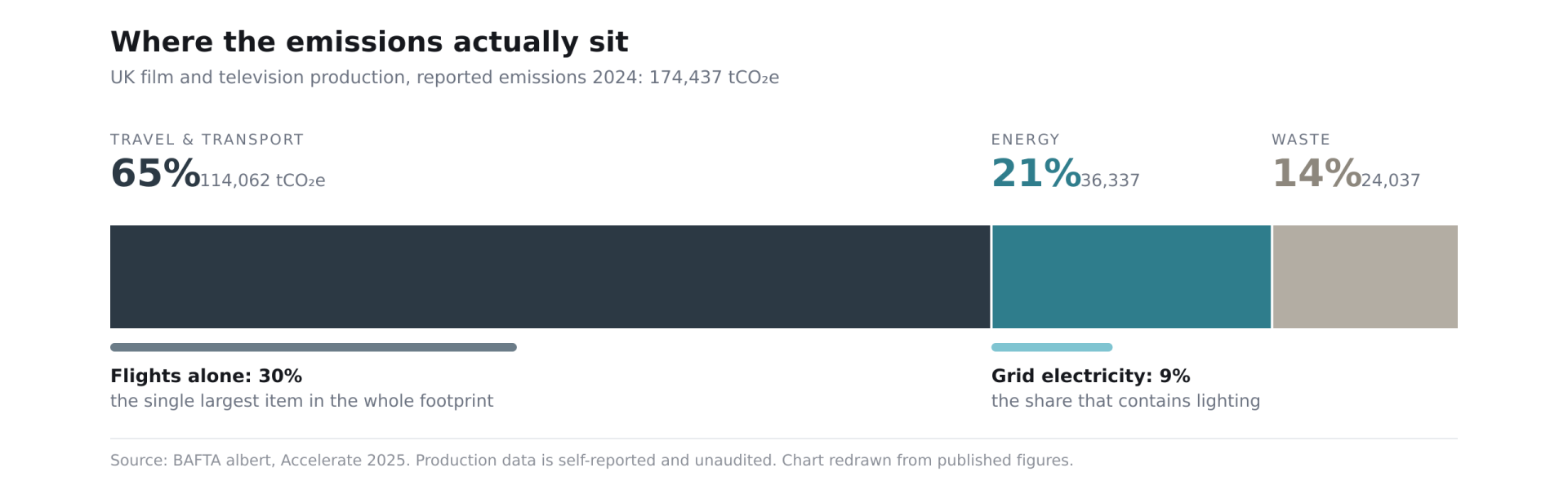
It is worth being honest about the size of that lever across a whole production, though. The most recent BAFTA Albert figures put energy use at around a fifth of the UK industry’s footprint, and mains electricity at under a 10th of it. Travel and transport account for close to two thirds, with flights alone almost a third of a production’s footprint. Cleaner power and leaner kit deliver real savings. But those gains sit inside a small part of the whole, and they get outrun by scale and by travel. As a production grows, total emissions climb regardless of how clean the lamps are. Cleaner kit is a per-unit lever. It is real, and it is partial. Anyone selling it as the answer is not telling you the truth.
So the cinematographer’s leverage over carbon is honest but limited, which makes the question not really about lamps. It is about leadership. The DP sets the tone on a set in a way that no spreadsheet captures. Heads of department take their cue from the look you are after and the working culture you establish. If sustainability is treated on the floor as a compliance form someone else fills in, it stays a compliance form. If the person whose judgement the set already respects treats it as part of good practice, it becomes part of the work. Leadership here is not a sermon about the planet. It is bringing the same trade-off judgement to carbon that you already bring to everything else, out loud, where the crew can see you doing it. And this is no longer a fringe conversation. The BSC has been putting sustainability on its own Expo stage, and the tone in those rooms has already moved from whether to how.
I can hear the objection, because I have heard it on sets: this is not our job. Carbon belongs to production. There is a coordinator and a form for it now, and a DP who takes it on is doing someone else’s work for free while their own gets harder. I understand the position. I think it is wrong. Nobody is asking the DP to fill in the form. The form was never the work. The work is the hundred small trade-offs that decide what the form eventually says, and those trade-offs are already ours. The genny that idles all day because nobody planned the tie-in. The night exterior that could have been dusk. The extra 18K on the truck because it has always been on the truck. Production can count those decisions after we make them. Only we can make them differently. Handing carbon to a coordinator and looking away is not neutrality. It is a decision to keep choosing the same way and let someone else do the arithmetic.
Which brings me to the second variable, and the harder one.
Generative AI has arrived in the visual pipeline, and the conversation about it has gone straight to the wrong question. One camp says the tools are an energy disaster, all those data centres burning power for a single image. The other says they are obviously greener; fewer trucks, fewer build days, fewer people standing in a field. Both are arguing about the wattage of a single lamp while a fleet of generators idles behind them and a unit flies across the Atlantic. The energy a prompt consumes is not nothing, but it is not the figure that decides anything.
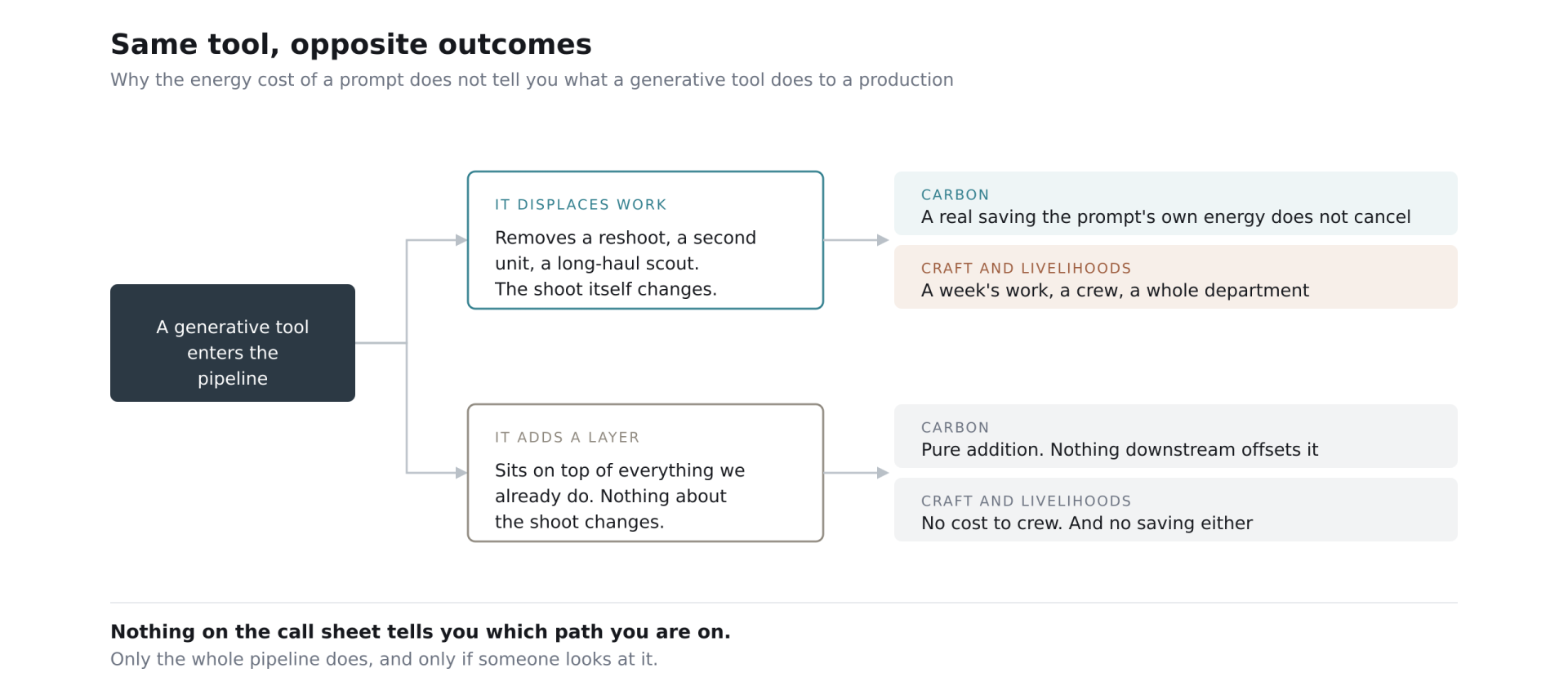
The question that actually decides something is this. What workflow does the tool displace, and what is the net effect across the whole production. A tool that removes a reshoot, or a second unit, or a long-haul scout, may carry a real downstream saving that its own energy cost does not come close to cancelling. A tool that simply adds another layer on top of everything we already do, changing nothing about the shoot, is pure addition. Same technology, opposite outcome. You cannot know which one you are looking at until you look at the whole pipeline, which is exactly the kind of looking a cinematographer is trained to do.
We have seen this shape before. When the DIT first appeared, the role was resisted as cost and overhead, another day rate on a budget that was already tight. It is standard now, and not because anyone won an argument about principle. It became standard because the upfront cost bought a downstream saving. Fewer surprises in the grade, fewer things to fix in post, fewer reasons to go back. The cost you could see on the call sheet was never the cost that mattered. The net effect across the production was.
Sustainability judgement and AI judgement will follow the same curve, and here is the part I would rather say plainly than politely. The cinematographers who refuse to engage with these tools will not stop them arriving. They will simply hand the decision to someone else, and we should be clear about who that is. Not another craftsperson. Whoever holds the spreadsheet. And a spreadsheet has one column that matters, cost per shot, on which the machine wins every time, because a spreadsheet cannot see what we can see. It cannot tell when a tool genuinely nets out across a production and when it simply deletes a department. It has no cell for judgement. If the only people in the room are the ones reading the numbers, crew become a line item, and line items get cut. Refusal feels like a principle. In practice it is an abstention, and the bill lands on the crew, not on the person who abstained.
So the argument about these tools needs to happen between cinematographers. At the monitor, in the BSC, in these pages, and soon, because the decisions are being made either way. The only question is whether the people deciding what a crew is worth have ever stood on a set.
But there is a cost the pipeline analysis does not show, and it is the reason I would not let anyone, including myself, get comfortable here.
If a tool displaces work, it displaces people. The reshoot that did not happen was someone’s week. The second unit that was not needed was a crew. The set that was built in a machine instead of a workshop was a department. Those people are the readers of this magazine. A cinematographer who reaches for AI purely to cut carbon, or purely to cut budget, without weighing what it does to the names on the call sheet, is not making a sustainable choice. They are making a narrow one and calling it sustainable. Sustainability that ignores the social dimension is not sustainability at all. It is just cost-cutting wearing a better word.

So the balance is not emissions against cost, which would be easy. It is emissions, cost, craft and livelihoods, all held in the same hand. That is a genuinely difficult judgement, and there is no formula that resolves it. There is only the willingness to keep all four in view and to decide honestly, case by case, what the trade is worth. I would rather work with a cinematographer who finds that difficult than one who finds it simple, because anyone who finds it simple has stopped looking at one of the four.
This is what I mean by the cinematographer as the balance point. Not that we have the answers. We do not, and anyone who claims a clean answer to any of this is selling something. It is that the cinematographer is already the person on a set whose entire craft is the holding of competing demands without letting any single one of them win. Carbon is a competing demand now. The machine is a competing demand now. They sit alongside the look and the schedule and the budget, and they get weighed the same way, by the same judgement, by the same people.
We have always decided what goes in the frame and what stays out of it. The carbon is in the frame now. So is the machine. The job has not changed. The frame just got more crowded.
Jack Shelbourn is a cinematographer and senior lecturer and programme leader in Film Production at the University of Lincoln, whose practice-based PhD examines the carbon impact of reflector-led, natural-light cinematography. He is a BAFTA Albert education partner and advises screen productions on sustainability through Jack Shelbourn Advisory.