

Entertaining, funny, thought-provoking and eminently memorable – the recently held 30th anniversary celebrations of the Society of Norwegian Cinematographers, the FNF, had it all!
A good 100 or so of us invited guests found ourselves at the Krypton Film facilities at Myrens Verksted in Oslo in the evening of 25 October, sharing welcoming drinks in anticipation of the round of interviews that had been prepared as part of the anniversary festivities.
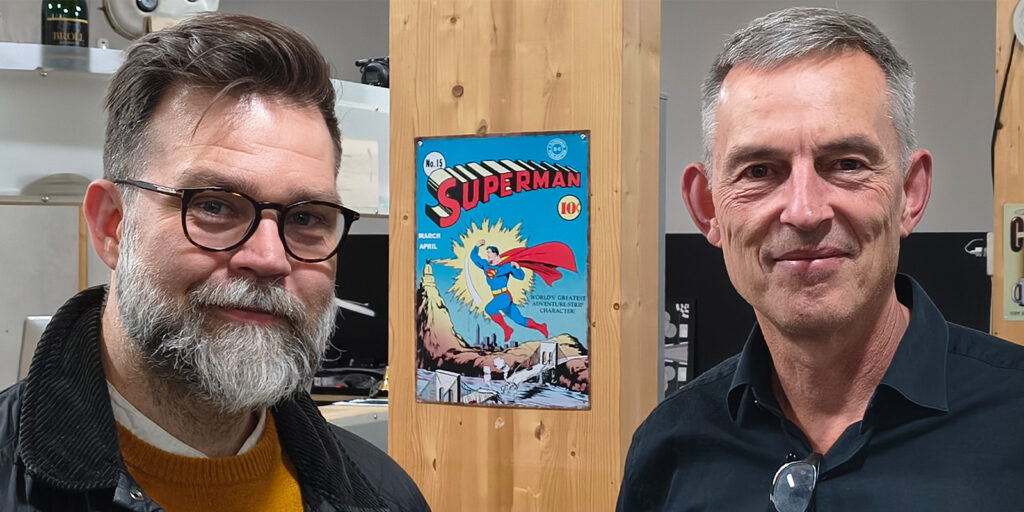
“Krypton”, you may ask yourself, noticing a familiar ring to the name… No, in this context, Krypton does not mean Superman’s home planet. Krypton Film AS is a very large Norwegian rental house which was founded in 2004 by three Norwegian cinematographers, Theodor Kristensen, Marius Johansen Hansen and Jørn Broll FNF, and the company is located in a vast industrial building where all sorts of manufacturing and repairs – ranging from railroad cars to what-have-you – have been taking place in the past.
Along with Storyline, Krypton is one of the two largest rental houses in the Norwegian movie industry. The lean and challenging nature of the past three years for most of us in the business has also taken its toll on these two, but Storyline Studios, a descendant from the once mighty Norwegian state-controlled movie company Norsk Film AS, seems to be the one most impacted from the situation as they’ve had to move into smaller premises these days.
For this special occasion, Krypton’s giant studio hall has been divided into four rooms by means of large curtains of black cloth. In the entrance area, where we all initially hang out chatting merrily, there is a south sea island-style bamboo bar and a reception area, and in the next room there’s a sofa so you can sit and have a quiet chat. The third room has a lot of behind-the-scenes photos from various film sets, and then finally a very large auditorium has been created with a giant virtual production wall from Xvision/Hilux used as the screen. One of the advantages of this is that you’re not locked into how to present footage, the way you would be on a regular film screen, rather here you can show dozens of images all over the wall or just a small one in the lower right corner if you prefer that. As the world is full of unsung heroes, the young man responsible for flawlessly putting all that imagery on the VP wall deserves a shout-out: Arne Nedrebø Hadland, an employee at Krypton in the camera department since 2018.
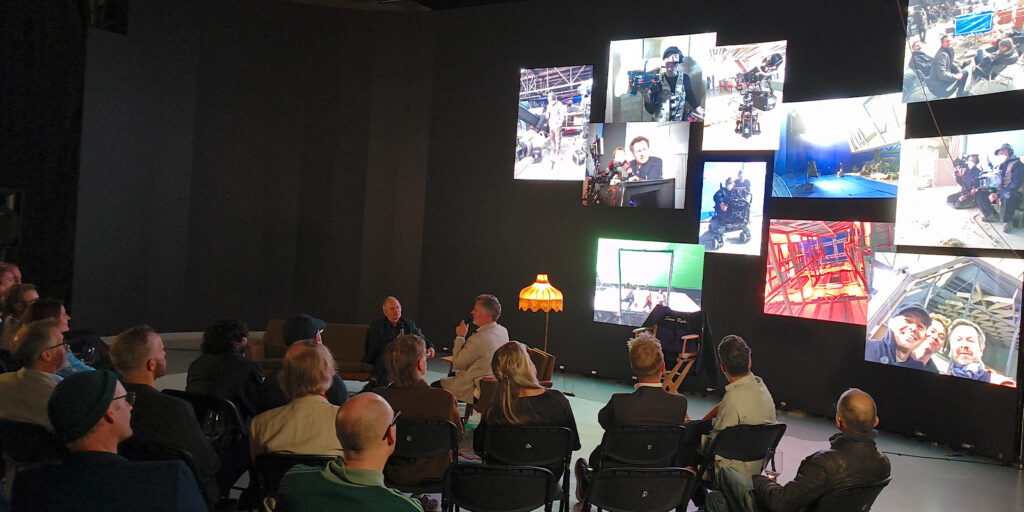
A cinematographers’ society as ambitious as the FNF needs to have sponsors, and actually I was hoping to meet Steve Calavitis here at the party, since Camera Nordic is a major sponsor to both the Norwegian and Swedish societies, but unfortunately Steve had to go see his family in Greece and so couldn’t be here. Three of FNF’s sponsors are present: Foto.no, Nanlux and Kelvin – the latter a pretty unique Norwegian LED manufacturer whose fixtures have a cool, decidedly industrial look. Finally all the guests have arrived and we pass through the cloaked spaces and gather in the large auditorium, where chairs are placed in a semicircle in front of the VP wall. At the foot of the wall there’s a small podium, furnished with two comfortable armchairs, where the interviews will take place.
Two men enter the stage, and one of them, FNF’s young and energetic President Ole Andreas Grøntvedt FNF, greets everyone welcome. He introduces the whole event and expresses praise for the society’s most prominent members present here tonight, notably among them Paul René Roestad FNF, who has been both president of the FNF as well as president of IMAGO, the international society for cinematographers. Roestad has been instrumental in making the FNF famous around the world, not least through the Oslo Digital Cinema Conference which he has arranged every other year since 2006.
Ole Andreas Grøntvedt FNF then relates how every major country has a cinematographers’ society. The more than centenarian ASC is the world’s oldest, the BSC was founded in 1949, the FSF in 1961… and in 1995 a handful of Norwegian cameramen felt it was time to start a society of their own. This leads us to the other gentleman on the stage: Pål Bugge Haagenrud FNF was the very first president of the Norwegian society.
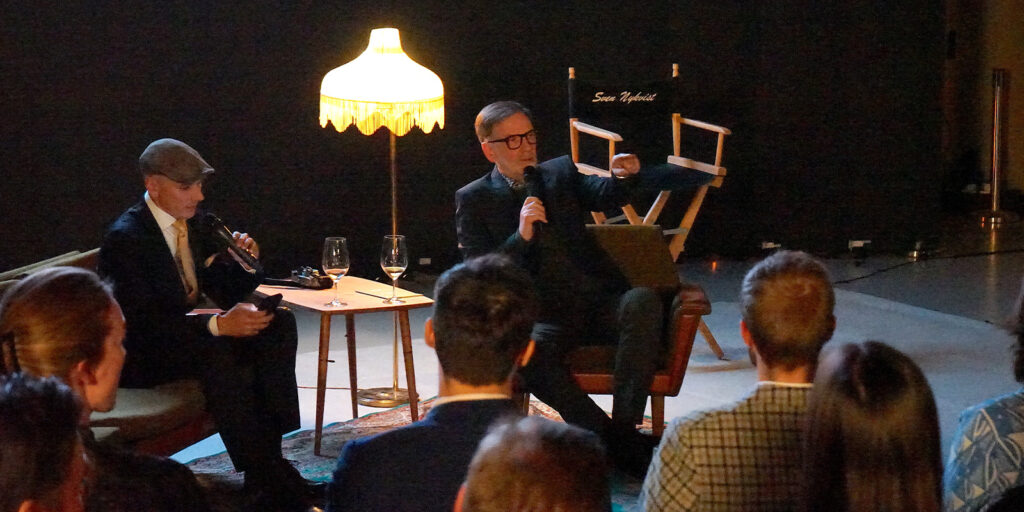
One of Norway’s premier cinematographers, Haagenrud got his education in America and graduated from the AFI, where one of his classmates was Wally Pfister ASC, in 1988. Haagenrud was one of the cinematographers on the Official Olympic Film from Lillehammer in 1994, for which he received an Emmy, and the year after he got another big break when he was assigned to assist Sven Nykvist ASC FSF on the massive epic Kristin Lavransdatter, directed by Liv Ullmann. Haagenrud is also known to a wider audience today for his work on TV series such as Dag (2010 – 2015) and the critically acclaimed Exit. He has also made his mark in comedy with the hilarious Lilyhammer, a series depicting the cultural clash between naive rural Norwegians and an American expatriate mafia hitman!
Through his education and extensive experience in the US as a young man, Haagenrud was in touch with the ASC and felt a similar society should be started in Norway as well. So in 1995 he and freelance DP’s Halvor Næss and Hans Erik Lindbom took the initiative to create a Norwegian society. They invited Helge Semb, Bjørn Tønnesen and Arne Borsheim, from the national broadcasting corporation NRK, who joined the initiative together with 1st ACs Hilde Malme, Charlie Curran and Wencke Hovet. These men and women founded the FNF in the Filmkameratene AS premises on Stortorvet. The Norwegian film industry was fairly small at the time and it was therefore important to get the assistant cameramen involved in order to muster enough members.
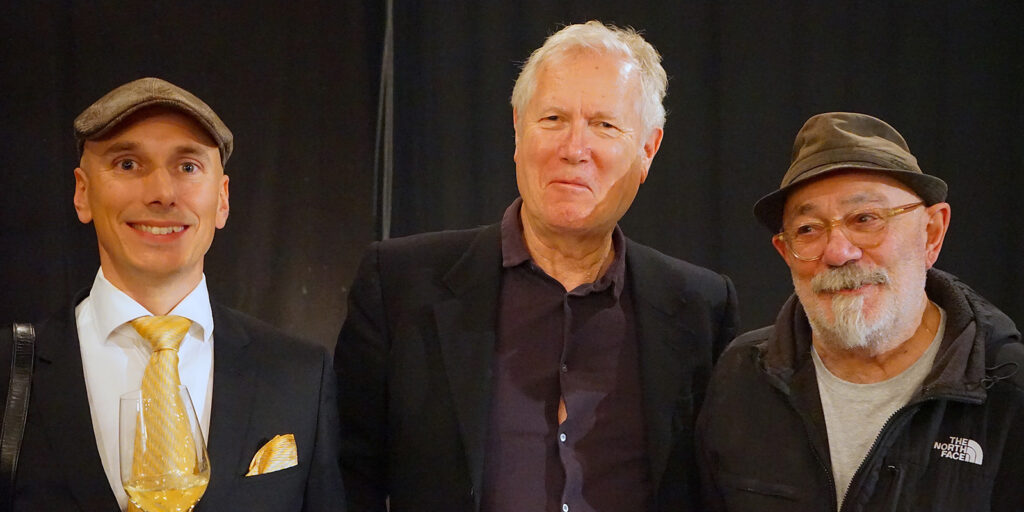
The next speakers on stage are cinematographer Philip Øgaard FNF and director Hans Petter Moland, in a conversation moderated by Pål Bugge Haagenrud. That Philip Øgaard, who has racked up more than 50 feature film and TV-drama credits as a DP during the past 45 years, is currently in production on a feature film tells one a lot about the stature of this man, since in an industry facing headwinds, there are only a small handful of feature films in production in Norway at the moment. And the month of October must also definitely be considered off-season for feature film work. Øgaard and Moland are famous for their collaboration on the features In Order of Disappearance (2014) and its 2019 US remake Cold Pursuit, starring Liam Neeson. Øgaard has also successfully tried his hand on lighter material with the HBO series Beforeigners, which is a sci fi fantasy comedy series which chronicles hilarious cultural clashes between modern society and time-traveling Vikings, with their barbarian tastes and practices! Hans Petter Moland praises the dedication of his friend, observing that “Philip works for the story, he isn’t collecting shots for his showreel”.
Initially, I remarked that the FNF anniversary celebrations were entertaining and thought-provoking. Well, they evoked those feelings, and with the next two guests on stage there was the occasional belly-laugh thrown in for good measure as well! Another one of Norway’s heavyweight and most prolific cinematographers, John Christian Rosenlund FNF, is joined on stage by a former colleague who has now transitioned to working as a Director, John Andreas Andersen. And these two guys really know how to work a room. Like most of their peers on stage this evening, they both started out by making super eight movies. The original 1977 Star Wars movie came out when these guys were young and Jon Christian and his friends built a large model of the ice planet Hoth in his basement and shot it on super 8.
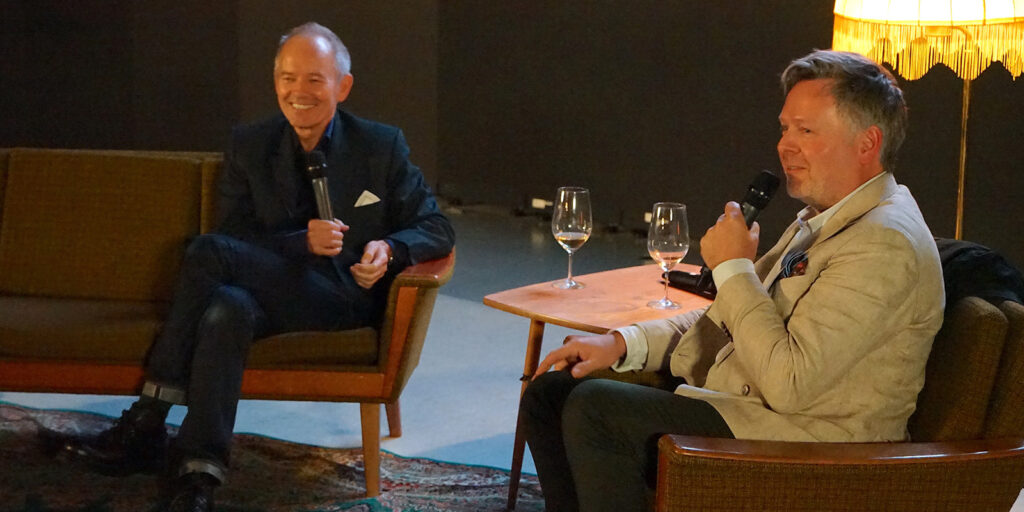
Like Pål Bugge Haagenrud, Jon Andreas also worked on the Olympic Games film in Lillehammer back in 1994. A year or so down the line, Andersen was still bouncing around in the movie industry, and accidentally happened to meet “this Sven Nykvist guy” (not knowing who he was). Andersen was wearing his official Lillehammer crew jacket and Nykvist, affable as always, remarked ”what a nice jacket”, to which the young Jon Andreas – noticing that Nykvist was also wearing a nice jacket – replied “wanna trade?” And so it happened that John Andreas Andersen became the proud owner of Sven Nykvist’s team jacket from What’s Eating Gilbert Grape (1993). A garment he would now probably not mind being buried with.
Andersen eventually figured out who Nykvist was, and like many of his contemporaries here this evening, John Andreas also wound up working on Kristin Lavransdatter in 1995. When the crew arrived at the nearly thousand year old Nidaros cathedral in Trondheim, Nykvist pulled up a chair and sat solitarily in the middle of the cathedral, taking it in. John Andreas slowly approached him with great deference, curious as to how The Great Master would decide to approach the monumental task of lighting this giant church. And then, when he got close enough, he could hear Nykvist mutter to himself “How the heck am I gonna light this!?!” But of course, the experience of having shot – by that time – well over 120 feature films paid off, and Nykvist soon put everybody to work to light the cathedral beautifully. Every single light fixture and scrap of cable, which the production and gaffer Knut Haraldsen had brought to the location, was used.
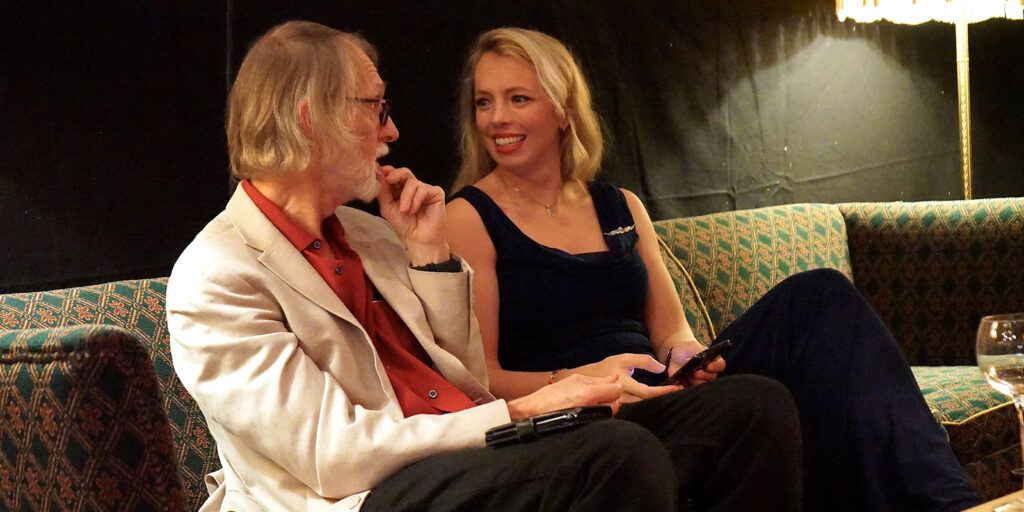
The final guests to enter the stage give the impression of being a charmingly Odd Couple, since at first glance Norway’s first astronaut – and indeed the very first cinematographer of any nationality in space! – Jannicke Mikkelsen FNF doesn’t seem to have a whole lot in common with veteran large format specialist, director and animator Morten Skallerud FNF. But we are about to find out that there are more links connecting them than first meets the eye. Morten Skallerud’s career dates back to the 1970s and he has produced very impressive and memorable Large Format short subjects shot on 65mm film, both in the 15 perf IMAX format as well as the 5 perf Super Panavision 70 format.
In his animation catalogue, we find really state-of-the-art Wallace & Gromit-style stop motion work, complete with rack focus and dolly moves. His credits include three Flåklypa films, In the Forest of Huckybucky and the combined animation film When the Robbers Came to Cardamom Town, released in 2022. One of the Flåklypa children’s films, fittingly, takes its characters out on a space flight, and additionally, a few of Skallerud’s other documentary titles deal with the Northern Lights… Which leads us to the world’s first cinematographer in space, Jannicke Mikkelsen FNF, since one of the objectives of her space flight was scientific research on the Northern Lights as these can in fact disturb satellites in their operation. So why send a cinematographer to space when there are plenty of satellites to do the job? Well, turns out it makes perfect sense because satellites don’t take direction particularly well… “Oh, could you pan slightly to the left there?” Nope, by then the satellite is on its merry way someplace else in orbit around the Earth.
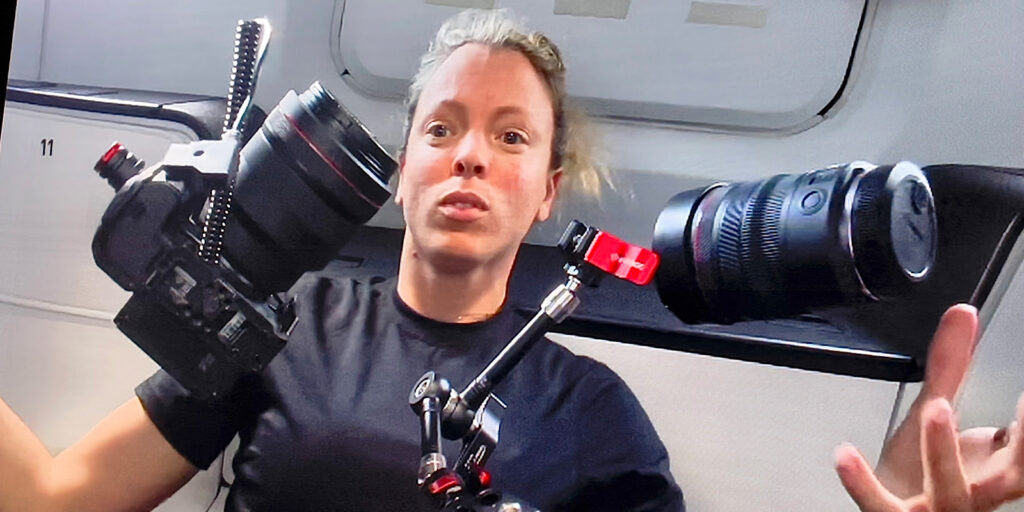
But a brief introduction of Jannicke is in place before we go any further. What she has accomplished so far in her career makes you suspect she is secretly one of the DC superheroes – Wonder Woman, perhaps? She wanted to be an astronaut right from the start and actually – as a child – called NASA up to enroll for space missions(!). A graduate from the National Film School in Great Britain, she has worked for Sir David Attenborough on a nature documentary, and then being interested in astronomy and 3D imaging, she studied both 3D imagery and astronomy for this UK scientist who asked her if she could make a video of his band? She was happy to do that, not knowing that doctor Brian May’s band was Queen… She pulled off the concert movie brilliantly and a few years later she circumnavigated the world in a jet plane, crossing both the north and the south pole, managing to set a number of world records in terms of traveling certain distances faster than ever before.
Jannicke’s space flight, christened ’Fram 2’ in reference to the Nansen-Amundsen ship used to explore the arctics more than a century ago, was the first mission pole to pole, since normally space travel follows the equator in order to capitalise on earth’s rotation. Space flight 90° to the equator is much more difficult. Jannicke has lived a long time on Svalbard, the world’s northernmost populated islands, knows the geography by heart, and therefore was the ideal candidate for this. Cameras and lenses worth a fortune were tested and ruined prior to the mission since they needed to be extremely resilient. For instance, cosmic radiation will fry memory cards and sensors. Once Jannicke had used a card she put it in a small lead bag and hid it in the middle of all luggage, to shield it from radiation, which will mess up all sorts of things, including your cell phone.
Space travel is of course “a hard act to follow” – and chronologically the film clips shown weren’t presented in the way I relate them here, but I must take a moment to mention a film, which is very difficult not to be affected by. Because so far this evening we’ve had fascinating, funny and entertaining. With Morten Skallerud’s A Year Along the Abandoned Road (1991) we can add downright moving to the list of emotional experiences. This is an incredibly ambitious time lapse film shot in 65mm, depicting the passing of an entire year in the abandoned picturesque Norwegian fishing village of Børfjord. We see the snow melt away and the foliage slowly coming to life as winter passes into spring, we see the water levels rising and ebbing away with the tidal gravity. People appear and disappear, occupying just a few frames. It becomes a meditation on life itself, our brief moments in time that we are alloted and must make our best of…
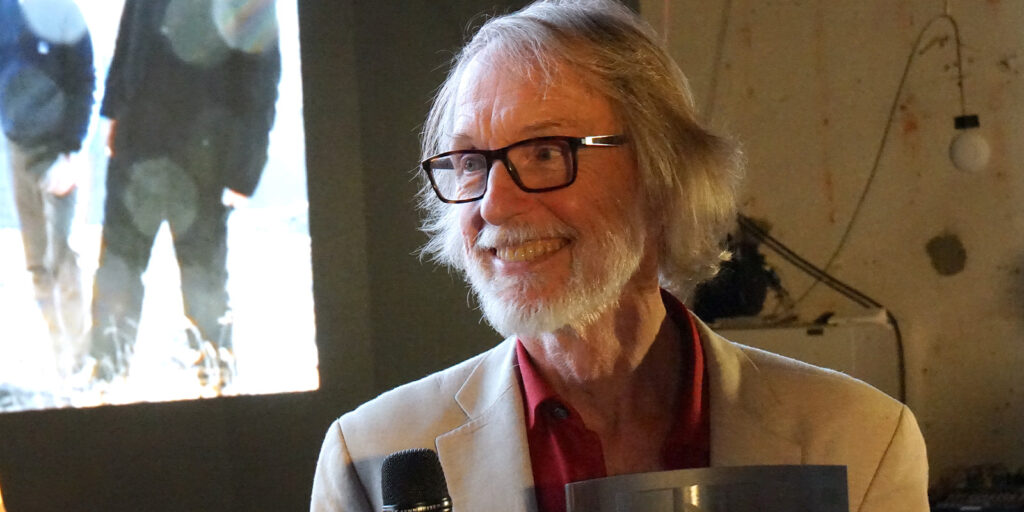
As the last presentation on stage draws to a close, the whole thing is rounded out by FNF president Ole Andreas Grøntvedt awarding Morten Skallerud Honorary Membership in the Society and presenting him with FNF’s Honorary Award for his Outstanding Contributions to Norwegian cinematography. His peers speak warmly about Morten Skallerud’s personal qualities, being knowledgeable, humble, gentle and generous, and he receives warm and prolonged ovations when he accepts it. As it happens, we learn from Ole Andreas, it was the last prize, and new ones now have to be manufactured.
Tables are now brought to the auditorium and the chairs rearranged so that dinner can be served, and the aforementioned south sea island bamboo stand by the entrance magically turns into a drink-all-you-can-hold free bar, and with each visit there I feel my understanding of the Norwegian language improves dramatically. We all share a truly wonderful gastronomic experience and there’s a great opportunity here for those just starting out to mingle and converse with the seasoned pros who are generous with their time in this respect.
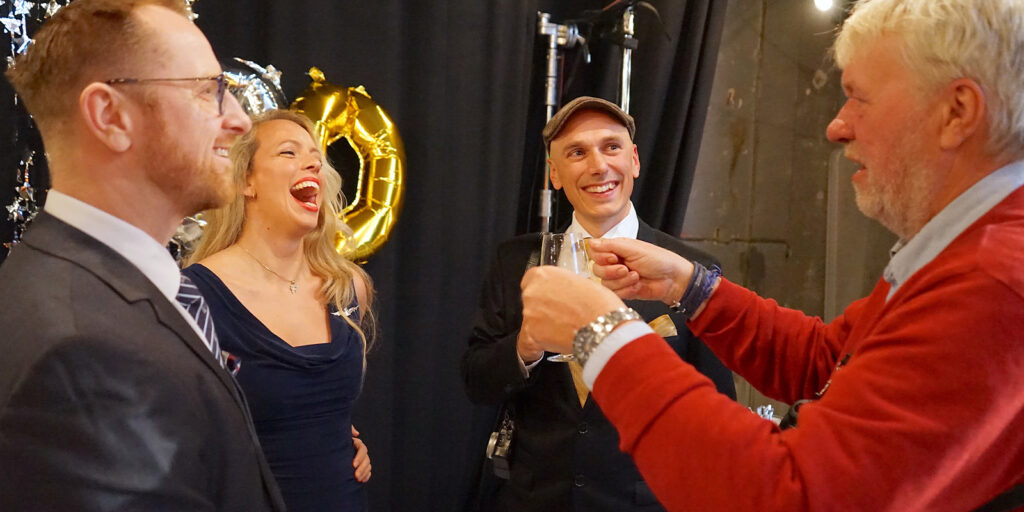
The party is really amping up and the festivities here are bound to last until the wee hours in the morning, but as I don’t really know my way around town I’ve been invited to tag along with one of the locals who happens to be leaving and is heading in the same direction where I’m told my hotel is. So I bid a hasty farewell to both my newfound and my old friends and continue out in the cool Oslo evening, which offers a jet-black sky making the beautiful glittering cityscape look spectacularly photogenic. And we’re off on a little night-time stroll around the magnificent Norwegian capital.