
SUBJECTIVE CINEMATOGRAPHY
Bella Gonzales explains why The Twisted Tale of Amanda Knox required a visual approach grounded in empathy and restraint, with every choice designed to honour perspective as something shaped by experience rather than certainty.
As a cinematographer, I am drawn to projects that demand a use of visual subjectivity—where character perspective directly informs camera language. The Twisted Tale of Amanda Knox presented that challenge immediately. The scripts were structured around multiple, often conflicting, perspectives, exploring how lived experience, bias, and emotional state shape perception. Because the series is based on real events and real people, the responsibility was not only narrative accuracy but visual integrity: how to render perspective without judgment, and how to allow the audience to inhabit each character’s internal reality.
Early creative conversations centred on a clear guiding principle: whose perspective are we in, and how should that perspective influence the physical behavior of the camera, lensing, and light? Every visual decision—movement, proximity, focal length, and colour—was driven by character rather than coverage. The show’s visual language was designed to reflect the writing itself: slightly off-kilter and cerebral. Within that structure, I focused on maintaining intention while allowing controlled imperfections within the frame—small visual disruptions that subtly echoed each character’s inner state.
Interior worlds and emotional proximity
Colin Watkinson ASC BSC, director Michael Uppendahl, and showrunner K.J. Steinberg established an initial visual reference point in Amélie, a film that Amanda Knox frequently escaped into. After all, it was the film she was watching the night of the murder. Its expressive camera movement, subjective lensing, and heightened colour became an entry point into Amanda’s interior world and informed our approach to curiosity, intimacy, and emotional proximity across the series.
The camera package consisted of the Sony Venice 2 paired with Zeiss Supremes, augmented by a custom behind-the-lens blue net with a centre cut. This introduced a subtle vignetting and gentle colour shift, softening the frame edges and reinforcing a subjective, character-forward image. The effect encouraged the audience to remain locked to the subject, allowing the periphery of the frame to fall away—an aesthetic foundation that carried through the series.
Within that framework, the 29mm became the primary lens of the show. It offered just enough distortion to introduce a sense of visual quirk while still rendering faces with intimacy and emotional clarity. We were often working within only a few feet—or inches—of the actors, and that proximity became central to the visual language. For our block, the 50mm functioned as our longest lens. The language of the show was less about compression and more about presence, with lens choice dictated almost entirely by emotional proximity to the subject.
Depth of field played an equally critical role. We frequently worked between T2.2 and T2.8, allowing for significant falloff that further isolated the characters from their surroundings. Wider stops were reserved for moments of psychological rupture—when the experience felt destabilising or out-of-body—while stopping down slightly allowed the environment to press back in, reinforcing moments where the world felt inescapable.
One narrative, two perspectives
I worked closely with director Natalia Leite on episodes 105, “Mr. Nobody”, and 106, “Colpevole”, which present the same narrative timeline through two opposing perspectives: Raffaele Sollecito and Amanda Knox. This structural device became a technical and emotional challenge—how to depict identical events using entirely different visual language. Our approach required designing distinct camera behaviours, lighting strategies, and movement philosophies for each character, allowing the same spaces and moments to feel fundamentally different depending on whose story we were inside.
For Raffaele, that perspective was rooted in his idea of manhood and self-mythology. While Amanda retreated into Amélie, Raffaele escaped into anime, shaping a worldview influenced by early abandonment and a self-imposed role as protector. His coerced confession and refusal to distance himself from Amanda were emotionally tied to that identity, reinforcing his need to remain present even as events spiraled beyond his control.
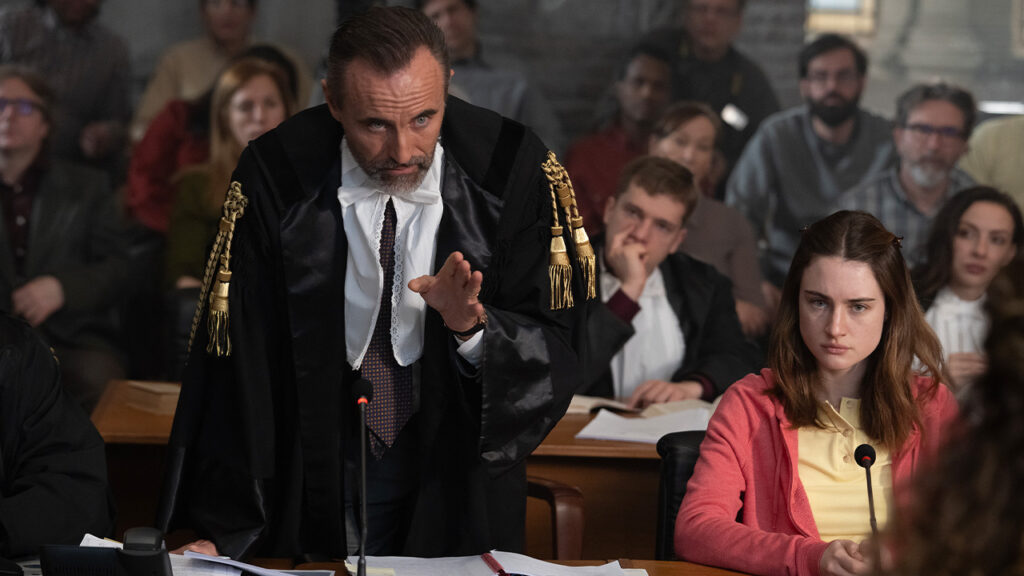
These ideas directly informed our approach to “Mr. Nobody”. Raffaele was treated visually as peripheral to his own trial—listed as a +1—an afterthought within the system. Lighting leaned into heightened colour saturation, continuous camera movement, and punctuated lensing. In the courtroom, we often shot from his perspective, remaining locked on Amanda, mirroring both the press’s fixation and his own inability to look away. Handheld was used sparingly; instead, Raffaele was framed with deliberate intention, akin to panels in a manga—an orbiting camera and composed, tableau-like images punctuating his presence within the space.
Amanda was consistently looked down upon—by the court, prosecutors, and public—and that judgment informed our camera language. Her youth and sexuality were weaponised through cultural and confirmation bias, and we chose to reflect that scrutiny visually. The camera often occupies elevated vantage points, looking down on Amanda, maintaining a balance between emotional access and imposed shame. Wide lenses held close to the subject reinforced confinement, particularly as she distances herself from her family.
Visual evolution
As Amanda’s will to fight returns, the visual language evolves. The camera gains energy and agency: deliberate movement gives way to kinetic motion. A 360-degree circular track around Amanda and her stepfather marks this shift—the world continues to move, but now she moves within it with purpose. Handheld becomes an expression of defiance, while dolly movement accelerates and sharpens, mirroring the renewed momentum of time and hope within the prison.
I collaborated closely with camera operator Armando Avallone to refine this language through tight eyelines, wide lenses, and close proximity. While scenes were carefully designed in prep, we treated blocking as a flexible framework rather than a fixed plan. The camera carried a restless, floating quality—responding intuitively to performance rather than predetermined movement. Armando’s willingness to drift from initial intention allowed us to remain responsive to Giuseppe De Domenico and Grace Van Patten’s performances, capturing moments that felt immediate and emotionally charged.
Emotional truth always took precedence over choreography. By establishing clear visual intent early, we were able to loosen our grip in the moment, allowing performances to lead and trusting the camera team to follow instinctively. That balance—structure paired with responsiveness—became essential to the work, creating a rhythm that felt less like execution and more like a quiet, ongoing dance between actor, operator, and camera.
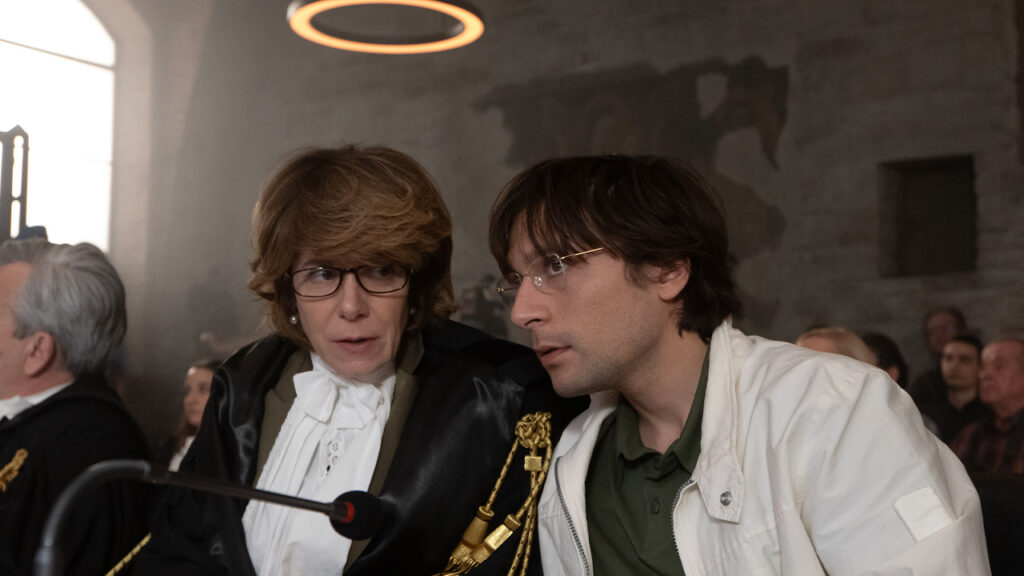
The guilty verdict, shared between the end of “Mr. Nobody” and the beginning of “Colpevole”, became a pivotal visual point. For Raffaele, we set up the moment as an intense Technocrane push into a direct to camera close-up—his last breath as a free man—followed by a Dutched roll axis to fracture his sense of balance. As he exits the courtroom pulled by Steadicam, attention remains fixed on Amanda, reinforcing his diminishing agency.
The following episode shifts entirely into Amanda’s perspective, demanding a radically different approach. We wanted the audience locked to Amanda’s experience—unable to escape her physical and emotional journey. With our grips led by key grip Krisztian Demeter, we designed a custom Snorricam-style rig attaching the camera directly to Grace Van Patten. Extensive testing by placing the rig on myself determined the precise lensing and distance needed to balance environmental awareness with psychological confinement.
Using the Rialto system, the camera body was reduced to its smallest possible form and tethered via umbilical to a backpack worn by the key grip, allowing Grace full freedom of performance. This shift in perspective—from observational to embodied—became one of the most effective visual strategies employed across my episodes.
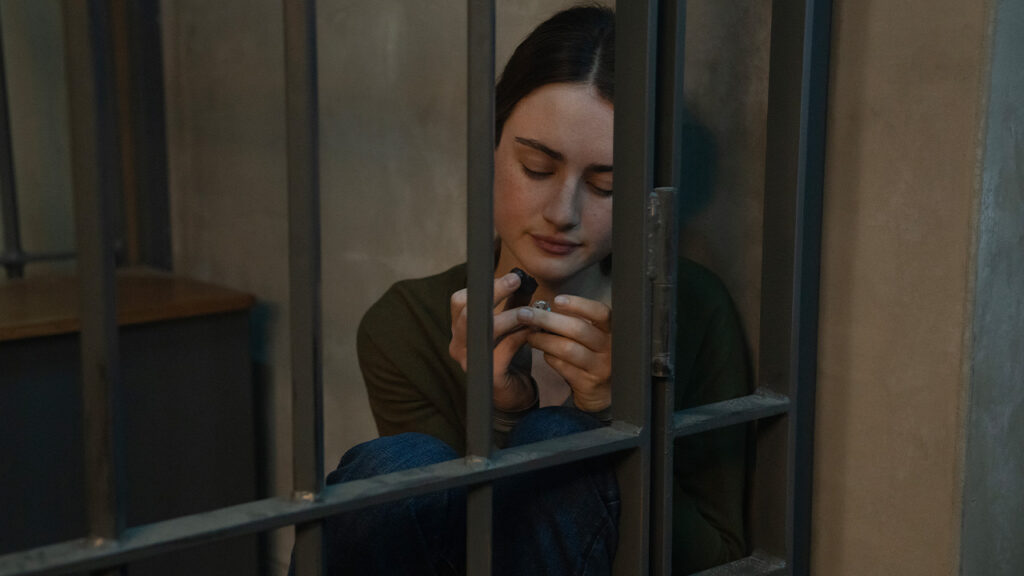
This was not the only custom rig built to explore Amanda’s interior world. Later in “Colpevole”, Amanda imagines her existence in prison and contemplates taking her own life. Natalia wanted this moment to feel suspended—clearly psychological rather than literal—so we designed a floating visual language. Two rigs were built: one dolly-mounted bar that allowed Grace to bear weight while dragging her feet, echoing her earlier removal from the courtroom, and a second forward-mounted dolly that enabled her to sit and glide ghost-like through the prison hallway. An integrated slider allowed us to push into her as the environment closed in. The sequence concludes with heightened, stylised POVs, emphasising the moment’s dissociative, imagined quality.
The importance of colour
Colour functioned as an emotional barometer throughout the series, allowed to degrade, rupture, and occasionally resurface as perspective shifted. The show begins in a warmer, Amélie-influenced palette—an orange-leaning softness that reflects Amanda’s initial sense of curiosity and romanticism. By the time my episodes begin, that warmth has largely evaporated. We are immediately dropped into the cool, dingy atmosphere of the interrogation room, where colour drains from the frame as certainty, comfort, and agency begin to erode.
Warmth was used sparingly and with intention. It returns briefly in flashbacks of Amanda and Raffaele together in his apartment on the night of the murder—moments that exist outside the machinery of accusation and are rooted instead in intimacy and perceived safety. The most deliberate reintroduction of warmth occurs during the guilty verdict. That moment felt singular, irreversible, and operatic. I approached it with the sensibility of a Caravaggio painting—high contrast, sculptural light, and a gathering of bodies collectively bearing witness. Hundreds of eyes fixed on two young people at the exact instant their lives fracture. Visually, it needed to feel distinct from every other courtroom scene, because narratively, this is the moment when everything shifts forever.
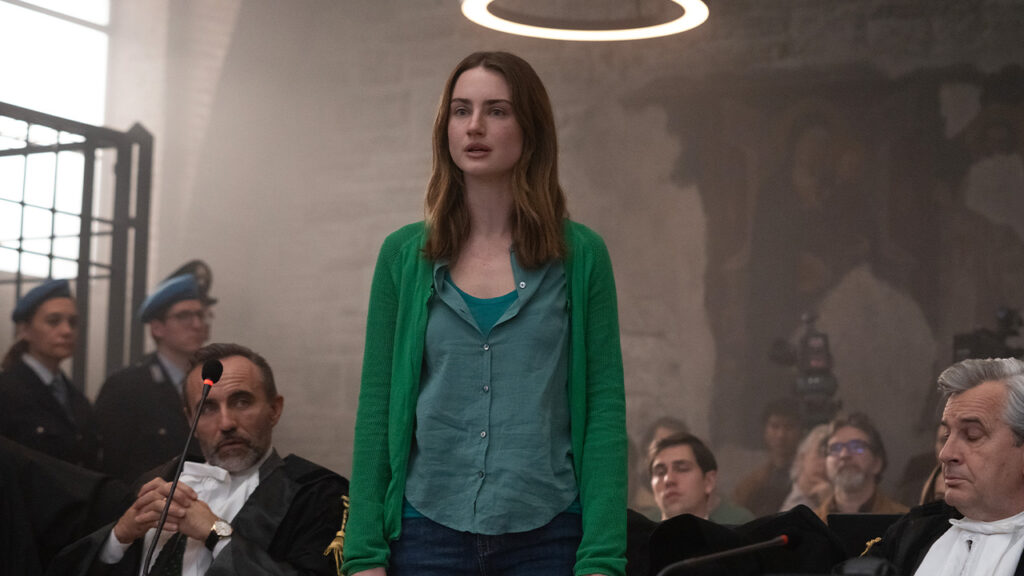
Lighting throughout the series was required to serve both expressive and logistical demands—shaping mood and perspective while allowing constant camera movement within an aggressive schedule. I was fortunate to collaborate with Gromek László Molnár, whose work on Poor Things became a touchstone for our approach. That film’s embrace of ultra-wide lenses and broad, flexible lighting informed our strategy, particularly for the courtroom work. Colin and Gromek constructed the courtroom ceilings as controlled softboxes, mounted on chain motors that allowed individual adjustment for precision and speed.
The courtroom storyline spanned 11 months of narrative time, and it was essential that the audience feel that duration. To achieve this, each window was equipped with multiple sources—Mole Beams, Maxi Brutes, Vortexes, and SkyPanel 360s—allowing us to continuously shift light quality and time of day. Visual diversity within the lighting was of major importance to me as I wanted to be able to track the journey of the characters over the progression of time. With over 50 pages shot in that environment, block shooting became necessary, requiring meticulous continuity notes and reference stills to maintain visual coherence amid constant lighting transitions.
Something I talk about a lot with directors, mostly in initial meetings, is how constraints lead to creative approaches. How do we simply tell the story in an effective way that also allows us to have the time to give the actors and Natalia the space needed for the rest of the work? A voice-over sequence of Amanda reflecting on the passage of time was originally conceived as a complex motion-control shot tracking changes in wardrobe and physical deterioration. As time became the limiting factor, I proposed a simpler approach: beginning tight on Amanda’s eyes while we altered lighting states around her, then pulling out to suggest the accumulation of time. The result conveyed the same emotional weight with greater efficiency, reinforcing my belief that restraint can often sharpen storytelling.
Ultimately, The Twisted Tale of Amanda Knox required a visual approach grounded in empathy and restraint. Every choice was designed to honour perspective as something shaped by experience rather than certainty.