

Veteran cinematographer, director and producer R. Michael Givens reflects on classical lighting in the age of virtual production.
For the first time in my career, I walked into a location — and the light said nothing. For a cinematographer, that is a strange moment. Normally the room speaks immediately. Surfaces reveal where illumination will fall, shadows suggest where they belong, and the frame begins to assemble itself almost before the crew has unloaded the truck.
At the time, I had already spent years lighting films and commercials across North America and Europe, and I had grown accustomed to understanding a location within moments of stepping into it.
It was a tech scout in Toronto — a bar interior built for a commercial campaign. For years, I had prided myself on walking into a space and seeing it almost immediately: key here, negative fill there, a controlled edge to separate subject from background. Five minutes and the frame would resolve itself. Light would present its logic.
That day, it did not.
The director — a longtime collaborator and friend — watched me expectantly. “You always know right away.” I didn’t.
On shoot day, still searching, I stepped through a doorway into an adjacent room. Nearly identical in proportion. Similar architectural lines. But in that room, the image arrived. I could see how light would rake across the walls, where shadow would gather, how the frame would settle into balance.
The building’s owner confirmed what I sensed. The first room had been newly constructed. The second was centuries old.
That explained it.
Age changes how surfaces receive light. Old timber absorbs differently than new lumber. Limestone carries shadow differently than drywall. History changes reflectance, texture, and density. You can measure it in the way light rests.
Over time, I have learned that before placing a light, you must let the room speak.
I first felt this years earlier, standing in a stone farmhouse in the French countryside — three centuries old, occupied by the same family since its construction. At the hearth, the weight of time was unmistakable. Not as sentiment, but as density. The walls carried something of the lives that had passed through them — laughter, grief, endurance — and light settled into those surfaces differently.
Later, while preparing a film in a château outside of Paris, I saw it again. The aged wood and stone did not simply reflect illumination — they held it. The structure seemed to speak in many voices, but all carried the same quiet human story.
When you encounter that, you don’t impose light. You listen for it.
Not mysticism. Observation.
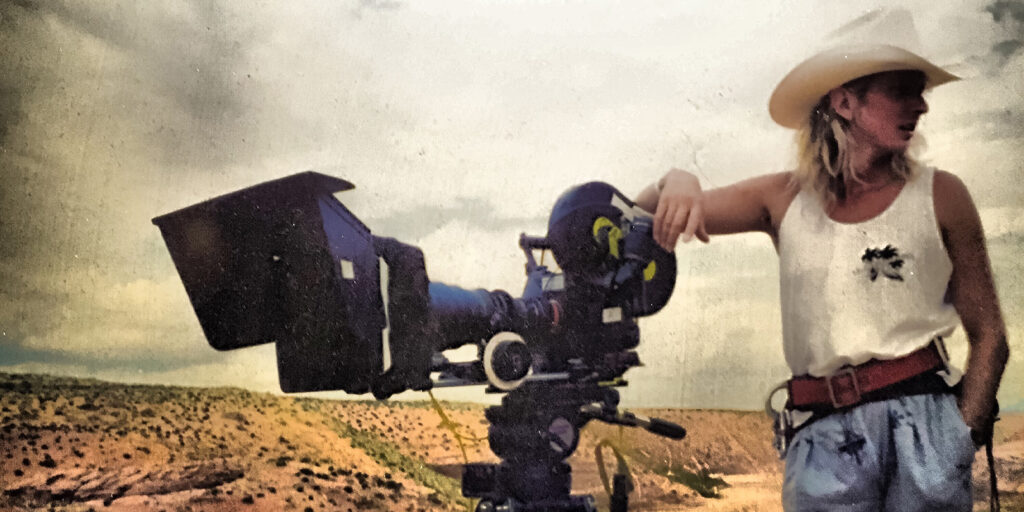
I came of age shooting millions of feet of 35mm film. Exposure was not a menu setting. It was chemistry, influenced by temperature, emulsion, filtration, and the quiet variables that separate precision from accident. There were no monitors to reassure us. There was a light meter, my eye, and the knowledge that by the time dailies screened, there should be no surprises. If something drifted, I usually knew where it had crept in. Discipline removes mystery.
I have received the call from a lab informing me that exposed negative had been forced through an X-ray machine after an unexpected security decision. The returned film carried diagonal radiation bands — blue streaks cutting through the emulsion like swords, stabbing through it with a violence that felt almost theatrical. Not a gentle fog. An incision.
Film does not forgive inattention.
We tested lenses before the first day. We guarded our stock. We kept scenes on the same batch number because subtle emulsion variations could fracture continuity. We sat with timing technicians at midnight discussing printer-light values — three columns of numbers that would determine whether tomorrow’s screening held together or fell apart.
None of this made the past superior. It made it disciplined.
Cinematography has always required the mind of a scientist and the instincts of an artist — precision guided by intuition. Exposure is measurable. Emotion is not. The craft lies in aligning the two before the first take.
Lighting was never decoration. It was narrative.
An actor’s face in shadow is not an aesthetic decision unless you understand what that shadow communicates. If the audience cannot see the subtle contraction at the edge of the eye that shifts a character’s trajectory, then the lighting has failed its obligation. Light does not flatter performance. It enables it.
Today we work in extraordinary conditions. We can previsualise entire environments before stepping on set. We can adjust skies in real time on LED volumes. We can extend landscapes and architecture with AI‑assisted tools that would have required armies of artists only a decade ago.
But tools do not replace judgment. Technology expands possibility. It does not create intention.
The danger is not innovation. The danger is speed without understanding.
We can summon history with pixels. But if we do not understand how age alters surface, how contrast guides emotion, how shadow reveals character, we will generate images without gravity.
The storm we face is not technological. It is attentional.
Long before I stepped onto a film set, I stood in front of paintings and studied how light directed the eye. When you understand that, you light accordingly.
The future of cinematography will not be secured by brighter panels, faster processors, or more sophisticated software. It will belong to those who remember that light is not equipment. It is storytelling.
Light is still language — and always has been.