

As we mark Wales Climate Week, it’s time to recognise how Welsh creativity is shaping a greener future for the sector through research and development.
While the global spotlight often falls on LA or London, collaborative media innovations are quietly taking shape around the capital of Cardiff, making Wales a prototype for a greener screen industry.
Most people outside of the industry are unaware of the screen sector’s sizeable carbon footprint. Unlike aviation or heavy industry, it leaves no visible trail across the sky, yet an average hour of filming generates as much carbon pollution as a flight from London to New York. An average day’s filming can produce as much as most people do in an entire year.
Film and TV production can be messy. Location shoots are often powered by diesel generators, cast and crew travel in fossil-fuelled vehicles. Then add waste from one-off sets, costumes and props, it soon piles up. Hidden from view, data storage for media is energy intensive, relying on power-hungry servers running 24/7.
Our news media have also struggled to convey the urgency of the climate crisis. Despite more than three decades of scientific warnings, media coverage has rarely matched the scale or immediacy of the challenge. As a result, public understanding is superficial at best and actions taken are tokenistic or misplaced. Without a sense of urgency, the public and political will to act remains weak.
While most media companies want to be greener, they lack the time and resources to follow through with this desire. But the tide is turning. BAFTA albert’s Screen New Deal has used Wales as the UK prototype for green innovation, outlining practical steps for the screen industry to cut emissions. Media Cymru – a £50m creative innovation programme – partnered on the Screen New Deal: Transformation Plan for Wales, adopting it as a frameworkwhich provides a technical route map for stakeholders in Wales to transform the film and high-end television (HETV) industry to a zero-carbon, zero-waste sector.
Media Cymru is working to make Wales, the home of the pioneering Well-being of Future Generations Act, a globally recognised model for low-carbon media. Our aim is to use innovation to make sustainable choices more accessible, affordable and commercially viable, proving that greener production can also be good business.
This means developing innovations across the board – in infrastructure, practices, technology and training. We need to demonstrate that it is possible to move away from increasingly power-hungry technologies, wasteful one-off production and built-in obsolescence.
From developing greener power sources to creating a cohort of sustainability co-ordinators across multiple productions, Welsh researchers and producers are working together to make Wales an exemplar for the future of climate-smart creativity.
Greening screen production
In collaboration with partners including Ffilm Cymru Wales and BBC Cymru Wales, Media Cymru has supported more than 30 innovation projects designed to reduce the media sector’s environmental impact.
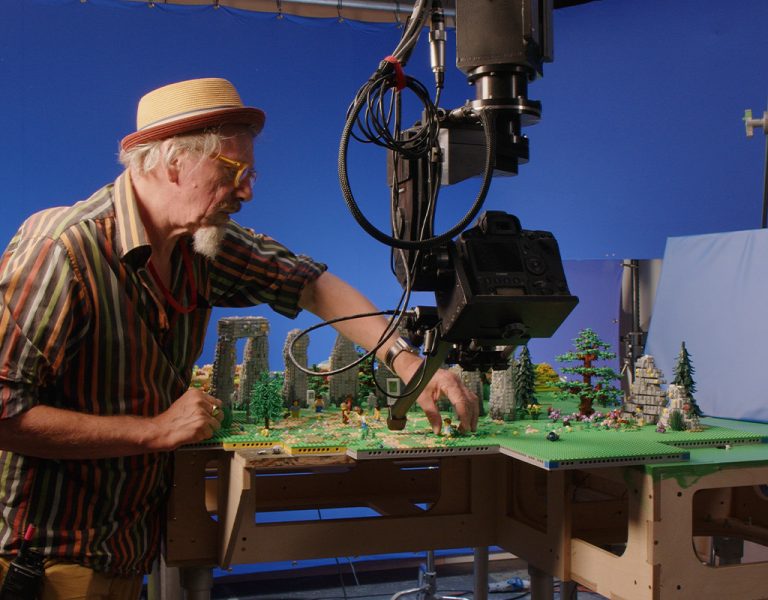
One example is Rusty Design, which is developing large-scale 3D printing using sustainable, reusable materials for props and sets, cutting waste and carbon at every stage of production.
Here, Rusty talk about their R&D journey leading to their latest Future Proof Props project:
Meanwhile, On Par Productions and fivefold Studios are pioneering the use of virtual production powered by green energy, reducing the need for carbon-heavy location filming. Although virtual production can be energy intensive, when powered sustainably it significantly lowers overall emissions.
At this year’s Urdd Gobaith Cymru Eisteddfod, Welsh TV company Afanti showcased Afango, its net-zero initiative for broadcaster S4C. Using Welsh green hydrogen, advanced battery systems, mobile EV charging, and responsibly sourced biofuels, one of their largest on-location productions was powered entirely by renewable energy.
Wolf Studios – home to Doctor Who and His Dark Materials – has introduced new systems to cut and recycle water, reducing site consumption by 23% (1.1 million litres) between 2023 and 2025.
Knowledge and coordination are key to sustainable change. After a successful pilot on Severn Screen’s Havoc (Netflix), Media Cymru funded training for a new cohort of sustainability coordinators, delivered by the University of South Wales. The first six coordinators, supported by Welsh Government, are now embedding green practices across multiple productions.
Greening content
The climate crisis is not just a technical or industrial challenge; we also need to look at a communications problem. Since the first UN Intergovernmental Panel on Climate Change (IPCC) report in 1990, the science has been clear: we must cut fossil fuel pollution or face dire consequences. But, 35 years and dozens of reports later, emissions are higher than ever.
Global heating remains an existential threat, but public – and political – concern lags way behind the science. While topics like immigration or terrorism dominate headlines, climate change struggles to engage audiences emotionally. The old ways of telling this story simply aren’t working.
That’s why Media Cymru is supporting new storytelling approaches. Working with BBC Cymru Wales and Ffilm Cymru Wales, we’ve backed ten filmmakers to research and develop R&D that delivers fresh ways to connect audiences with climate change. Through comedy, drama, documentary and immersive formats, they’re telling new stories about climate in ways that resonate emotionally and scientifically.
Just as importantly, these productions are themselves being made sustainably, drawing on the green production methods pioneered across Wales.
This week, led by colleagues at Ffilm Cymru Wales some of these green initiatives came together for a Greening the Screen event to showcase of innovation and best practice designed to share learning and inspire collaboration across the sector.
Wales already leads the world in recycling. Wales Climate Week reminds us that tackling the climate crisis requires every sector to act. The screen industries are proving that change can be both imaginative and practical. By aligning creativity with climate action, we aim to make it a global model for sustainable media.