

A HEALING ARTFORM
Filmography highlights so far:
Feature film: Can’t Say Much (dir. Philip James McGoldrick, first phase wrapped)
Short films: KOKO (dir. Sychelle-Kristina Yanda, 2024); Time Won’t Heal (dir. Sychelle-Kristina Yanda, 2023)
Documentary: Girl in the Corner (dir. Sabrina Hunte, 2025)
Music video: Invisible Scars (dir. Cormac Hyde-Corrin, 2025)
When did you discover you wanted to be a cinematographer, and what inspired you to follow this career path?
Channeling the civilian world through cinematography has been essential for me mentally and physically after leaving the Navy. It is a story about being authentic and being yourself again.
I don’t think I was seeing reality the same way others did when transitioning. The hardest part was the loss of identity. No more weapons to service, but the noise never stopped. I couldn’t sleep. Sharp whistles, rushing footsteps, invisible generals shouting orders—these things stayed with me.
Even on a Zoom call with my tutor, I feared tear gas. I’d brace myself for parachute drills, terrified I’d be tangled up in a tree. Always waiting for the bad guys to come through the door. No one sees what you see. It felt like I’d buried myself in endless finding missions—always searching for a hidden weapon, unable to switch off, unable to self-medicate when it all spun out.
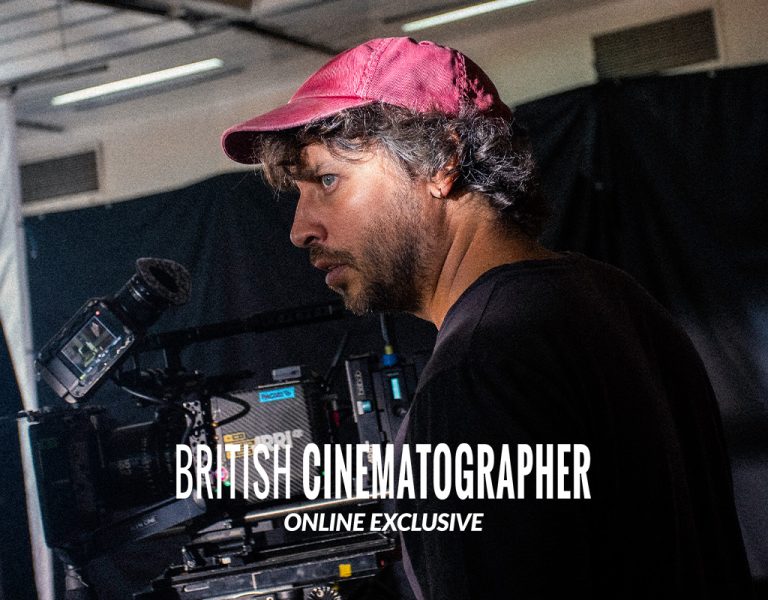
They said I was damaged. But I learned to respond to chaos with rhythm. And when I look through the DP monitor, my world goes quiet. The frame brings order. It’s familiar—like looking through a sniper’s scope.
So yes, putting the world into a piece of cinematography helps me return to something like normal. It’s art therapy disguised as a career.
Where did you learn your craft?
I trained at the NFTS on the Creative Business for Entrepreneurs and Executives course—same one Carthew Neal (producer of Jojo Rabbit) did when it was still called Entrepreneurial Producing.
While there, I spent time observing the cinematography department and realised that their approach—precision under pressure, quick problem-solving, working with a clear chain of command—actually aligned more closely with the training I brought from the military.
I decided to go off the beaten track when I realised that cinematography was sort of a creative outlet for my previous training. I ran sets the way I used to run military operations—as structured, high-stakes environments where adaptability and clarity were key.
I threw myself into every challenge that came my way during this transition, and my learning curve became smoother and smoother as I immersed myself in the music video world.
What are your favourite films, and what makes them stand out?
Martin Scorsese’s Taxi Driver and Jim Jarmusch’s Only Lovers Left Alive are both big influences. I actually colour graded a short film for Jozef Van Wissem, the Cannes Award–winning composer of Only Lovers Left Alive. His minimalist sound inspires me.
I love Tramp by Philip James McGoldrick — not just because I colour graded it. I see myself in Tramp’s journey- fighting to reclaim something that’s been lost. It’s a feature film that resonates deeply with resilience, reinvention, and embracing life’s unexpected challenges, especially when experienced in a cinema setting.We recently had a private screening at Genesis Cinema in East London. Even UFC superstar Michael ‘Venom’ Page turned up to the premiere.
Who in the film world inspires you?
Tristan Chenais is a big inspiration for me. His cinematography in Tramp has a raw elegance that carries so much emotion and grit. I also really love the work of Miles Ridgway who shot the short film ‘Born of violence.’ And when people question my non-traditional path, I often mention Eben Bolter ASC, BSC. “Google what he studied at university,” I say. It usually settles the debate.
What’s the most useful advice you’ve received, and from whom?
It came from my Battalion Commander during a tough exercise before the Seaborne Assault competition as part of the International Army Games in Kaliningrad. He was more than a comrade—he was my spiritual mentor.
Before my first parachute jump, he put me at the front of the queue. My legs were weak from fear and cold. There was no turning back. He told me the cameras were rolling, and the footage would be shown to my parents.
That first jump, from 1200 metres, changed everything. It rewired my brain. I began to understand fear, and what it means to let go.
So now, I live by his words: Be first through the hatch. Let it happen. Once you conquer fear, nothing holds you back.
What advice would you give someone considering becoming a cinematographer?
Start with music videos. They teach you rhythm. Pick your crew and grow together.
When I first came to the UK, during Covid, from a rocky economy where government jobs were the safe path, I was hesitant. I didn’t trust the private sector. I was too reserved when British dancers and singers approached me—and I missed chances.
Ironically, many of the camera crew on my first feature film came from my first music video(Chris Hosker the gaffer for example), which screened at Atlanta Film Festival.
These moments helped me understand both the UK industry and my own biases.
What have been your greatest triumphs and disasters on set?
The gaffer van is my tank. On the way to set, I feel like we’re gearing up for battle. You plan, then execute with rhythm.
On my first music video RUN (directed by Sychelle-Kristina Yanda), I was the only Asian. Everyone else looked different, spoke fast. My English wasn’t confident—I relied on body language. But the set called out my name—‘Jia!’—and it felt incredible. My visuals were understood across cultures.
But I’ve made mistakes. One afternoon, I didn’t double-check the recording format before action. The footage came back Rec.709 instead of ARRI LogC3. When the director found out, it was a disaster. From then on, I made sure the camera was in a place where no one could access it during the lunch break.
What’s been your proudest moment?
It was the moment a rivet from a Hunter’s medal was slammed into my chest — no ceremony, just raw recognition. I shouted “Hunter fighting!” through the pain. That was my version of a BAFTA Breakthrough. For a soldier, it meant everything.
What’s the worst knock-back you ever had?
Accepting that I have PTSD. Accepting that I need therapy. Letting go of the idea that I could power through it alone.
Tell us your hidden talent or party trick.
I’m a node-tree designer and curve artist — I like to push colour grading beyond DaVinci Resolve’s native math, and I’m not afraid to dive into DCTLs to do it.
Also, if you ask my old NFTS cohort, they’ll probably tell you: “Oh yeah, Jia — he’s the Sichuan chef who hosted my birthday party.”
What lights your fire outside of work?
The night cops around here know me — I’m the guy out running at 2 or 3 a.m., claiming I’m training for a 100-mile ultramarathon. They think it’s paranoia. I call it instinct.
I run so my emotions don’t make choices on my behalf.
In the woods, I ground myself. I raise my BDNF levels, rewire my brain, and make peace with the past. It’s how I’ve learned to accept things that feel unacceptable — like the military rank I fought to earn suddenly meaning very little in civilian life. But out there, in the dark, I can outrun that feeling.
What’s been the biggest challenge in your career, and how did you overcome it?
Veterans don’t like being called victims. I laughed the first time my Steadicam op, Ben Thomas—a fellow former Royal Marine—mentioned PTSD. I’d been calling him at 3 a.m., restless, and he finally said, “You’re not just angry. You’ve got invisible scars.”
Six months later, Dr. Sudipto Das gave me a formal diagnosis. Since then, he’s helped me navigate it—encouraging me to use cinematography as a form of healing.
A month after that, director Philip James McGoldrick—whose Born of Violence won a Shiny Award and was nominated at Cannes Lions—told me, “Jia, let’s make a feature film to explore these feelings.” That meant the world.
In other news, I’m working with Cormac Hyde-Corrin on his music video directorial debut through Chronic Pictures to shed light on PTSD struggles and turn the once terrifying into something to ponder.
Which film would you love to have shot?
Mending the Line is a film that addresses veterans’ issues without being exploitative. It is surprisingly gentle despite opening with a horrific scene of combat. The simple act of standing in a river and waving a stick can have enormous therapeutic value for these ex-Marines, and this is the real power behind Eve Cohen’s cinematography.
Which productions are you most proud to have lensed, and why?
I’m just starting my first feature film, which I can’t say too much about, it’s produced by EMC Productions and we’ve just wrapped on the first phase of filming.
We shot the feature film on Cooke Panchro — with special thanks to Carey Duffy and Genevieve Subbotin for their support.
The triangle between myself, Philip James McGoldrick the director and Carmela Schönenberger the editor has been positive, which even started from brainstorming on my new wave piece before shooting, just like the triangle in the BAFTA-winning Rock, Paper, Scissors.
I got to work with Chinese DOPs I really respect as part of my camera crew — Jiajun Pan and Jessie Jing — both technically sharp and creatively in sync with the vision. We understood each other without needing too many words, which made the process smooth and collaborative.
I was also lucky to have a crew I’ve worked with before and trust — like 1st AD/Line producer Yixuan and Assistant Producer Hanlong Zeng. They’re people who make the job easier just by being on set.
The film is set in Croydon, which is depicted in a completely different light than what’s usually portrayed in the press. Croydon is often associated with crime and urban decay, but I believe it’s time to change that narrative. It’s a thriving hub for emerging artists, and it deserves to be recognized as an exciting, creative space.
What’s the best and worst thing about your job?
Best thing? Working with directors from different cultures, seeing through their eyes, and translating emotions into light. I never leave the battlefield. But now the war is creative.
Worst thing? Phone calls still scare me. They sound like muster whistles, triggering old instincts. Please text instead if possible.
If you weren’t a DP, what job would you be doing now?
Probably a trail runner—disappearing into the wilderness to find new paths beyond GPS. Or a chef, layering flavours like nodes in a colour grade, crafting meals to surprise and delight the people I care about.
How would you describe your approach to cinematography?
Make fiction look like documentary. Keep things real. Those military ‘cautionary tales’ we watched to avoid discipline failures—they trained my eye. That’s my aesthetic, deep down.
What are your aspirations for the future?
To lens more feature films that matter. To find a mentor—maybe someone from the BSC—to guide me through the next ‘firsts’, like my Battalion Commander once did.
What do you think are the industry’s biggest challenges?
One of the biggest challenges is that the UK film industry still relies too heavily on outdated, traditional models that don’t reflect current needs. The process of making a feature film is often about applying to the same institutions, over and over again. But these systems can paralyse younger filmmakers, stopping them from taking risks or pursuing unconventional ideas.
If a project isn’t already polished into a marketable form, it’s often dismissed — even though these institutions are funded by taxpayers and should, in theory, be nurturing diverse and emerging voices, not just rubber-stamping what’s already sellable.
I think we need to open up to more cross-cultural collaboration — trust and creative exchange between countries could really enrich the domestic film scene here in the UK.
I am working with producer Sabrina Hunte of Afro-Chinese heritage to reconnect with her cultural roots through a documentary that chronicles Princess K, a 16-year-old dancer who performed alongside Stormzy at Glastonbury aged 10, experiencing the challenges of transitioning from childhood to womanhood.
And I believe it’s important to support young people, including young men, who may feel overlooked by these institutions. Rather than discarding anyone because of perceived privilege, we should acknowledge the complexities of their experiences and find ways to empower them, particularly in an industry where talent and opportunity can be easily sidelined.