

Director of photography Alex Metcalfe discusses the making of Cielo, a film about a young girl who embarks on a journey across the country to take her mother to ‘heaven’.
BC: Which cameras and lenses did you use and why?
AM: Primary camera RED Gemini 5K. Secondary Camera Black magic 6K pro Drone DJI Air 3. Primary lenses Celere (18mm to 85mm)
Flashbacks – Set of rehoused 1950s Soviet lenses with oval iris (Hand-picked lenses rehoused in Ukraine). Aspect ratio 2.39:1
There is one rental house in Bolivia and when we were prepping there was slated to be another film shooting at the same time as us so hiring locally was not an option. That meant we needed a camera that gave us as much flexibility as possible. The Gemini is as good in bright high-contrast environments as it is in dark night exteriors. It gave us a good selection of higher frame rates and has a small form factor. We brought the Black magic 6K pro along too for the flashback scenes which were all shot on a small gimbal. The initial idea was to shoot each flashback vignette as a one-shot scene so the viewer witnesses the memory in an uncut moment. We could put the RED on a gimbal but it became a much larger beast which I felt would reduce our options and be more stressful for our young lead.
I’ve liked the Celere lenses for some time. Their look is gentle and warm, naturalistic but imperfect. They flare nicely but can be controlled relatively easily and I find the focus drop-off pleasing. For the flashback scenes we wanted something that visually jarred our expectations. Memories are messy and there is often a disconnect between our memory and the real event. We chose to use these 1950’s lenses that were mass produced in Soviet times. I found an excellent lens technician in Ukraine who matched a set of 6 lenses and rehoused them. I asked him to add oval irises to smear the bokeh and create a more ‘unreal’ visual feel. We ended up using the more extreme of these lenses, a MIR20, the helios 44 and Jupiter 85.
BC: Which lighting equipment did you use and why?
AM: The remote nature of the locations we were in meant that a gennie truck was out of the question so everything had to be run off nothing bigger than a 6K portable generator. I had agreed with Alberto that we would aim not to light any exteriors on the understanding that I could work closely with production to pick the correct time of day for each scene. There were no lamps available that we could practically run that would have any effect against the incredible intensity of sun in Bolivia so this approach of using the sun path was really a no-brainer and a huge thanks to production for working so closely with me on scheduling the scenes. Our lighting package consisted of a few LED fixtures (600W and 300W Aputures) and lots of smaller fixtures; traditional 1K, 650W, 300W ARRIs, Dedos. We supplemented these with a couple of fabric soft panels. It was a small package but one which was appropriate for what we were trying to achieve and the size of the interior locations we were in. We then used frames, bounce and mirrors to balance the exteriors.
BC: Can you talk about the experience of filming in Bolivia?
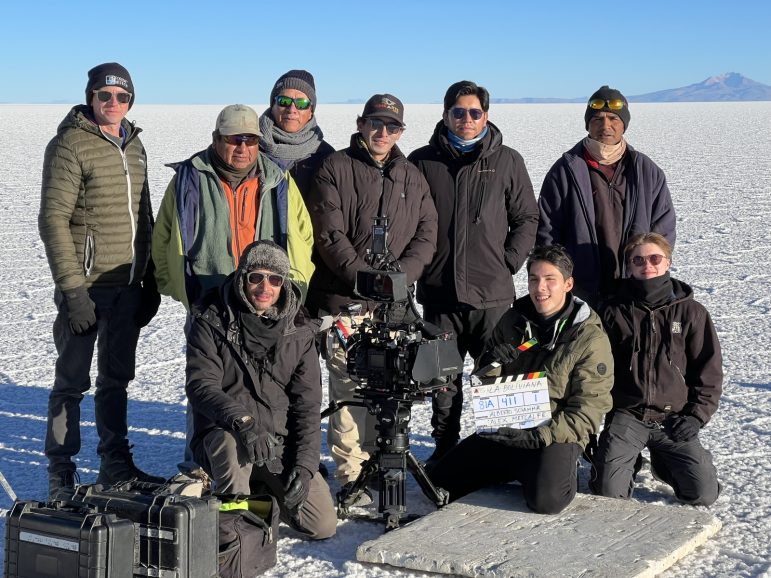
AM: Bolivia is the most amazing country; such a variety of locations and the enormity of the vistas is breathtaking. We shot in the dry season as the skies are pretty much ‘cloud free’ for many weeks at a time. It looks very warm but was far from it. In the mornings and evenings it got increasingly cold very quickly so we were in this bizarre situation of blue skies, piercing sun, woolly hats and thick coats! I think one night it dropped to -16 centigrade. Production base was in La Paz, a vibrant city over 4000m above sea level which meant the air is very thin and made moving at more than a walking speed out of the question as you just can’t get your breath! We had a scene where I was running with Santa holding a gimbal and within 20 seconds I was gasping for air whilst she was happily skipping away!
The light is very ‘clean’ and very bright. Being at such altitude there is little in the way of UV to soften it. I had shot in high contrast environments before and had experienced problems with double reflections on highlights that were in-frame, especially when using heavy ND filters and polarisers. I am an ambassador for the filter company Formatt Hitech and they kindly developed a combined filter for me where ND and polariser were combined into one piece of glass, which was a life saver.
It’s a country that you can’t help being moved by. The people are so friendly, the colours vibrant, the landscapes varied and overpowering. There is a belief in the spirit of the land that runs deep and whilst in this world of beauty that can look surreal to a newcomer it feels natural to open up to this possibility and I hope that the photography for Cielo reflects this emotional response.
BC: Can you talk about how it was to work with director Alberto and the rest of the crew?
AM: I prepped a film with the director Alberto Sciamma a number of years ago which sadly ran into difficulties a week before shooting and so I knew before we started Cielo of the detail level that he likes to work to. We actually started talking about the essence of what Cielo is two years before we started principal photography which was a great time of discovery. This is key to working with Alberto, there was not one moment in the film that he did not understand at a visceral level and for him to relax he needed to know that his HoDs were at the same point. This was absolutely a blessing for me, having discussed every scene, knowing intimately the beat points and character development of each interaction gave us a great freedom when we came to shoot those interactions. Apart from the SFX scenes we did not storyboard but we all had very clear understandings of what each scene had to achieve and so the shots just seemed to surface once we had blocked the action. When, at times, I wasn’t finding the right visual path for a scene Alberto would encourage me to be ‘more Bolivian’ in my approach which meant taking more visual risks, allowing the spirit of the people and country to overthrow my European based technical caution! It was very cathartic to be given this freedom and pictures became more authentic to the story because of it.
All of my camera, lighting and grip crew were local and were outstanding. The film world in Bolivia is a relatively small world and crew members tend to work in different departments on different films which helped give a real sense of family and inter-departmental crossover that I found very refreshing. Whilst all departments and crew excelled on this film a special shout out has to go to my technical head and B camera operator Nicolas Taborga and my head of Camera team Julio Cesar Cruz, both of whom contributed to the look and ran their teams so well that I had no technical distractions to take my focus away from the core story-telling.
BC: What was the biggest challenge and how did you overcome it?
AM: We shot a very complex multi-location story in 30 days so completing the day was always a huge challenge. For more than 20 of those 30 days we had a return journey of between one and two hours travel each way on rutted dangerous roads. It was exhausting and exhilarating in equal measure. Alberto would download all his thoughts and intentions for the day to me on the journey to location so that when we arrived we hit the ground running. I jokingly called him my morning podcast but it became a routine that was enormously helpful. During this time we would also agree a scene that we felt could be shot in a single shot if we were slipping behind schedule, giving us freedom to push times if another scene needed it.
BC: What was the biggest learning curve?
AM: The biggest learn for me was working with an unrelenting sun that always looked the same regardless of the mood you were trying to evoke. It took an enormous amount of planning to schedule for each location so that we were shooting at the time most appropriate for the scene. Alberto felt strongly that we should always be able to see into the cast’s eyes, so allowing a high sun to banish their eyes into shadow was not going to work and we could not bounce directly onto the cast with mirrors as it was such a blinding light. It was often difficult to put frames over them as we had no sources big enough to compensate for the overexposure this caused in the background. We did use mirrors extensively but always to add shape or side-light when the cast were in shade or especially in the bus. The lighting crew also had a supply of small hand mirrors which we used to add bright streaks into the background of a scene. It sometimes became a challenge to take that one big source in the sky and send it in as many directions as possible! Again a huge thanks goes to production for making this scheduling possible.
BC: Did you have to work differently due to your young lead and if so, how?
AM: Santa, the lead character, is played by a Fernanda Gutierrez Aranda who turned eight years old on set. She is remarkable both as a person and on-screen. It often felt that she wasn’t acting, but feeling every moment that the character of Santa was feeling. The camera, and me as I was operating, were the closest technical thing to her whilst she was experiencing this and so creating a very calm and welcoming space on set was imperative. We needed to light and prepare the scene and then be hands-off when she stepped on. On a few occasions she found a scene so emotionally difficult that we waited a couple of hours for her to be able to play the scene, or we knew that she would only be able to perform it once so just needed to create an atmosphere where she felt comfortable enough to make herself vulnerable. Of course when off-set she laughed and played as any young person would but when she was Santa we all had to be respectful of the purity of emotion she expressed and give her the space to allow it to happen.
BC: Which scene or sequence are you most proud of and why?
AM: I don’t really think in scenes or sequences. I think that every project will have a few scenes that you are proud of but what feels more important to me, and so I suppose, what I’m proudest of, is the consistency of the world we made. Of course there are some elements that you enjoy for the solution you found and for me they are normally the simplest. In the hospital and towards the end of the film when Santa is semi-comatose or ‘between worlds’ I made some broken mirrors which combined magnification shaving mirrors with standard mirrors and we filmed Santa’s POV into these mirrors. The effect is disorientating and achieved very elegantly. I also particularly enjoyed the archive lenses with the oval irises for the flashback scenes as it created moments of distinction from present day. It’s a very subtle look but I’m always hopeful that the viewer feels it, even if they don’t consciously see it. Big set pieces are always great fun and technical challenges but they are rarely high points for me as they are logistics rather than emotion.
I wanted the landscapes to be seen the way Santa would have seen them. Full of colour, stimulation and promise. She embarked on this journey having spent her life, up to that point, in poverty and fear. The film charts her journey through a world she has only imagined and the photography needed to reflect a child’s joy in exploring this new vibrant world. When I watch the film now I feel we really were successful in that and so creating a consistent, appropriate and believable world is the core element of photographic success for me.
BC: How did your work on the production inform how you will approach your next project?
AM: As a cinematographer you always bring something from your last project but the essence of how you see will be the same. I have views on framing, colour and camera movement that you would be able to track throughout all my films. A director will choose to work with me as they have seen these constant themes and feel that they will work for them. Working on Cielo has given me more complete knowledge of working with exteriors, it has reminded me that the camera team contribute to an atmosphere on set that the cast feel and that knowing the script is different to knowing the script ‘Alberto style’! Having that depth of knowledge of the script and being involved from such an early point has fundamentally changed the depth that I would like to understand all future scripts.
BC: Is there anything else you would like to add?
AM: The consistency in Cielo is the result of Alberto’s pure vision and his ability to communicate it. He has a real talent in keeping a firm hand on the tiller whilst allowing people to bring their individual slants on those ideas. It was such a blessing to work with him and I very much hope that we will continue our journey together.
Our colourist Emily Russul Saib from On-sight was the perfect partner to grade Cielo with. We had shot to hold all the colours naturally in the Bolivian landscape, always keeping a reference of gemstone colours that Alberto liked. She took the colour pallet that we wanted, added her own presence to it and pushed the look until it became the concentrated form of what we had dreamed of.