

Lars Pettersson FSF runs through the tech, trends and talking points from an eventful BSC Expo.
Whoever came up with the idea of opening this year’s Expo on the ominous date of Friday the 13th certainly had nerves of steel, since superstition runs rampant through cinema history, and is in fact the reason the classic monster movie King Kong from 1933 is 14 reels long. The first edit ran 13 reels, and to release it that way was unthinkable, so either cut down or shoot some more. Filmmakers Ernest B. Schoedsack and Merian C. Cooper knew they had a hit on their hands and so shot the famous scene where King Kong smashes a subway car in New York City.
But if the ominous opening date makes you nervous, you can always try to attend the VIP opening the day before. I can’t say it’s becoming a tradition, because I’ve only done it twice, but starting out “the BSC experience” at the pre-BSC VIP open house at CVP on Great Titchfield Street certainly feels like one in the making. It’s simply a great idea, and since CVP has several showrooms in London and Europe, should you have missed this particular event, or you’re just curious, you can always explore the latest technology and get expert advice by visiting one of them.
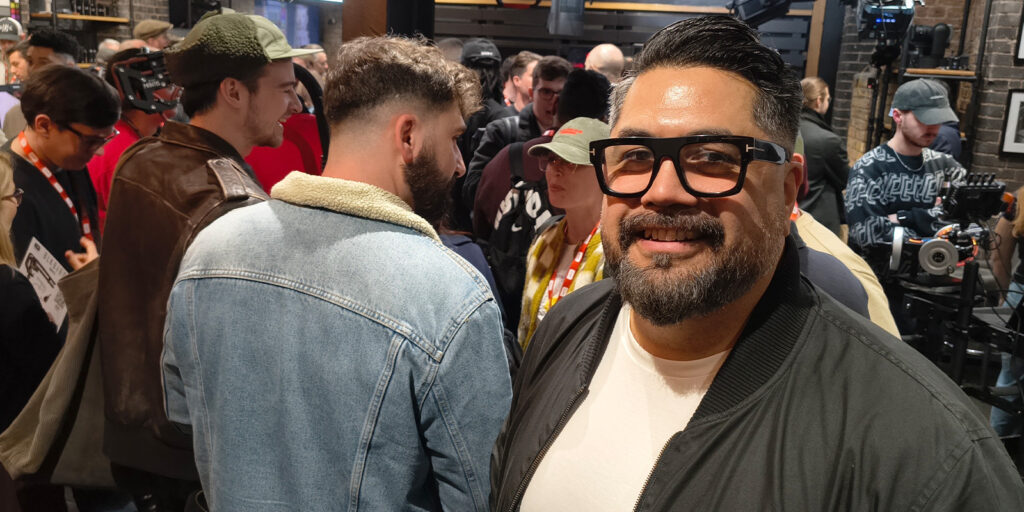
I find the stunning Fitzrovia showroom is brimming with guests and equipment, and bump into Aaron “Bad Boy” George – famous for nearly wrecking the mezzanine floor of the BSC Expo some years ago (though not alone, I hasten to add!). I ask Aaron for a quick update on the situation, and Mark Szeliga, sales director at CVP, also shares his perspective.
The message is ultimately a hopeful one: there is work, and there is demand for equipment – it’s just not always in the places we’ve traditionally expected to find it.
“The BSC Expo provides us with a fantastic platform to reconnect with customers and old friends,” Mark explains, “and enables us to understand how we can best support both new and existing opportunities. Across the three days, we’ll focus on supporting our legacy customer base while also engaging with a new, non-traditional audience, showcasing our technical expertise and value-added services across a wide range of areas. Traditionally, CVP’s core customers have come from production, rental houses, broadcast, film, and television. We understand the challenges facing the traditional cine market and remain committed to strengthening the relationships we’ve built over many years.
“But significant opportunities are also emerging elsewhere. Large corporations that once outsourced content creation are increasingly bringing production in-house, building their own studios to improve quality control and cost efficiency. Many experienced professionals from the traditional industry are moving into this space, bringing deep technical expertise with them – creating new opportunities not only for work, but also for equipment and workflow solutions.”
Is Akira Kurosawa a greater genius than Orson Welles? Is James Cameron’s Aliens better than Ridley Scott’s Alien?
The double-decker bus ride from CVP to the Expo in Battersea Park is not to be missed; one feels a bit like a school kid on a field day trip. Everyone is chatting away merrily and needless to say every conversation is about movies. One gentleman even plays a trumpet he’s brought along to cheer us up. Finally we arrive at the Battersea Pavilion, in a torrential downpour! True to tradition, there’s a forest of trucks, cranes and lighting equipment in front of the Expo entrance, and the lights really get to demonstrate their IP66 certification in the tremendous rain.
At CVP, we already found out there’s hope for our industry, a light at the end of the tunnel, we all just need to be a bit resourceful to make it happen. But what can be said about this year’s BSC Expo? What’s new, what are the trends? Let’s find out!
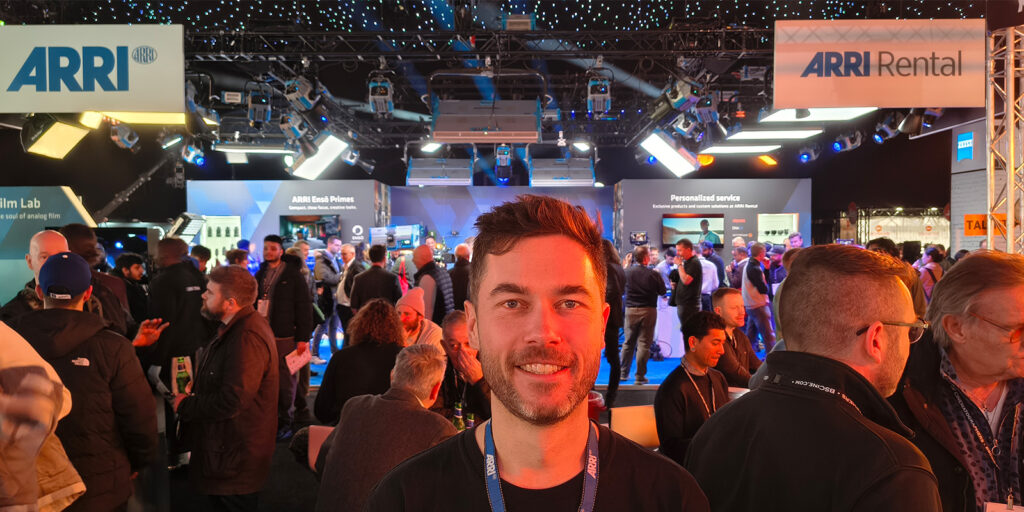
ARRI is back in full force and with a magnificent booth. “We have a big presence at the BSC Expo,” Sean Dooley explains, “because the UK is the biggest shining light at the moment for us. There’s a lot of production here, particularly in the high end, where we really excel and which is what our products are designed for. ARRI Rental here are incredibly busy as well, lots of shows.
“So the focus of our booth now is really the Alexa 35 Extreme and the Ensō lenses, where we offer 14 focal lengths, the widest range of any prime lens, ranging from the 10.5mm T2.8 – really wide, amazing lens that’s now shipping – all the way up to the 250mm, which has a 2x extender dedicated for it.
“And the Alexa 35 Extreme is actually being quite a bit more popular than we expected, and we’re still back ordered for that camera and all of the upgrades for people who would like to turn their Alexa 35 into an Extreme. And at the most recent film festivals, we’re really happy to see the Alexa 35 being now the most dominant camera, especially in TV series, which is definitely what it was aimed for. And interestingly, the 16mm mode, which was used so successfully on the movie The Apprentice, has now turned out to be one of the most popular shooting modes for that camera, which we really did not expect.”
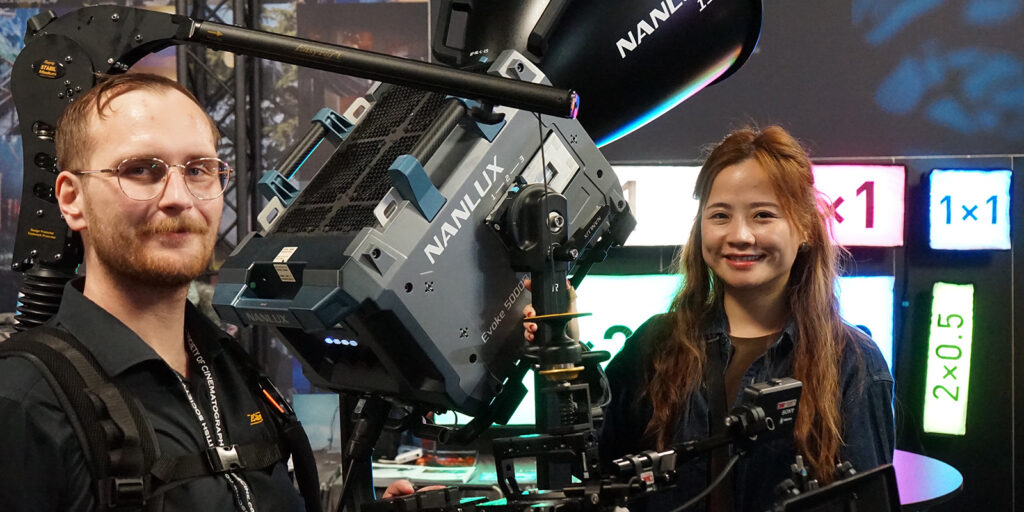
Ever since the Nanlux Evoke 5000B began shipping just under a year ago, this powerhouse of a bi-colour LED spotlight has been very well received and put to good use on a lot of big projects, so Risa Zhu in the Nanlux booth has every reason to be smiling. But when we strike up a conversation, she prefers to highlight the company’s other brand, Nanlite.
The Nanlite PavoSlim series has been around for about three years now, and has made a name for itself as an ultra-thin, lightweight and durable bi-colour panel LED light. Originally launched in a handful of sizes, Nanlite keeps adding to the series, and the latest addition is the Nanlite PavoSlim 4×2. The PavoSlim lights are selling very well and can be seen in the background in the above photo.
And if you’ll remember, last year Easyrig opened up towards a whole new category of customers thanks to the company’s Easyrig Boom Rig for boom operators, and also during 2025, it released the Vario 6 camera support system. Its brand new product, demonstrated here at the Expo, is a support arm called STABIL Medium, which has been specifically developed for the Vario 6 system.
Pontus Jonsson, head of operations at Easyrig AB, is here to present it to us. “So the STABIL Medium is a close relative to the STABIL Light arm, but with some very important upgrades,” Pontus explains. “We’ve added a stronger coil spring and somewhat thicker plates, which means the arm can now stabilise cameras weighing between four up to 14 kilos. We also decided to put the Vario 6 out there at a more competitive price than the Vario 5 because we know right now, in today’s market, not everyone has ready cash, and we want to do everything we can to ensure that as many people as possible can afford the Vario 6. And the four to 14 kilo capacity means that it can easily handle many popular cameras that are already out there.”
If you’ve been in this business long enough, you may remember the old days when being sent out to do some shooting on location could mean you had your camera gear and a kit of three or four tungsten lights. You just put them up and lit a little area for shooting, then carried everything maybe 10 yards to the next spot and lit and shot there.
Well, Astera is pretty much reintroducing this line of thought in a new product: the Astera QuikBeam.
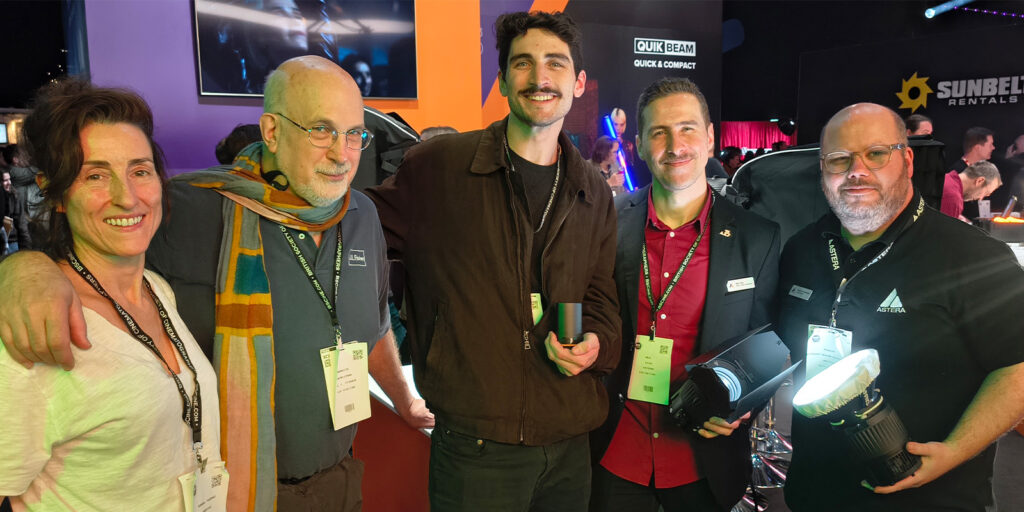
Ben Diaz is here in the Astera booth to tell us all about this exciting new light, and in order to give some background we need to go to the origins of Astera, its DNA. Astera has always catered to the grassroots, so to speak. Say, for instance, a DJ is doing a show somewhere – he has his stereo running on a table and some battery-powered fixtures here and there to create the light show, and doing the whole show himself. Now, Astera has created a small family of spotlights catering to both the event world and the film world.
The QuikSpot and QuikPunch are aimed mainly at event professionals, and now the QuikBeam – while also interesting for event crews due to its compact size and faster rental logistics – is a little bit like that tungsten light kit you had decades ago on location shoots, but with the addition of swappable batteries, inbuilt CRMX, and direct sACN. It comes in three different kits: eight units in a flight case aimed at the event world, and two kits aimed at the film world – the smallest of which is just two units in a backpack. Its big brother is a four-unit kit with versatile accessories. Astera has deliberately kept the price attractive because it wants to reach the independent filmmaking crowd. It also feels a responsibility as a manufacturer to make technology affordable. What’s not to like about that?
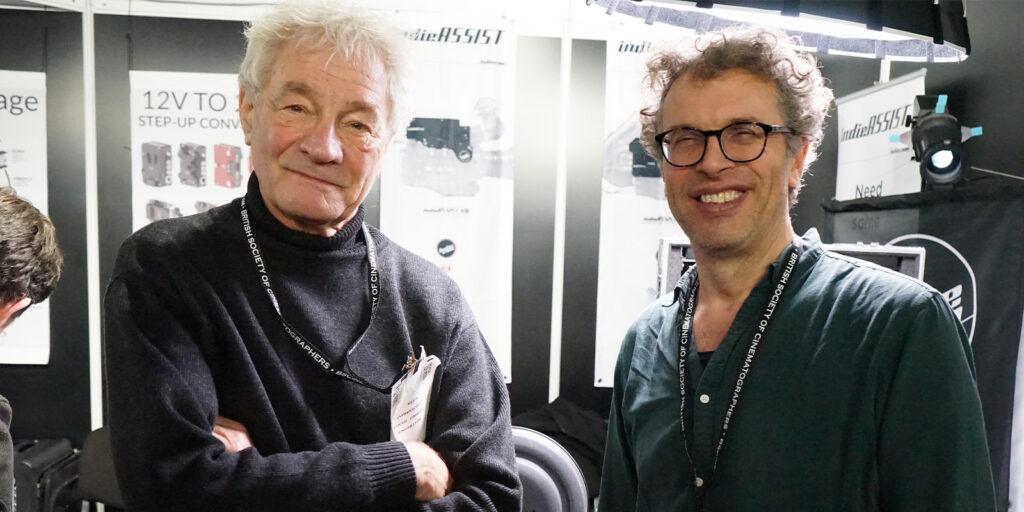
Well, you’ve heard about the French one… Here’s “The Netherlands connection”! Amsterdam-based used cine equipment expert Herman Verschuur has his booth right next to the BSC’s own, and there we meet not only him but also distinguished cinematographer Kees van Oostrum ASC. I ask these gentlemen for a few brief words – and almost end up with “an evening with Kees and Herman”! Anyway, here’s the lowdown!
Herman divides his time between two businesses, as he is one of the premier vendors of used cine equipment in Europe, and he also offers stunning HD video assist equipment for the most popular 35 and 16mm celluloid cameras. I ask Herman if there’s a “refrigerator-angle” to the video assist business? Meaning, with refrigerators, once you’ve sold one to every household, you can’t sell another one until one breaks down. But not so in the cine world. “That won’t happen anytime soon,” Herman laughs, “There’s a healthy demand for more items to be sold.” We also touch upon the used equipment business as a good indicator that the market is picking up. “When people start calling, looking for certain items, that’s usually sort of a pre-warning that things are going up,” Herman agrees, and also hints that there’s somewhat less money in the business recently, but not because of lack of profitability. Rather, there’s a lot of money made with filmmaking, but it doesn’t necessarily go back into the business, it goes elsewhere.
For Kees, the 2020s have started out anything but dull. He accomplished great things as president of the ASC, was then elected president of IMAGO, but had to leave after an all too brief reign because of conflict of interest, since he was offered the position as chairman of Cooke about that time as well!
“I spent five years at Cooke, just finished last year,” Kees smiles, “and it was a lot of fun to experience that end of the industry. My main projects were the Varotal full-frame zoom lenses, the small SP3 Speed Panchro lenses, and I also started the idea for the Panchro 65, which only recently came out. Lead times on creating a lens is like three or four years before you actually have a product on the shelf.”
“Since about eight years back, I also have a company called Optica Magnus, offering a full-frame finder and also expanders for the older zoom lenses, like the Angénieux, so they will cover full frame,” Kees continues. “And the way we design them, you don’t really lose any optical performance. Since I’m no longer with Cooke, as of last year, I can concentrate myself a little bit more on my company now.”
So, what about that connection, you readers may ask yourselves? Well, clearly the customer who buys an extender from Kees may very well want it for a legacy lens he bought from Herman.
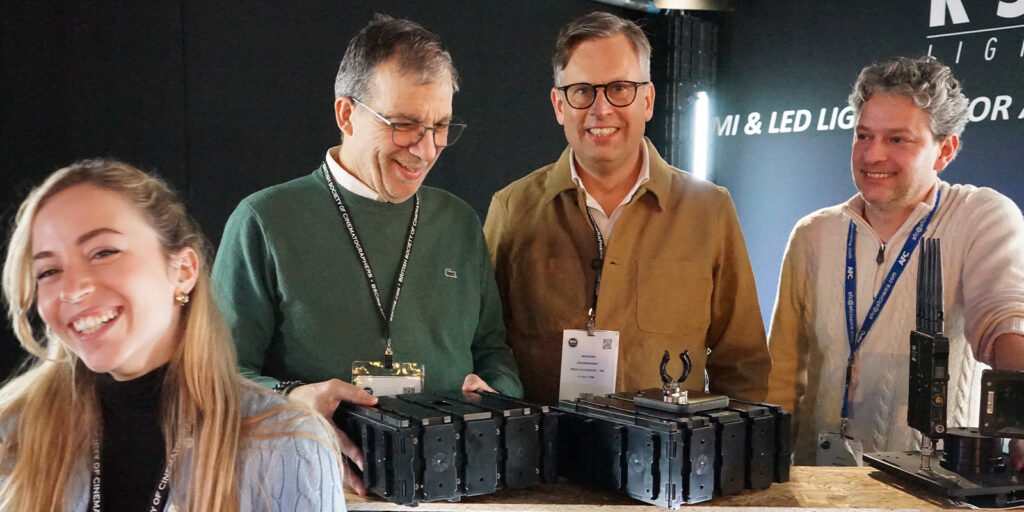
Across the room from Astera along the left-hand wall when you enter the exhibition, we find its friendly competitors and fellow lighting specialists in the One Stop/K5600 booth, a solid French stronghold if ever there was one. And I don’t know about you, dear reader, but when I was a kid, Lego bricks were one of my favorite things in the world, a background I suspect I share with Marc Galerne and his One Stop colleagues. How else could they have come up with this brilliant idea of the C-Box, basically a giant size Lego for grown-ups! Why hasn’t anyone thought of this before? We’re used to having apple boxes, camera risers, makeup tables and so on, and they’re always a particular size and not necessarily the one you want. But with this new invention, you just build what you want to suit your needs for any given situation! Clearly, these guys were “thinking outside the box” when they came up with this!
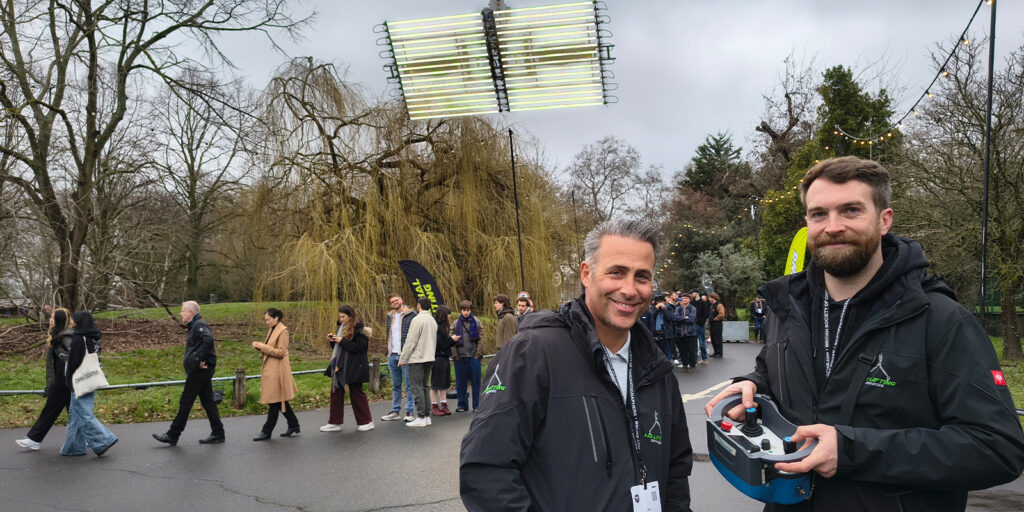
Stepping outside the Expo for a bit of cool evening air, I’m struck by the enormous throng of people waiting in line to get into the Pavilion, and therefore very relieved to already have my visitor’s badge around my neck. I also can’t help but notice the huge lighting fixture hanging above the crowd from a giant telescopic crane, so I have a little chat with Jody Whitmore and Luke Hancock from Lee Lifting Services. Hoisting a grand piano to the 10th floor is literally a piece of cake for these guys!
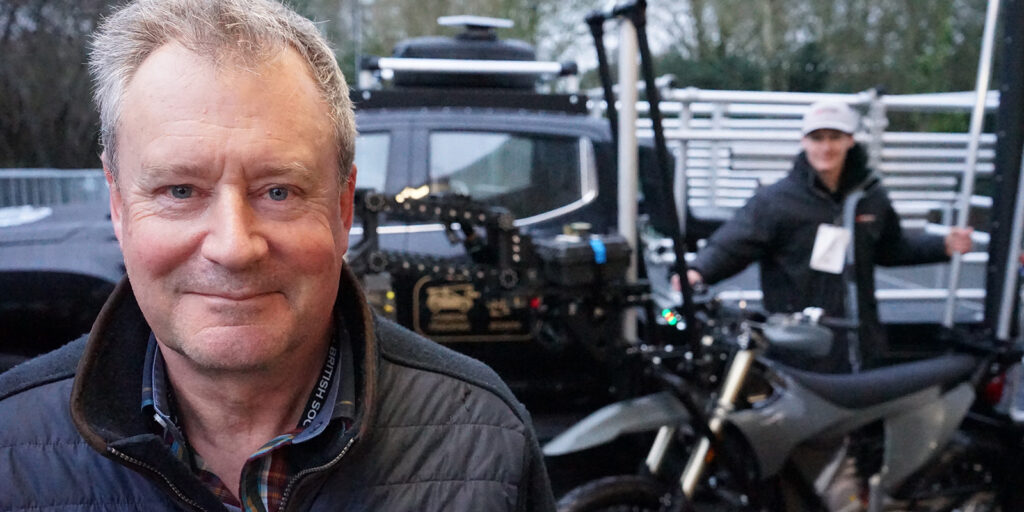
Paul Bickers, who is something of a legend in the industry for his many custom vehicle builds, such as the PanaViper self-ambulating telescopic crane, camera cars, motorcycles etc, has his remarkable vehicles next to the Lee crane. Paul, his family and his associates are actually celebrating the 50th anniversary of their company this year, and they have a number of exciting new vehicles on display here. The family business was founded by Paul’s father Dave Bickers, who was one of the premier stunt drivers of his day and therefore frequently called upon to double for cast members in dangerous situations. Our conversation went something like this.
“So, Paul, could you tell us a bit about the 50th anniversary of your company and also the two amazing new electric vehicles you have here on display?” “Yeah, it’s our 50th anniversary,” Paul smiles, “from when my father started our work and my father was a professional motocross scramble rider in the ‘60s and then he got invited to ride a motorcycle on a movie and that was the start of the company then for him to be a stunt rider. And then he started building equipment and making things to help the industry, and he worked on a lot of the earlier James Bond films. So we were working on both Octopussy and Never Say Never Again at the same time in the early ‘80s, and my father had to be really careful not to mention he was working on either of the two movies, because Never Say Never Again was not really an official Bond movie.”
“But it looked great,” we remember, “shot by Douglas Slocombe BSC OBE, no less. And your company has expanded a lot, I mean, a lot of vehicles?” “We have, yeah, every year we try to build new vehicles,” Paul describes, “I mean, there’s only a certain amount of work for us in our industry, but if there’s a gap, we try to fill it with building new equipment. And we’re going more electric now, we’ve got six electric small tracking vehicles, including one full-size tracking car and two electric motorbikes. They start out as regular motorcycles, then we do the conversion work to make them camera-friendly. Equipment-wise, it’s good because it’s smooth and quiet and good for the environment. The electric truck is a new build for us, so it’s a bit of an experiment, really, but it’s good for doing a lot of horse carriage-type work and when you need silent shots and stuff like that.”
“And being electric,” we chime in, “maybe that could be good for anywhere where exhaust would be a problem, like indoors in a big studio?” “Yeah, perfect for that, yeah,” Paul confirms with a smile, and asks me if I would like a copy of a beautiful biography about Dave Bickers’ life, written by Ian Berry and published in 2023, which I naturally gratefully accept. We shake hands and I head back into the Battersea Evolution building.
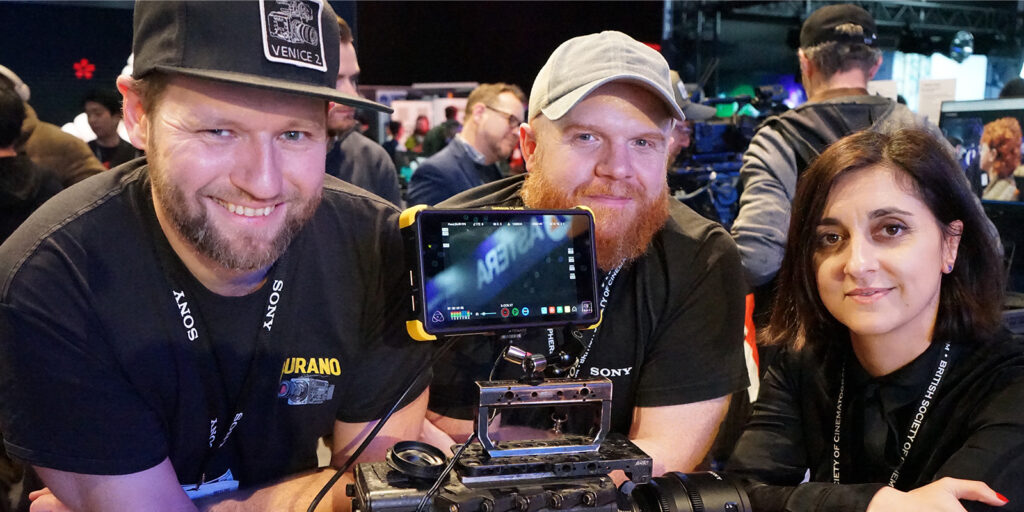
One of the first things to catch my eye is that Sony has what basically looks like a very expensive piece of charcoal, with a lens and a monitor attached to it, on a pedestal in its booth… The backstory is, a camera truck full of equipment caught fire, and this particular camera became very badly burnt. Just out of curiosity, Sony checked out if it was still working, and it turns out it still produces flawless pictures! And so it decided to showcase it at the Expo as testament to the ruggedness of the camera’s design. After all, perhaps for a Sony Venice, this kind of exercise is just a warm-up? (Oh I know, I shouldn’t have…)
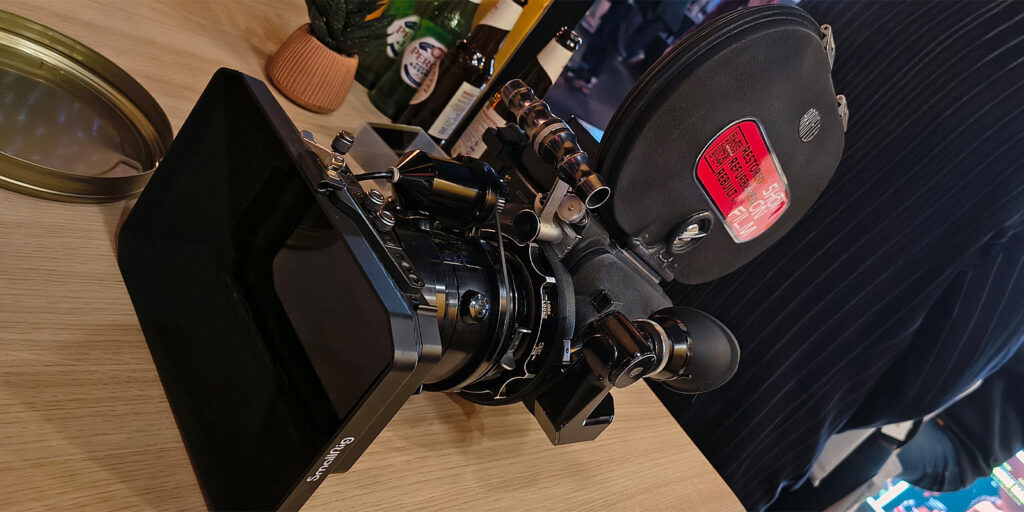
In the Kodak booth, it’s strictly standing-room only, as it is packed with people and wonderful analogue gear. Flanking a beautifully red-painted Photosonics 65mm prism camera, which can handle single frame up to 800fps and both 6-perf and 12.5-perf formats, are Artjon Shahaj and Luca Bonicalza from the company K65K. Having shot extensive tests in collaboration with Kodak, plus a short movie called Jumping to Conclusions, which is on its website, they are now looking for a suitable big production to showcase their amazing camera.
And I don’t know how fireproof traditional motion picture cameras are, but one venerable classic version, which I have personally seen fall flat on a rock surface and still continue to work flawlessly, is the ARRI 16BL. There is an absolutely pristine specimen on display here, and I have a chat with Ross Yeandle from the company Shot on Film, who is an expert on these cameras.
“What we at Shot on Film do is we’re trying to get people to use the older 16mm Arriflex cameras like the BL and the ST,” Ross clarifies, “because they’re beautifully engineered, very, very reliable cameras. We can repair and refurbish them to the point where they are like new. We look at it like renovating a classic car, basically. They do have some electronic circuitry, but it’s much simpler than the later SR range, where the electronics are more complicated and expensive if it goes wrong.
“But the other thing we’ve found is that the casting and the general build quality of, for example the 35C is… well, I would say you can tell it’s an older camera design than the 16mm, which are truly precision instruments featuring amazing, wonderful engineering.
“So we have a small fleet of cameras that we rent out, and when we do, we can come out with a camera for not a lot of money, pricing it so that it’s more the camera hire, and then that way I load the camera and help on set with someone operating the camera. That way if anyone gets any problems, they’re not scratching their heads while everyone’s standing around waiting.”
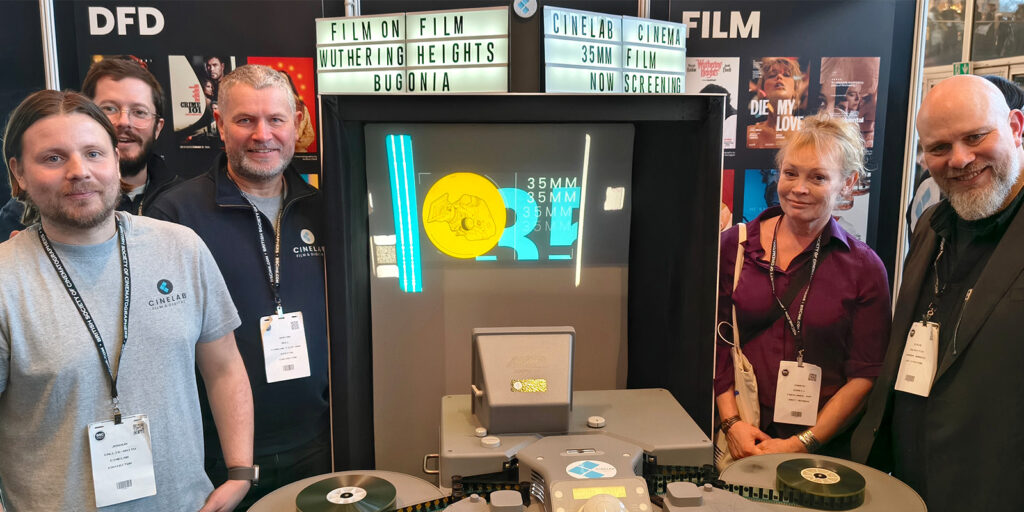
Without a decent film lab, the use of traditional motion picture cameras is obviously somewhat restricted, so the obvious next stop is to check out what’s going on at Cinelab -and who better suited to lay it all out than their CEO Adrian Bull?
“2025 was busy for us,” Adrian leads off, “and this year there’s quite a lot in the pipeline, but winter is usually slow because a lot of productions aren’t shooting. But we’re doing lots of deliverables now, like 35mm prints. The exhibition space is really challenging and independent cinemas are struggling to get audiences into theatres, but there’s been a really good revival of people wanting to see 35mm prints, to the point that even productions shot on digital will sometimes want film prints, using our DFD process. And people will go and seek out these releases, since it’s a different experience.
“So the year starts out with releases like Wuthering Heights, directed by Emerald Fennell, and shot by Linus Sandgren ASC FSF on film, and quite a lot of it in VistaVision as well, and it looks really, really lovely. That gets released now on Valentine’s Day. Another project, Bugonia, with Robbie Ryan BSC ISC and Yorgos Lanthimos, was shot on VistaVision pretty much exclusively. We did Die My Love with Seamus McGarvey ASC BSC ISC and the majority of that film was shot on Ektachrome. Looks very, very distinctive and different, great look to it. And again, created a lot of interest, a lot of people have asked us exactly what was done for that film.”
We find out that another kind of popular deliverable is YCM masters for studios, protection stuff to put in the vault for long-term archival purposes. “Yeah, a YCM is the sort of holy grail for it,” Adrian agrees, “especially if you consider having it on hard drives and migrating it every three years. A YCM can realistically last hundreds of years.”
“Another aspect of film which we’re talking quite a lot to people about now,” he reflects, “is just the unique sort of permanent, immutable nature of film. There’s a very strong reaction to the whole onslaught of AI-generated content, and film is real evidence and proof of the performance. If you capture it on film, that person definitely did this, when you go see that, you’re watching something that really happened, which takes things up on another level. For a long time we’ve had people be passionate about the aesthetic of shooting on film, but I think this aspect of it being real is becoming an important point. Now actually from a creative perspective, this is what protects us as actors and as filmmakers.
“And for the same reason we’re seeing a return to people doing a lot of stuff in camera, since a lot of CGI has aged badly. We’ve just finished Robert Eggers and Jarin Blaschke ASC shooting Werwulf. Shot on film, and again, a lot of stuff in camera. Really, really impressive.”
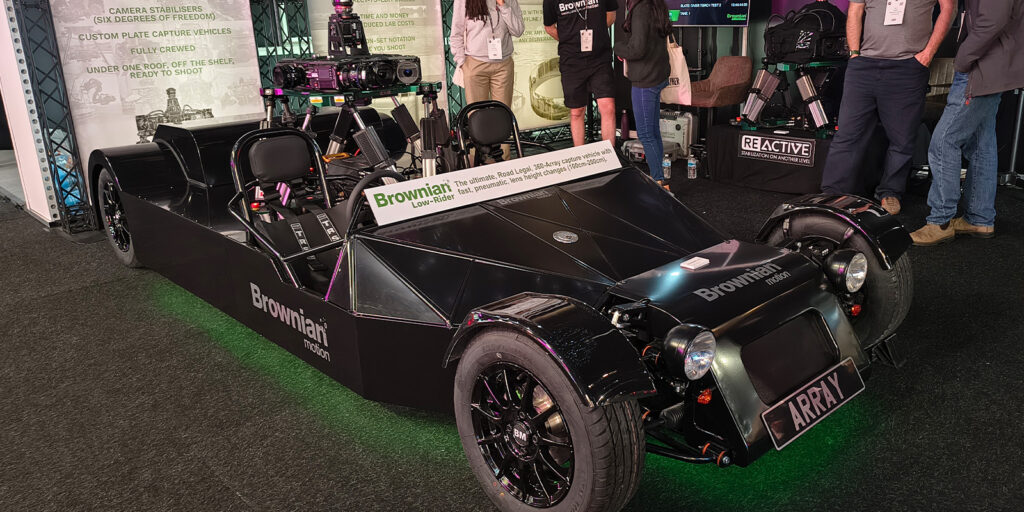
Almost without exception, vehicles used for capturing driving plates are modifications of existing production cars that happen to be suitably low enough for a reasonable lens height. Brownian Motion, the plate specialist with the catchy motto “stitch happens!”, has put a radical new twist on this situation by introducing the Brownian Lowrider, an ultra-low custom-built plate-catcher vehicle. Company representative Jonte Beswick is here to give us the details.
“So, the Brownian Lowrider is our new custom-built vehicle designed to support our new reactive camera stabilisation platform”, Jonte explains. “It’s got a two-litre 180 horsepower Ford engine in it, and it allows us to work at a lens height of just one metre. The whole point of scratch-building the car is to get it ultra low, there’s nothing out there that will be able to get a lens height that low, which is good for plates simulating most sports cars. And we can also raise our platform all the way up to two metres, and now we’re talking SUV height, saloon height.
“As for turnaround, the VFX supervisors can make their selects from the Stitchbox files we give them on the night of the shoot. After that, we normally ask for, like, a week to 10 days to do the fine stitch, ready for delivery to volume screens or green screens, although we have done a Friday shoot, working over a bank holiday weekend, ready for delivery on the Monday. But that’s about the fastest turnaround possible.”
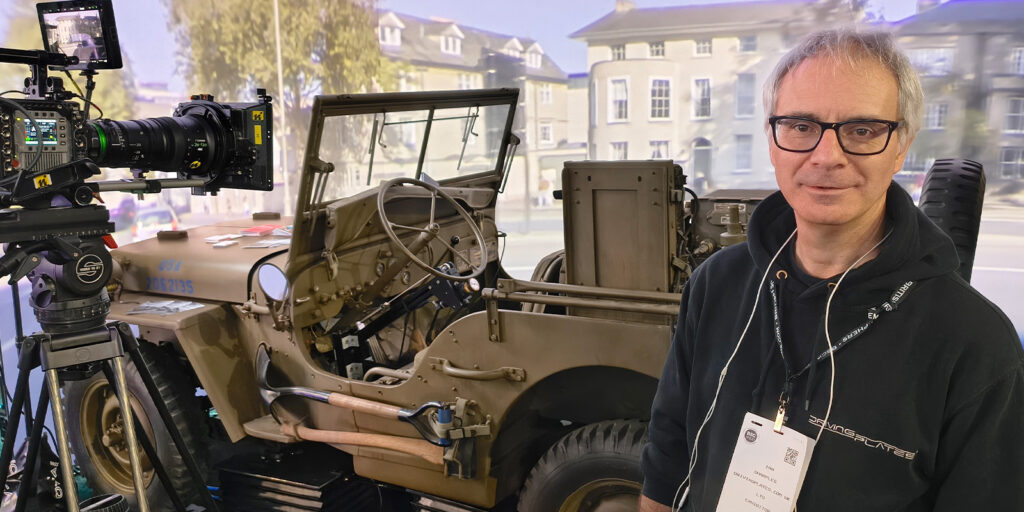
Just a short, brisk walk across the exhibition, we find the veteran among plate acquisition companies, as Driving Plates has a very interesting set-up on display here. In fact, if you’re pressed for time, and need car plates from downtown New York City or Hong Kong – or just about anywhere in the world – Driving Plates probably already has them in stock, since it has the world’s largest library of street backgrounds for car scenes – most of it in 4K, but since 2023 it has 6K too.
Company representative Ian Sharples is here to give us the full picture. “Virtual production is very glamorous,” he admits, “but about half our work still is green screen or blue screen. If you just have one short scene or a couple of short scenes, it’s probably more cost-effective to go green screen. And if you have a lot of visual effects, if you’re going to add dinosaurs or explosions or someone’s chasing you, then green screen is probably easier.”
The set-up which Driving Plates has on display here is really interesting, so Ian elaborated a bit on it. “So, right now we have partnered with a company called Mo-Sys, and they’ve developed a system that puts compressed air bellows underneath the car to simulate the bumps in the road, which is one of the things that hampers virtual production in convincing the audience, and in addition to that they have an attachment to the steering wheel which turns the wheel on the corners, so the actors don’t have to remember to turn the corner. The wheel will go around by itself.”
But one obvious major point in visiting the BSC Expo is to see how many important and fascinating professionals and artists you can run into here. So, on the subject of “Who was there?”, here’s a little selection.
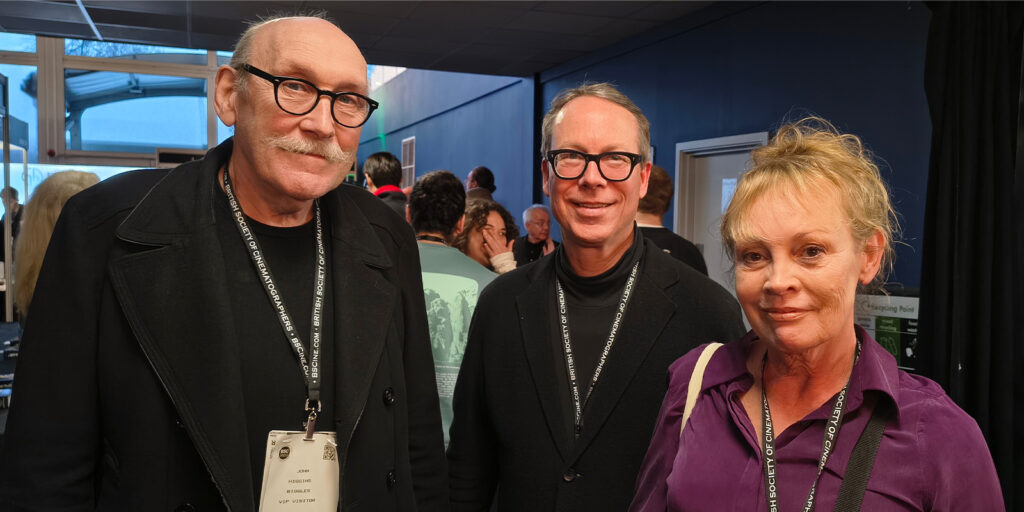
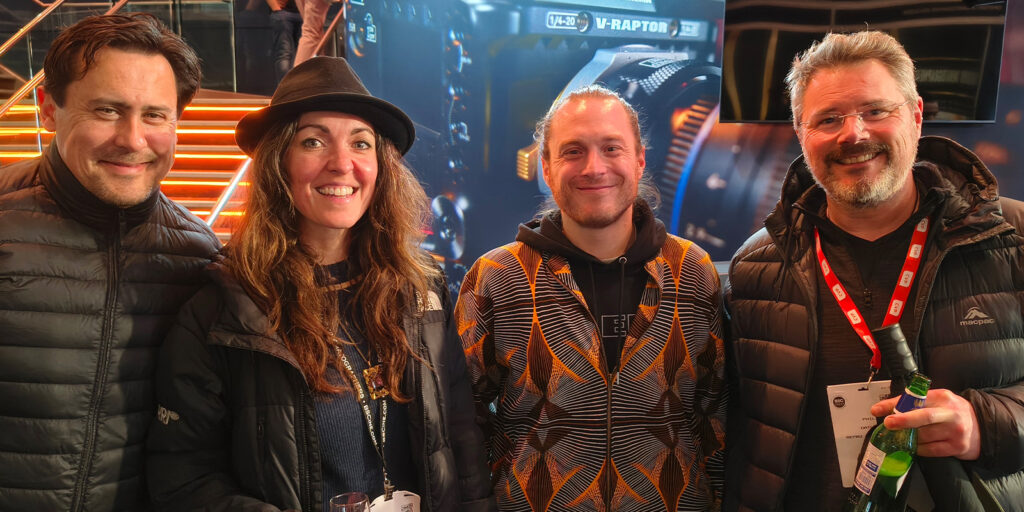
After three decades at Netflix, Technicolor and Park Road Post, many of you will probably recognise Phil Oatley, who since about three years back is CEO of RePro Stream, a company specialising in live streaming collaboration for production and post-production in movies and television.
“So, basically,” Phil explains, “the biggest bottleneck in production isn’t rendering or logistics, it’s communication. On projects now about 10 different platforms are used to do 10 different things, and I think it really irritates filmmakers. Everyone at RePro Stream has a production filmmaking background, like DITs or similar, and the company’s quest is to build a platform that effectively becomes a singular place for crew, producers, content executives etc, to collaborate.”
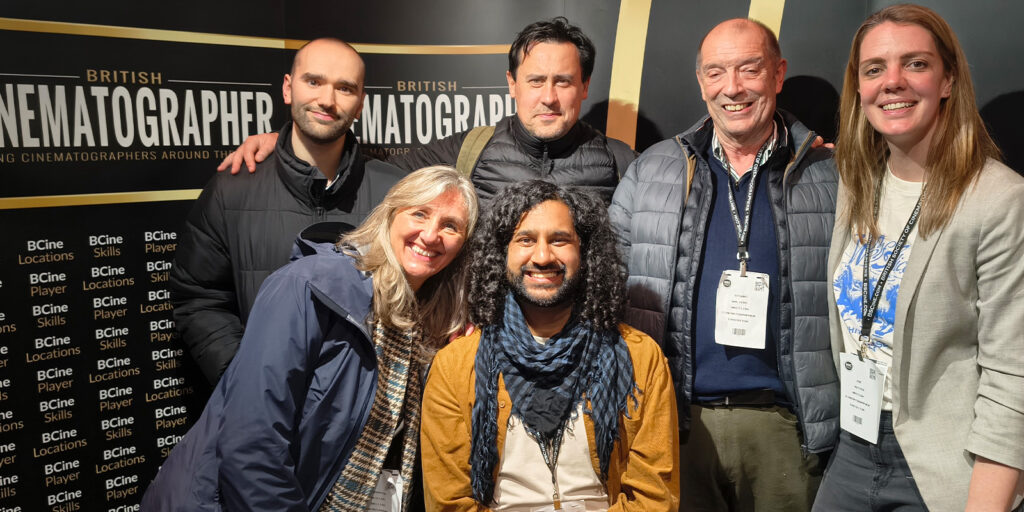
All photos by Lars Pettersson FSF.