

CRAFT WORK
Filmmakers and technicians converged on Evolution London, exploring new tools, ideas and talent, all driven by a passion for cinematography.
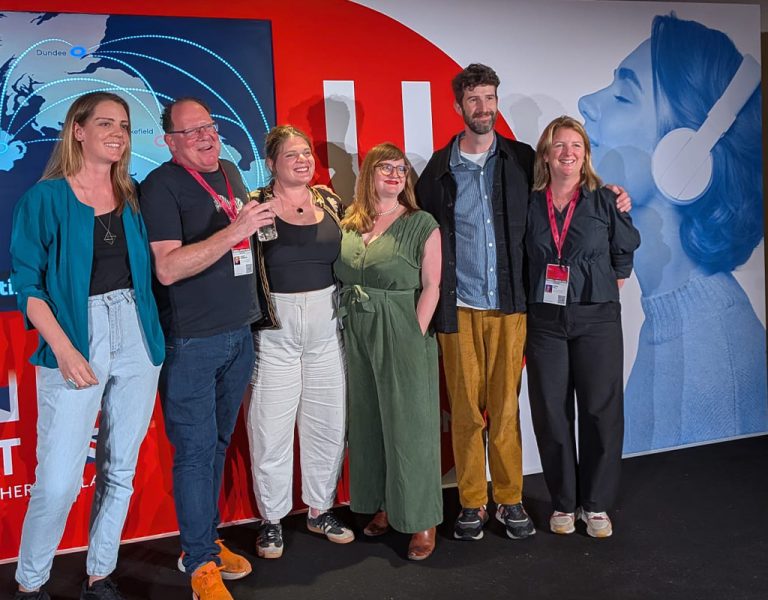
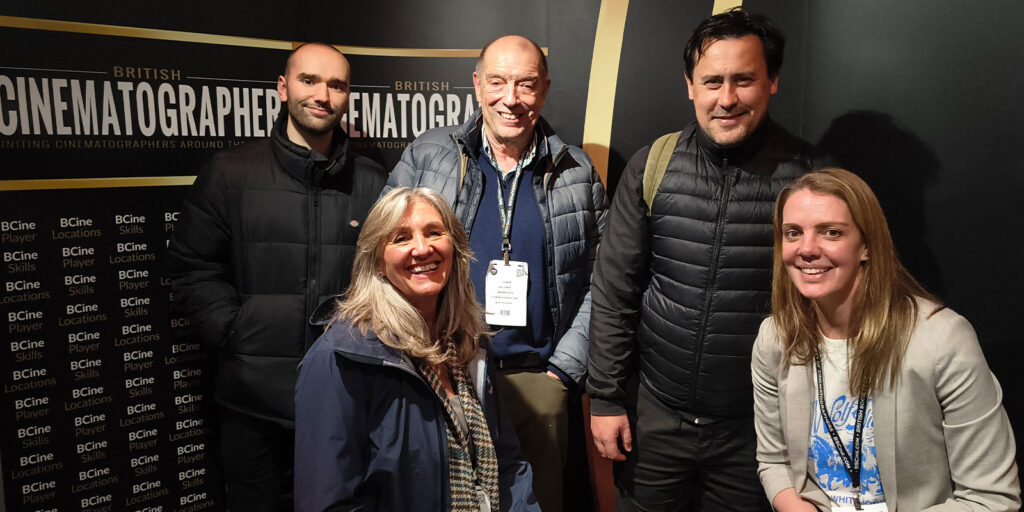
Oliver Stapleton BSC attended his first Expo as society President, joining members and guests at one of cinematography’s key annual gatherings. Across three days, the weather swung wildly — biblical rain on Thursday, the setup day and VIP evening, giving way to a crisp, bright Saturday when many attendees shook off hangovers with a brisk Battersea Park park run.
For the people by the people
One of the focuses of the BSC stand was celebrating the life of the late Joe Dunton MBE BSC, who originated BSC Expo in its previous form and who the seminar theatre at the event is now named after, following his recent passing. As well as marking 70 years of the BSC Awards, a variety of books written by members, including Preserving the Vision (Phil Meheux BSC and James Friend ASC BSC), Cinematography and Lighting for Television: A Contemporary Approach (Tim Palmer BSC) and Check the Gate (Harvey Harrison BSC), and merchandise including new BSC-branded beanies were on display.
“It’s been very busy on the stand and on the show floor and the seminars have been full,” Duncan Bruce BSC, membership and engagement officer, told us at the show.
This year, the BSC Talent Bar – headed up by the BSC’s Equity and Inclusion Committee – evolved the offering by providing more one-to-one slots. “We found that to be an extremely useful process because not only can an established camera operator, cinematographer, gaffer or person working in another role meet with someone who is fully established, like a BSC or ACO member, but people who are brand new to the industry can meet with someone who isn’t that far away from where they are,” said Billy Abbott, cinematographer and one of the coordinators at BSC Talent Bar working alongside other team members such as Hilda Sealy GBCT, Rachel Clark BSC and Laurie Rose BSC.
On the Friday of BSC Expo, 101 1-2-1 sessions were carried out and when we spoke to Abbott on the Saturday, they were on track to do the same that day. “We’re partnering with even more associations and groups this year including illuminatrix, ScreenSkills, Futures in Film, First Steps Cinematography and CineCertified, to name a few,” he told us.
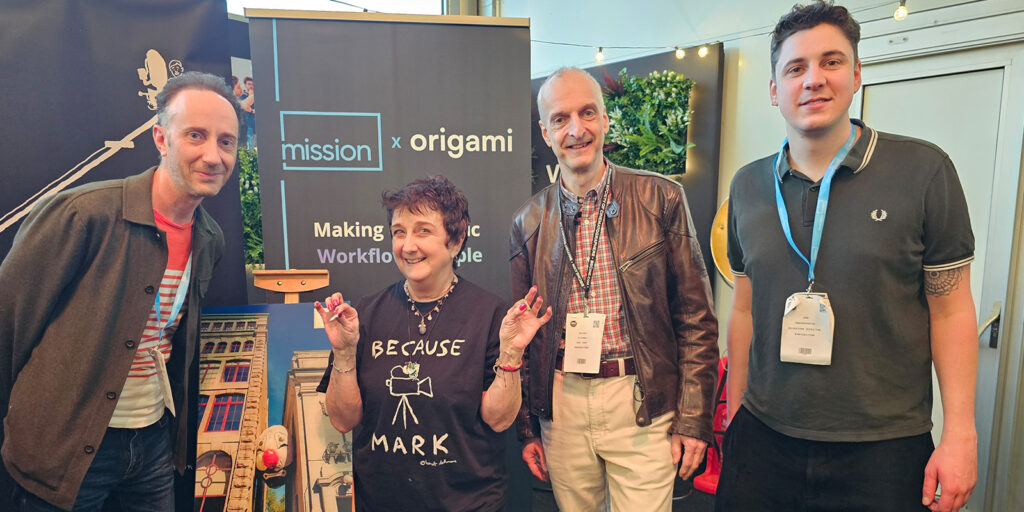
Andra Milsome, founder of the Mark Milsome Foundation, was promoting the Kit Start initiative, run by Dan Evans, who was mentored by the late Mark on the set of Downton Abbey. “Dan provides a three-day in-house training programme to help them get their foot through the door and then we offer ongoing mentorship afterwards,” she said. “Hopefully, we’ve picked the right people and given them that leg-up into the industry.”
Meanwhile, Rob Emmanuel, vice-chair of the GTC, commissioning editor of Zerb magazine and exhibitions lead, was “spreading the word and connecting with people” to explore whether the organisation might be right for them. “It can be very isolating being a freelancer at the best of times — and the last two or three years have been the worst,” he said. “Primarily, I think BSC Expo is about enabling us to connect with like-minded people. It’s a fantastic place to find new stuff, old stuff, to get the chance to speak to people.”
Elsewhere, the GBCT had an extended stand this year, with chief operating officer Lorraine Luke celebrating two years at the helm.
“It’s important for us to be here today — we want to have a physical presence for both our members and non-members, to show what the guild is about,” she said. “We’re getting a lot of interest from students and non-members. Each day we also have a social networking area for our members over a two-hour period, plus a raffle with incredible prizes from our amazing Patrons. It’s lovely to see members connect with others who they are aware of but have never met. You never know what might come from it.”
As is the case across the industry, for the Association of Camera Operators there’s one topic that’s of particular importance. “AI is definitely something to consider, because it’s absolutely terrifying how fast it’s coming on,” says legendary camera operator Rory Moles ACO, a member since 2016, who’s been looking after the stand during our visit.
AI is also a key focus for union Bectu – it’s a topic that often comes up for those on the stand at the Expo and in their wider community, with varying outcomes. “It’s a difficult conversation to have,” says LPD assistant national secretary Jenny Tingle. “There are some members who would like to be able to just throw up their walls and not have to deal with it, but there are others who get really excited about it.”
Cameras and lenses
RED’s rebel branding has evolved into a more versatile range, exemplified by the V-Raptor XE. “E” stands for “essentials”, retaining a full-frame sensor with global shuttering while trimming some I/O options and limiting acquisition to 60fps at the highest resolutions.
The Nikon–RED technology transfer is bidirectional: Nikon mounts on RED bodies, and the 6K full-frame Nikon ZR, launched last September, records RED-style RAW. Nikon balances the ZR at around £2,100 against the five-figure V-Raptor XE kit. Its Mark Roberts acquisition also added a Cinebot with compliant mode for hand-repositioning.
Blackmagic Design highlighted the URSA Cine 17K 65, expanding its large-format platform with a 2.2:1 sensor offering 16 stops of dynamic range and interchangeable PL, LPL and Hasselblad mounts. The URSA Cine 12K sits alongside it with PL, EF and LPL options. Both feature Lemo and Fischer connections, 8TB internal storage and 10G Ethernet. Also on show was the PYXIS 12K, using a multi-scale RGBW sensor to capture 4K, 8K and 12K, up to 40fps at full resolution or 112fps at 8K.
At True Lens Services, the rehoused Vega65 range uses Nikon’s vintage AF-S lenses for coverage from 24–165mm, alongside a rehoused 1980s Angénieux 45–90mm. TLS demonstrated the lenses with a Blackmagic URSA Cine camera and the latest version of DaVinci Resolve, whose AI-assisted rotoscoping is impressively precise.
Cooke’s Panchro line reflects today’s appetite for vintage glass. At Expo, the focus was the Panchro 65/i, bringing that character to large-format cameras. The range covers 30–100mm at T2.8 (T2.5 from 55mm), with a 152mm due March 2026. Part of the wider “Panchro ecosystem”, it pairs easily with SP3 and Panchro/i Classic lenses, even for lightweight or drone setups.
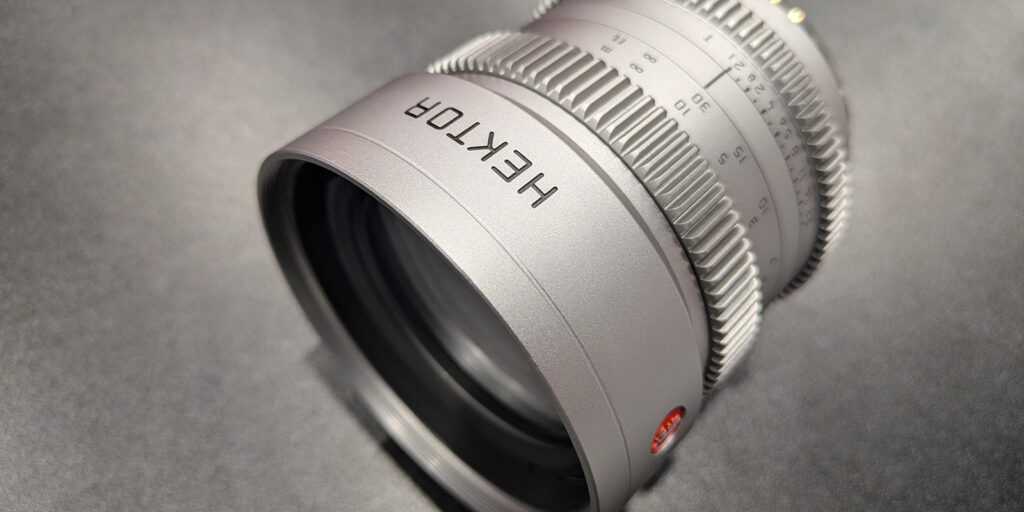
Leitz provided us with a particularly good example of market diversification in its new Hektor set, built to be small and light and to suit mirrorless cameras. Comparison with Cooke’s SP3 are inevitable, though Leitz charges more for the Hektors. The range includes six focal lengths from 18 to 100mm, all at T2.1 and made at the company’s factory in Germany.
Zeiss already has its comparable Nano set, which gives up very little in pursuit of economy and portability. Its other 2026 release looks to be the very different Panoptes 65, built to cover large sensors, with Alexa 265 particularly in mind. From June, the company will ship Aatma, a modern, high-capability lens set with nine focal lengths from 18 to 135mm and a fleet T1.5 throughout.
We also encountered Sigma, confident in the established success of its full-frame lenses and showing both Aizu primes and two Cine Zooms. Aizu is a departure in that it is not based on a stills design; this is Sigma’s first purpose-built cinema set, with eight lenses (four more soon) between 25 and 75mm and achieving T1.3 on large format sensors.
ARRI showed the Ensō 10.5mm T2.8 prime, part of its large-format range with magnetically attached rear elements, catering to the appetite for versatile lenses. The company also showcased the Alexa Extreme, capable of 600fps.
Fujifilm now puts the GFX 100 sensor in a cinema body with the Eterna, offering choice in this market segment. Its photographic roots limit it to 60fps, but the sensor’s image-gathering power and compatibility with high-end lenses remain impressive.
Some of the most memorable camera exhibits were perhaps the least likely to be anyone’s A-camera. Kodak, with no small interest in encouraging people to shoot 65mm, hosted a Logmar Magellan on the booth.
When VistaVision starts seeming like the moderate option, we are in the presence of greatness. Panavision showed a classic Beaumont VistaVision camera recently used by Robbie Ryan BSC ISC on Bugonia. The principal concern was apparently finding a way to handhold the camera without inserting the magazine firmly through the side of one’s skull, something Ryan solved. Panavision matched its lenses to the camera using add-on expanders and showing the Ultra Panatar II on the Alexa 265 using the same technique. The company’s exhibit also included the Lens and Lantern bar, a place to get a drink and look at a nicely-done virtual production backdrop.
On the theme of virtual production, one of Sony’s more recent developments is its Ocellus tracking system. Simplifying the jenga tower of technologies associated with virtual production is a perpetual goal, which makes Ocellus’s markerless operation particularly attractive. The system also handles lens metadata, further reducing cabling and configuration. The company seems to intend Ocellus for both multi- and single-camera operation, as well as for in-camera and electronically-composited applications.
Nearby, we found drivingplates.co.uk, shaking the room with airbags placed to move an otherwise static World War II jeep in front of an LED wall. Said jeep also boasted a force-feedback system on the steering, giving actors something to react to. The success of virtual production as a hugely effective way to shoot driving material is hard to overlook, especially allied with that sort of physical effects technique. The company seems keen to both expand its library of environments and find new ways to shoot them, with a 6K single-camera system now available.
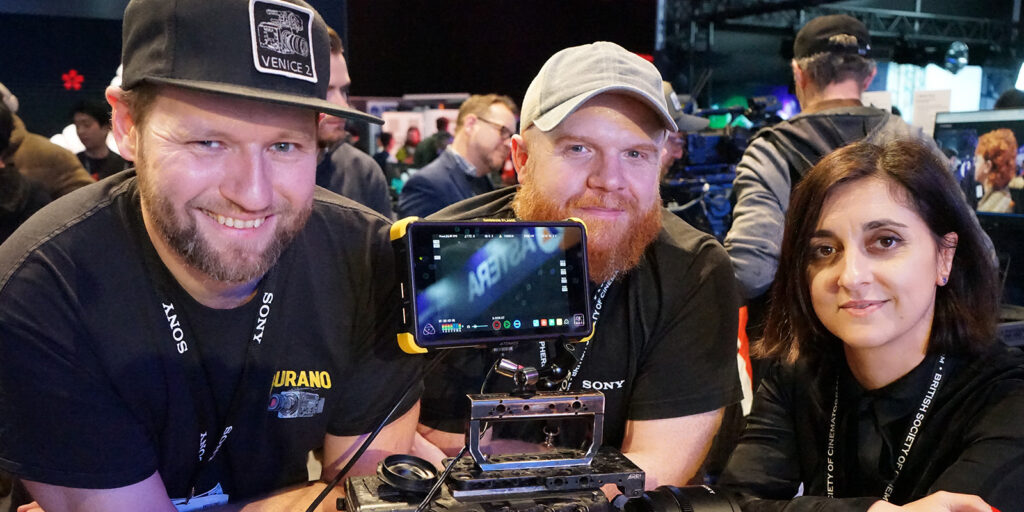
CineArray displayed a nine-camera, 360-degree helicopter array using Komodos with 21mm CP3s. Central to it is LiveStitch, enabling live stitched previews, recording and global streaming from a compact, aircraft-powered unit to reduce flying time.
We also spoke with Helicopter Girls and The Aerial Filming Company about recent projects, including first-person drone work — a racing-derived, high-agility approach scaled up for cinema with expert pilots and brief, high-performance flight times.
Placing cameras in interesting positions is something Tiffen’s Steadicam range has done for a long time, only latterly facing at least some competition from gimbals. Putting (essentially) a gimbal on top of a Steadicam is an idea which predates the wide availability of gimbals. The Volt system is an alternative which seems to retain more core Steadicam behaviour while greatly easing the more trying aspects of operating. The Steadicam Magic is the new release, a lighter, lower-cost option incorporating Volt 3 technology (influencing pan as well as tilt and yaw).
Back in the world of post-production, Mission Digital was keen to discuss the provision of on-set internet, aggregating things like Starlink and 5G. That forms a bridge to many other things the company does, and one of those things is Origami. Described as a workflow automation, asset management and metadata handling system, Origami should allow production, post and VFX to coordinate more efficiently.
Cinelab bridges Mission’s IT expertise with film’s photochemical traditions. Alongside processing and archival scanning, its busy digital-film-digital (DFD) service lasers footage to film and scans it back, offering controlled tiers recently used on Peaky Blinders: The Immortal Man, Crime 101 and Night Always Comes.
Elsewhere, sleeper hit Bun-G-Ring provides an ultra-light way to mount rectangular filters without a mattebox, ideal for drones and lightweight Steadicam setups.
Tilta’s Nucleus adaptor is an example of something which seems obvious only once it exists: it extracts autofocus data from mirrorless mounts, adapts to PL, and passes the data on to motors operating a cine lens, a combination of technologies which may actually be entirely novel. It can be overridden at any time using a hand controller.
Lighting
Sebastian Kudanowski at Pixarpro showed us its motorised yokes rigged on Long Johns, all IP rated and with wireless DMX, running off a Gaffers Control. The larger models can take multiple Vortexes or SkyPanels, or a reflector. “It’s for the last 10% of adjustments,” said Kudanowski. Pixarpro is the UK distributor for Godox, whose own stall was up on the mezzanine. Its M-series COB LED heads and P-series panels were prominently displayed. The latter can be fitted with adjustable diffusion. The MG4KR is equivalent to a 4K HMI, we were told, and the brightest full-colour RGB LED on the market.
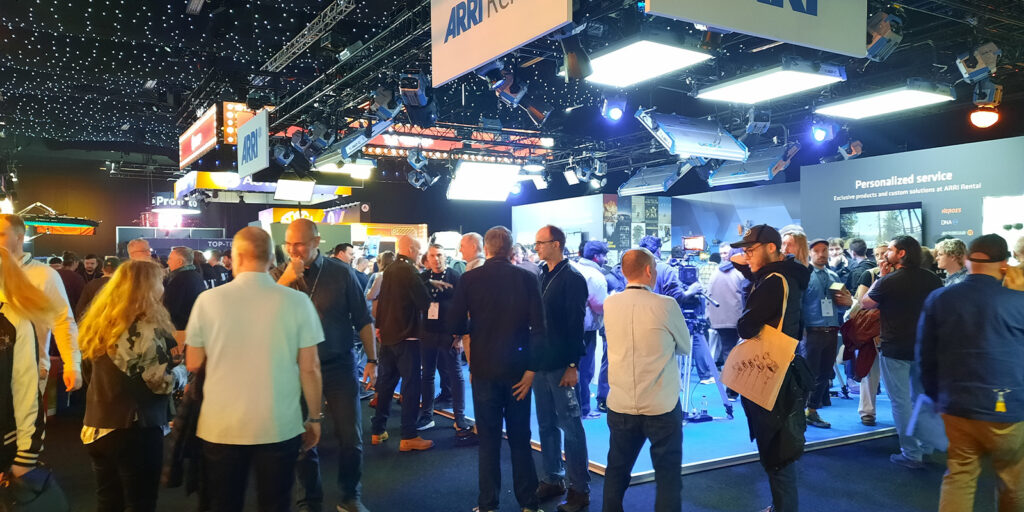
At Aputure’s stall we spoke to Tim Kang, who developed the BLAIR-CG colour engine and chairs the Lighting Committee in the ASC’s Motion Imaging Technology Council. “We’re reinventing the panel,” he said, showing us the Nova II in 500W 1x1ft and 1,000W 2x1ft flavours. He emphasised that his colour system produces a full spectrum rather than “tricking the eye”, and proved this with his Sekonic colour meter, which gave the Nova II an SSI of 90%. Also, on Aputure’s stand were the Nova 9º 2×1, a compact spot aimed at night exterior work and the latest version of Sidus Link.
Panalux’s bar this year was “The Lens and Lantern”. It has been working with Racquet Studios to service a mixture of traditional and VP stages. While LED manufacturers still race to produce bigger and more powerful units, Panalux representative Henry Howes felt there is more emphasis on smaller units in 2026, and even more so on modifiers. “The big end of tungsten is the last place that’s still safe,” he remarked, “but it will go eventually.”
Smaller LEDs were certainly the stars at the Nanlite/Nanlux stand, where the 5C was unveiled. These 5W torch-like units come in a self-charging case packed with modifiers – diffusers, fresnels, barn doors and projectors. Elsewhere on the stand was the 360W 4×4 Pavo Slim, its 1cm-thick full RGBWW panel, and the Evoke 150c and 600c, featuring deep red chips “for excellent skin tones”.
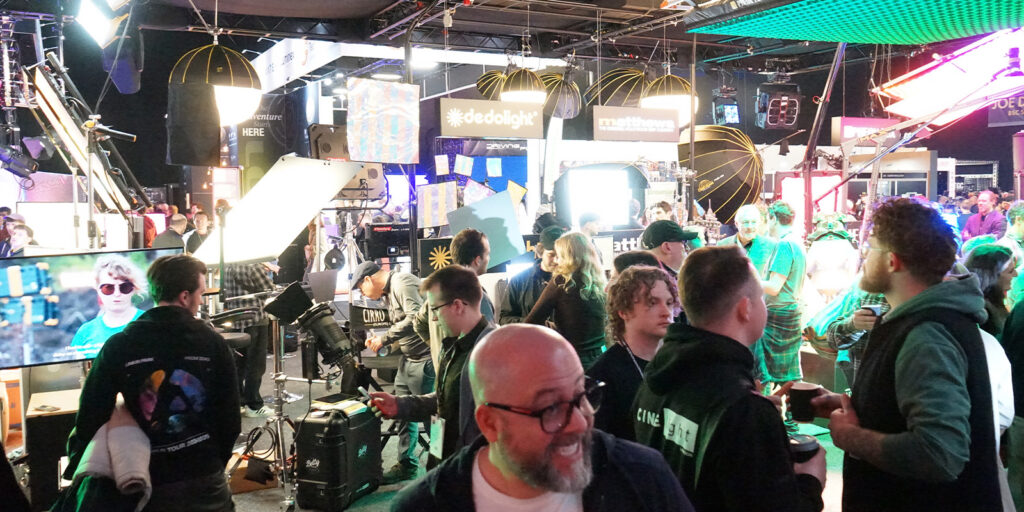
Cirrolite distributes a number of well-known brands. Dedolight displayed the Eflect multicolour flexible reflectors, intended for creative background lighting, while Fiilex exhibited the K10, a 900W punch light with swappable lenses, which can be installed on its Moto Yoke. The US Superbowl broadcast apparently used 80 K10s. Kino Flo announced the Diva Lux 4 – a 400W RGBwWcW panel – while the Celeb IKON 12 is now on the market and a yoke to stack three Ikon 6s together is in the works. New from Matthews was the Matthellini 2, a slick black update to the clamp which has been designed not to lock up when it’s unscrewed. No more taking a hammer to it, we were assured! Cirrolite also had two new brands on its stall: Betty Light, a rival to the CRLS, and CineVeam,whose novel LED fixtures open up just like umbrellas.
On display at Velvet’s stand were the new bi-colour versions of the Kosmos fresnels. “They’re built as a real fresnel,” we were told, meaning that the chip moves back and forth when zoomed, not the lens. Asymmetrical Cyc lights were in evidence too, capable of evenly illuminating a 6m-high backdrop from a distance of 1m.
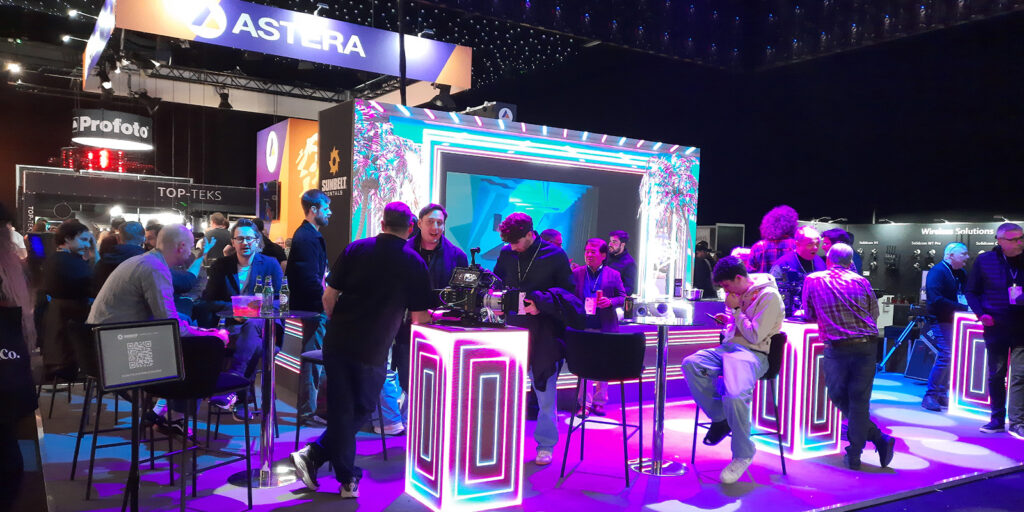
Astera demonstrated its new QuikBeam, 20W fixtures with 200W equivalent tungsten output. These IP65 units have removable batteries, PoE (power over ethernet) and a beam angle of 60-13º plus an extended “hot beam” mode – useful for CRLS work, for example. The company’s Netbox can monitor and configure four QuikBeams as well as enabling web access via a PC. A self-charging case of four QuikBeams is available, as is a backpack to carry two of them.
Robe showed us the iFORTE LTX mover. The unique feature is the transferable engine, user-swappable in five minutes. Two engines are offered: high output and high colour fidelity (CRI 96). The fixtures have an active weather protection system with an internal micro-climate that allows them to operate down to -50ºC. For this reason, they saw heavy use at the Winter Olympics.
On Lights Camera Action’s stall, DoPchoice was going for a Batman theme. The slogan “Snapman and Rabbit” referred to the new softbox which unfolds like batwings. Rosco had several innovations to show, like its Window Cling ND filters that adhere with a little bit of static electricity, grey Silent Gridcloth to both dim and diffuse the sun, and Slideys, which velcro onto flags, converting them into reflectors, muslin bounce or chromakey backdrops. Creamsource showed us the Intensifier for the Vortex 24, adapting its native 110º beam to 80º. They’ve also introduced the LNX1 combined rigging system which apparently “sold almost before it was made”. By the time you read this, demo units of LiteGear’s LiteTile Spectrum Ultra should be out. The LT8 is a 400W model with 64 pixels, while the LT4 is 400W with 32 pixels, and both feature an improved RGBACL engine.
Cineo’s stand was all about Lynx, a modular LED batten available in 2ft (110W) and 4ft (220W) sizes. Joseph Mendoza, vice president of sales, called it “the most compelling, exciting product we’ve produced.” A 2ft unit sat glowing in a fishtank, surrounded by rubber ducks. Eight of the 4ft models were combined into a Lynx Maxibrute, an impressively bright (76,800 lux) reimagining of the tungsten Quarter Wendy.
New to Profoto’s lineup were the L600C, a COB RGBWW fixture, and the ProPanel 3×2, a 2,200W competitor to the Vortex24 and SkyPanel s360 but half the weight, both new additions offering 16.1 million colours. All of Profoto’s range have integrated ballasts, and are flicker-free up to 8,000fps.
AC Entertainment previewed movers with the same six-colour engine as its existing ProLight fixtures. Also on the stand was the Chroma Q Color Force 3, an IP65 asymmetrical batten light more than twice as bright as its predecessor.
At Elation Lighting, Tim Haskell showed us the Fuze Wash 250, a little brother to the existing Fuze Wash 500, and three new sizes of the KL batten range: 12” (four cells), 48” (12 cells) and 72” (16 cells). Each cell is a 100W addressable pixel comprising a cluster of RGBMA emitters. In the KL fresnel range, the 6” and 8” models are getting an imminent upgrade to IP65 with motorised zooms.
At the Vivendum stall, Litepanels demonstrated the Bluetooth communications module, which allows fixtures to be linked together and controlled via the starCTRL app. Stablemate Anton Bauer showed us its new fleet management system, allowing customers to check the batteries’ status via the Cloud and download the analytics. SmallHD displayed a software update for its monitors providing a user interface for vertical shooting, the ability to add LUTs to the SDI output, and 4K SDI-HDMI cross-conversion. Teradek unveiled the RF-X, an automatic video switcher for the Bolt that takes up to six receivers and seamlessly switches to the one with the best image quality, ideal for long tracking shots or locations with line-of-sight obstructions. Wooden Camera’s new shoulder rig allows the bridge plate to be slid onto the dovetail itself, and the crossbar can be kept on with the dovetail too, unlocking quicker mode changes from head to handheld and back.
Grip
Motion Impossible’s stall was packed full of robotic systems including the company’s flagship Agito Cine. Chelsea Fearnley, head of marketing and brand, told us they’re now reselling stabilised heads like Antares, Cammotion and Torq.
The two things getting the most attention at Grip Factory Munich’s stall were the GF-NEO column and the Modulus-X truss system. The former – made of carbon fibre and weighing 16kg –is designed for “quick, smooth and silent” movement of lighter cameras, and supports both under- and over-slung modes. The latter is a “revolutionary” modular truss system made of extruded aluminium.
Modulus-X was in action above The Grip Company’s counter, forming the arm of a large spinning rig with a Titan head on the end. “By grips for grips” is the company’s motto and everything it produces is to solve a problem that the company itself has experienced on set.
Panther exhibited the S-Type EVO, a battery-driven scissor arm dolly with wireless control and the X-Type dolly, with a range extender that raises the camera bracket twice the distance of the central column.
The Low-rider was the centrepiece of Brownian Motion’s stand, a bespoke car to carry its stabilised camera array platform. Providing a lens height as low as 1m, the vehicle has a top speed of 140mph.
One of Cineo’s rubber ducks sat atop Camera Revolution’s Waterbird, a submersible tracking system. The company focuses on custom solutions, including the Rib Cage, a body-worn support for front-heavy rigs.
Power
Hawkwoods announced 26V and 14V Gold Mount batteries in 150Wh and 98Wh flavours at the expo. Its chargers handle both voltages, using a cunning magnet system to detect and switch between the two. The new batteries have replaceable contact blocks since these sustain heavy wear and tear in the rental world.
Bebob factory GmbH has added a USB function to the micro V-mount series of batteries. Coming soon is the Case 2000, an IP65 2,000Wh battery. It supplies 3,600W, charges in two hours and can be daisy-chained.
IDX had the VL-PD1 on display, a Bluetooth-equipped USB power distributor and V-mount charge plate. The UC-PD6, also exhibited, is a six-channel fan-less charger, while the IDX Guardian is a 2kWh semi-solid lithium-iron battery weighing in just under 17kg.
Parisian company Nestor generated some buzz with the Nomad, a 110kWh 30KVA battery. It conforms to the Euro pallet format and fits in the back of an L1H1 van. Most notably it can be charged from any EV charger; on a DC supercharger it can go from 10-90% in an hour. Three years after Nomad’s French release, Green Kit now has the first unit for hire in the UK.
Rental and distributors
Hawk London had its busiest month in December 2025, general manager Steven Moulsher explains, which also “translated into January”. Top of DPs’ wish lists are the class-X Anamorphics, which were used on Shōgun. “We get calls every week asking for the Shōgun lenses,” Moulsher laughed. Striking white V-Lite Vintage 74 lenses are also in high demand, which have some of the coatings removed to create a “more ‘70s vintage look”, as are V-Lite16 Anamorphic Primes – with Moulsher proudly declaring that “Hawk are the only people in the world who make a full set of Prime lenses for 16mm film”.
Ovide showed off its new M400 12G and M400 3G video assist systems, highlighting the low weights (10.6 and 11.8kg respectively) and ethernet connectivity with PoE. The former handles four 4K feeds, while the latter handles four in HD or a single 4K. Koko v1.8, the latest update to Ovide’s 10” recording monitor, permits live switching and XML file collection. Software counterpart QTake have upgraded the server with a new editor and multi-track capability. It can now connect to the script, so the user can assign video clips to portions of text for use by script supervisors and others.
Sunbelt’s display dominated the area outside Battersea Evolution, featuring Robe movers on a 40ft crane, a Scorpio 23 on a Scarab all-terrain vehicle, and a 154kWh hybrid genny truck. Inside, it exhibited the Sony Venice 2 Rialto Mini along with several Hawk primes and Supreme zooms.
One Stop Films were excited to take delivery of a Long Shot Lens in March, an optical adapter that allows large-format lenses to be mounted on 16mm cameras. Meanwhile, its K35 lenses are “a big hit”, Tamashiis and anamorphic Stateras continue to be popular, and Tribe7 Blackwings are the newest addition to the lineup.
CVP’s area of the mezzanine was busy as usual. Angénieux and Canon shared the space, the former exhibiting an Optimo 12x on an Alexa 265, the latter focused on visual podcasting solutions from the tiny C50 up. At the CVP repair bar a Sony Burano was being taken apart and put back together. The company is now holding auctions for used equipment, the next of which is in April.