

ANOTHER VICTORY IN VISTAVISION
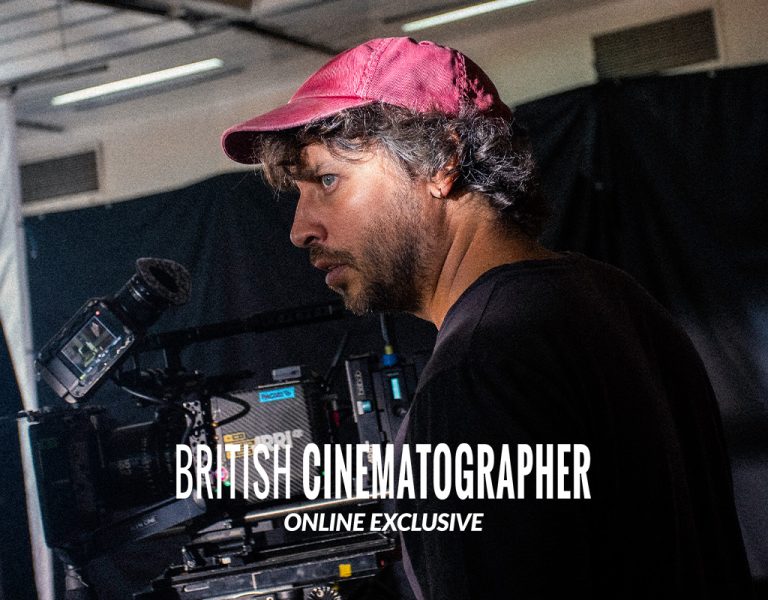
At the BAFTA Film Awards, British Cinematographer caught up with winners who excelled behind and in front of the camera. As One Battle After Another dominated the night with six wins and Guillermo del Toro’s Frankenstein received three craft prizes, crew and cast reflected on creative collaborations and bold visions.
“It’s unbelievable. All the nominees were incredible and the work this year was fantastic and inspiring. It’s surreal,” Michael Bauman told British Cinematographer backstage at the BAFTA Film Awards, having just received the Cinematography award for his lensing of Paul Thomas Anderson’s One Battle After Another.
The talented Cinematography nominees Bauman referred to were Autumn Durald Arkapaw ASC (Sinners), Adolpho Veloso ABC AIP (Train Dreams), Dan Laustsen ASC DFF (Frankenstein) and Darius Khondji ASC AFC (Marty Supreme).
Bauman, who also won the Feature Film prize at the BSC Awards earlier in the month, commented on making his fifth movie with Anderson: “It was a really incredible experience that was a career highlight. I think this story has a tremendous range as far as all the locations and environments [are concerned], and I’m just incredibly humbled to have been the recipient of all this.”
One Battle went on to win one BAFTA after another as it collected five more prizes including Best Film, Director and Adapted Screenplay. Talking to British Cinematographer in the winners’ room at the ceremony, Paul Thomas Anderson reflected on his long collaboration with Bauman and shooting in VistaVision (the format in which last year’s Cinematography BAFTA-winning film The Brutalist was also captured).
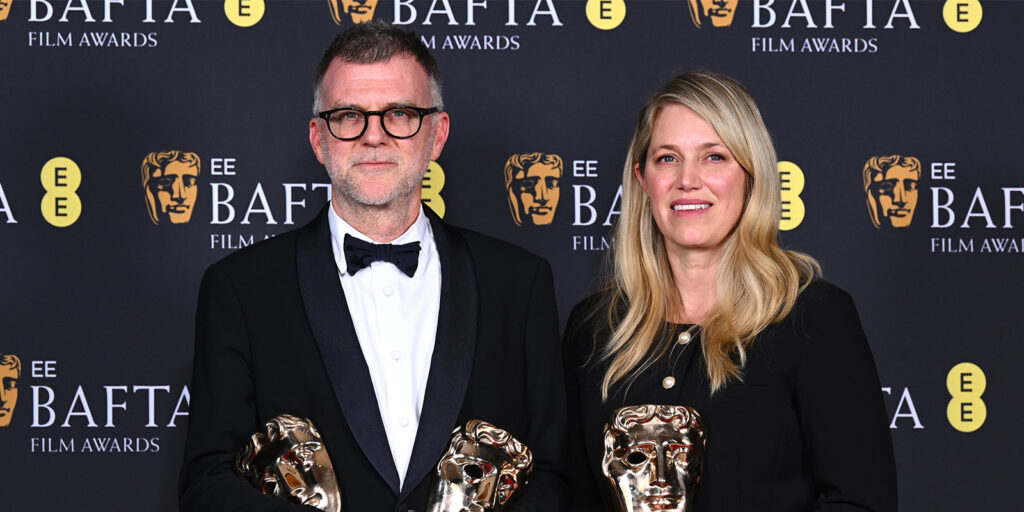
“Michael Bauman and I have been working together in one capacity or another for 10 or 12 years. He was a gaffer with me for a long time and the natural progression is that he’s now the cinematographer I love to work with. The collaboration is instinctive; there is generally a lot of planning and then it all goes out of the window and we adapt,” he said.
“From the very beginning, it was important to shoot this film in this format that we loved and we thought that [VistaVision] would be a terrific vehicle for audiences to experience [the story] in. It blows up well to IMAX which audiences like to see. Whatever this film is, it at least pretends to be an action film to entice audiences. Maybe it has other things on its mind but that was important to us.”
Editor Andy Jurgensen, who also won for his work on the film, said the key challenge was “trying to figure out the tonal shifts because obviously there’s a father-daughter story at the core of the movie, there’s action, comedy and satirical elements and there are intense scenes, so it was about shaping that and building up tension”.
Having worked with Anderson for 12 years, he added: “When you’re working with someone for that long there’s a shorthand, so I now can watch footage and know what he will want in the movie or what he doesn’t like. I know his sensibility now which is important when you’re an editor.”
Anderson praised Jurgensen’s work on a scene featuring Benicio Del Toro’s character and immigrants “which is very long and complicated editorially”, and highlighted the climactic car chase as a “spectacular example of editing when the collaboration with [Andy] is really what makes that work”.
Sinners won Original Screenplay, with writer-director Ryan Coogler emphasising the special collaboration he enjoyed: “Filmmaking is a team effort and I had the best cast and crew any filmmaker could ask for so I share it with all of them. If I didn’t have this incredible cast and crew then nobody would be talking about this movie. I see each acknowledgement as verification of what I knew all along when I was watching everybody work; that they were doing incredible stuff.”
Crafty conversations
It was a triple whammy craft win for Guillermo del Toro’s Frankenstein which came out on top in the Costume, Make Up & Hair and Production Design categories. Accepting the production design prize with production designer Tamara Deverell, set decorator Shane Vieau noted “these [types of] shows don’t get made a lot so for Netflix to give us the tools to be able to do what we needed to give Guillermo his vision was amazing”.
Costume designer Kate Hawley – who admitted to being a “bit of a historic research nut” – described the meticulous research process which began with Del Toro’s screenplay: “Guillermo set [the film] against the Crimean War so there was an obvious place to look for silhouette and a starting point for characters, but after that it’s all the metaphors and imagery that comes from the script and the feelings.”
The project also carried great weight for the heads of department. “All of the HODs felt the excitement but also the burden of trying to create his giant passion project,” Hawley added. “But with Guillermo you know you’re always going down an interesting pathway and he’ll push us.”
Prosthetics head Mike Hill praised Jacob Elordi as having “the patience of a saint because that makeup took 10 hours some nights” to transform him into Frankenstein, while makeup department head Jordan Samuel revealed his team’s research process involved studying period portraits and etchings from the era. “There was a point when we departed from the traditional confines of a period movie and started to get a little more fantastical because it is Guillermo, so working with Kate [Hawley] and Tamara [Deverell], we started to become a bit more operatic in our designs. We work very closely with cinematographer Dan [Laustsen ASC DFF] too and this production is unlike any other I’ve experienced. Guillermo curated a team of artists he’s picked up over the decades and we all understand the palette and the visual language.”
When Avatar: Fire and Ash scooped Special Visual Effects for the stunning work on James Cameron’s latest epic cinematic adventure in Pandora, Irish visual effects supervisor Richard Baneham shared details with British Cinematographer about working with cinematographer Russell Carpenter ASC to ensure seamlessly integrated visual effects. “We have a very different and interesting paradigm shift in our process. We bifurcate the cinematography from the performance so our actors are free to act and they don’t have a camera in their face, so they can have credible emotional engagement with our scene partner. We then employ an RCP (Rough Camera Pass) process where we template the movie, all digital, even the live action, which Russell is heavily engaged in.
“So having the ability to integrate someone with a skillset like Russell into the process without having to ask him to change what he does is important. It is literally asking him to tell us how he would behave on set and we will make that happen. We’re in a blessed position to be able to get great plates that allow that true integration and that idea of making it look the way we want in the live action elements, allowing us to marry the CG elements. Hopefully this is about as good an integrated movie as you’ll ever see.”
Best of British
Following Hamnet’s Outstanding British Film win, producer Liza Marshall spoke of the film’s impact and how it has done “incredibly well all across the world” as “people are coming together in dark cinemas and having an emotional cathartic experience together”. Director Chloé Zhao spoke of going on “a journey together” and being “transformed by the experience”.
“It was started by this woman [Maggie O’Farrell] here and the book she wrote,” Zhao added. “For the rest of our lives, wherever we find ourselves, we can always [know] we were transformed by this experience from the forest to the Globe Theatre.”
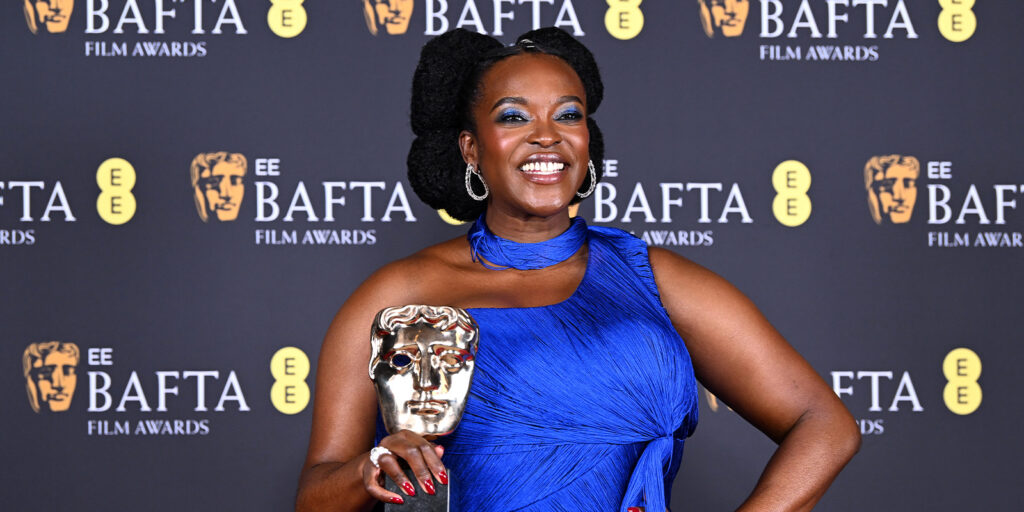
In the acting categories, it was another win for Hamnet as Jessie Buckley scooped Leading Actress. Meanwhile, Sean Penn took Supporting Actor for One Battle After Another and Wunmi Mosaku scooped Supporting Actress for her role in Sinners. In the winners’ room, Mosaku said “creatively Ryan Coogler’s vision and Autumn Durald Arkapaw [ASC]’s cinematography, that surreal montage, should be studied for generations to come”.
It was a double win for Robert Aramayo, who received the Leading Actor and EE Rising Star awards for his performance in I Swear (the film based on the life of Tourette syndrome campaigner John Davidson MBE). Commenting on his surprise at receiving two awards in one night, Aramayo told press: “I never even expected them to read [my name] out once. I didn’t even write anything. But when they read it out a second time I couldn’t believe it, it totally blew my mind and still blows my mind and I still can’t speak.
“I’m just really happy that I Swear has shone a spotlight on something that is really misunderstood. I think there’s still a lot more education needed around Tourette syndrome, what it actually is and how we as a society can help. It’s complex and complicated and it requires us to have grace and… there are lots of tics that people don’t see. It made me passionate about wanting to spread that through the work.”
Other winners celebrated on the night of cinematic achievement included Mr. Nobody Against Putin (Documentary), Zootropolis 2 (Animated Film) and F1 (Sound). Chairman of NBCUniversal Entertainment, Dame Donna Langley, received the BAFTA Fellowship and creative director of Picturehouse Cinemas and Picturehouse Entertainment, Clare Binns, won the Outstanding British Contribution to Cinema Award.
Inclusive worlds
When Akinola Davies Jr and Wale Davies won Outstanding Debut by a Writer, Director or Producer for My Father’s Shadow (lensed by Jermaine Edwards), Wale recalled that when his brother [Akinola] started his journey in film as a director it gave him the confidence to write the story that began life as a short film and then a feature. “When I sent [the script] to [Akinola] his response further invigorated me,” Wale said.
“It’s important for filmmakers and storytellers to tell honest stories and what I mean by that is some of us are British but Nigerian, British but Indian, from different parts of the world and we experience things in [different] ways. As there are so many filmmakers in Nigeria who wouldn’t have the platform or funding to make films, it’s important for us if we do have this [to look at] how we say something honest and how we do it in a way that we project the type of world we want to see. It’s especially important in a world where everything is engineered in a way to separate us. Film gives us the opportunity to create more inclusive worlds.”
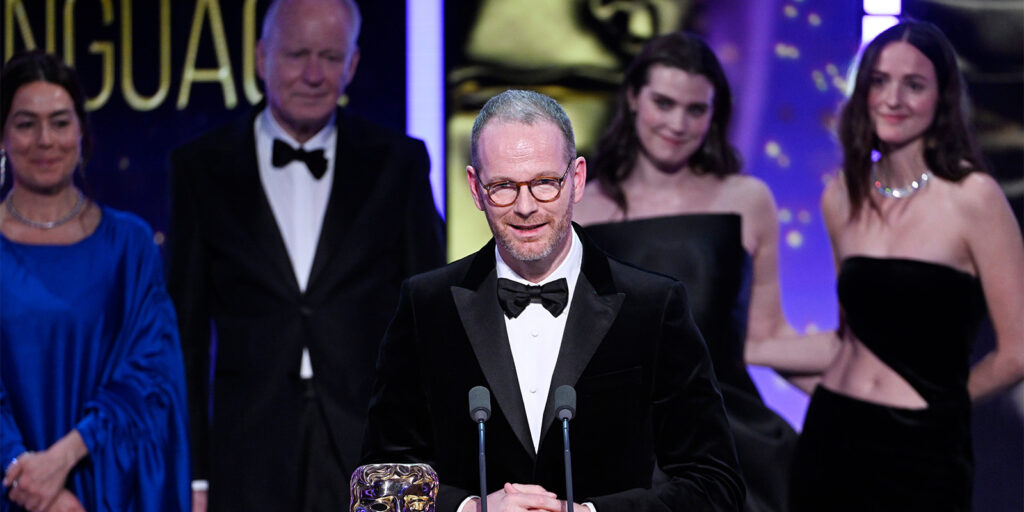
Danish-Norwegian director Joachim Trier, who studied Fiction Directing in the UK at the NFTS, told us he was “feeling a little bit local” after his film Sentimental Value won the BAFTA for Film Not in the English Language. As a film student he always looked to the BAFTA nominees and winners as films he had to see that season. “Who would have thought I would be here with the first Norwegian BAFTA win ever?”
Having written six features with Eskil Vogt, when Trier teamed up again for Sentimental Value – a “personal film about family” -they felt like they “were at a moment in our lives when we have kids and our parents are still around and we felt ready to talk about family life, intergenerational trauma and all those things we don’t know how to talk about. [The film’s] turned out to be more universal. We thought it might be a local story, but here we are!”