


TOOLS, TECHNOLOGY AND TALENT
Recently appointed BSC President Oliver Stapleton BSC discusses the evolution of BSC Expo, emerging technologies shaping cinematography and why education, sustainability and global dialogue remain at the heart of the event.
How does the event create a global focus, and why is it important to have this?
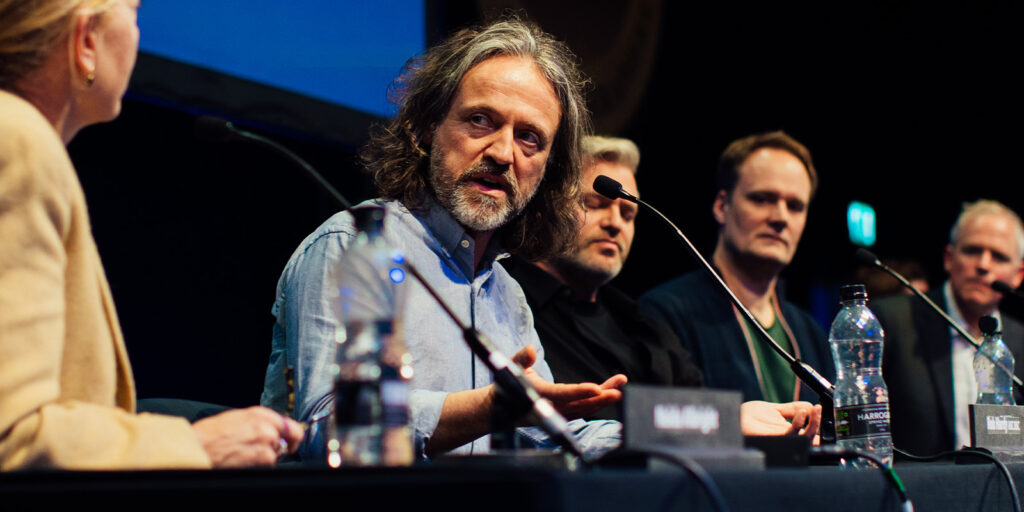
BSC Expo began life as the BSC Equipment Show, founded by Joe Dunton MBE BSC in 1993. The current BSC Expo was later developed by Rob Saunders at SCS Exhibitions as a large global event which has lost none of its original ethos. The focus is on “tools for the job”, with emphasis on real life needs of cinematographers and marketing and hype very much coming in second place. Emphasis is on patrons presentingtheir equipment with a clear focus on “why?”. Our patrons populate their stands with people who really know their products, or even those who invented them. Alongside the equipment, BSC members put together seminars that are often modern and forward thinking and appeal to students and working cinematographers in equal measure. Visitors from all over the world attend the event as London provides a wonderful backdrop for all cultures.
What’s new for BSC Expo in 2026?
We’ll welcome over 70 exhibitors, including some for the first time – each showcasing the latest technology, software and innovation. In addition, we’re building on the success of the Talent Bar which was run last year by our Equity and Inclusion Committee and providing more spaces for young and up-and-coming cinematographers and operators to seek advice. Our seminars will offer a mixture of fascinating discussions surrounding specific pieces of work and topics such as working with a camera operator to debates on issues facing our industry.
The past year has seen film formats, especially VistaVision, creating a lot of buzz. How will BSC Expo tap into that?
Evolving the technologies involved in making films is an ongoing dialogue between filmmakers and engineers. One year it might be 3D, another it might be celluloid film. Whilst many innovations are science and technology based, celluloid formats continue to thrill for a diverse mixture of reasons — part nostalgia, part aesthetic but most of all driven by the “desires” of cinematographers and directors.
Which other tech trends and innovations do you see creating a buzz on the show floor and throughout 2026?
Lighting continuously evolves and I expect we will see new lights, lighting controls and pre-vis systems. I would hope cameras will continue to build on some of the things that bolt on and hang off the side of a camera. There are still breakdowns and unreliability in image transmission equipment and I would hope we will start to see this improving this year. Stabilisation is almost at miracle level already, but this will only continue to improve.
Emerging technologies like AI continue to prove a major talking point in the industry – how will BSC Expo approach these technologies?
AI can be seen two ways – as a threat or as progress in human ingenuity. I subscribe to the latter, although regulation is essential to prevent the “bad guys” from abusing it. Just as we once reacted to the telephone (“No way I’m having one!”), TV (“an abomination”), the internet (“the death of reading”), and social media (now banned for under 16s), AI is now the latest transformative force. At BSC Expo, AI will be everywhere, but mostly unseen — advertising copy, graphics, images and words will be influenced by AI if not used directly. This powerful, mostly hidden technology is rapidly spreading worldwide. Our task is clear: call it out, humanise it and ensure it’s not misused by the wrong people in ways that harm all of us.

Sustainability is a major issue in film production today. How will BSC Expo continue to encourage greener production practices within the industry?
Our Sustainability Committee — chaired by Mattias Nyberg BSC and Greenkit’s Pat McEnallay — continues its drive not only to make our events and masterclasses more sustainable, but also to educate cinematographers about the more troubling aspects of our productions. A number of our patron stands, especially those handling power supplies, continue the drive to move away from diesel-powered generators toward cleaner fuels. Something often overlooked is that cleaner diesel (HVO) is now available, which can be specified (at slightly higher cost) for gennies and reduces CO2 emissions by 90%. Greenwashing is a constant irritation, so education is key — which is why we have a committee devoted to this.
Collaboration between cinematographers, VFX teams and post-production teams is tighter than ever. How is BSC Expo helping those conversations to happen in meaningful and effective ways?
Our seminars, Q&As and masterclasses always endeavour to link people together in the wider film community. Pre-production times for our cinematographers have become longer in recent times on the bigger shows, reflecting the need for those of us shooting on the floor to be fully prepared for what is going to happen to our images after we have gone home. In many instances, VFX supervisors can stay in touch with us with ever more sophisticated tools that enable comments and corrections to be made during the making of final images. At the heart of it, as always, is communication — and nothing replaces those meetings in a boardroom during the prep process for all of us to talk through our aims and intentions. One of my mantras is that when things look like they are sliding downhill on email, pick up the phone and have a conversation. This solves most things before they become a problem. Those of you starting out have the advantage of smaller teams, less interference with your ideas so there is great value in that — you can just make the film with your director in the manner you see fit.