

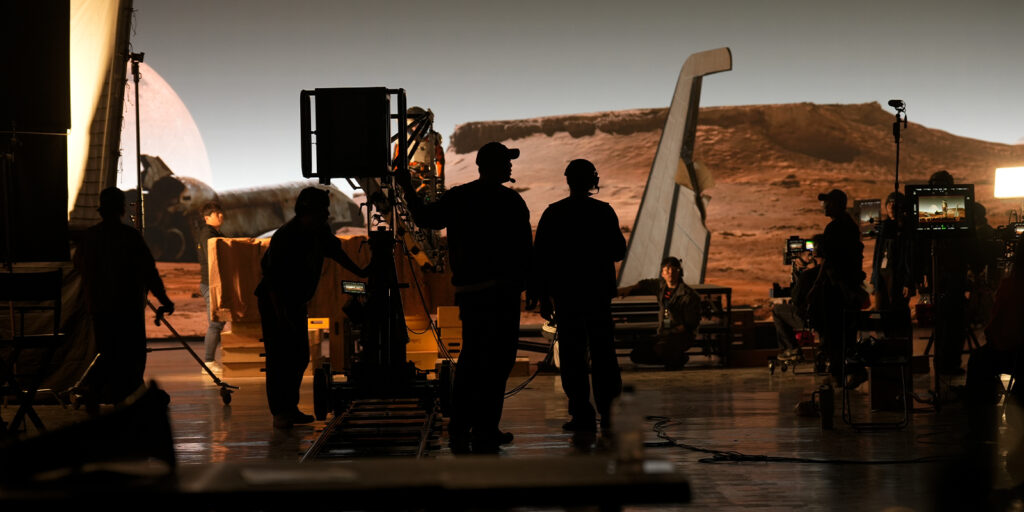
In early December 2025, the Korea Creative Content Agency opened Studio V, a next-generation virtual production stage within StudioCube, South Korea’s largest public broadcasting content production studio.
Developed to “strengthen the country’s broadcast and content ecosystem, the facility establishes a new benchmark for large-scale virtual production in a permanent public-sector environment”, a press release said.
Founded in 2017 by South Korea’s Ministry of Culture, Sports and Tourism alongside KOCCA, StudioCube supports the “growth and global competitiveness” of the nation’s creative industries.
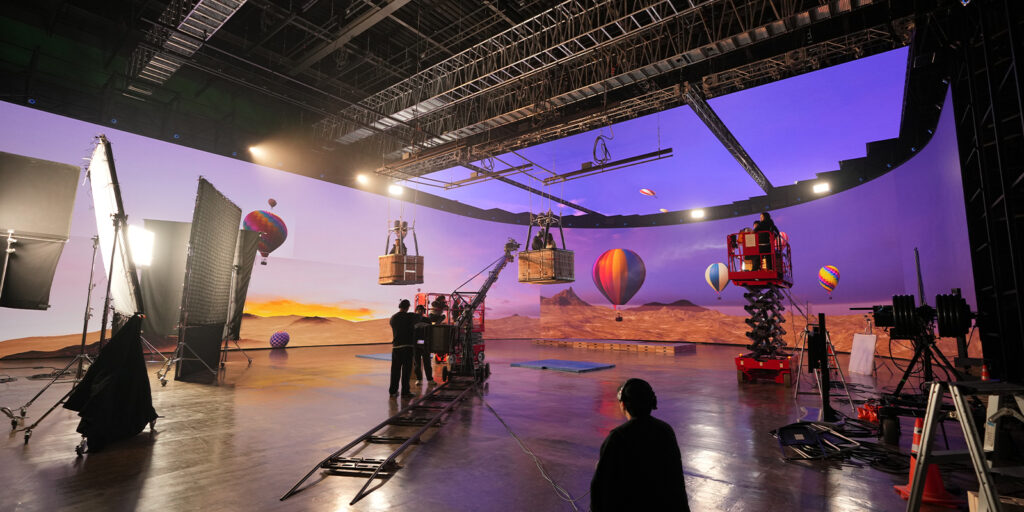
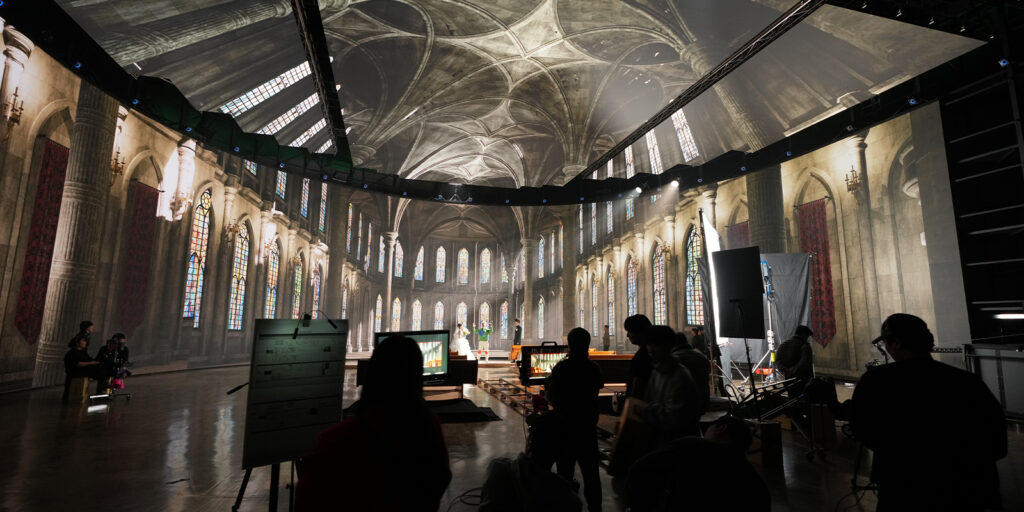
The addition of Studio V introduces a large-format LED volume designed for both high-end production and education.
The stage features a 60-metre-wide by eight-metre-high main LED wall, a 21 x 15 metre LED ceiling and two movable 5 x 5 metre LED side screens, delivering more than 94 million pixels in total.
Driving this canvas is a distributed 20-server AV Stumpfl PIXERA four RS system specified and integrated by Seoul-based LIVE-LAB Co., Ltd.
The architecture comprises 17 Render Nodes, one Director and two Inner Frustum Nodes, forming a “synchronised infrastructure purpose-built for enterprise-scale virtual production”.
Studio V was developed around a fully IP-based production ecosystem incorporating SMPTE ST 2110 workflows, reportedly positioning it among the first large-scale public virtual production studios globally to implement this architecture at full operational scale.
With IP-based routing, multi-camera tracking synchronisation and stable real-time rendering required under demanding production conditions, LIVE-LAB production supervisor and technical director Alvin Chu required an enterprise-grade media server platform.
“Studio V needed a platform that could serve both production and education, offering intuitive operation, long-term stability and flexibility, while maintaining seamless operation between Unreal Engine, camera tracking and other production systems,” said Chu.
“PIXERA was selected not only for its performance and flexibility, but also for its scalability and suitability in a shared public workspace.”
As a permanent public broadcast facility serving multiple production teams and educational users, Studio V required a system capable of deterministic synchronisation and long-term scalability.
PIXERA’s 64-bit platform supports real-time media processing, compositing and high-bandwidth playback across distributed nodes.
Through its Director-led architecture, playback and control are centrally orchestrated while rendering is distributed across synchronised servers, ensuring frame-accurate alignment between camera tracking, rendering and LED output.
To implement SMPTE ST 2110 at this scale, LIVE-LAB and AV Stumpfl’s PIXERA HQ established a structured joint research and development framework early in the project.
This collaboration extended well beyond conventional integration and included early-access ST 2110 software builds, GPU Direct validation, PTP synchronisation testing, workflow simulation and replication, and closed-loop validation cycles between on-site and HQ teams.
The partnership operated through daily reporting cycles and environment replication testing, validating system behaviour under real-world production conditions before commissioning.
“PIXERA HQ provided direct access to core engineers and participated in structured research and development sessions throughout the pilot phase,” added Chu.
“This wasn’t just configuration support. It was collaborative development aligned with KOCCA’s vision of building a future-ready public virtual production facility.”
This process enabled engine-level optimisation tailored to Studio V, validation of distributed Inner Frustum workflows and comprehensive multi-camera tracking synchronisation testing prior to launch.
“All content is managed and orchestrated through PIXERA’s distributed infrastructure across 20 synchronised servers,” Chu revealed.
“This ensures frame-accurate synchronisation between camera tracking, rendering and LED output, which is a fundamental requirement in large-scale virtual production.”
By validating distributed workflows ahead of opening, LIVE-LAB ensured stable day-one performance within a high-throughput public broadcast environment.
“The end client has expressed strong satisfaction with both the technical result and the operational readiness of the studio,” concluded Chu. “We’re proud of the work we accomplished and the collaborative partnership behind it.”