

APOCALYPTIC VISION
Anthony Dod Mantle ASC BSC DFF and Danny Boyle — creatives with a shared passion for exploring bold cinematic storytelling techniques and tools — join forces once again for a new take on the terror they first unleashed in 28 Days Later.
Familiarity is a dirty word in filmmaking, according to Anthony Dod Mantle ASC BSC DFF. “It marks the early stages of death of the medium because you’ve seen it before and know where it’s going,” says the cinematographer behind Danny Boyle’s ambitious post-apocalyptic horror 28 Days Later and now the third and equally powerful film in the franchise, 28 Years Later, plus many boundary pushing productions in between.
While some productions look similar due to “convention, taste, or storytelling traditions” that “pattern of habit” does not excite Dod Mantle. He rejoices in working with filmmakers with a fresh take on storytelling such as Boyle and “pushing the envelope to explore whatever way we find appropriate for the story”. As expected, techniques and tools are anything but familiar in their latest inventive collaboration.
The sparkling script – written by Alex Garland, who also penned the first film – picks up the story three decades after the Rage virus outbreak, following a small group of survivors who have set up a base on a tidal island – scavenger Jamie (Aaron Taylor-Johnson), his son Spike (Alfie Williams), and wife Isla (Jodie Comer) whose illness is yet to be diagnosed. Heading to the mainland, they discover the extent of the danger and new variants of the infected.
Garland’s narrative centred around a family “is inventive writing in a way that was exciting for everyone involved and helped make us feel like we were making an original film, and not a sequel,” says Boyle, who like Dod Mantle believes filmmaking is “all about the power of the story”.
“Rebooting” every time, they “change the dictionary” from film to film, both having only made one other sequel – T2 Trainspotting, the follow-up to Trainspotting (Cin: Brian Tufano BSC). “When making a sequel, it’s about having roots in something that’s existed before and injecting something new or refreshing,” says Dod Mantle.
23 Years Later
Memories of making 28 Days Later (2002) remain vivid in Dod Mantle’s mind, marking his “cinematic christening with a UK director in England” and an “extraordinary” debut. “Suddenly I was on the streets of London with Danny, Cillian Murphy [Jim], Alex Garland and production designer, Mark Tildesley. It felt like I’d come home.”
Making a third film – to follow 28 Weeks Later (Cin: Enrique Chediak ASC, Dir: Juan Carlos Fresnadillo) – was toyed with over the years but plans took shape after Dod Mantle watched Boyle’s “exceptional” 2023 theatre production Free Your Mind. The stunning production and costume design sparked conversation between Dod Mantle and Boyle about how theatre offers a 3D experience of sound, vision and space, which film can struggle with.
Two weeks later, Boyle invited Dod Mantle to come on board 28 Years Later, a collaboration that “felt so right”. As the action moved to more natural settings – forests, tidal causeways, ruins and bone temples – recces explored Lindisfarne (Holy Island), a tidal island off England’s northeast coast which was ideal for the remote island upon which the survivors live. Mainland sequence locations included Kielder Forest, Cheddar Gorge, Northumberland villages and parishes, Fountains Abbey in North Yorkshire, and the Aysgarth Falls waterfalls.
Boyle was first affected by Dod Mantle’s work on Thomas Vinterberg’s The Celebration (1998) – the first of the Dogme 95 films, known for strict rules around how they were shot. “Our conversation about that film marked the beginning of a friendship and 10 feature collaborations,” says the DP. “We have enormous respect for how the camera moves and the use of mise-en-scène in cinematic storytelling.”
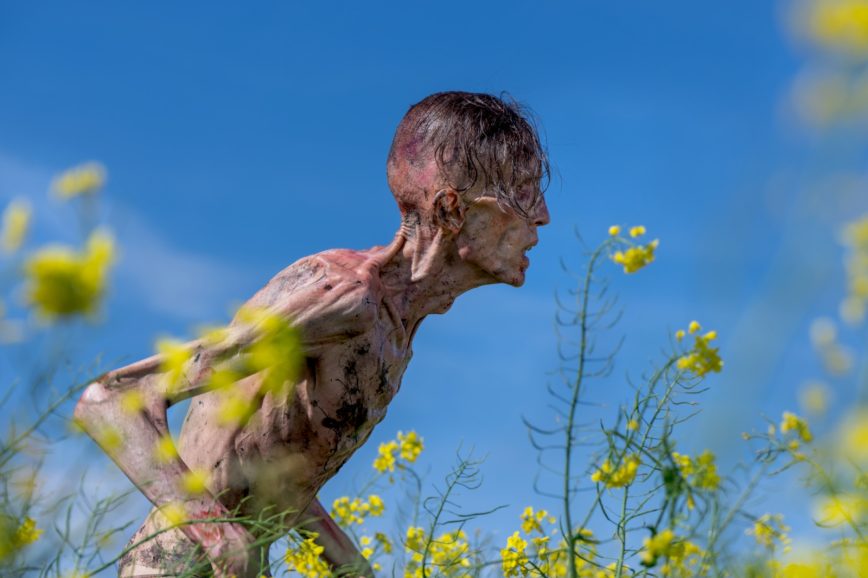
The jerky movements of the first generation infected from 28 Days Later were carried into the latest film, along with new approaches to capturing the movement of new forms of zombie, from the slow, fleshy Slow-Lows to the towering Alpha. “We spent long days on recces, standing in fields with wind in our hair and rain in our face, imagining these strange creatures twitching across the landscapes,” adds Dod Mantle.
They discussed the dichotomy of the dramatic story revolving around few key protagonists – mainly Jamie, Isla, Spike and Dr. Kelson (Ralph Fiennes) – in a colossal, barren landscape, and “how to navigate that, refine the horror, and refine the darkness”.
Seeking inspiration from all aspects of life, Boyle was keen to merge his experiences in theatre, including the film’s centrepiece – the temple of skulls and bones honouring the dead – which was the masterwork of production and costume designers Gareth Pugh and Carson McColl who worked on Boyle’s theatre show Free Your Mind. Pugh and Carson worked closely with supervising art director Paul Ghirardani and the art department to realise the film’s unique vision.
“Danny experienced something different in theatre he wanted to bring it into this world,” says Dod Mantle. “Similarly, the band Young Fathers’ powerful soundtrack is an interesting, inspired choice after Danny and I attended their concert and felt their songs were made for film – quite short, high speed and almost tribal sounding.”
Big screen experience
Partly inspired by 28 Days Later’s unique look – famously shot on Canon XL1 prosumer camcorders recording onto MiniDV tapes – Boyle “carried it as an influence,” shooting the latest instalment on phones. “It’s wonderful to give yourself parameters you use to try to depict it and have technical limitations,” he says.
Boyle’s early description of intended techniques included long shots and rack zooms. But while the subject is “dystopian, strange and beautiful”, as the language used and sketches “adhering to more traditional lensing”, Dod Mantle initially spotted “potential issues shooting on phones” which extensive testing later resolved.
Boyle’s requirements included a widescreen aspect ratio, theatrical release and creative control, aiming to embrace both an epic and immersive feel, incorporating intimate moments that made the original a beloved horror creation. “If you’re on a widescreen format, [the infected] could be anywhere… you have to keep scanning, looking around for them,” he says.
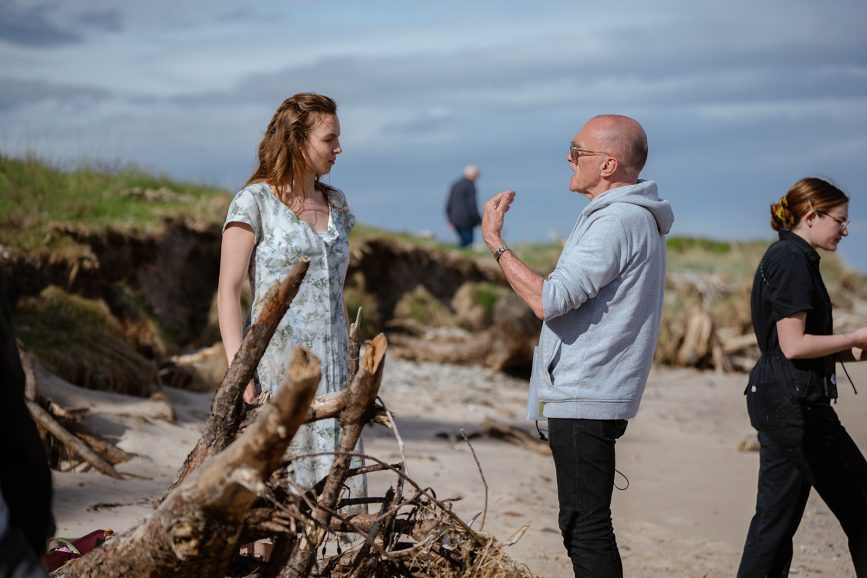
Testing different phones – iPhone, Google, Samsung – in varying light conditions at Camber Sands beach, they experimented with the shutter, accumulating a 50-minute reel of phone-based material screened at Battersea Power Station cinema. The iPhone 15 Pro [shooting at 4K, up to 60 fps and on the 48Megapixel main 24mm/F1.8 camera sensor] was chosen in part as it was the most familiar.
Beast mode
Initially Boyle did not intend to shoot more than 2.39:1 widescreen but during testing Dod Mantle noticed additional real estate on either side which the iPhone sensor was not using, and felt with a clean extraction, it could be a 2.76:1 format, “look beautiful and be one hell of an aspect ratio.” Boyle was equally enthused and together they imagined what it could do for sweeping landscapes with protagonists centre framed and agreed it was the best choice for the film.
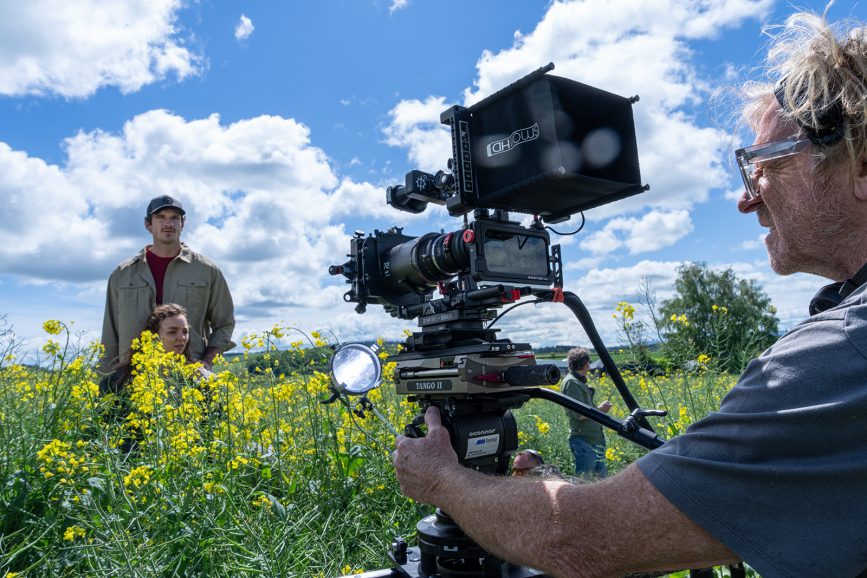
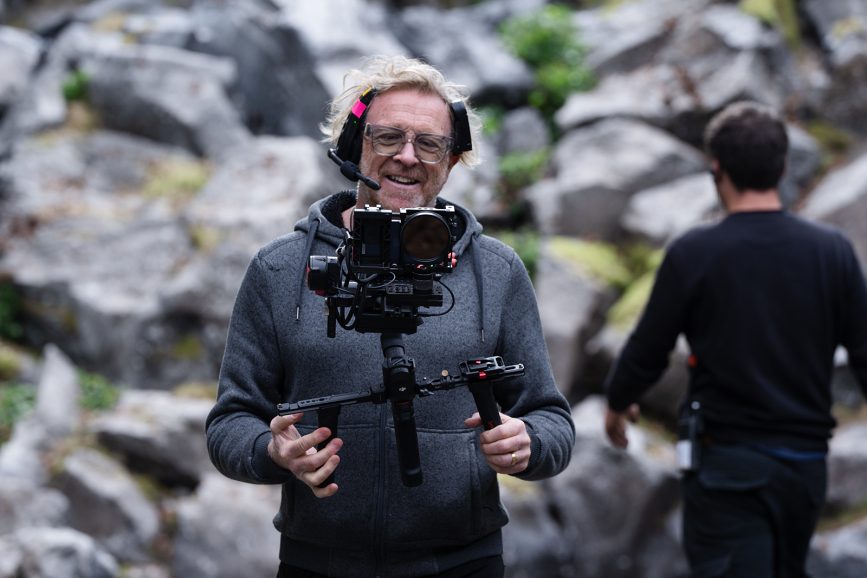
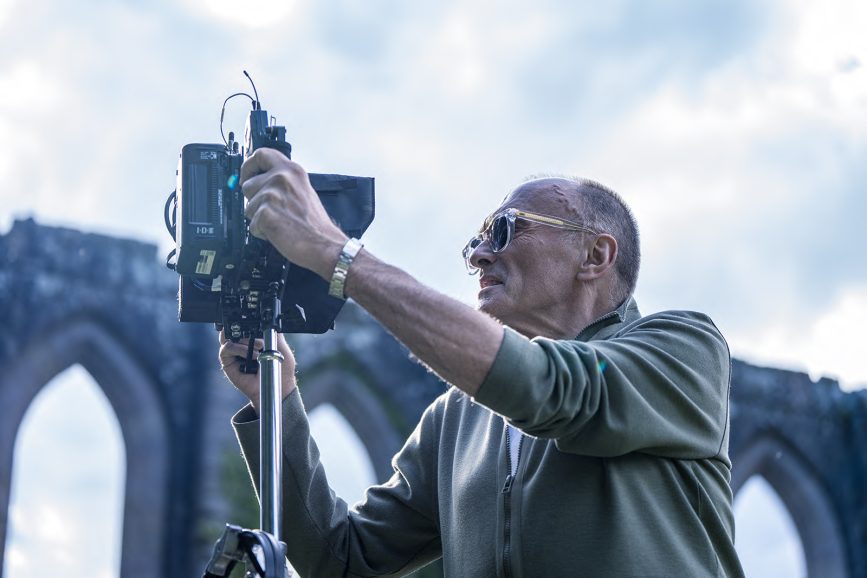
After it became clear the shooting methodology needed to be developed further than the “naked” iPhone and explore additional lenses, Dod Mantle, 1st AC David “Spooky” Churchyard and DIT James Knight tested kit at ARRI Rental, with weight and remaining agile important, as was caging the camera so Dod Mantle could operate as though the “camera was an extension” of his body.
Discovering how lenses might attach to an iPhone reminded him of 28 Days Later when, rather than using the in-camera lens, they “ripped the camera apart and used an adaptor to attach film lenses”. They embraced image quality loss “because it created something different that became our Dogme. It’s a film Danny considers truest for its integration of philosophy, concept, vision, and palette. That’s where the phone comes into this latest film; he felt it offered something new”. But a phone’s static photo sensor is “not an organic creature with physicality like a piece of tape moving across a head” they used on 28 Days Later.
“Rather than massive units getting stuck in the mud; Danny wanted the crew to be light on their feet to make a film that was more rock ‘n’ roll and visit unspoilt areas not always available to the public while respecting the nature forming the film’s backdrop,” says Dod Mantle, who also praises the work of essential team member, 1st AD Richard Styles.
After investigating iPhone-compatible lenses content creators used and how they attached them, nine weeks of testing saw Dod Mantle, Churchyard and Knight discover that Beastgrip’s DOF (Depth of Field) adapter that could fit EF mounted lenses was superior optically and from a focus puller’s point of view. Much like the ProCam 35 adapter with a spinning shutter, the system had a stable ground glass that was photographed onto.
EF mounted lens options were limited by Dod Mantle’s aim to shoot anamorphic and what suited the desired look. “The wonderful Simon Surtees and world-class ARRI Rental team replaced the EF mount with a PL Mount, opening up options,” says Churchyard, acknowledging his team including A Cam 2nd AC, George Pedol, B Cam 1st AC Ben Foat, B Cam 2nd AC Saskia Dedman, 2nd AC Ben Roberts, camera trainees Nia Berry and Amos Menin, and DLP Remotes Dan Lobo-Pires.
Despite imagining “something violent, brutal, jagged and sharp against a more soft, almost melancholic landscape” captured by his “beloved” vintage spherical Helios lenses, Dod Mantle realised they were too large. Based on Surtees’ suggestion, he chose the Atlas Mercury 1.5x Anamorphics as they are “well manufactured, light, and offer an anamorphic feel and beautiful 1.55 squeeze putting them in a class apart from others”.
Working with Churchyard, two modes for the phone were created: Adapter Mode allowing use a set of 1.5x anamorphics (36,42,54,72 and 95mm and spherical Canon K35 25-120mm Zoom) and Consumer Mode with a single 1.3x Anamorphic screw-in lens from Beastgrip and allowed them to use spherical wide, tele and macro lenses.
“The 1.3x Anamorphic was effectively one focal length,” adds Churchyard. “However, we could push in digitally on the Blackmagic Camera app to change focal length as a set of different focal length screw-in lenses didn’t exist. After finding the film plane on Adapter Mode and back focus on the Blackmagic app, testing the lenses and marking up on a Preston focus control system was easy; becoming our “studio” camera build.”
“The ground glass has a softness and there’s focus fall off on the edges; almost how an anamorphic lens behaves. Adding an anamorphic lens with a diffusion filter to the adapter, doubles image softness and focus fall off, but we embraced it. This is creative filmmaking and Anthony is an innovator.”
Rigorous testing transformed the iPhone into a camera with more familiar settings. Finding the “infected shutter” – a jittery effect similar to 28 Days Later’s look when the infected were on screen – included experimenting under a sprinkler at ARRI Rental as Boyle wanted to see rain droplets. “We finally found our base for camera speed and shutter angle; it was fun pretending to be infected!” says Churchyard.
In Consumer Mode Prestons or matteboxes could not be used, so the Tilta Nucleus Nano II Focus handset pulled focus on the Blackmagic app. Tiffen also made diffusion, FSNDs, Soft Edge NDs and diopters which easily screwed into the lens via a 77mm step up ring.
As Boyle incorporated zoom quite late in prep, Dod Mantle pulled in the vintage Canon K35 zoom lens he often uses. “It’s quite a small zoom in comparison to many; you still couldn’t really hand hold it but could cushion it on your chest or use it on a tripod or monopod,” he adds.
An emotional art
Pulling focus is an important storytelling tool because Dod Mantle’s “emotions develop from one scene to the next”, reacting to additional comment from Boyle. Churchyard considers the DP “a true artist” who uses focus control to “convey feeling and story tell”. Having focus control in Adapter and Consumer mode improved ability to guide the viewer’s eyes to important areas of the screen from scene to scene.
“It’s almost like we don’t need to talk,” says Churchyard about pulling focus for Dod Mantle on multiple collaborations. “We’re connected on another level.”
The film marked cinematographer Stefan Ciupek’s fifteenth collaboration with Dod Mantle, on this occasion operating B camera, continuing a friendship of more than two decades. “Back then I was pioneering digital cinematography as one of the first DITs and colourists in Europe,” says Ciupek. “When Anthony asked me to join him and Danny again I was very excited as I love how both push visual language far beyond usual boundaries.”
Boyle – who knew Ciupek from 127 Hours and Slumdog Millionaire – is “a director who is all about camera”, and wanted Dod Mantle’s B camera operator to “be whatever it is he likes” about the way the cinematographer works. “Stefan and I aren’t identical, but he listens and we understand each other,” adds Dod Mantle.
Ciupek entered the 28 Years Later world “feeling” the image, “responding emotionally to the context of scenes, something Anthony masters on his filmsets”. Ciupek also sometimes tested and prepared scenes with complicated lighting set-ups or camera rigging. Venturing outside traditional cinematography approaches, they were free and intuitive in choosing camera set-ups, sometimes “planting” up to 14 cameras – with guidance from Dod Mantle for frame approval and key grip Terry Williams’ crew for rigging them – and combining super long lens spherical shots and wide-angle anamorphics, reminding Ciupek of wild combinations of camera-setups and formats [such as detachable systems and still cameras shooting in burst mode] and dynamic approach they used on Slumdog Millionaire.
He often found working with the iPhone “liberating”, especially for shots needing small camera rigs to freely move around actors. “With the wide, anamorphic lens the camera had to go physically close and enter the actors’ space. When you were amongst the infected, you could literally feel them breathe down your neck.”
Using the wide 2.76:1 aspect ratio, corners of the frame went quite soft because of the DOF adapter, so Ciupek had “to compose shots differently and relearn instincts, but there’s something special and immersive about that”.
Phones were also used as simple drop cams – in their most minimal configuration, rigged for quick fixed additional shots and setups. Sometimes more than five were dropped and hidden in shot, while Dod Mantle and Ciupek operated the main cameras.
Previous collaborator, key grip Terry Williams is considered “unshakable and physically tough” by Dod Mantle. Whether tracking actors through abandoned buildings, creating tension through slow, creeping shots, or enabling high-speed work in unpredictable outdoor conditions, “movement was everything”, highlights Williams, whose grip team worked quickly between setups, often faced with limited access and rapidly changing weather.
They worked with a wide range of grip equipment including custom-built rigs, tracking systems, and lightweight dolly setups, especially when navigating wilder locations and chaotic environments.
Being mobile was also key, creating a more liberating guerilla-style shoot. As much of the film is Dod Mantle “hand operating on mud and sand and in woods,” with Ciupek operating B cam, they “needed to be physically free”. But while Boyle wanted stable images, relying on the phones’ interior stabilisation was not possible, so research into gimbals used by filmmakers working with prosumer kit guided them to work with DJI’s Ronin RS3 Pro gimbal, assisted by gimbal/Ronin tech Andre Pinto.
Williams’ team also adapted and customised the Ronin RS3 Pro gimbal systems with DLP Remotes with Pinto to help keep up with the visceral, on-the-move style and remote location work.

Embedding the audience
No stranger to creating bespoke systems, during creature effects tests Dod Mantle suggested attaching cameras to actors, especially those playing the infected, using their bodies as a dolly. “That’s the joy of small cameras. Working with phones or GoPros for those sequences, the camera moves with their body in a close-up pointing back towards them, and I helped take the weight, gliding around them. I love placing the audience almost on the shoulder of the actor – embedding them in the scene.”
Shooting at longer distances using the iPhone sensor was also required, capturing long lens shots of an Alpha, for instance. “But I can’t then march three miles over to the other side of a hill with an iPhone because Danny wants a close-up,” he adds.
Even with the ability of pushing in on the sensor to change focal length, they did not want to stress the unknown size of the iPhone sensor. With Adapter Mode the longest prime was a 95mm and the K35 25-120mm Zoom with a 2x extender was not long enough.
Following online research, Churchyard suggested the “potty” idea of attaching the phone to a telescope. “Anthony and Danny loved it so we used it a lot,” says the 1st AC. “In S35 terms, it’s something like a 2000mm lens, but the look is unlike anything we’d seen, fitting a 28 film’s aesthetic.”
Considering it “the most imbecile piece of glass” he has put on a camera, Dod Mantle likens it to some vintage lenses he calls his “dysfunctional children”. Enjoying refracting images, depending on the story as “sometimes it’s about feeling like we’re watching somebody”, the stabilised telescope was a “gift” for the cinematographer as it made such sequences possible.
Ready for anything
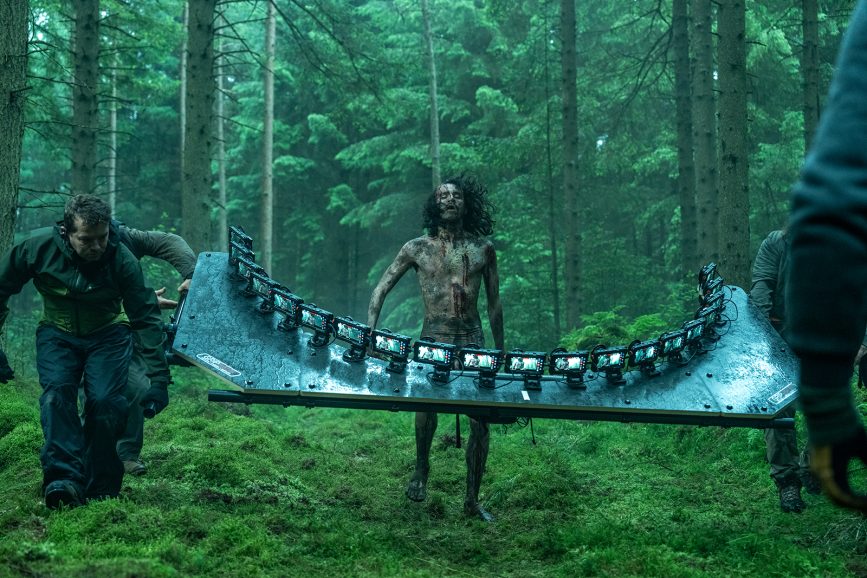
Dod Mantle and Boyle’s filmmaking journey has seen them develop many ambitious techniques. “You just have to be ready for anything,” says the DP. This time they set out to explore the agility of shooting on phones, combining them to create an array, something they touched on shooting Pistol with Canon EOS R5 still cameras rigged together in a bar cam rig [a similar system to those used to capture stunts in films such as The Matrix].
“Size and light weight came into play so the bar cam could spread out the spatial angle to one point of action, with an arc around which the array works,” says Dod Mantle. “Danny liked that you move around that space rapidly, frame by frame. There was also something about the actors not knowing where the camera was coming from; they land in that space and the cameras are around them.”
Boyle adds: “It gives you 180 degrees of vision of an action, and in the editing you can select any choice from it, either a conventional one-camera perspective or make your way instantly around reality, time-slicing the subject, jumping forward or backward for emphasis. As it’s a horror movie, we use it for the violent scenes to emphasise their impact. For a moment the audience is inside the scene, the action, rather than classically observing a picture.”
The director highlights a powerful shot in the second half of the film captured using the 20-rig camera: “You’ll know it when you see it. It’s quite graphic but it’s a wonderful shot that uses that technique in a startling way that kind of kicks you into a new world rather than thinking you’ve seen it before.”
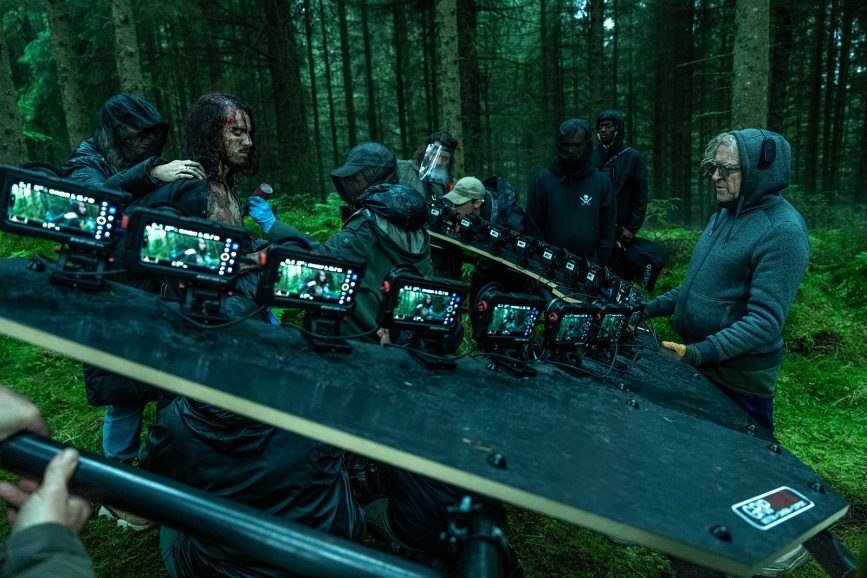
For David Reeves and the team at Griphaus, developing a custom rig from the ground up for Dod Mantle using unconventional materials was a “dream come true”. They developed the super lightweight 8-iPhone bar cam with custom lightweight lens mounts and large 20-iPhone bar cam integrating products from Beastgrip and Quad Lock to provide mounting solutions and a more holistic appearance.
Systems went through 14 iterations, from an iPhone-only assembly to a full-blown “iPhone extravaganza”, quadrupling the original anticipated payload. Daily assembly and derig of the system in various terrain would be time consuming so the focus was on transportability, assembly, workability and adaptability, developing a system to be transported in parts and assembled locally. Creating a camera mount allowing for quick removal but maintaining the camera pan and tilt angles for the next day prevented needing to reset everything every morning.
Built using carbon fibre composite panel sections combined with custom reinforced carbon fibre tubes, modified Doughty Clamps and 3D printed camera mounts, the system allowed landscape or portrait camera mounting and filming radially/outwards or nodally/filming to a point.
“Having worked with Danny and Anthony before, we knew to expect the unexpected. Therefore the “handheld only” request was never going to be adhered to, so we developed a general rigging plate mounted onto an OConnor 120 EX camera head and a large mounting plate and counterbalance system for a Libra remote head,” says Reeves. “Following a successful test with ARRI Rental and Camera Revolution, we mounted it on the end of a 50ft TechnoCrane for a causeway scene.”
Although originally commissioned to design the bar cam, key grip Williams asked grip Reeves and camera loader Ben Roberts from Griphaus to manage the rig. Roberts even developed blood splatter “iMac” raincoats for iPhones and to better suit VFX requirements Griphaus created an impromptu bar rig fitting within the confines of a train carriage, providing full 180-degrees of coverage inches off the floor.
Churchyard, Knight and B Cam 1st AC Ben Foat set up and checked each camera of the bar cam individually, ensuring they were lined up and settings like exposure and focus were correct. “Touchscreen cameras made it difficult to manage, especially at the pace we were shooting,” says Knight. “As the team developed a rhythm, we could dial these settings in more easily.”
Variable NDs were used for all bar cam rigs if quick exposure changes needed to be made. A later beta version of a ‘master’ iPhone connected all iPhones to the same network, allowing simultaneous control of all phones.
“Reloading an array rig and being handed 20 mags, while running around forests and beaches in addition to the dedicated quality control role” made the film one of Knight’s most challenging but also one of the most “memorable, intense and gratifying” experiences. “We pioneered new methodologies, led by an inspiration, Anthony, who has always broken new boundaries. Every day he thanked us for our hard work as we trekked deep into rural areas that had never been filmed before.”

An assortment of weapons
Through experimentation and extensive testing, Dod Mantle gathered “an assortment of weapons” that could be used with the iPhone that could do different jobs, and “get us out of hell and into hell, if necessary”. While there was no pre-established link between Apple and the filmmakers, the iPhone worked well with the Blackmagic Camera app which Dod Mantle refers to as a “filmmaker’s app” due to terms it uses such as aperture, shutter speed and shutter angle.
“The words are the same, but the function and software mechanism inside the phone is different, but it was closer to feeling like a filmmaker with a phone,” he adds.
Discussions with Apple and Blackmagic about how to get the feed from the phone resulted in a workflow incorporating a backpack rig for each iPhone which all accessories were built into, created by Knight, Churchyard and 2nd AC George Pedol and referred to as the Flux Capacitor. The iPhones had USB C extension cables that went over the operator’s shoulder or down the side of the head and legs. The Anker USB C Hub had an HDMI out, PD USB C port and standard USB C port and the HDMI out was fed into a Blackmagic HDMI to SDI converter, which then fed a Vaxis transmitter.
The PD Port was plugged into a Bebop battery, providing power to the iPhone, charging it while shooting. The USB C port had a USB C cable plugged into a rugged external Samsung Shield T7 SSD hard drive to protect data in case they were dropped.
“We opted for external 1TB camera mags to avoid the iPhone maxing out its capacity or having to switch out iPhones when reloading the camera,” says Knight. “Considering we had 55 iPhones on the job – including our standard shooting packages and the 8- and 20- bar camera iPhone array rigs – this also meant we had 170 T7 Shield SSDs camera mags to service this insane number of cameras.”
A beta version of Blackmagic’s app was made available through the Apple TestFlight application, with any additional features requested, also working with the Apple team including Jeff Wozniak, John Carr (workflow support) and Sam Jones (support). “We were initially not able to output Apple Log, framelines, and we added the 2.76:1 frameline which took advantage of the 1.55x Atlas Mercury Lenses with the 16:9 iPhone sensor,” says Knight, who also praises data manager Andrea Michelon and DIT assistant Alex Charlesworth from his team, CineArk, post production supervisor Ann Lynch and the Blackmagic team.
“Shutter degree angles are not the same as in conventional digital cinema, so we worked out our vocabulary first and tested which shutter speed worked best for different scenes, from the violent to the serene,” adds Dod Mantle. “We ended up with an app in the camera that allowed me to control fundamental things in the field.”
Intentional imagery
Ed Lachman ASC’s EL Zone System was used along with spot metering (on an Odyssey 7Q+) the Log feed, Knight’s preferred workflow on set. An input LUT provided by Company 3 from Apple Log was used, converting it into LogC3, which allowed the DIT to use predetermined IRE values – 39% for medium grey – to monitor exposure correctly. This conversion was done through LUT boxes (Box IO) on his DIT rig, and then implemented in the colour pipeline. This he considers “the secret sauce”, allowing them “to nail exposure on the day”.
The film was also finished in LogC3 in the grade by Company 3’s Jean-Clément Soret, informing the team’s decision to resemble this process on set. “Exposure was a serious challenge,” says Knight,” which began with us searching the web for Full Spectrum screw in ND filters, as many screw in filters had IR pollution issues.” Tools like the EL Zone provided a quick reference when clipping and overexposing.
“As we did not have a T stop, we used ASA to ride exposure in thirds of a stop. Considering there was no ’native ISO’ for the iPhone, we attempted to keep the ASA between 55 ASA – 400 ASA, minimising noise when possible. These values provided the cleanest image.”
Much of the film was shot in rural landscapes and exterior locations with fluctuating light levels. On a cloudy day with intermittent sunlight they set exposure in the ‘middle ground’ (often starting around 250ASA) so if the sun appeared or cloud darkened they could use dynamics in the DI.
The show LUT – ARRI_Photometric_v2_Rec709 – is one LUT Soret uses in house at Company 3. Input LUTs were used for various camera formats the team shot on to convert colour spaces into LogC3 (Apple Log, GP Log (GoPro), DJI D Log and Panasonic V Log. All onboard monitor LUTs were concatenated with the Apple Log to LogC conversion, along with the show LUT.
LiveGrade was used on set – the first time this has been done with an iPhone – creating CDLs for different looks. “We shot a lot of day for night where these CDLs became integral to visualise what it would look like in the cinema. These CDLs were then sent to the dailies colourist who balanced everything for the rushes,” says Knight.
The grade was integral to the technically ambitious film’s success, seeing Dod Mantle reunite with Company 3’s Soret for a tenth time. “Danny likes to shoot fast and we were often working with available light, so some aspects were refined in the grade. It’s getting it the best possible organically during the shoot and then working with editor Jon Harris to rip it apart and put it back together again and in the grade it’s part damage control and part creativity,” says Dod Mantle. “But this film was pretty much in the ballpark of what we expected.”
Boyle and Dod Mantle sought a look reminiscent of 28 Days Later in some ways. “Although it was dictated by technical limitations at that time, it brought something to the aesthetic,” says Soret. “Rather than a desaturated, gritty look that would have been a natural choice, we went for a vivid colour palette this time.”
Limitations Soret faced included dynamic range, stability, focus, noise, and artefacts. “But they were part of the look and embraced, removing some and adding some. Everything in the image is intentional and a result of an artistic choice.”
Used to “making things beautiful, high quality, expensive”, Soret adopted a different way of thinking. “It was different this time: raw and unconventional. Anthony, Danny and I always explore the possibilities of reframing during DI, including camera shake, stabilisation, vibrations. We added quite a few thumps, crash zooms, red blood, played a lot with skin tones, highlighting details, even composited some images to augment their impact.”

Demonic energy
Dod Mantle knew aerial would be a powerful addition to the storytelling arsenal, but “didn’t want them flying around all over the place, like sports cameras” as it is not what he considers “dramatic storytelling”. He likes safely flying high-quality drones close to actors, “enjoying the dramatic approach when moving down to eye level or 20 feet in the air; both are essential and the movement is just as important”.
Drone operator Peter Keith (Pistol, T2: Trainspotting) was tasked with presenting characters within vast environments, reflecting the basic, brutal existence of the island community alongside the constant threat on the mainland. “But the brief was not to romanticise the landscape,” he says. “The film is a series of journeys across many landscapes with characters always on the move, so Danny and Anthony felt a drone would help capture the action without disturbing the terrain underfoot.”
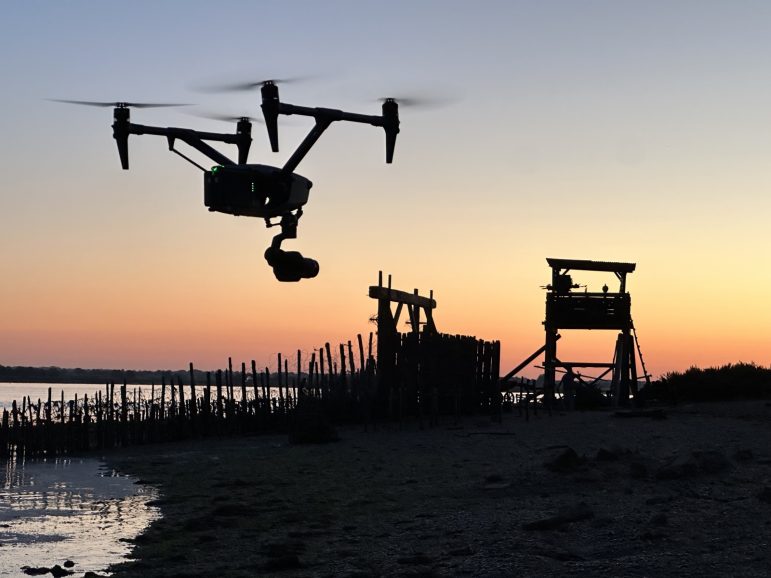
Dod Mantle also wanted to use alternative methods to achieve closer angles to actors rather than solely relying on them as wide scene setters. Unusually for drone work, Keith and his team – Robbie Jones on camera, Joseph Dixon Tsitsikas on focus and Keith as remote pilot – were engaged throughout the shoot, involved with main unit nearly every day including interior locations, mainly working with the DJI Inspire 3 as it is a “flexible and dependable craft, light and mobile, quick to setup and safe to fly in closer to cast with prop guards fitted”.
“Whether skimming over long grass or rivers, flying under the canopy of the forest, descending the spire of the abbey or pulling back under the bridge in front of the vast overflowing dam, we were there finding angles not always associated with drone material,” says Keith, who highlights capturing Kelson leading Spike and Isla in to the bone temple as a highlight, slowly tracking back in front of them in one continuous move and then rising up to reveal the central structure as they see it for the first time.
Smaller FPV drones captured more kinetic aerial shots such as arrow hits, chasing the infected through forests and swooping down over Jamie and Spike crossing the causeway. The FPV aerials’ energy fitted well with the “frenetic sequences Danny loves to create”.
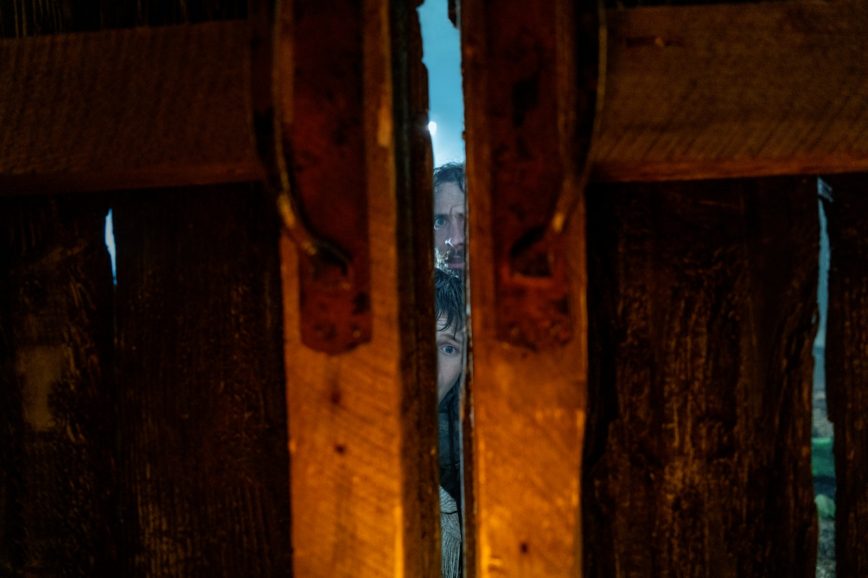
The terror is elevated in hellish infrared sequences of demonic creatures captured at ground level too. While being committed to the iPhone, it was not possible to “rip them apart” to achieve the desired look, so a system that could capture perceived thermal energy and infrared was required.
“Danny and I are keen on that kind of thermal energy where you see a deer’s eyeballs, and there’s almost a yellow energy inside the animal. We wanted to translate that to shooting actors,” says Dod Mantle.
Having previously tested the Panasonic AU-EVA1, Ciupek knew the filter could be removed to achieve invisible light recording. Working with IR lighting and “shooting it blind” before grading it blood red allowed the vision to be realised, following extensive and sometimes amusing testing.
“After a long day shooting in Northumbria, Stefan and I went into a field and chased sheep, trying to film them with the system while the light dropped down. We found a palette I think is interesting and nasty,” says Dod Mantle, who also worked with filters and elements in front of the lens like grease, oil and crystals.
Perfect pairing
Gaffers David and Ian Sinfield had not worked with Dod Mantle for a decade due to their schedules, “but being on set with him again, it felt like we had not been apart; he’s a brilliant man and DP,” says David Sinfield.
“The Sinfield brothers are great separate, but even better together,” adds Dod Mantle. “Their team was amazing and flexible – they could do big rigs or stand next to me with a handheld Astera.”
Working with real locations with limited space required thinking outside the box regarding how to move fast. “With multiple iPhone camera set-ups with limited latitude, we needed to allow actors to be free to move and in the moment without lighting affecting them,” says Ian Sinfield.
Recces informed them there would be many ins and outs of locations in one day and remote, hard to access sets both day and night. Green Voltage batteries became the key power source as some locations did not permit using diesel generator due to either cable run length or time permitting and some locations seeing 360. Nanlux 2400 B lamps, small HMI and Creamsource Vortex lamps allowed them to work in remote places, moving through forests and farmland quickly and easily, always prepared to move either to the next location or just out of shot.
Aside from the causeway sequence’s studio set-up, the biggest build was the bone temple, the setting of one of the most emotionally charged scenes. Difficult to light as it was in a beautiful but inaccessible valley and the surrounding area needed to be preserved, it required a cluster of MBSE Vulcans on a crane which could be driven in in a trackway and not be seen, offering around 340 degrees of filming angles. They also positioned 360 manitous with Vulcans on around the hidden trackway, with all fixtures supplied by MBSE.
When transitioning to night, a large overhead lightbox with Astera Titan Tubes and Ayrton Dominos was moved around the set, creating an underexposed ambience. Vulcans on machines changed to Vortex 8 clusters and Dominos and Vortex 8 were positioned on turtles around the site for backlight atmos. Astera Tubes and V4 were used in pixel mode for fire effects along with real flame bars provided by SFX. For backlights and edge light mainly V8s were used and Ayrton Dominos that played cooler.
“We had less time at the bone temple than Sean Bobbitt BSC, who shot the film that will follow this one [directed by Nia DaCosta], as it is one of that movie’s main locations,” adds Dod Mantle. “We had a few days there but would have loved to spend weeks to really explore that extraordinary build.”
For other night work, the Sinfields aimed for simplicity. As there is no electricity in the movie’s narrative, they mainly used moonlight as a “key light and a reason for the lighting”.
Creating the magic
Adam Gascoyne, VFX supervisor and co-founder of Union VFX, has found working with Boyle and Dod Mantle on a broad spectrum of projects over 25 years to “always push the creative and technical boundaries”.
“It’s a place I’ve found myself most comfortable. They do not make films you traditionally associate with VFX,” he says. “Everything we do must be very much background and found within the photography, requiring extensive planning to achieve that and give them freedom to shoot and get the performances they need without interference.”
The 4:2:2 chroma subsampling of iPhone footage lacked the colour detail of 4:4:4 formats, making blue or greenscreen keying less effective. To address this Union utilised greyscreens and roto for bigger studio-shot scenes. The sensor also offers limited dynamic range, leading to clipped highlights and some edge artefacts.
“We leant into this, matching iPhone clipping levels on CG explosions to maintain that aesthetic,” says Gascoyne. “Variable shutter speeds occasionally created challenges matching motion blur in CG, and zoom or focus changes via the touchscreen weren’t recorded, complicating matchmove and distortion workflows. CG tracking was comparable to standard cameras, with accurate parallax and no major rolling shutter.”
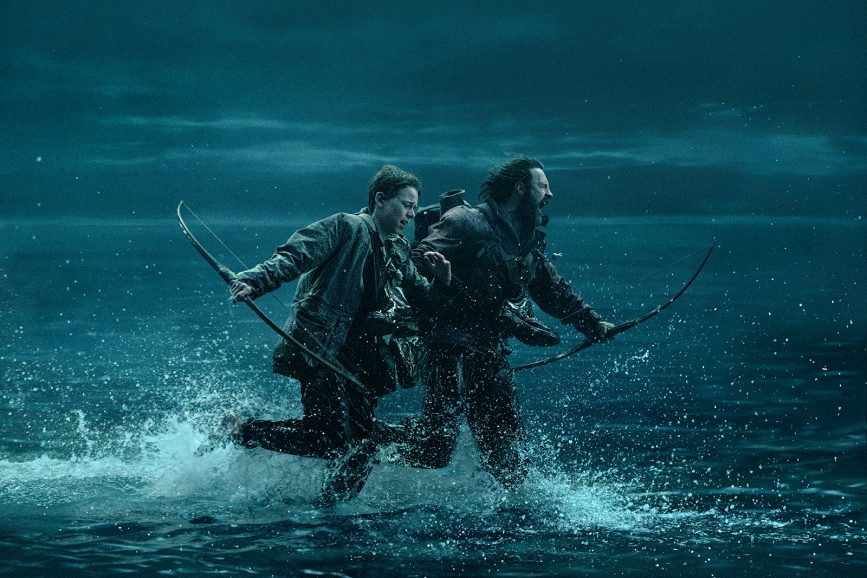
Union’s team of 148 across the London and Montréal offices, supported by the wider Union team, delivered close to 950 VFX shots. Sequences such as a magical, almost ethereal causeway scene which sees Jamie and Spike fleeing from danger along a tidal causeway, were visual effects heavy, containing almost 130 VFX shots.
The causeway had to look like it was 1.5 miles long and included a fully CG aurora nebula sky housing a murmuration of more than 10,000 CG birds. “We created an environment for that to happen in, and extended all that water out and put it in the sky. We had amazing photographic references from photographer Dan Monk at the Kielder Forest Observatory,” says Gascoyne.
“At certain times of year the Milky Way is perfectly clear because there’s no light pollution around. This inspired us to put this amazing sky above the causeway because we felt after 28 years of no light pollution, you would see amazing, beautiful vistas at night.”
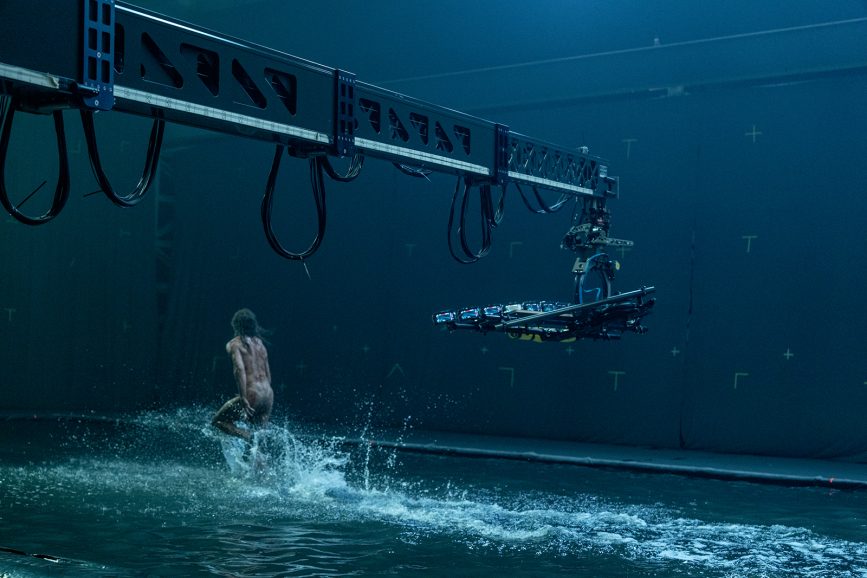
Footage captured using a bar cam array at a studio-like set-up outside Newcastle – complete with lighting grid and 100-metre water basin – was combined with the environment created by Union. They also experimented with the contact water so “when the actors’ feet touch the water, there’s almost a glow like the bioluminescence created by plankton”.
Bleak beauty
Dod Mantle finds the juxtaposition between the beautiful and horrifying an important and interesting element of horror films: “Beauty’s in the eye of the beholder and is a very individual thing. Danny and I discussed whether this film potentially became too beautiful in places, but some of the most horrific films I’ve seen – Psycho or Romero – were beautiful.”
While he has worked on ambitious and demanding films, both with Boyle and other pioneering directors, he considers this film the most technically challenging. “It’s uncovered territory and while it’s not unusual for me to work with a vanguard idea and creative struggle, this was experimentation concentrated in prep and working with technology with a mind of its own which is wonderful and Danny may have liked to explore even more.”
28 Years Later was an extension of, “but just a bit madder than, some of the mad productions” the cinematographer has lensed. “It’s another level and I’m proud of that and happy to have got the chance to do it. The priority is always understanding where to be with the camera and thinking for an extra moment about why, and really feeling what you’re trying to convey. That immediate proximity to the camera and understanding how you move is difficult to get right. You can’t teach it, you’ve just got to feel it.”