
ROMANCE AND RUIN
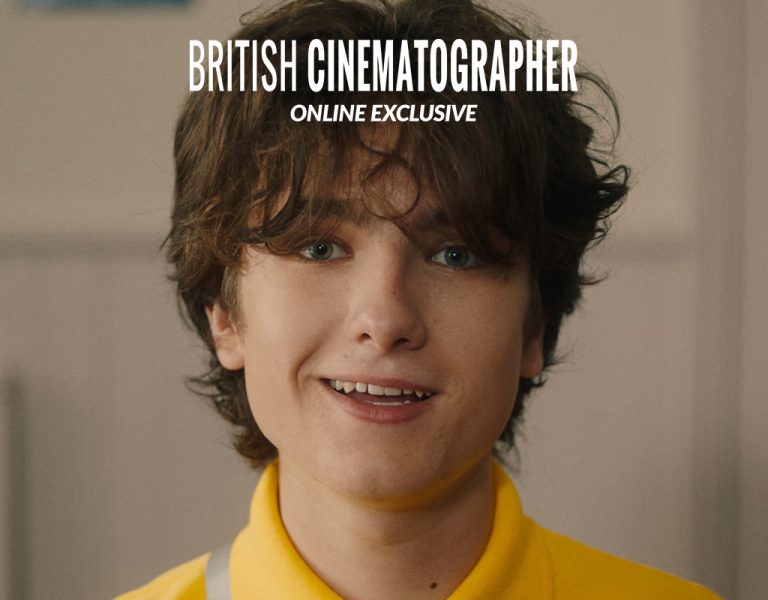
Shooting on 35mm and VistaVision, Linus Sandgren ASC FSF embraced a painterly approach when helping achieve Emerald Fennell’s bold vision of Wuthering Heights – a tale of obsession, desire and despair. Whether capturing sweeping Yorkshire moors, passionate performances or exquisite set design, emotion was the driving force behind every shot.
In true Emerald Fennell style, the writer-director’s interpretation of one of the greatest love stories ever told — Emily Brontë’s Wuthering Heights — is bold and brave, especially visually thanks to her collaboration with Linus Sandgren ASC FSF. Artistic freedom and shared instinct steered their partnership in a welcome extension of the boundary-pushing dialogue that began with Saltburn (2023), once again rooted in trust, bold ideas and conveying the emotion of the story.
With a screenplay penned by Fennell based on the first half of Brontë’s book, the daring story of romance and forbidden passion which descends into madness and destruction stars Margot Robbie as Cathy and Jacob Elordi as Heathcliff, the orphaned boy taken in by Cathy’s father Mr Earnshaw (Martin Clunes).
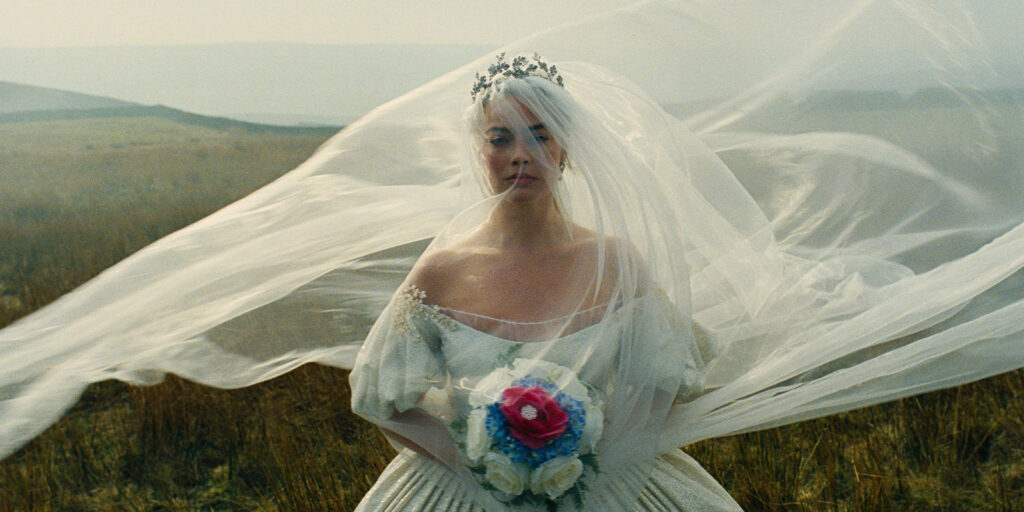
Fennell considers Brontë an artist, having physically responded to the book since she first read it as a teen, believing it to be so ahead of its time it would not make sense to treat this interpretation as a traditional period drama. “[Emily] was a transcendentally genius poet, and her work connects to people in a way that very few things do. So really what I wanted to do was acknowledge my connection to it, to the way that it made me feel, and know that it wouldn’t necessarily be the way that it made every reader feel.”
As a director, she aims for audiences to have a visceral reaction to her films and focused on accuracy of feeling rather than period. “The book is extraordinary because it absorbs you into it, it swallows you up, so that is the feeling we endeavoured to recreate for a movie audience,” she says.
Having enjoyed a “fantastic and inspiring” experience on Saltburn, Sandgren considers Fennell a “genius, original auteur who is fearless and trusts her own instincts”. This approach mirrors that of other directors he has collaborated with such as Damien Chazelle (La La Land, FirstMan, Babylon) who focus on discovering the most truthful way to tell a story rather than convention.
A fresh take on a classic tale
Sandgren had not read Wuthering Heights prior to joining the production; instead choosing to respond to Fennell’s interpretation of a love story of hope and despair, obsession and tragedy.
Conceiving cinematography as a form of “painting with light,” he often looks beyond cinema for inspiration. Rather than drawing too directly from other films, he turns to painting and photography, whose more indirect influence allows him to develop a visual language unique to each project, one aimed at producing imagery that feels both original and emotional.
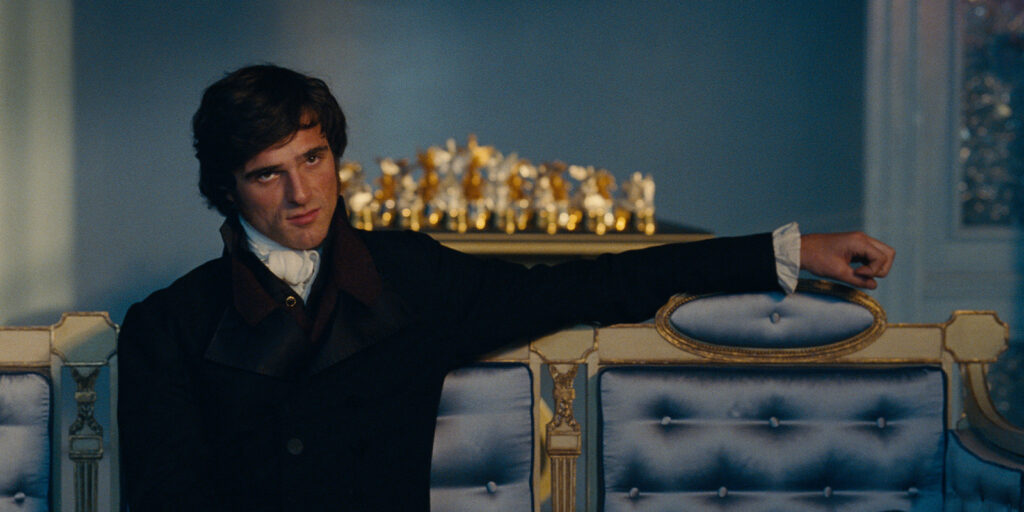
“Uniquely to this film, I was allowed to paint with light without feeling the restraint of reality,” he says. “It was only about lighting and composing each scene, to convey the right emotions.”
Achieving this also required the whole team to collaborate on blocking. “Margot and Jacob are true filmmakers who believe in the visual storytelling as much as Emerald and I, and I am so grateful that they helped us work out the blocking, so we were able to both light and compose the shots in the most powerful way possible.”
Drawing upon a range of artists, from Baroque through to Romantic, he finds dramas lean towards Impressionism. But Fennell’s take on Wuthering Heights was infused with obsession and emotional extremes, demanding a more visually expansive approach, almost beyond reality. “If the story goes all the way, then the visuals should too,” he says.
For Margot Robbie, who executive produced as well as starring in the film and first worked with Sandgren when she starred in Babylon, Fennell’s instinct to incorporate the physical aspect is central to her films’ success. “It’s always about the sweat and the spit. It’s about these very physical reactions that the characters are having, and letting the audience see it and also share in that physical experience,” Robbie says.
“Her instinct is to put that glistening sheen in the frame, and Linus captures that amazingly, whether it’s these shots of sweat falling down someone’s neck, or rain on someone’s face falling into their mouth… They’re a great combination, DP and director, in that way, they really feed off each other’s inclinations to give that experience to an audience in the most beautiful way.”
Brutal beauty
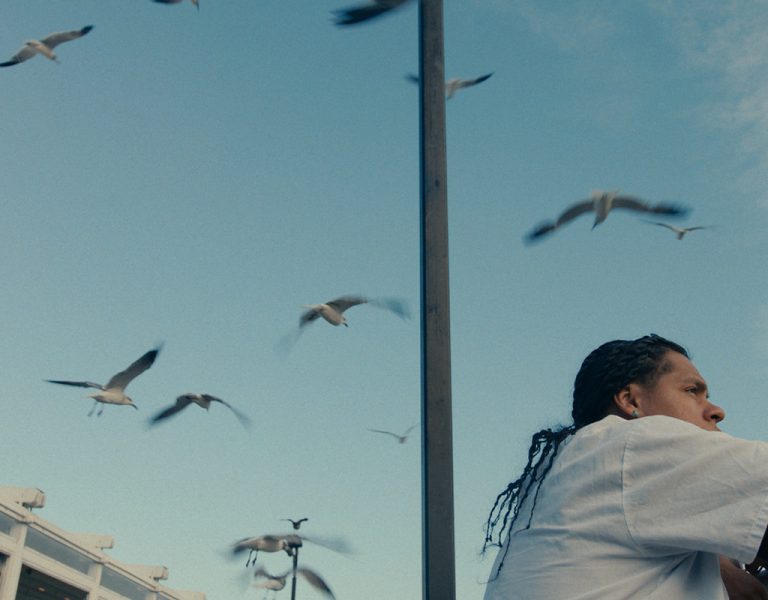
With part of the story unfolding on the windswept Yorkshire Moors, landscape and weather conveyed drama and mirrored characters’ emotions. Fennell wanted nature to function almost as a character, which Sandgren highlights also placed the film within the Romanticism art movement. “Taking place in the Yorkshire Moors means it’s already naturally dramatic. Emerald wanted it to be like man against nature,” he says.
Drawing inspiration from artists such as Johan Christian Dahl and Caspar David Friedrich, he found their work exploring loneliness and humanity dwarfed by vast landscapes aligned with Fennell’s visual ambition. Eugène Delacroix, and his use of striking reds within compositions, informed bold colour choices in Wuthering Heights when red dominates the frame, heightening the visuals and extending them outside the realm of realism.
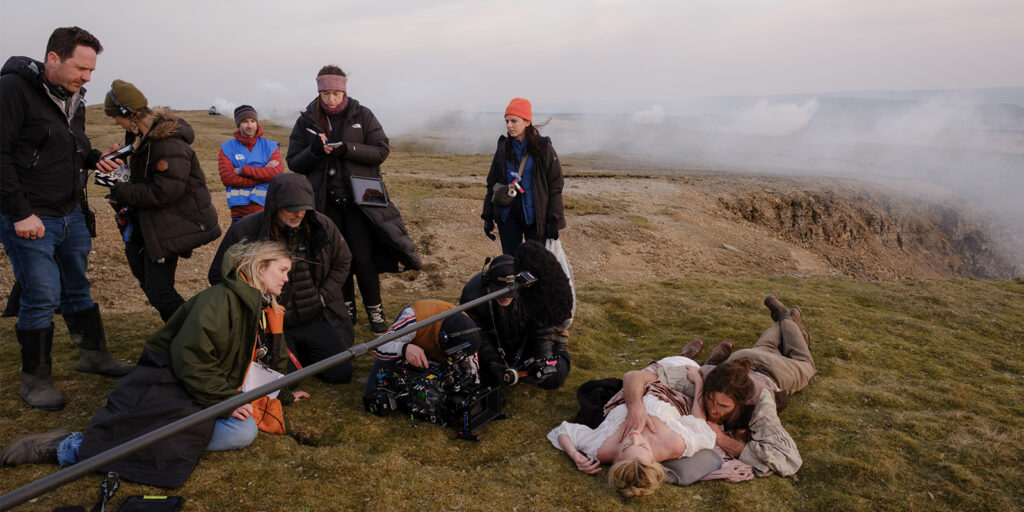
While location work took place in the Yorkshire Dales, most of Wuthering Heights was shot on Stage 1 (the Thrushcross Grange set combining inside and outside spaces allowing continuous movement between rooms and garden), Stage 3 (the Wuthering Heights house) and Stage 4 at Sky Studios Elstree in London. Filming also took place in 600-year-old stately home Knole House in Sevenoaks, Kent, including the opening sequence where young Cathy and young Nelly watch the spectacle of Hanging Day.
When working with production designer Suzie Davies — who also helped create the world of Saltburn — Fennell wanted the bleak and brutal Wuthering Heights house where Cathy and Heathcliff spend their childhood to feel like a place that is being taken over by a hostile landscape. “It’s sliced in half by huge slate rocks,” says Fennell. “And as it ages it becomes more malignant, it starts to crack, things start to ooze out of it. In the gothic everything is alive, so we wanted that to extend to the sets.”
As Sandgren highlights, “the Wuthering Heights house needed to feel miserable and was all about the wetness, filth and a claustrophobic feeling”. In contrast to Wuthering Heights — “a place where nature is thrusting itself into the man-made” — the more colourful, seductive Thrushcross Grange which tempts Cathy to leave her life behind and marry wealthy Edgar Linton is the opposite and attempts “to constrain nature”. Fennell wanted it to “feel like a place of unimaginable luxury and wealth” and to replicate the feeling Dorothy experienced stepping from the sepia world into the Technicolor land of Oz in 1939 film The Wizard of Oz.
“Thrushcross Grange is like paradise, seducing Cathy to make her feel like she has everything,” adds Sandgren. “We then learn the colourful things are hollow and she feels trapped there instead, imprisoned through ambitious set design of elements such as the staircase.”
In Davies’ bold design for Cathy’s bedroom Robbie’s skin, including veins and freckles, was printed onto padded fabric with a sheer latex overlay, and trapped inside panels. The fireplace was created by sculptor Megan Skill from casts of hundreds of hands — many belonging to crew members — which in certain lighting, created shadows resembling birds in flight.
Fundamental to Fennell’s approach was ensuring everything was “handmade and shot in-camera. The fun of making something from scratch, and why we wanted to make a kind of old school studio movie, is that you can decide everything, even where the windows go, so you can control the light and create your shots from early on”.
In every aspect of the production the filmmakers were “feeling out where the edges were, where the pleasure centres were, where the cliff edge was (and often going off them!). If we have a physical response to a room, or a fabric, or mise-en-scène, then so will the audience. Pushing boundaries, putting things under just the right amount of duress, just before they break, that’s where the interest is for all of us,” she says.
The joy of celluloid surprise
Sandgren and Fennell share a love for celluloid shooting and its unpredictability, texture and expressive quality, choosing to capture Wuthering Heights on 35mm and VistaVision, fulfilling Fennell’s desire “to see the grain”.
“[Linus] always shoots on film, which I love about him, and he always makes everything stunning, but also visceral, like it’s alive,” says Robbie. “The frames he creates can look both liquid and painted, but also gritty and real at the same time. It makes you want to be there. It makes you want to be in it. There’s something delicious about it.”
Despite testing push and pull processing, Sandgren and Fennell settled on normal processing with one stop of overexposure using tungsten stock — Kodak VISION3 5219 (500T) and 5213 (200T).
Cinelab Film & Digital handled processing and 4K scanning throughout the shoot and produced the digital scans used in post. The scanning pipeline preserved the full tonal range and texture of the photochemical image while integrating smoothly with the film’s digital post workflow, ultimately supporting the grade with Company 3 colourist Matt Wallach.
From Cinelab’s perspective, the project reflects continued interest from cinematographers in the aesthetic qualities of large-format photochemical capture. VistaVision in particular offers a noticeably larger negative area than standard 35mm, allowing Sandgren to capture fine detail and subtle tonal gradations while retaining the organic qualities uniquely associated with film. Cinelab ensured the negative was processed and scanned with the highest fidelity, carrying the character of the original photography all the way through the digital post pipeline.
Having initially considered an aspect ratio of 2.35:1 and reflected on Saltburn where they opted for 1.33:1, the filmmakers felt this story called for more classical framing reminiscent of Gone with the Wind and that 1.85:1 aligned with a painterly composition while allowing high ceilings to be seen.
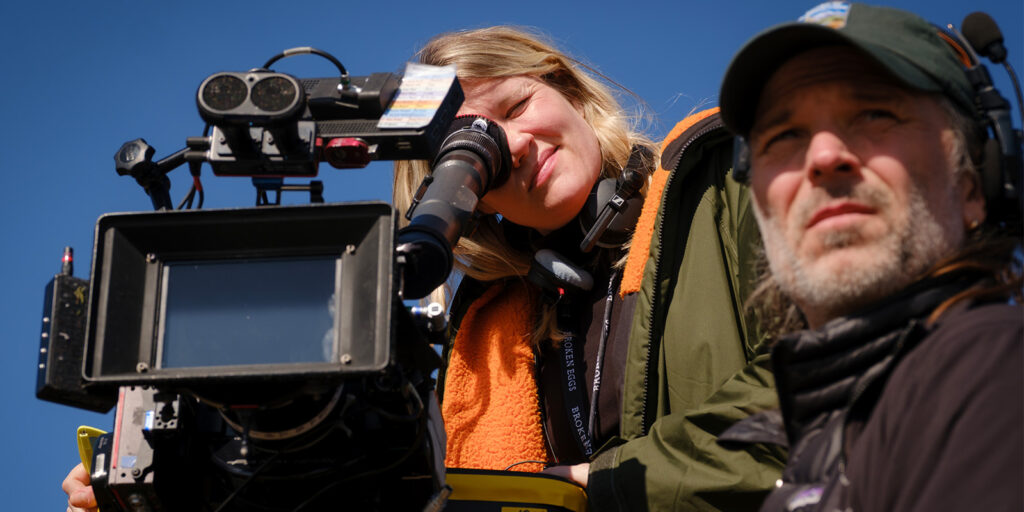
Serviced by Panavision, the film was shot on Beaumont (Beaucam) VistaVision 8-perf cameras for wide shots of landscapes and expansive stage builds where detail was key. For the majority of the film, the compact Aaton Penelope 3-perf camera allowed nimble shooting. “It’s a smaller and neater camera that’s easy to rig and use in tight environments. I used it on Jay Kelly too; it’s so quick to work with but you can only shoot 3-perf or 2-perf, so you can’t shoot anamorphic,” says Sandgren, who previously combined formats in a similar way on The Nutcracker and First Man, using larger formats for wider frames and smaller formats for more intimate sequences.
While the VistaVision cameras were noisier (as the filmmakers did not work with soundproofed “blimped” cameras) and presented some technical challenges, shooting with two units ensured reliability. Emotion guided camera movement, with camera operator Ossie McLean ACO SOC adopting a slow creeping motion, more erratic movement or static camera depending on what the narrative demanded. Jo Eken Torp FSF was splinter unit DP, shooting sequences alongside the main unit such as horse riding shots and close-ups.
“In a scene where drunken Mr Earnshaw talks to young Cathy and Heathcliff we used quite static camera language and tight shots until he stands up and moves,” says Sandgren. “Then it’s one camera move as he pulls Heathcliff around the table and into another room, the door closes and you hear whipping. The intention was to go from static and claustrophobic to more brutal movement, considering emotion and not overusing crane or dolly moves. Key grip David Appleby worked with varying sizes of crane, from a 23-foot to 78-foot Scorpio, allowing flexibility in different sets.”
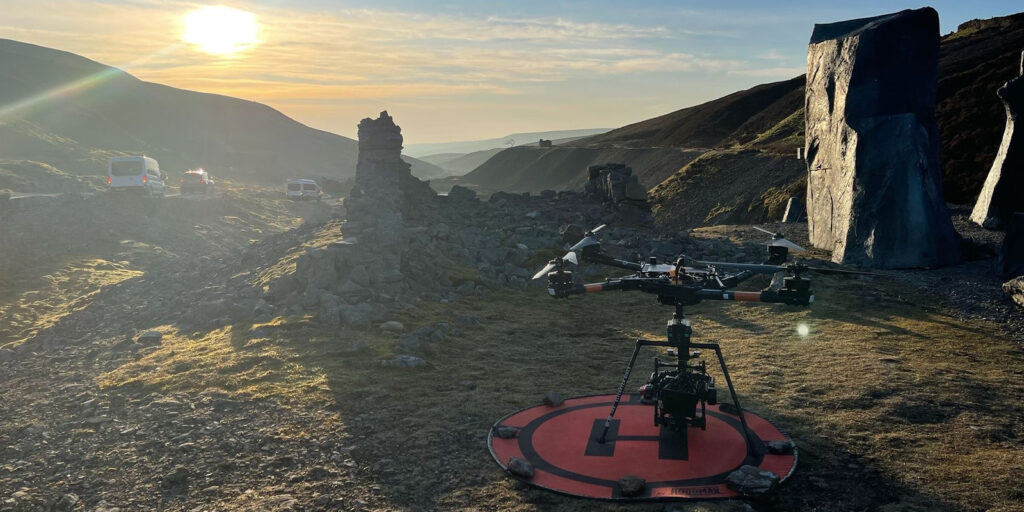
Helicopter Girls pilot Pete Ayriss, aerial DP Will Roth and 1st AC Glenn Coulman carried out aerial work, connecting the characters within the bleak landscape such as the horse tracking in silhouette along a ridge or following young Cathy and Heathcliff running over rocks with a playfulness within a vast wild setting. “The drone was there to help with beats of the story, set the scene and get to hard-to-reach places where it would be impossible to place a tracking vehicle,” says Ayriss.
They flew the ARRI 235 film camera under their Alta X super heavy lift aircraft system, switching from a 400ft magazine to 200ft to accommodate the same Panavision Primo lenses Sandgren shot with. “We have full lens and camera control so only having two minutes of film in the air didn’t pose a problem,” says Ayriss. “We fly a Ronin 2 gimbal and that set-up proved ideal.”
Having flown film many times, the team know a thorough prep day is important to rig and balance the exact payload and check everything is working as expected, including the monitoring. “The benefit of shooting on film is that before you shoot, the conditions have to be exactly right — the ridgeline shot of the horse was at dawn, so we were in position before sunrise, waiting for there to be enough light for the ISO. We sat for a lovely moment, ready to go, watching the sunrise, able to appreciate the beauty.”
The breathtaking rocky, heathery uneven landscape was the biggest obstacle. “It was so beautiful and so inaccessible, so we had to overcome moving hundreds of kilos of equipment which took brute force and determination under time pressure,” adds Ayriss.
Sandgren also shot VistaVision on vehicles and captured some sequences using U-Crane including Heathcliff riding on horseback. “Jacob Elordi rode a fake horse and a 15-foot TechnoCrane off a raptor vehicle allowed us to do crane moves around him,” he says.
Intimate imagery
Spherical lenses were chosen partly due to the intimate nature of the visual storytelling. As well as working with a prototype lens created by Panavison, Sandgren chose to once again work with the company’s trusty Primos which impressed him on Saltburn, The Nutcracker and Jay Kelly by being “sharp yet not clinical and offering deep blacks and a distinctive, almost oily quality”. Prime lenses made it possible to “capture intimate shots and get in tight”.
As Fennell wanted to capture spontaneity, rehearsals were often filmed by a small crew so as not to distract from the performances and allow actors to immerse themselves in the action. Longer focal lengths were used when the story demanded to compress space and deepen emotional connection. Moving the camera on the dolly as actors moved and improvised was challenging and when often shooting at wide apertures such as T2 or 2.8, exceptional precision was required from focus puller, Jorge Sánchez.
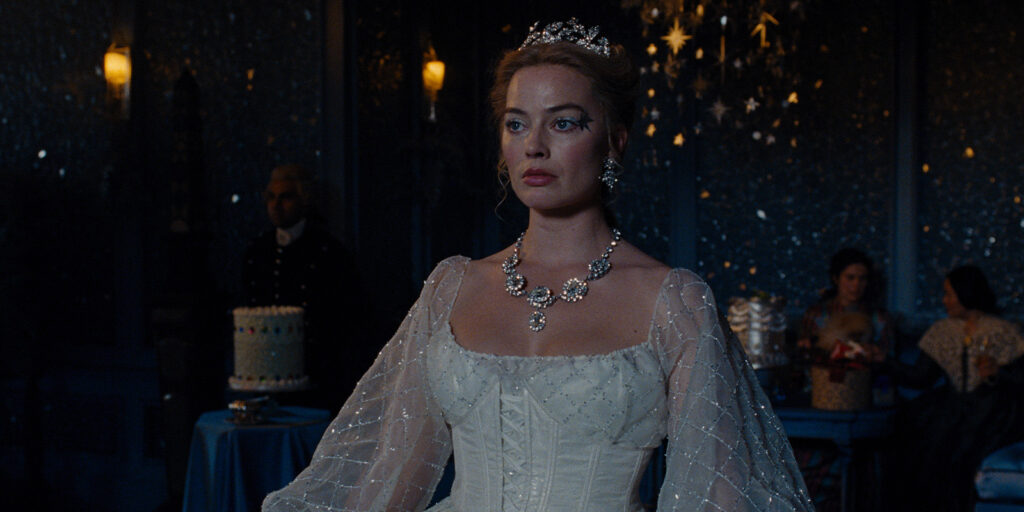
Among the most challenging but rewarding scenes features a doll’s house constructed by Isabella — Edgar Linton’s ward who was taken in by his family when she was orphaned. As it is a replica of the house in which they live the scene demanded close collaboration between all departments and a perfect scalable version of the room the characters were in, with food appearing and lit in the same way it was on the table. They achieved a shot where it appears the characters are in the room and then suddenly in the doll’s house with Isabella’s hand reaching through the window. The doll’s house reflective silver interior made it possible to manipulate colours, maintaining consistency, even when Isabella’s hand partially blocked key light.
Sandgren worked with Company 3 senior colourist Matt Wallach in the grade who he teamed up with on No Time to Die through to Saltburn and most recently on upcoming production Dune: Part Three. Dailies colourist Doychin Margoevski helped establish the look early, guaranteeing consistency through the edit and in the DI with Wallach. “Doychin and Matt both have a great sense of what we need and a similar visual taste which I respond positively to,” says Sandgren.
Drop it like it’s hot
Supervising art director Caroline Barclay worked with Sandgren and Davies to dress two sound stages at Sky Studios Elstree with wraparound Rosco SoftDrops. One 35ft-high by 463ft-long high-resolution Yorkshire Moors translight backdrop bordered the Thrushcross Grange gardens set, enabling lighting to simulate different times of day and weather conditions, and a second 49ft high by 434ft long SoftDrop was used in the Wuthering Heights set.
Sandgren began by offering guidance on the lighting range and dramatic sky he wanted to achieve before Davies and Barclay defined the dimensions and integration with the practical sets. Sky references Sandgren shared, with adjusted exposure and contrast, became Rosco’s reference points and Rosco RDI senior creative specialist Sarah Horton developed the skies and clouds using assets from the RDI (Rosco Digital Imaging) Library, supplementing them with location photography. The Wuthering Heights backdrop required precise shooting positions to align with built set pieces, while multiple Thrushcross Grange options were captured and combined into a composite fictional landscape, optimised for camera views on stage.
Lighting the Wuthering world
The theatrical yet naturalistic lighting approach avoided relying on large overhead soft boxes, sometimes leaning toward German Expressionism, from silhouettes in windows and stark contrast between darkness and light, with emotional authenticity always a priority for Sandgren. “Our idea was to use minimal VFX, accommodate for all scenes and be flexible so Emerald could choose to shoot what she wanted,” he says.
Having previously collaborated with Fennell and Sandgren on Saltburn, Ian and David Sinfield were excited to join “yet another passionate project”. Detailed meetings at Elstree Studios with production designer Davies and her team focused on the three major set builds, all needing to function as interior and exterior environments and requiring wind, rain, sunshine, overcast skies, dusk, dawn and night, often within the same controlled space. “It was pretty much everything you could plan for on a movie,” says David Sinfield.
While shooting on stage presents some challenges, “you also have complete control of the look,” Ian Sinfield explains. As Sandgren and Fennell are passionate about shooting on film, the lighting approach had to embrace bold colour choices and strong contrast, demanding extensive discussions about lighting tools, including traditional tungsten, LED and diffusion materials.
“You must trust your eye,” Ian says, “particularly when working at low light levels. You must be brave about how much you can push the film stock.” Some key night scenes were lit as much as four stops under. “This is when pre-lights on finished sets become most valuable,” says David. “You can play with colours and looks to decide what works best for the characters and story.”
The more colourful and expressive Stage 1 Thrushcross Grange set was lit by two 20Ks; 15 12Ks; two 6-light, two 9-light and two 12-light Maxi Brutes; 126 Space Lights; 224 Cineo Lighting Quantum Studios to achieve the brighter more romantic look; 12 Quantum 2s; 126 Creamsource Vortex 8s; and two 100K Luminys Systems SoftSuns on tracks simulated low afternoon sunlight for garden scenes, creating a more seductive look and feel before the cracks begin to appear and the reality of Cathy’s new life and her lust for Heathcliff become clear. Rain rigs, fog and carefully positioned translights allowed rapid shifts between flat grey and dramatic skies. Stage 3’s Wuthering Heights set needed to be harsh, overcast and textural and featured six dimmed or gelled tungsten 20Ks; 35 6-light Maxi Brutes; 60 Space Lights; 270 Quantum Studios; and six Quantum 2s, while Stage 4’s interior Thrushcross Grange set used 16 12Ks and 196 Quantum Studio fixtures.
Grey silks enabled precise control of soft top light. “If a key light had spill hitting the grey grid cloths, it didn’t bounce any excess light back onto the set which made things quicker and easier, especially if we didn’t need to flag every piece of spill light,” says David Sinfield. “It also enabled us to shoot off the Rosco SoftDrop for some scenes and became an extension of the overcast sky which helped due to our aspect ratio and high sets on the Wuthering Heights stage.”
Lighting the vast SoftDrops required skill due to space limitations. “For some scenes for dramatic horizons we would line up 5K tungsten lamps and blast them from behind the soft drop,” he adds. “Mixing tungsten and LED sources throughout gave a lovely mix of natural colour, especially through the grey grid cloths. Tungsten fresnels are always good when run low on a dimmer for a beautiful warm light. You can also achieve these on LEDs but we like how the film absorbed the tungsten sources when we tested and the hard single controllable light the fresnels gave.”
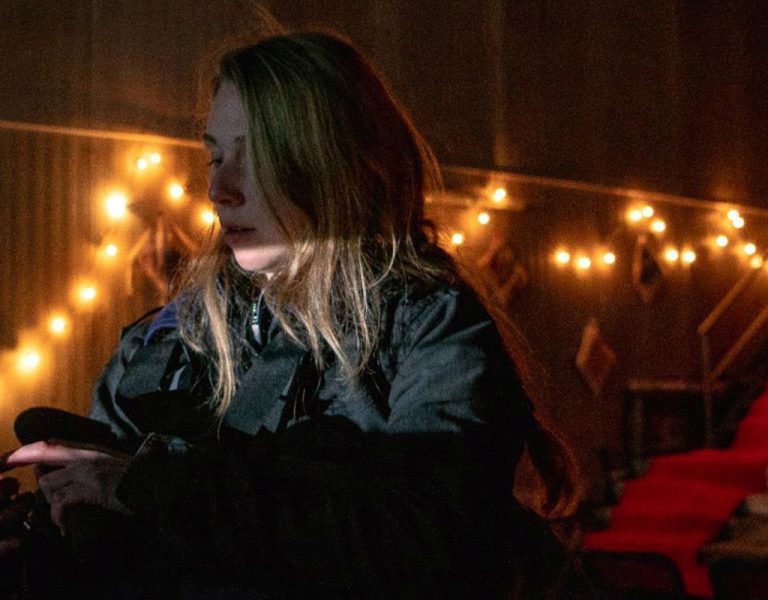
Night interiors were typically shot around T2.8, with the brightest sources sometimes as low as T0.7 unless practical flames were in frame. “Emerald wanted dark to be dark and Linus has an amazing eye for achieving this on stage and on film without using big lighting monitors,” says Ian Sinfield, who devised custom 275-watt tungsten bulb rigs in varying sizes to augment real fire sources, producing a rich warmth on skin tones that blended with practical flames.
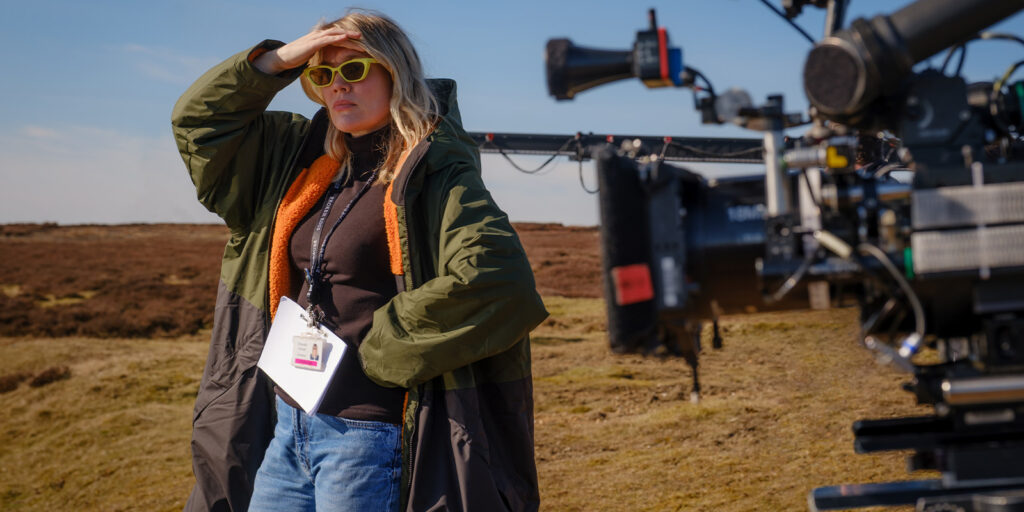
Despite the crew and cast hoping for grey, overcast weather for location work in the Yorkshire Dales, they were met with constant sunshine. Therefore they relied heavily on textiles to block or shape sunlight and bounce and negative fill techniques. Many locations were remote with limited access, so battery power and compact LED units were essential with larger fixtures like ARRI M90s used only when necessary. Instead of large-scale rigging equipment, most control came from ground-based stands, often in strong winds.
A portrait of passion
As with Saltburn — another tale of seduction and obsession — Sandgren and Fennell were unafraid to push boundaries. But emotion always guided the visual direction, whether it was tight eyelines reflecting power dynamics or the use of restraint when observing a character in profile rather than head on. “I see my work as an extension of a vision that should be strong because I want to make the director’s movie, I don’t want to make my own. I try to be open to anything,” says Sandgren.
He revelled in being part of a project driven by instinct and that was not only about passion but created with passion by a talented team. With no rigid rules or imposed period constraints, the filmmakers created their own unique visual approach that was bold, painterly and motivated by feeling.
“For me, that’s what every film comes down to: feeling,” he says. “This production felt freeing and offered an opportunity to go all the way visually.”