


Representing cinematographers in this year’s BAFTA Breakthrough cohort, supported by Netflix, is Nathalie Pitters – who was selected after her stunning work on Channel 4 two-parter Brian and Maggie. The one to watch explains what she hopes to get out of the programme…
Congratulations on joining the BAFTA Breakthrough cohort. How does it feel?
It feels very strange, but in a very good way. I feel really honoured about being selected. It can be difficult when you’re a freelancer, and especially when you’re a creative, to know if you’re on the right track. Have I made good choices in my career? Am I even good at this job? Do people like my work? Being recognised by someone like BAFTA is incredibly validating, and it does make it all worth it. It’s not an easy career to pursue. It can be quite isolating, quite lonely, quite scary, so it’s really nice to know that people believe in me and I have that support behind me.
Could you take us through your career so far, starting with who or what first sparked your interest in cinematography and how you got started on that path?
I’ve really loved watching films for forever, and that peaked in my teens. I also really loved photography. I liked photojournalism. But I didn’t understand the principles of composition, lighting and story. I was just like, ‘Oh, that’s a cool wall with graffiti,’ and I’d take a picture of it and move on.
I did English Literature and Art History at university. I wanted to study photography, but my mum was having absolutely none of that. She was like, “You have to study a real subject.” So I did those two. I remember I’d finished my undergrad, and my friends were doing master’s courses, but I didn’t have a master’s in mind. I felt very left out, because they all knew what they wanted to do and I didn’t.
So then I googled a bunch of stuff, including my interests – like photography, film, London master’s and so on – and the results came up with “study cinematography at the National Film Television school”. I was like, ‘Oh, what’s that? That sounds interesting… cinematography?’ I looked it up, and I was like, ‘Oh, holy shit. This is the thing that I’ve been wanting to do.’
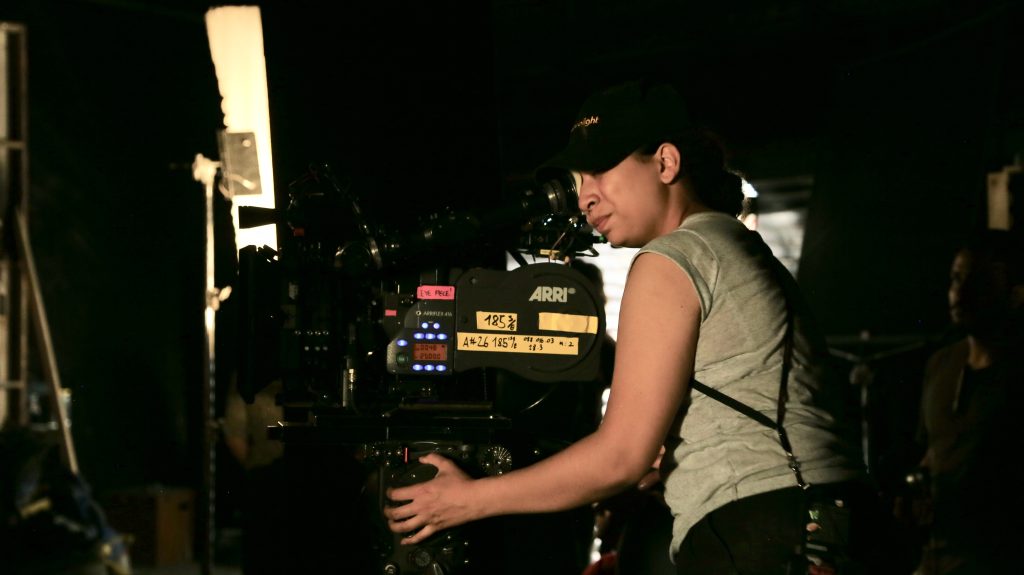
But then, from finding out that cinematography courses existed to doing anything about it was about nine years, because I was so nervous. It suddenly, immediately became my dream job, and I thought, ‘If I try it, and I’m crap… I can’t fail at this. I’d rather not attempt and never succeed than try and fail.’ So I put it off for ages. I moved to Japan, and I taught English for a few years. While I was there, I took loads of photos and made little videos, but there was something missing. And I think what was missing was the inspiration of collaborators. When I was trying to do things on my own, it was just a mess. I’d stand in a cool place and try to take a video and just feel lost.
Eventually, I had to come back from Japan because my mum was sick, so I came back to look after her, and I thought, ‘Well, now that I’m back in London, why don’t I try this film school thing?’ So I applied to London Film School, got in, did an MA in filmmaking, did not know my ass from my elbow, but somehow did quite well.
I graduated as a DP, but then still didn’t feel like I knew what it meant to be a DP. I still didn’t feel large and in charge. I decided to help out a bit with my friends, ACing and sparking and just doing anything to be on set, in the camera or lighting departments, for about 18 months. Then I decided to try and apply to NFTS, and I was very nervous. I did not think I was going to get in. But then I did, and it changed my life – it made me feel a lot more confident about my abilities on set, and it taught me how to manage people, how to lead people on set, which I didn’t really know how to do before.
What qualities do you look for in a project before deciding to take it on?
My criteria has always been centred around whether I can read a script and see the finished project in my head – because I can’t always. That’s not because the script is bad or boring or anything. It’s just because there’s something in me that doesn’t connect to something in the script. And that’s fine, but it therefore means I’m the wrong person to do it, because I think every time I get a script that I end up shooting, the reason I’m proud of it at the end – and I think I am proud of every project in some way – is because there was something in me, specifically me, that I extracted to bring to that project.
It will be some hidden, subconscious memory in a corner of my mind that it reminded me of, something in my childhood, or a song, or a smell, or some visceral emotion that is tapped into when I read a script that I connect with.
The nature of my job is that I interview a lot, and I don’t get every job I go for. So it can be very gutting when there’s a job that feels fully aligned with my heart and soul and I don’t get it. There have been a few of those that went to someone else, and the other person did a very good job of it, but I’m absolutely gutted.
Which of your projects so far are you most proud of?
I think that would be the project I am on the Breakthrough cohort for, which is Brian and Maggie. It’s period, which I really love shooting. It’s set in the late ‘70s through to the late ‘80s, and it charts Margaret Thatcher’s rise to power as the prime minister, in correspondence with her friendship with the journalist Brian Walden, who interviewed her at the beginning of her career and then at the end, just before she resigned.
What I loved about it was that I got to collaborate with Stephen Frears, who’s obviously a titan in the film world. And it felt like a feature, even though it’s a TV show. Because it was a two-parter, a mini series, it was a one-off, it felt like a feature. It felt like we had freedom to express ourselves. Some scenes are a one-take, and in some scenes I leaned into darkness and silhouette, and I developed a different look for episode one and episode two.
Episode one is about Thatcher’s rise to power, and then she’s at the peak of her power, and they’re at the peak of their friendship, and everything’s going great for her, and the country loves her, and everything’s going well. Then episode two is more about how even her own party is starting to turn on her. Everyone’s saying she’s off her trolley, she’s lost her mind, she doesn’t know what she’s doing, she should resign.
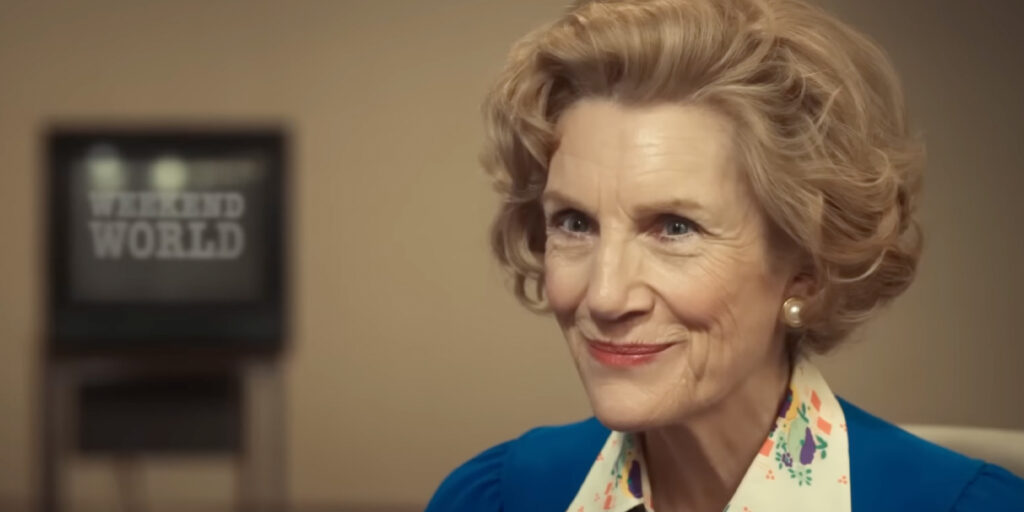
It was great for me because I was able to really create, with Stephen, a visual arc for Margaret and for Brian; it was never entirely her story or his story. Different scenes go between different people. But it was just really fun. We had a lot of fun making it. We didn’t have a huge budget, so we did have to be quite smart about certain choices, and I’m really proud of what we did.
When my agent told me that Stephen Frears wanted to interview me, I thought she was joking – that it was some April Fool’s joke or something, but it wasn’t. Then when I found out that he wanted to go with me, I also thought that was a joke, but it wasn’t. None of it was a joke. It all was real! I hope people like it. I know a lot of people don’t love Margaret Thatcher. I don’t love Margaret Thatcher either. But I hope people watch it as a piece of TV and a piece of history.
What do you hope to get out of the BAFTA Breakthrough programme going forward?
I applied because I wanted career guidance and mentorship. Especially with this being my breakthrough year, I’m hoping that, with the projects that I take on in the future, every single project is a slight step up for me. I don’t want to be doing the exact same type of project, the exact same budget level, filming in the exact same city. I want every project to be a bit bigger, a bit more creative, a bit more collaborative.
As I navigate that, it’s going to be really important for me to speak to people who have been there before, so hopefully they can connect me with some of the DPs that have gone on the same path as me, and who are now doing bigger things, or now have more responsibility.