
PORTRAIT OF A FRACTURED MIND
Reuniting with Lynne Ramsay, Seamus McGarvey ASC BSC ISC pushed visual boundaries when framing a tortured soul; finding the heartbreaking beauty along the way as the mental state of Die My Love’s central character gradually deteriorates.
Crafting a film exploring the boundaries between sanity and madness, reality and fantasy, love and despair called upon its filmmakers to build a cinematic world where nothing is as it seems.
“We wanted the hand of the filmmaker to be palpable,” says cinematographer Seamus McGarvey ASC BSC ISC about lensing Lynne Ramsay’s Die My Love. “Every shot reminds us that cinema is not reality, but something stranger, more dangerous, and far more revealing.”
He recalls the gripping experience of immersing himself in the script and then embarking on a visceral journey when lensing the powerful story. “Lynne is adroit at the depiction of the psychological in film,” he adds. “The way she can describe spaces with a camera is incredible, her lens rendering them as psychological spaces, ghostly realms almost. It’s as far from realism as you can imagine. It’s always a joy to see that in her films, the way these rooms become more than just sets.”
That mysterious blending of the real and the unreal has long defined Ramsay’s work. It is once again at the centre of the aesthetic of Die My Love, based on Ariana Harwicz’s novel and developed with Jennifer Lawrence, Martin Scorsese and Robert Pattinson among the executive producers attached to the project. The film stars Lawrence and Pattinson as Grace and Jackson — a couple who move from New York into a dilapidated house in rural Montana. Their raw and passionate relationship deteriorates as her postpartum depression sees her spiral out of control and what begins as a love story transforms into a violent, hallucinatory and unsettling tale.
Ramsay and McGarvey are no strangers to telling emotionally-charged cinematic stories about troubled souls, having teamed up on productions such as 2011’s We Need to Talk About Kevin which focuses on a strained relationship between a mother and her son who commits a harrowing act.
Ramsay and McGarvey’s director-cinematographer partnership has grown out of a decades-long friendship dating back to Ramsay’s time at the National Film and Television School, with the trust built during that time demonstrated in their multiple collaborations. “She has a unique rapport with her cinematographers, having been one herself during the early stages of her career,” explains McGarvey. “There’s a joy when communicating with a director who knows about cinematography which essentially leads to fervent discussions at the outset — we pore over ideas, light, lenses, how to approach the story visually.
“There’s that wonderful depth to our conversations, photographically speaking. And those discussions don’t continue while we’re shooting, they’re done very much at the outset. And then, on set, she’s free to focus on performance and mise-en-scène, and can hand over the reins, knowing that the groundwork has been laid.”
Their shared shorthand allowed them to dive straight into making artistic choices around the film’s themes which include isolation and the corrosion of love and sanity as cracks appear in Grace’s relationship and psyche. Early conversations centred on how the visual language could convey this loneliness and the descent into madness by “bending reality” and how to use the camera to depict different states of mind.
Bold palette choices
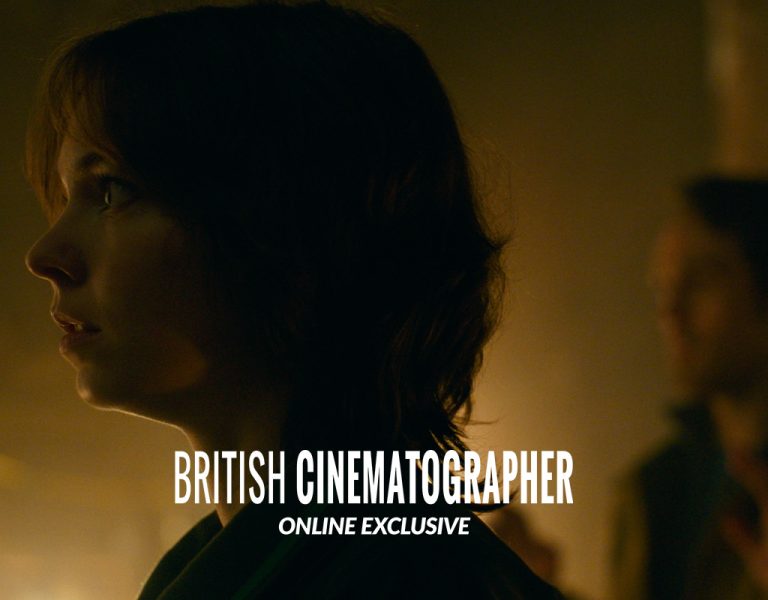
Early in prep, the decision to shoot a significant amount of the film on Ektachrome 100D (5294) — Kodak’s reversal stock, known for its saturated, high-contrast look and limited exposure latitude — set the tone for the film, acting as a canvas for Ramsay’s vision. “We wanted there to be a defiant sense of artifice,” McGarvey says. “Ektachrome stock imbues the image with a photographic signature that signals that this isn’t reality as we know it.”
One of the earliest discussions was around realism and how the camera is sometimes seen as registering the real, which, as McGarvey highlights, is not the case. “The film camera is the most unreliable depicter of the real you could possibly imagine. It’s an illusory showing of the real. But we wanted to embrace all the things cinematography does so well, in adjusting and interfering with reality.
“So one of the first discussions was around what stock we would use. Ektachrome is one of my favorite stocks, partly because it has a much narrower latitude. It really helps in showing that you’re in another realm effectively, and inside the character’s head.”
The choice to shoot on celluloid was driven by the feeling it conveys as much as it was by aesthetics, “transforming everyday spaces into psychic landscapes”. The Ektachrome stock produced a heightened, almost hallucinatory image for interiors, daylight scenes and intimate performance and character-driven moments.
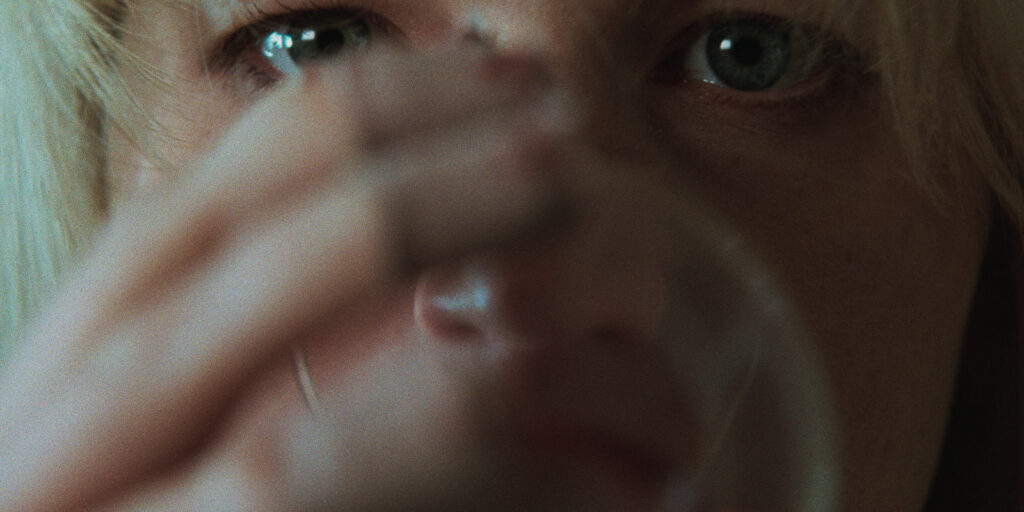
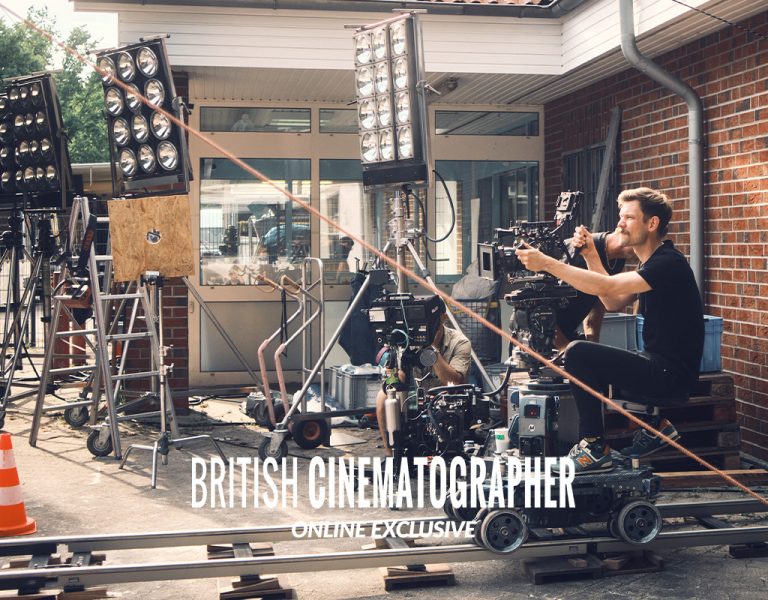
At 100 ASA, the Ektachrome stock also demanded high lighting levels, especially for interior scenes, with the crew flooding derelict houses in Calgary with light. Gaffer Martin Keough and key grip Gary Winters lit and shaped spaces with skill, working with large exterior units to punch daylight through windows, allowing actors the freedom to move within real locations while maintaining practical exposures.
“We were still shooting pretty much wide open. The producers kept joking about how much firepower was outside those windows,” McGarvey laughs.
For night interiors and when light levels were too low, Kodak’s Vision3 500T (5219) negative was chosen, later graded to resemble the look of Ektachrome for consistency. Vision3 200T (5213) was also used for select sequences that demanded balance between speed and colour fidelity.
Embracing the unsettling
While the interiors of the house Grace and Jackson share echoed the claustrophobic aspect of Grace’s everyday life and gradual unravelling, the exterior shots of the surrounding landscapes opened the narrative up into something more expansive but equally as unusual.
Landscapes are significant in the film from a metaphorical point of view and by implementing day for night techniques when shooting a series of peculiar and mystical scenes, the filmmakers captured nocturnal landscapes with a dreamlike quality. They wanted to avoid traditional night shoots for artistic reasons as well it being a practical choice as they knew they would be working with babies which would not be possible when shooting at night.
To achieve the unique effect, Seamus devised custom optical flats smoked with candle soot. By burning candles under glass, he darkened the filter and created a mottled effect with semi-transparent patches which, when placed in front of the lens, created a painterly, uneven and atmospheric effect and transformed bright skies into dark skies with the illusion of moonlight breaking through storm clouds.

Day for night shots often benefited from backlight. “Sometimes you get a two-minute window of perfect light where the sun is in exactly the right place and flares in the camera. It’s such an evanescent moment of cinematographic happenstance and if you’re quick, you capture something that leaves you smiling for days,” McGarvey adds, who has previously explored day for night on films such as Enigma.
The work of Larry Sultan was an influence behind some of the film’s haunting and psychologically-motivated images. “There’s something about Ektachrome that has a ripe to the point of rotten feeling and some photographs taken by Larry Sultan on X-rated movie sets we found very alluring; there was something off kilter about them and the way the colour registered in a very hyper real sense. We were always trying to push the limits of believability and steering away from the entirely truthful.”
The day for night approach adopted was also inspired by Pictorialist photographers such as Edward Steichen whose cyan-toned nocturnes were produced by printing day shots with cyanotype processes. “Steichen’s lake moonscape in Connecticut really caught our eye in terms of the colour and the way some colour would leak through as we wanted to achieve a silvery, surreal quality,” says McGarvey.
Cinematic Pilates
To capture the portrait of an increasingly fractured psyche, McGarvey used Panavision PVintage glass alongside 58mm and 85mm Petzval lenses which the cinematographer especially enjoys using for portraiture and chose for the beautiful swirling bokeh the lenses produce “when the out of focus dances in circles around a central sharper image”, echoing Grace’s state of mind in sequences such as her crawling through the grass like an animal.
“It’s a photographic way of showing turbulence without words. Grace’s mind at the centre, with the madness cascading around it,” he says, highlighting that the choice felt almost allegorical, as Lawrence’s character is spiraling out of control and losing a grip on reality.
The main camera package was built around the Panavision Panaflex Millennium XL2, selected in part for its modularity. “I love Panavision cameras and lenses and we knew we’d need to shift quickly from dolly to handheld or Steadicam which that Panavision system allowed for,” McGarvey says, crediting A camera operator/Steadicam operator Chris Chow as a key creative partner who captured many emotional sequences.
Focus puller Cory Budney’s precision also ensured images were razor-sharp. “On features shot on film, you can’t rely on monitors for focus,” says McGarvey. “Cory’s skill meant there isn’t a soft shot in the film.”
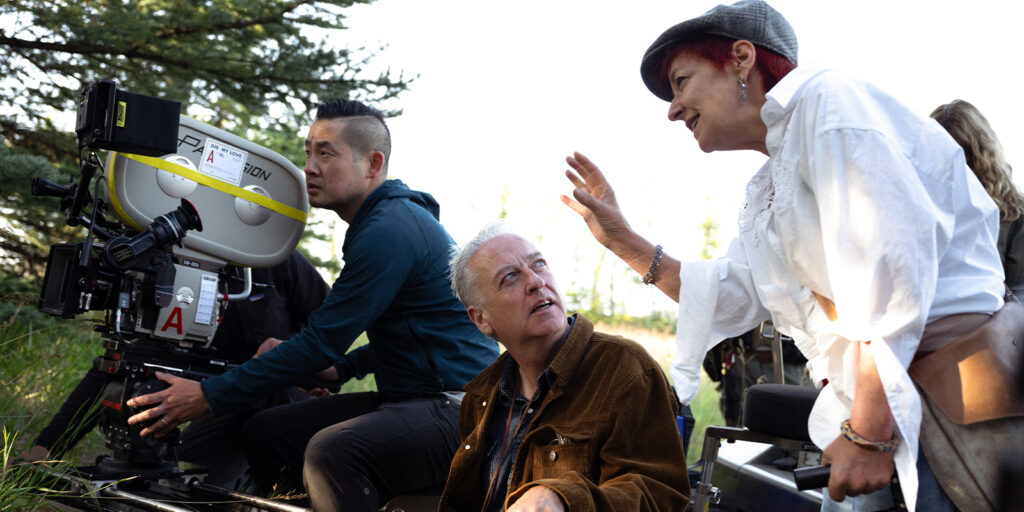
To capture raw, handheld moments, the team also occasionally used an ARRI Arriflex 2C whose light weight allowed for more spontaneous, documentary-style shots. “Lynne was behind the camera for some sequences and loved shooting with the 2C,” he says.
Driving sequences introduced “another layer of artifice”. Rather than shoot on location, Ramsay chose to stage the driving interiors in a studio by screening background arrays on an LED stage which had been digitally captured with an eight-camera Blackmagic multi-cam rig. This liberated the actors to “do cinematic Pilates, stretch a bit and run with it”, improvising and delivering performances free from distractions of shooting scenes of real driving.
Ramsay’s rhythm
Rhythm of sound and imagery is important in Ramsay’s films which shift suddenly between chaos and calm. The cinematography of Die My Love is no exception with camera movement mirroring the protagonist’s mental state as gliding Steadicam shots intersperse with abrupt close-ups and raw handheld. The opening scene demonstrates this, transitioning from stillness “as the camera holds for minutes in a wide shot before hurtling into a raucous, unhinged naked sex scene”, accompanied by a backing track of Ramsay singing her own song, setting the tone for the director’s storytelling approach and disruptive effect of sound and vision to create a sense of unease.
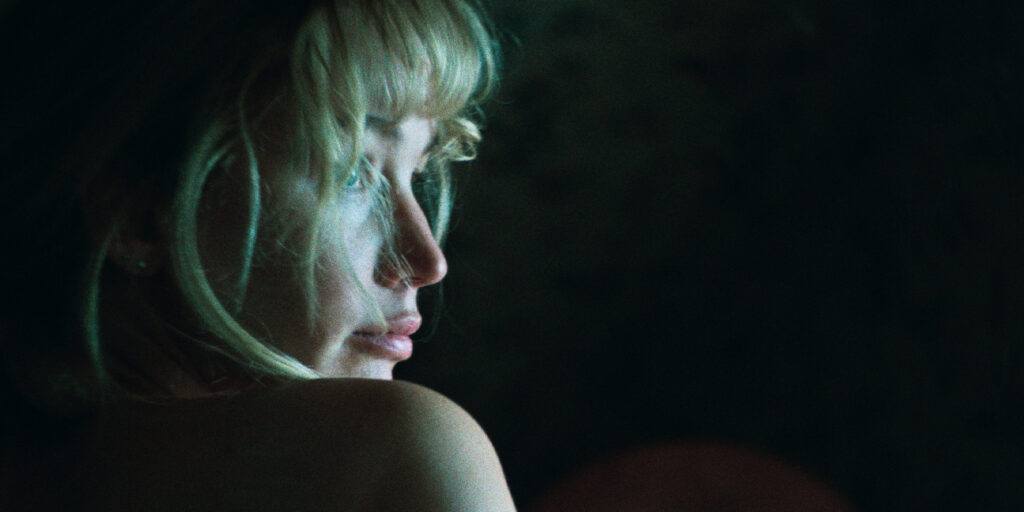
As the story unfolds and Grace’s mental state deteriorates, moments of fantasy are intertwined with reality. “We didn’t want to go into a flashback machine,” McGarvey explains. “When one loses one’s mind, madness fuses very comfortably with reality. That elusive shift between sanity and insanity is a dissolve, not a jump cut, to use a cinematic term. The apparitional presences such as the erotic hallucinations with LaKeith Stanfield’s character Karl, scenes that drift between real and imagined, are treated with the same lens, leaving audiences to question what is reality, as Grace also does.”
Soulful landscapes
Although interior spaces were a significant narrative tool, the Canadian landscape also became part of the film’s psychological visual vocabulary. Cutting from the cramped interiors to the contrasting vast landscape, highlighted the instability of Grace’s fragile mind. Calgary’s expansive skies, sweeping plains and everchanging weather became metaphors for Grace’s unravelling. “Those turbulent cloudscapes embodied her own suffering,” McGarvey says.
Experimentation with aspect ratio led the filmmakers to land on Academy 1:1.33 as they felt although landscapes played a large part, they were also shooting domestic landscapes. “We wanted to really look at faces and that format is beautiful for portrait photography,” he adds.
Finding suitable locations was not always straightforward and the size of the houses challenged the crew to fit equipment into tight spaces, sometimes lighting spaces from the outside. Production designer Tim Grimes found the beauty in the dilapidated by transforming a near-derelict house into a crucial set, maintaining its rawness and achieving a balance between authenticity and functionality.
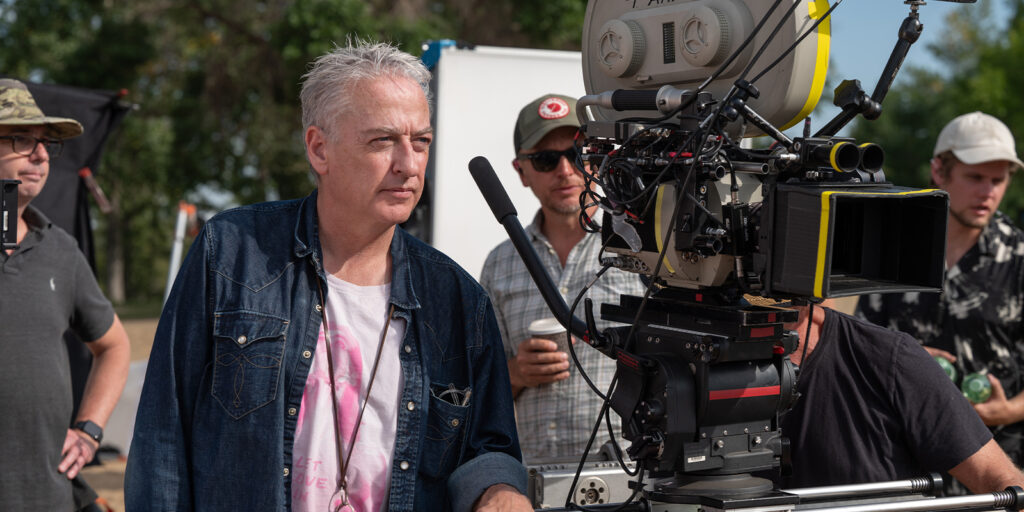
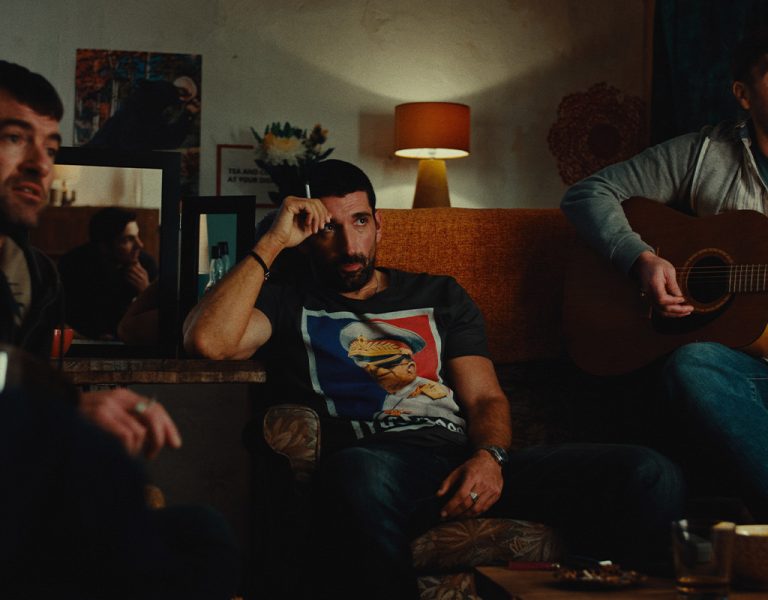
Inside the confinements of the houses, the lighting approach was based around flexibility and realism. “We wanted the actors to move freely in real spaces,” McGarvey says. Large exterior sources simulated daylight, while low-profile fixtures like Astera Titan and Helios Tubes provided interior accents. Small sets were also built on location such as the hotel room set where Grace’s mental state deteriorates further.
“I like lighting where the source itself has a logic, so in Grace’s house we placed large lights outside to shine through the windows,” he says. “When working with the higher speed stock for interiors, I loved working with the Astera Titan Tubes, especially if you’re working in a real location with no walls that float, you need sources that you can tuck just out of shot, that are low profile and produce a good source of light but are also colour controllable and dimmable without the adverse effects of low level dimming and the consequence of colour shifting.”
For exterior scenes, natural light dictated schedules. “We didn’t have the resources for giant silks,” McGarvey admits. “So it was about timing and letting 1st AD Beau Ferris— who ran the set with efficiency—know we need to be shooting a scene from two o’clock so the sun gives us shape.”
Endless learning opportunities
Having tested a number of iterations of look with Darren Rae at Cinelab London, McGarvey decided to process the Ektachrome in a negative bath. “We didn’t want the cross process effect which added grain and saturation, so testing allowed us to fine tune both the day and night exteriors and day for night, a process which Darren was pivotal in guiding me through.”
Collaboration during the DI with colourist Adam Inglis at Harbor refined the palette, working closely with Ramsay and always choosing restraint over excess. “When Adam saw the Ektachrome sequences, he said not to play with them much,” McGarvey recalls. “It was already exactly what we wanted.” Adjustments focused instead on the day for night sequences. Early passes leaned into bold cyan-green palettes, but then the filmmakers pushed for a subtler, more silvery monochrome look skewed towards blue. “We still kept a hint of cyan but pulled back the saturation.”
The DI also balanced differences of stock, ensuring the Vision3 500T scenes blended seamlessly with the Ektachrome material. A climactic, fantasy-like sequences of a raging fire in a forest merged practical and digital effects as tungsten nine-lights on dimmer chases simulated flicker which provided a foundation for the VFX team at One of Us to build upon. For these sequences — which were meant to “depict the mind traveling through a space, either in a memory or in a future projection” — Steadicam and long tracks produced a steady image for compositing, with the rails needing to be eradicated in post.
Despite decades in the field, during which he has enjoyed a fascinating and rewarding adventure that offers creative discovery and enlightenment with each project, McGarvey is excited by the lessons learnt on every production.
“It’s especially true when working in a new place. Crews approach problems differently. You see solutions you’d never have encountered elsewhere. That openness to discovery is what keeps the work fresh and alive.”