A REVOLUTIONARY ART
Nouvelle Vague recounts the production of Jean-Luc Godard’s seminal debut Breathless in fascinating detail, marking a triumphant pairing between Richard Linklater and rising French cinematographer David Chambille.
Richard Linklater’s Nouvelle Vague (New Wave) spirits audiences to that most defining moment in French cinema, when Cahiers du Cinéma critic Jean-Luc Godard took to the Paris streets to make Breathless. Telling the story of how Godard’s seminal debut came in to being, New Wave pairs Linklater (Boyhood, Before Sunrise) for the first time with rising French cinematographer David Chambille, who recently shot The Great Arch, which was in this year’s official Cannes Film Festival selection alongside New Wave.
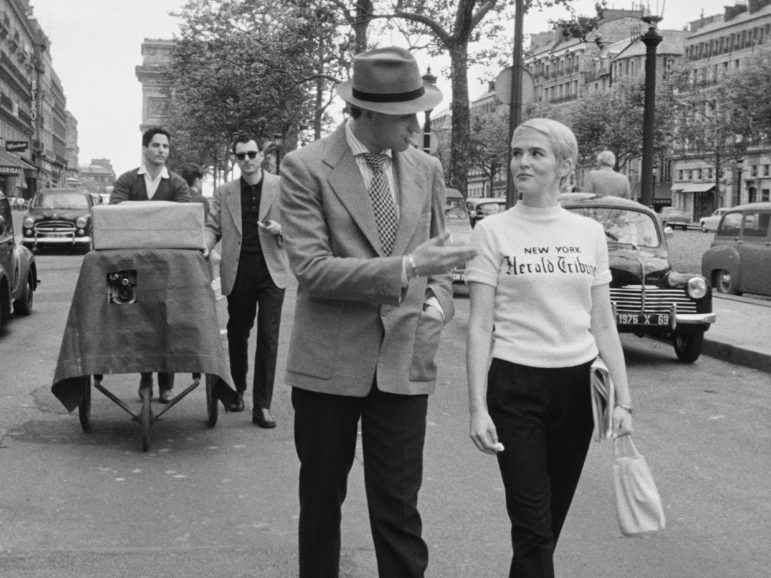
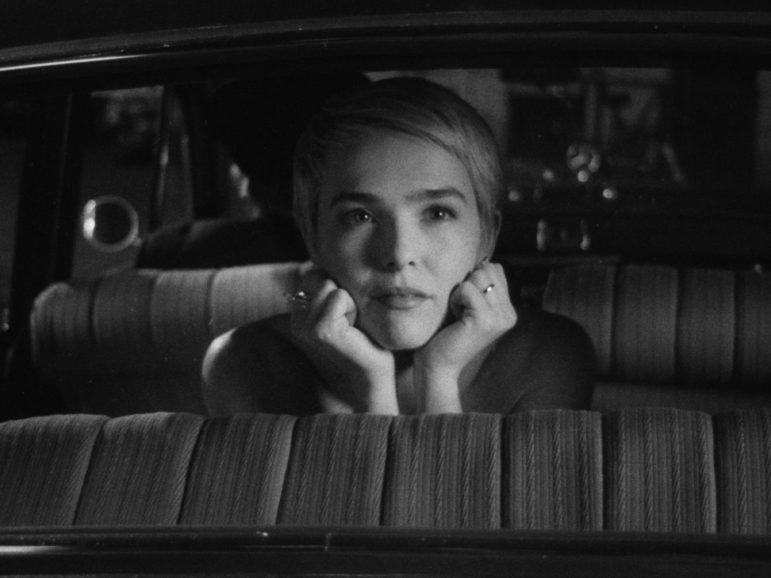
An influential work that ripped up the rule book, 1960’s Breathless centres on a small-time criminal Michel (Jean-Paul Belmondo) and his relationship with Patricia (Jean Seberg), an American student making ends meet by selling the New York Herald Tribune on the streets of Paris. In New Wave, which recounts the production of Breathless in fascinating detail, Guillaume Marbeck plays Godard, Aubry Dullin is Belmondo and Zoey Deutch is Seberg, all bringing this trio to life with uncanny skill.
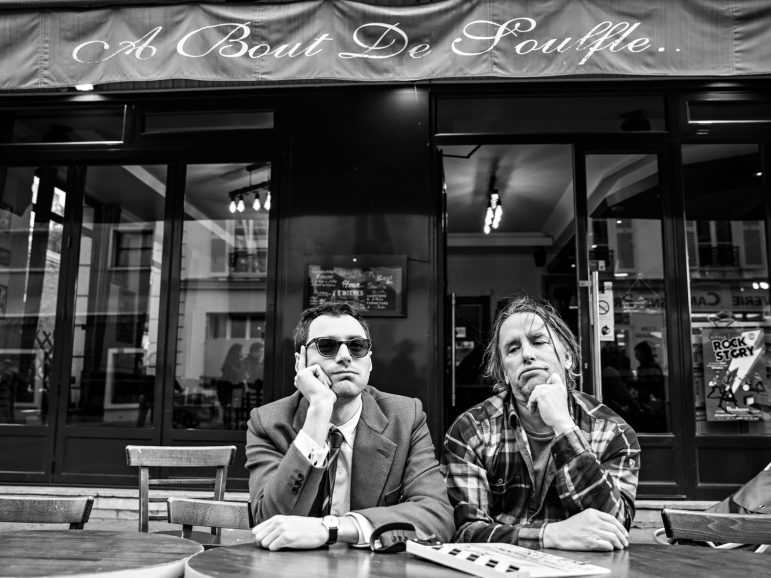
When Linklater arrived in Paris, he met with Chambille, who was thankfully a huge fan of the so-called French New Wave, the movement led by Godard and others that revitalised French cinema. “It was the beginning of my love for cinematography. It was a really free way to see cinematography,” he explains. That Chambille also wanted to replicate that spirit across the shoot for New Wave was another box ticked for Linklater. “He understood I was keen to be light, to be quick, to be open, to find more solutions than problems.”
Aesthetic considerations
Electing to shoot in black-and-white, Linklater’s ambition was to create a film that looked like it belonged to the era Breathless was made in. “One of the first things Richard said to me was, ‘I want the movie to look like we have just found it in an attic, in an old box of my grandmother’s’, like it has been shot at that time.” That meant, where possible emulating the textures, the grain, the lighting and other aesthetic considerations, as well deploying the filming techniques used at the time.
“We did not want to make something that they wouldn’t have been able to do at that time,” says Chambille, which meant being aware of the technical limitations Godard’s crew was under. It was also never meant to be a pastiche. “Richard wanted to keep to his own style, not mimicking Godard’s movie,” says Chambille. “He did not want to do something they wouldn’t have done, but on the other hand, he did not want it to look like a Truffaut movie or Godard movie…he wanted to keep with his own style, his own energy.”
Fortunately, Breathless is a film whose creation has been well-documented, with the New Wave team unearthing some real gems in their research. “We found a lot of notes from the script supervisor,” says Chambille, “so were able to find out at what time they shot scenes, with what lens, if the text has changed, so many things.” Other things discovered include the receipt for Jean Seberg’s dress, an annotated script belonging to Godard and, most intriguingly, a quote for the cost of film stock – Ilford HP5 – and camera rental.
Primarily, Chambille shot on digital using the Sony Venice 2 camera, pairing it with two different lens sets, Kowa FF and Cooke S2/S3. “Depending on the scene, depending on the light situation, I switched to one or the other. But both of them are really old. It’s low definition, it’s a lot of veil and a lot of flair. And I was really happy to play with that, because we were mimicking the kind of look they had on Breathless. Say, a sun shaft or a reflection in a car…they had a big glow, a big flare, and we were trying to go very close to that feeling.”
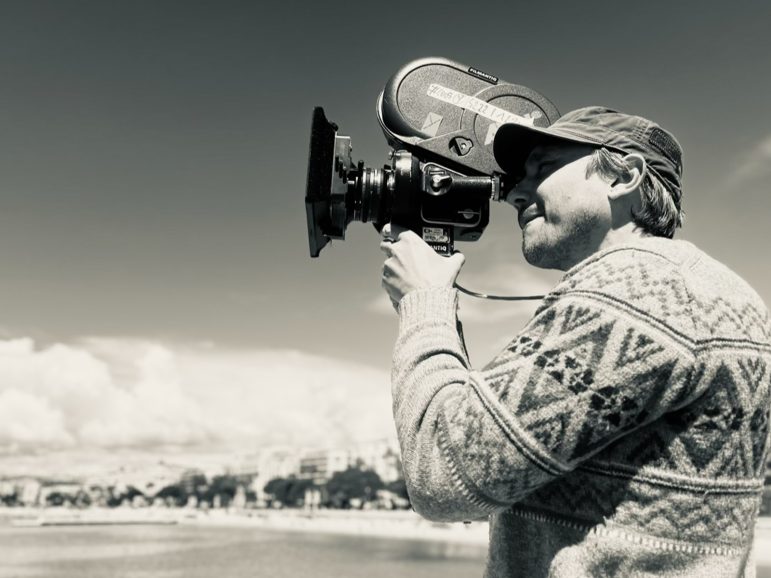
While the majority of the film was created using digital camera technology, Chambille also shot on film – using Ilford HP5 and Kodak 5222 stock and the ARRI 2C camera. “We would shoot a small roll of film each day, to keep the style, to have reference for the colourisation,” he explains. Ultimately, creating New Wave was a mixture. “We loved some details of the film: the elation, the bloom, the grain, the texture of the gray, but we loved what we could do with the colour digital negative, switching the colours to change the contrast.”
Iconic imagery
Filming in Academy Ratio – 1.37:1 – the plan was also to replicate the way Godard’s production approached coverage of shooting a scene. “We tried to begin the scenes as they did, like making a pan from the street to the door, for example, or the way the actors enter the frame,” he notes. “We would not choose to do wide shots and close-up, that kind of thing.” Every day before shooting began, they’d spend two to three hours revisiting French New Wave movies. “We would discuss car scenes, apartment scenes, night shots, each kind of scene that could match our script.”
Chambille stops short of calling New Wave a film that goes literally behind the scenes of Breathless. “We were exactly in the opposite position on set that they were,” he says, citing the iconic scene of Michel and Patricia walking down the Champs-Elysées. “We are in front of the actors and in the movie you see only their backs. And it was really funny to imagine what they would say when you are in front of them. It was that kind of thing Richard was looking for, trying to see what is missing in the movie, out of the frame.”
Again, in the desire to ape Godard’s own techniques, the film was mostly shot handheld, with occasional use of sticks where necessary. “What we didn’t want to do is Steadicam, for example,” says Chambille. “Richard is a big fan of Steadicam in other movies, but not for this one. It wouldn’t have been correct.” They also didn’t lay dolly tracks down but freewheeled shots, sometimes with Chambille holding the camera whilst being pushed in a wheelchair. “We were rolling in the streets of Paris, like they did.”
Hiring Camille Clement as 1st assistant camera and Emmanuelle Alaitru as 2nd assistant camera, Chambille also worked closely with gaffer Sophie Lelou. “She’s really calm,” enthuses the cinematographer, who knew he needed help finding the right lighting scheme. “The problem is that Breathless was shot in really, really sunny summer in ‘59. And the feeling in the movie is really sunny. It’s bright light.” Filmed in April 2024, “Sometimes, we were lacking sun or bright daylight. So I definitely brought modern fixtures on cherry pickers just to bring the sun we didn’t have.”
Aside from these additions, using HMI lights to boost the feel of daylight, Chambille strove to use lighting fixtures as Godard’s team would’ve done. “We worked as they worked, with few fixtures. It was only bare bones.” Colour-wise, “it was a mess”, he laughs, with this mix of modern and vintage lighting fixtures. “But with black and white [stock], it was incredible, because we were even capable of switching the contrast using the red colour of the tungsten bulbs inside in front of a blue hue of light coming from outside. It was another tool to manage the contrast.”
Movie magic
New Wave was shot almost entirely on location, bar a couple of scenes that required a studio soundstage – including the sequences of Breathless shot at Hôtel de Suede, a hotel located on the Left Bank near Notre Dame, which has since been refurbished. CGI was used regularly to erase evidence of modern-day Paris, while the production also shot in Cannes for scenes at the film festival, mixing this with archival footage. “It’s all a big magic trick,” says Linklater, who notes that “black-and-white is very forgiving” when it comes to cleaning up old footage and splicing it with newly-filmed material.
Chambille also worked remotely with the French, Tokyo-based colourist Yov Moor to refine New Wave in the post-production phase. “He is really important in the process, because he’s a geek and he’s really good with all technical things, but he has also his own point of view, and he brought a lot of ideas.” Among them, creating a worn look for the final film to make it seem as if it was a second or third generation print taken from the internegative, complete with scratches to show wear and tear.
What Godard, who died in 2022, would make of the film, Chambille is uncertain. “I’m not sure he would have liked it,” he smiles, “but it’s not a problem because it’s not supposed to be a Godard movie. It’s a Linklater movie. And I think it’s a really good Linklater movie.” For Chambille, New Wave was the perfect way to pay homage to the pioneering spirit of Godard and his peers. “[They showed] it’s possible to do it without money, without experience, but from your heart. Just go out in the streets and try something. And that’s what Richard wanted to show – that kind of energy: do it yourself, trust yourself and cinema is stronger than everything.”
Nouvelle Vague opens in cinemas in January 2026.