CREATIVE DRIVE
The need for speed and authenticity was the driving force behind one of this year’s most highly anticipated cinematic events— F1: The Movie. Claudio Miranda ASC ACC details the method he and director Joseph Kosinski implemented when lensing in the fast lane.
Watching F1: The Movie— especially the accelerated visual and sonic cinematic experience of viewing the film in all its immersive glory in an IMAX theatre—is the closest audiences can get to feeling what it is like to hurtle around the race track at full throttle in a Formula 1 car. That was the primary goal of director Joseph Kosinski and cinematographer Claudio Miranda ASC ACC—putting cinema-goers in the driving seat with the film’s protagonists, racing drivers Sonny Hayes (Brad Pitt) and Joshua Pearce (Damson Idris), as the teammates travel the globe, competing in a series of nail-biting races.
F1: The Movie is a story of redemption, peppered with cameos from real F1 drivers such as Hamilton and Max Verstappen, Charles Leclerc and Carlos Sainz and Lando Norris. Rogue underdog Sonny was once a rising racing star until his career was derailed by an accident. When approached to join struggling Formula 1 team, APXGP, he joins the young, talented—and on occasions overconfident—Joshua and the pair embark on a rollercoaster ride as they strive to gain each other’s trust and get the team on the track to victory.
“I’m always going to do Joe’s projects,” says Miranda, whose previous collaborations with Kosinski include Tron: Legacy, Oblivion and high-flying hit Top Gun: Maverick. “He’s a director who wants to use green screens and process screens as sparingly as possible, to give a really authentic feeling — and that’s exactly the kind of filmmaking I enjoy.”
According to Pitt [who was also one of the film’s producers alongside a dream producing team from the filmmaking and racing worlds which included Jerry Bruckheimer, Lewis Hamilton and Toto Wolff], the combined efforts of crew and cast resulted in what he considers “the most visceral driving experience” ever filmed.

For Miranda, authenticity is at the heart of his craft, and when making F1 he and Kosinski agreed the audience needed to feel the action captured in-camera, opposed to relying heavily on visual effects, a shared philosophy also at the centre when they shot aerial adventure Top Gun: Maverick.
This time, rather than placing the audience in the cockpit of a jet, the mission was to bring the world of Formula 1 racing to the big screen in a cinematic way that felt as close as possible to being there, “to feel connected to the races, to the speed, to the danger,” Miranda explains. “It’s about letting the audience feel like they’re really with the drivers.”
When making Top Gun: Maverick they wanted to avoid process work and digital trickery, instead mounting cameras inside fighter jets. “For F1, we didn’t want to use biscuit rigs, where someone else is driving and the actor is pretending. That always feels like it’s going a quarter of the speed,” adds Miranda.
The filmmakers chose the more ambitious and exhilarating route: putting lead actors Pitt and Idris behind the wheel of real race cars, driving at almost 200 miles per hour. “What Joe wanted was authenticity. He wanted to make the best racing movie ever made,” says producer Jerry Bruckheimer. “In order to do that, you have to put your actors into the cars… It’s the only way to make the movie.”
That commitment to authenticity filtered through the entire production; every department had to think differently — about safety, camera mounting, and how to work within the strict environment of an actual Formula 1 race weekend. Shooting the film during live racing events demanded seamless integration of the crew through a close partnership with Formula 1, who offered incredible access so the story of the fictional APXGP team could be captured by the hundreds of crew members, which exceeded the size of a real racing team on a typical race weekend.
Creating Carmen
Developing camera systems to capture the action demanded elevating the pioneering techniques and tools created for Top Gun: Maverick and exploring new ways to capture speed, resulting in a new cinematic perspective of motor racing. “On a fighter jet, you can put 40 or 60 pounds of camera gear, and it won’t affect it at all. Those things are built to carry much more than that,” says Kosinski. “But on a Formula 1 car, every kilogram makes a difference. Putting weight on a car is to slow it down, and that works against the experience we’re trying to capture.”
One of Miranda’s skills — and a reason Kosinski places so much trust in him — is his ability to talk with camera manufacturers who then build bespoke systems to help realise the filmmakers’ storytelling ambitions. “I learned that I can go to Sony and ask for a favour,” Miranda says with a grin.
For Top Gun: Maverick, Sony built the Rialto extension system for the Venice, allowing the camera body to be separated from the sensor block and mounted in tight spaces. For F1, Miranda had a new request for Sony which resulted in the creation of what he and Sony refer to as the Carmen and which the DP describes as “a sensor on a stick.”

The cameras needed to be as small and light as possible while delivering high-quality, full frame 4K images, dynamic range, and offering shallow depth of field. Multiple cameras would have to be on the move, controlled simultaneously by radio frequency without losing connection as they sped around the circuit.
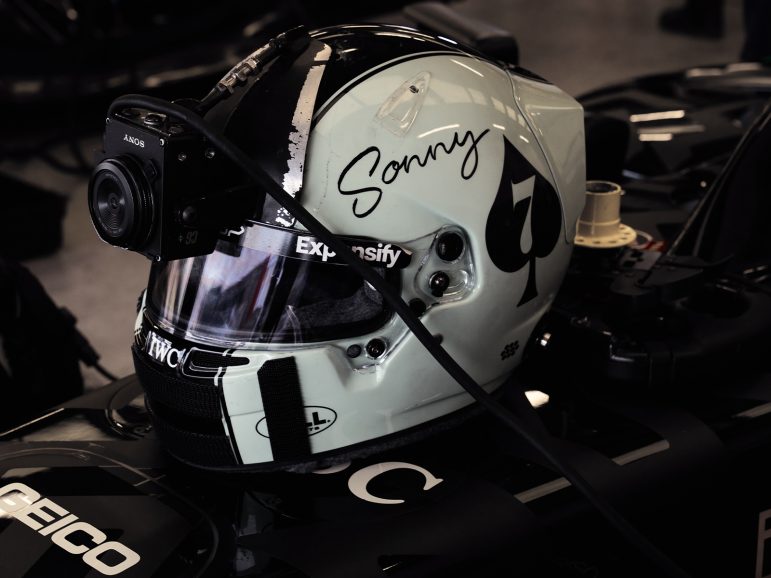
In order to be as small as possible, the sensor needed to be separated from the recorder unit. Sony developed a bespoke setup: a hybrid between a Sony FX6 and an FR7 remote camera, with a thin base unit that housed a recorder and an Ethernet jack, enabling the crew to set up a network around the race track and remotely control exposure as well as pan and focus (using a Preston motor). At the front end sat the “PanaPan” — a Panavision-designed miniature pan head that could even be mounted to the visor of a helmet.
As safety was a constant priority, it was not always possible to use the Carmen with actors when at full racing speed. However, stunt drivers often wore them during helmet-cam sequences to capture gripping, edge-of-your-seat footage. “That compact system captured shots such as extreme close-ups of an actor’s eye,” Miranda says.
Miranda could choose from a total of 15 camera positions on each car to capture multiple unique angles simultaneously. And as the 25 bespoke cameras Sony created could also pan and tilt, they offered the DP freedom to shoot any angle Kosinski required. Capturing footage demanded state-of-the-art radio frequency technology—wireless innovation capable of relaying the footage across the track without interfering with the race broadcast signal.
Filming inside a helmet is not always simple, especially as they create deep shadows and reflections that can hide an actor’s eyes and the emotion they convey. “In Top Gun it was easier — we could pull down the oxygen mask a bit to show more of the actor’s face,” highlights Miranda. “Formula 1 helmets are more closed and the visors are narrower, so we modified ours so they were slightly more open than a real F1 helmet, which helped with light and visibility.”
Prep that pays
Kosinski allows Miranda the long lead time many cinematographers dream of. “If I’d been brought in three months before, there’d be no chance we could have achieved what we set out to do,” Miranda says. “I needed at least six months to work with Mercedes, to find out what was the smallest, lightest camera we could build that still delivered film quality with cinematic lenses.”
In addition to the 25 network-controlled Carmens, Miranda used Sony Venice 2 bodies for traditional coverage and helicopter work, RED Komodos for plate shots, and DJI’s Ronin 4D — nicknamed “the turkey” by the crew for its unwieldy appearance — for handheld sequences in the pit lanes. “The Ronin 4D was a lifesaver,” Miranda says. “For things like the scene when the drivers’ national anthem is played, we couldn’t bring in a crane or a Steadicam rig. The Ronin let us move quickly, stay small, and still get stable, cinematic shots.”
Some sequences required even smaller tools. Working with Apple, custom miniature cameras were developed combining an iPhone 12 sensor with the processing power of an iPhone 15, allowing the filmmakers to capture a signature angle during every F1 race broadcast—from an on-board camera pod on the side of the F1 car.

Apple’s engineering team—working with F1, the Fédération Internationale de l’Automobile (FIA), Kosinski and Miranda—developed a way to bring the quality of the hardware, software, and silicon that makes up an iPhone camera system into real F1 cars, building a solution that matched F1’s on-board camera pods in design and durability, consisting of an Apple-designed iPhone camera sensor powered by an A-series Apple silicon chip, running iOS and a special camera firmware.
During filming at Grand Prix weekends, the powerful cameras delivering the high resolution and recording capabilities needed were placed on two or three real Formula 1 cars during real races. “We needed something without IBIS,” Miranda says. “Any camera with in-body stabilisation can’t perform in an F1 car. The vibrations are so intense, the stabilisation goes into overdrive and ruins the image.”
The result was a stripped-down, rugged cube that could be bolted directly to a car’s bodywork and survive multiple laps traveling at great speed. The crew initially tried loading four recorders into each car, but quickly learned to scale back to three. “Even with three per car, if you’ve got four cars on track, that’s 12 cameras rolling at once,” Miranda says. “We weren’t lacking in coverage.”
A network of trust
Kosinski has long-admired Miranda’s problem-solving approach. “Without these small Carmens, we’d have a different look — one we wouldn’t have been happy with,” says the DP. The director also credits Miranda’s persistence in collaborating with previs teams, camera manufacturers, and drivers to get the exact angles the story needed.
Miranda’s lens choices also reflected lessons learned on Top Gun: Maverick. For in-car shots, he returned to the tried and trusted ultra-compact Voigtländer and Zeiss Loxia primes. “They’re the smallest you can find that still deliver the quality we need. We couldn’t put filters on the wide angle 10mm in the front; they’d just get destroyed.”
For other setups, he used Zeiss Master Primes, Fujinon Premier and Premista zooms, Sony G-Masters on the Ronin 4D, and Panavision Primo 70s and Sigma FF High Speeds.
Right on track
Each location brought its own obstacles, but Abu Dhabi— the race track featured in the final race— was the most complex. The story required a sequence that transitioned from full daylight to the glow of magic hour, and finally into night under stadium lights, so Miranda had to divide the scenes into three categories and shoot them in that order.
Working out coverage for each race location began in the race simulator where lead stunt driver Luciano Bacheta ran the sequence virtually, with small cameras mounted inside the simulator to show Miranda and Kosinski what the beats would look like from the driver’s point of view. The production also collaborated with Formula 1’s own broadcast crew, who already had around 20 cameras positioned around each track.
“They were incredibly accommodating,” Miranda says. “We’d ask them to shoot at 50 frames per second and open the shutter as much as possible which would mean the sponsor logos could go a bit blurry, but then we’d take their footage and run it through VFX to smooth it back to 24 frames per second.”
Aerial thrills
In an era when many filmmakers rely on FPV drones for aerial shots, Kosinski and Miranda chose a different path. They wanted authenticity and weight—something they felt only helicopters could deliver. “FPV felt too gimmicky,” says Miranda. “We wanted the feeling of a real camera in the air.”
XBRAND—the aerial cinematography team co-owned by pilot and aerial coordinator Kevin LaRosa and aerial director of photography Michael FitzMaurice, who had previously worked with Kosinski and Miranda on Top Gun: Maverick—were involved in several pivotal sequences. From early testing to principal photography, the team played a vital role in crafting exhilarating aerial shots.
Testing began at Willow Springs Raceway in California, where the team explored how helicopters could track Formula 1 cars at speed. At Daytona Speedway they then combined sweeping high-altitude shots, including a dramatic fireworks scene, with low-level runs, sometimes flying just above the cars. One thrilling sequence involved a spin-out that allowed Pitt’s character to overtake. “Our helicopter inadvertently appeared in another camera’s frame. The production team chose to keep this footage, styling it to resemble a broadcast helicopter, effectively giving us a cameo in the film,” says FitzMaurice.
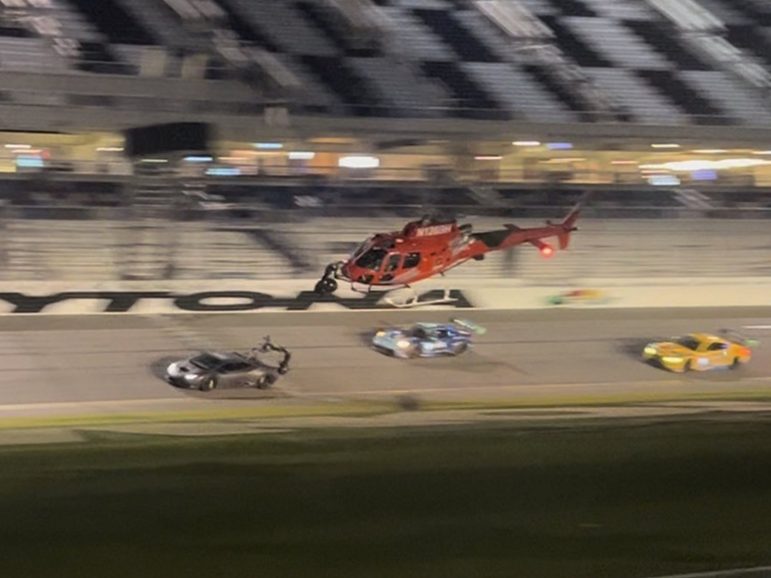
Their primary platform was an Airbus AS350 B3e fitted with a Shotover K1 gimbal carrying the Sony Venice 2 and Fujinon Premista lenses, allowing them to capture IMAX-quality images while tracking cars at over 200 mph. High-altitude passes delivered grandeur, while low-level counter moves emphasised raw speed and danger.
At the Las Vegas Grand Prix, LaRosa partnered with Formula 1’s broadcast helicopter cameraman Lieven Hermans, merging live broadcast footage with cinematic aerials, perfectly capturing the race’s energy. Supporting them were technicians Jared Slater and Stephen Scherba, who managed the gimbal systems, and aerial ground coordinator Alex Anduze, who kept communication flowing between the sky and the set.
After the racetrack work, the team returned for a climactic off-road chase across coastal dunes, pushing the helicopter’s versatility as it weaved through rugged landscapes, blending speed with sweeping desert vistas.
Parallel to XBRAND’s work, The Aerial Film Company, led by director of photography Phil Arntz (Mission: Impossible – The Final Reckoning, Masters of the Air) and camera helicopter pilot Will Banks, captured sequences at Silverstone, Abu Dhabi, and the British countryside. At Silverstone, they executed the ambitious opening shot: a seamless move from a wide aerial establishing view into the driver’s seat, a sequence demanding precise planning, rehearsal, and risk management to achieve.
In Abu Dhabi, their task was to inject maximum energy into the climactic race. Flying low and aggressively, they captured counters and converging passes that showcased the Yas Marina Circuit’s speed and scale. To keep pace with the cars, The Aerial Film Company needed the helicopter to be as light and agile as possible, so they used the compact Shotover F1 with the Venice 2 and Fujinon Premista lenses.
For Arntz, helicopters remain unmatched in capturing the intensity of racing: “We can fly at track level to replicate the close, visceral shots of a tracking vehicle, then climb to a higher vantage point, often within the same shot. With the ability to take shortcuts across the circuits, we can set up multiple counters and converging passes without disrupting the rhythm of the cars or getting in the way.
“The sheer speed and manoeuvrability of the helicopter made it a perfect match for Claudio and Joseph’s brief, allowing us to deliver dynamic, high-energy shots that kept pace with the action while also adding cinematic scale.”
Crew connections
Many of Miranda’s closest collaborators have been with him for years. First AC Dan Ming has been his “right-hand person” since Life of Pi (2012). “I sketch something, he refines it, and between us we figure out how to make it real,” says Miranda.
Ming brought in RF Film president Greg Johnson to manage the complicated network of camera feeds around the track. This required constant coordination with Mercedes engineers, as every camera mount had to be approved months in advance for both performance and safety. Action vehicle supervisor Graham Kelly oversaw the installation of all mounts, working directly with Mercedes-supplied parts. “If a car crashes, the mount has to break apart and cause no harm,” Miranda explains.
Key grip Sam Phillips used a specialised rubber material called Sorbothane to isolate certain cameras from vibration without compromising stability. This vibration isolation was handled manually, and based on variables such as tyre type, time of day and roughness of the track.

“We tried a gyro stabilisation head once but it came back in a bag of bolts,” Miranda laughs. “Hard mounting was better, but when you get out towards the sides of the car, vibration worsens. Sam knew exactly how much isolation to add for each position around the track.”
Miranda’s lighting approach was just as meticulous, relying on natural light whenever possible. In the garages, SkyPanel S-360s blended seamlessly with practical fluorescents to create authentic light, thanks to a close collaboration between gaffer Lee Walters and the practicals team.
In the hospital sequences, the crew relied entirely on natural daylight streaming through windows as they could not access them from outside to position lighting fixtures. For Joshua’s apartment, Miranda kept it intimate: “There was no real overhead light, so we hung a table lamp from the ceiling, just to add a bit of warmth.”
When F1 became filmmaking family
As with Top Gun: Maverick, Miranda and Kosinski were involved in all stages of the process through to post-production, spending four weeks grading with Company 3’s founder and CEO Stefan Sonnenfeld.
“We thought Silverstone would feel warm, but the reality is it’s overcast most of the time. Sometimes pushing warmth into a grey day just makes it look fake,” Miranda says.
One of his favourite sequences was captured at the Monza race track, which begins bright and sunny before shifting into rain and deep, saturated darkness. “It feels like it’s foreshadowing something significant — like the weather knows danger is lurking,” he says.
Las Vegas provided another distinct palette, with lower, temporary lighting rigs giving a staccato flicker to the nighttime racing. As it is a purpose-built track the crew had just 15 minutes to capture key sequences before the track was disassembled.
Collaboration on the visual effects side primarily involved reskinning cars, crowd replacement or making some shots look more cinematic, working with visual effects supervisor Ryan Tudhope (Spiderhead, Top Gun: Maverick) and the team at Framestore.
Picking only one high point from such a pioneering and fast-paced production is difficult for Miranda, but one emotional moment in particular will live long in the cinematographer’s memory. As much of the film was shot during actual race weekends, the crew aimed to fit their set-up into the smallest possible footprint.
“We were in the eleventh garage, with the real racing teams in the other ten,” explains Miranda. “For much of the shoot, we tried to stay out of the F1 team’s way. We’re there shooting scenes while the real race is going on, so we tried to be respectful and give them space.”
Miranda remembers one example of extraordinary creative collaboration in particular: during the Abu Dhabi race, when a red flag stopped the action and cars were brought into the pits for a restart. “I was operating the crane, and I saw all the race teams bringing out their cars to line up behind ours. Lewis [Hamilton] was ahead of us, and we had our two cars second and third, and then the whole line-up, as far as you could see, was made up of the real F1 cars.
“They were really supporting our film in a way that was incredibly touching. I was so blown away because normally you’d think a shot like that would be visual effects. They were part of it and it was a really emotional experience that went beyond practical filmmaking.”
That’s the cinematic magic Miranda treasures: where filmmaking artistry merges seamlessly with the world in front of the lens.