
A META MOVIE
When Charlie Shackleton was told his Zodiac Killer documentary had fallen through, he decided he couldn’t put his plans to bed. Enter: The Zodiac Killer Project, a meta film where Shackleton runs viewers through what he would have done had he got the green light, with unexpectedly gorgeous visuals and a cutting critique of the true crime genre following…
When did it occur to you that your inability to make a film could become an ability to make a different, more unique film?
When the rights to the book [The Zodiac Killer Cover-Up: The Silenced Badge] fell through, it certainly wasn’t the first time that I got a fair way along the road with a creative project and then had it fall apart. I kind of assumed that the process would be the same as it had been in the past, where I’d spend maybe a couple of months licking my wounds, and then take some small element of the idea and reapply it somewhere else.
But for whatever reason, this was one where I just couldn’t let it go. I think mainly that was because I had made the mistake of mapping out the entire thing in my head – the film basically existed in every sense except the one that matters, which was literally. At a certain point, after months of forcing my friends to listen to me describe at length these imagined scenes, I started to think that that itself could be an interesting subject for a film. So, long before I was even imagining it as a critique of true crime or anything like that, it was a film about that feeling of creative frustration.
There’s an inherent challenge to this film in that it’s discussing something that fundamentally doesn’t exist – how did you craft a plan for making this visually interesting?
I remember the first conversation I had with my cinematographer, Xenia Patricia, was about wanting to depict absence. Obviously, there are 10,000 ways you could go about that, so it wasn’t immediately obvious where to begin, but the thing that came to mind for me was my experience location scouting for the true crime film back when it was still planned to happen.
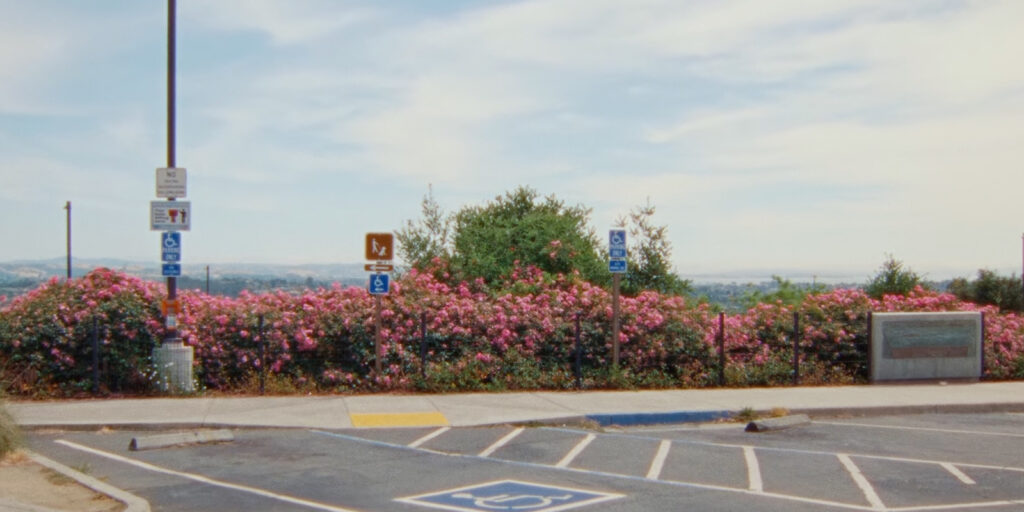
What that had entailed is what location scouting always entails, which is going to a place and imagining a lot of things, and often being struck by the contrast between what you’re imagining and what’s actually there for you to see.
In true crime, the story that’s told again and again is that the places where these horrific crimes took place are, in one way or another, indelibly marked by them; just to step foot there is to immediately feel the echo of this horrific past hanging over you. The reality, obviously, is that these are just normal places full of thousands of normal people going about their lives and not thinking about the Zodiac Killer, day in, day out.
So there’s inherently a weird contradiction to these sorts of spaces. Talking to Xenia about this, that pointed us towards how we were going to capture these environments, which was both leaning into the banality of them while trying to suggest in some way that this is quite a forced search for meaning where there isn’t necessarily any to find.
What we landed upon was what you see in the film, which is this quite mechanistic series of camera movements that takes place across every scene, where we would pan into our master shot, hold on that for a while, zoom in on almost nothing, zoom out, take in the scene again, and then end. And because we were shooting on 16mm, we were timing this all out by the foot, and would get two of these very, very formulaic series of camera movements per 500T reel.
It became a very meditative process, and did actually allow us, I think, to take in those spaces in a way that we wouldn’t have been able to otherwise, because it felt quite ritualistic at a certain point hopping in the car, driving 10 minutes down the road, getting out at another seemingly humdrum intersection, and then performing this almost religious ceremony of camera movements.
How was your collaboration with Patricia? How did the relationship work in terms of bringing the visuals to life?
It was great. All of our discussions inevitably became about the minutiae, because there were, in some ways, very few decisions to make. I think there were one or two shots where I was like, ‘I’m really going to surprise you here, I’m going to radically depart from our formula by suggesting that we zoom out instead of zooming in,’ or whatever it might be.

But other than that, our routine was that we would drive to the next location, and I would give Xenia fairly free rein to find the shot. She would find it, she would show it to me, and then she would zoom in to the final resting point, and I’d look through the viewfinder, and it would be a patch of wall with maybe a tiny bit of piping sneaking in the corner of the frame, and I’d be like, ‘Perfect.’ It became increasingly absurd, but that absurdity felt quite fitting, given the absurdity of the film’s premise. I couldn’t have been happier with what we came away with. I was very, very pleased with that collaboration.
Patricia has largely worked on narrative features and shorts – including London Film Festival closer 100 Nights of Hero. Why did you want a cinematographer with that sort of background, instead of one who has made their name in the documentary world?
I’d seen a couple of shorts that Xenia had shot, Filipinana and After a Room, and both were very precisely framed in a way that felt, to me, like it carried the same sort of irony that I was looking for. We talked a lot as we were preparing to shoot the film about that veneer of irony that can hang over an image, because it can carry so much more than it seems to.
This was especially useful when I was showing her photos I’d taken in Vallejo, where we were going to be shooting what might literally just be a shot of a wall with a bin in front of it. Talking about how to frame a shot like that such that it could carry all of this dramatic weight it was being asked to represent, it very quickly felt like we were on the same page about the multiple levels on which an image like that could speak.
It’s a gorgeously shot film – why did you decide to have such vibrant, eye-catching visuals when, as you mention in the film, a lot of true crime features and series opt for the opposite approach?
What I wanted to capture was that feeling I’d had when I first visited all of these spaces, which was a kind of disconnect between the stories I’d heard about the places and the lived reality of them. True crime stories, necessarily, are told in this gloomy, foreboding way, and so the picture I had of a lot of these places was quite a dark, shadowy one. Obviously, if you’ve ever been to California, it’s not a very dark, shadowy place.
Initially, we had planned to go out there and shoot in January, and for various logistical reasons, it got bumped, and we wound up doing it at the height of summer. Even though that was an accident, I think it was one of the best things that happened to the film, because it meant that that contrast was even more heightened. We were out there in the warmest, sunniest climate imaginable, shooting material over the top of which I would then be describing the dark clouds looming over Vallejo or whatever it might be. The pop that the really rich 16mm cinematography gave to those ironically sunny landscapes – which we shot with Arriflex 416 and Aaton XTR Prod and Canon 10.6-180mm and Zeiss Superspeed lenses – felt very fitting to me.

Our colourist, Jason R Moffat, created so much of the look that I hadn’t even really imagined. It was really him that brought that irony out in ways I hadn’t even envisioned exactly, and it got funnier. That was the joy of it. We were sitting in the grade, and obviously that’s usually the point where you just want it to be done and out the door. But as he was grading it, and as I was watching these images get more and more absurdly joyous, somehow the contradiction between that and what you were hearing me say just got funnier and funnier. All credit to him. I think he did a huge service to the film.
You’re speaking to us from Stockholm International Film Festival – how excited are you to have your film at the event, and how are you finding it all so far?
It’s great. It’s my first time in Sweden, but it’s probably the last festival I’ll be doing in person with the film. It’s been on the road at festivals for about a year now, so it’s coming to the end of its festival life. And indeed, it’s coming out in the UK and the US and a few other places this month. So I’m going to be confronting the reality of normal cinemas and actual paying audiences that I need to persuade to come and watch it very soon. This is my last little festival jaunt.