

DEATH BECOMES HER
Lead cinematographer Ashley Barron ACS explains how she shaped a visually expressive look, mixing warmth, haunting unease and storybook menace in How to Get to Heaven From Belfast.
The eight-part Netflix comedy-drama thriller from Derry Girls creator Lisa McGee, How to Get to Heaven from Belfast, follows three lifelong friends in their late 30s – Saoirse (Roísín Gallagher), Robyn (Sinéad Keenan) and Dara (Caoilfhionn Dunne) – who reunite for the wake of their schoolmate Greta. The bittersweet gathering soon spirals into a darkly comic quest to uncover the suspicious truth behind her death, as their own buried secrets resurface.
Shooting on the Alexa 35, we chose anamorphic lenses as it underlined the comedy in composition – allowing us to compose for our three heroines and play with blocking within the frame – and provided a heightened sense of the world. We shot on the Atlas Orions, with the 21mm becoming a workhorse – introducing a subtle strangeness that sharpened the comedy. A Cooke anamorphic zoom contributed to a more direct, unsettling tension.
The forest
The opening sequence of the series serves as an enigmatic invitation into the world. Haunting and mysterious, here light becomes the storyteller.
It was scripted as a continuous movement through the forest, a light source guiding us through the trees toward the action. Silhouettes, shafts of moonlight and drifting haze create a rhythm of discovery and concealment, keeping the scene poised between suspense and the faintly supernatural. By the end, nothing is explained, yet everything is felt.
The sequence was stitched together from two primary locations and a combination of a DJI Inspire 3 drone flown by Pivotal Films, with practical photography steered by operator Declan Ó’Grianna and key grip Donavan Gallagher, shot over multiple nights. Location continuity was a challenge. We were unable to find forests that matched visually and were close enough geographically, so care had to be taken with the schedule to preserve a sense of depth in the environment without revealing the edges of the location. The field they run across was too large to light. Following testing between grade and VFX we decided to avoid day-for-night, because it compromised the flashlights’ role as the primary motivated light source and the visual tone we were after. Shooting at night allowed the torches to drive exposure and control how information was revealed within the frame.
Extensive testing was done on flashlight units due to flicker and output limitations. Ultimately, we used a restricted setting combined with haze to help amplify the beams, with further shaping in the grade with colourist Gary Curran at Outer Limits Post in Dublin. We added warmth to the flashlight beams to contrast against cooler moonlight tones. The running sequence toward the cabin was shot in a separate woodland. We wanted the run to feel like a journey, a progression through space, even though the final cut is more condensed.
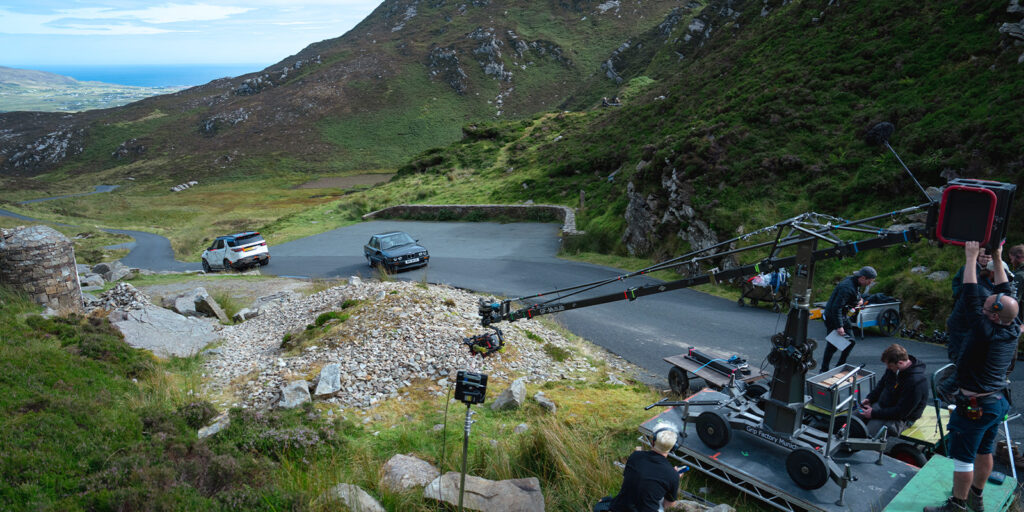
Lighting a forest at night was the first challenge I saw when reading the script and was mindful of it since day one! We wanted directional moonlight, embracing a slightly heightened, storybook quality — what our director once described as “aspirational horror”. It didn’t need to feel strictly realistic; it needed to feel expressive, transcendental.
The cabin itself had to be built in situ so the location needed to be serviceable both for production access and lighting. Gaffer Adam Slater and I carefully considered the canopy: its height, density, spacing and colour, as well as surrounding areas of land for machine access and the ability to hide fixtures.
A lot of the story was centred around this space, across shooting blocks, and would need to be done in a short amount of time so a lighting approach that allowed shooting in multiple directions with only minor, quick changes was paramount. We chose a location that had a perimeter of tracks and accessible fields along which we peppered a mixture of 3 x ARRIMAX 18Ks, 2 x ARRI M90s , and 2 Creamsource Vortex rigs – all on machines for our moon – and manoeuvred two Skylite LED Balloons within our shooting area for ambient texture and/or separation. Haze was essential to the tone, though there was a struggle at the time due to the wind.
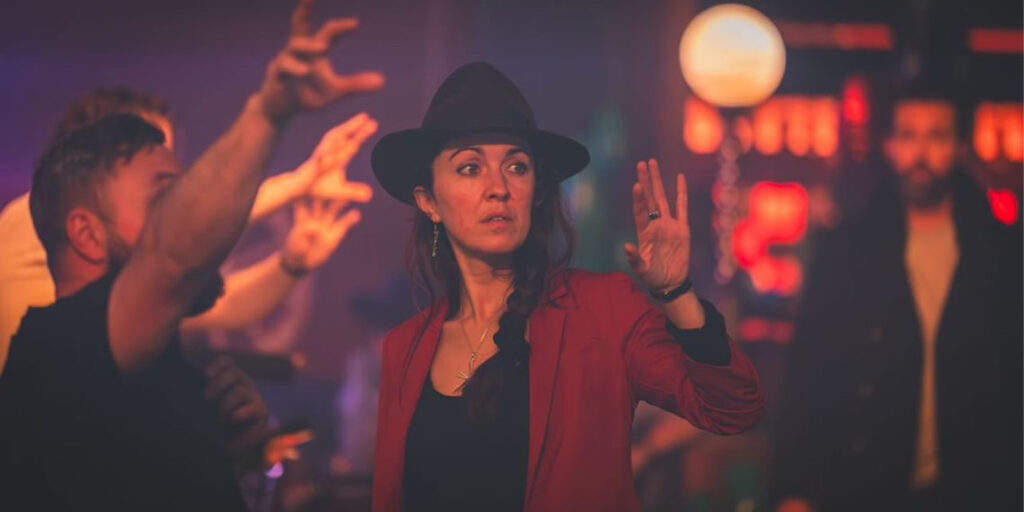
Working with the available resources gave me the opportunity to explore the Alexa 35’s Extended ISO setting.
Going to church
In episode two, the church sequence leaned into the show’s horror language. It centres on a guilt-driven vision and we wanted to avoid filling the space, but rather creating isolated pools of light. Practical candles were used sparingly and often close to camera to create abstraction. The location was a large cathedral in downtown Belfast, presenting significant access limitations.
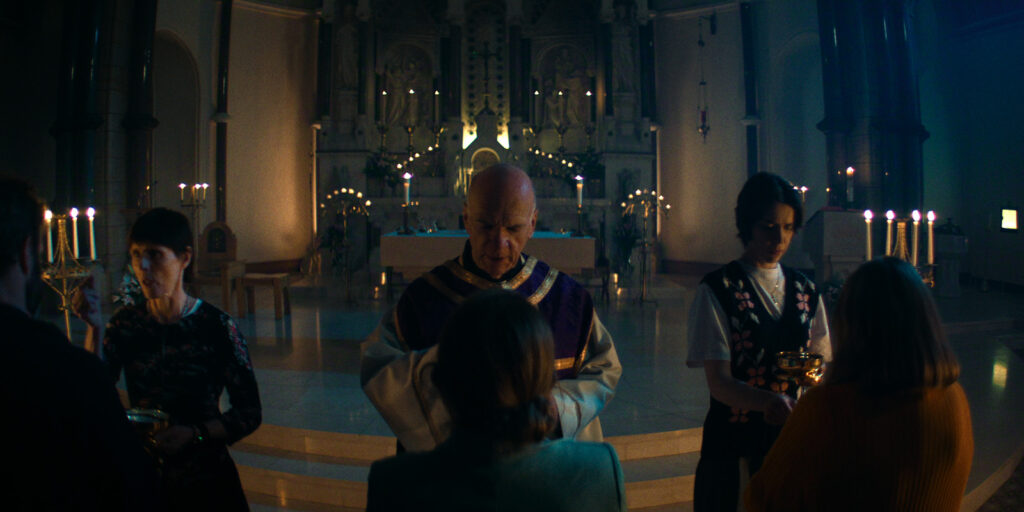
With narrow streets surrounding the building, we were only able to really light from ground-based positions, employing tungsten units – primarily 5Ks and 10Ks – along with Creamsource Vortexes. This predominantly uplighting-based strategy, supported the horror tone. Architectural features such as columns were used to hide fixtures and to uplight, which helped with creating a sense of vastness, depth and separation. The cathedral’s choir balcony allowed for a LiteGear LiteMat key light, which also cast a colourful glow into the haze – a technique used throughout the series to create a vivid, uncanny undertone.
Across the series the goal was always to serve the story: let the visuals whisper unease while the dialogue delivers the craic. In the end, the images feel lived-in, emotional and just a little haunted – like the characters themselves.