
RETURNING TO OZ
Last year’s Wicked defied not only gravity but expectations, nominated for 10 Academy Awards and banking $750 million at the global box office, becoming the most successful Broadway film adaptation of all time. Alice Brooks ASC explains how she and director Jon M. Chu are aiming to emulate that success – while creating a fresh experience – with follow-up Wicked: For Good.
“Colour means something in Oz.” Coming from its award-nominated cinematographer, Alice Brooks ASC, one might take that as a given – starting with yellow bricks and emerald couture and cityscapes. But it turns out the roads both to, and within, Oz are filled with “emotional cues […] and intentions” for both traveller and audience member alike, manifested not only through colour, light, and texture, but in the collaboration among Wicked’s creators too. Something perhaps even more palpable in its culminating second part, Wicked: For Good.
In part two, we get Wicked’s reckoning between Glinda and Elphaba, each with their own innate power, whether used a little too recklessly, or perhaps still latent and unclaimed, waiting for a moment of the heart to be made manifest.
“If the first movie is about choice,” Brooks summarises. “Then the second is about the consequences of those choices.” And with those consequences, “you feel the shadow.”
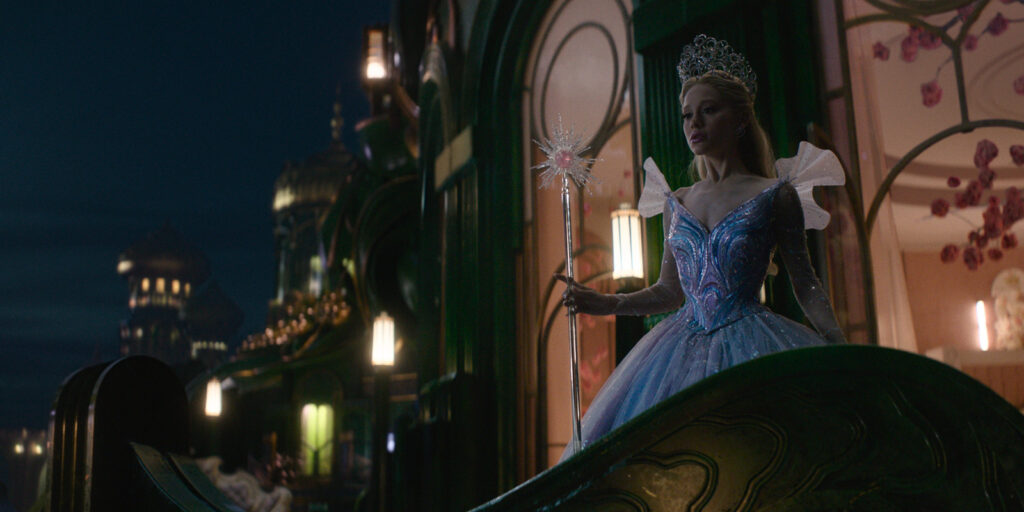
But to talk with Brooks about the multi-year process of bringing Wicked to life with longtime pals and collaborators director Jon M. Chu and choreographer Christopher Scott, among many others, is to also get a palpable sense of how all their cinematic power was made manifest over the production’s pandemic-slowed two-year “pre prep” period, “before we were in real prep”. During that time, she and Chu “started creating a visual library of ideas […] we collected thousands and thousands of images – and shared ideas back and forth.”
Seeing the light
Some of those images existed long before Brooks even knew there’d be a Yellow Brick Road in her future. During our interview, she excitedly shares books from her own childhood, like the National Book Award-winning Miss Rumphius, about another Alice who lives with her grandfather (who is based on an actual New England-based “lupine lady”, who spread plant seeds along the coast) and whose grandfather tells her she must do three things in life – “the first is to go and live in far away places, the second is to come home and live by the sea,” but the third, “which is the hardest , is to make the world more beautiful.”
For Brooks, that mission was rooted in an artistic upbringing: “My dad was a playwright, my mom a dancer and a singer [and] my sister and I were both child actors.” That eventually brought a move to LA, so Brooks and her sister could be on hand for auditions, commercials, etc., and included moments like the young still-thespian catching a showing of Basquiat, the ‘80s-era film about painter Jean-Michel Basquiat.
As for the light, it was also around this time, after being one of the two finalists for a role in While You Were Sleeping, that she recalls telling her mother, “I no longer wanted to be an actress – I wanted to be a cinematographer […] My sister was always on a TV show [and] I’d watch the lighting people create something magical out of nothing with light and thought, this is what I wanted to do with my life.”
She’s also delighted to find many of those same on-set folks are now her colleagues, and while she’s risen to the top of her craft, she’s remained open to a wide array of influences.
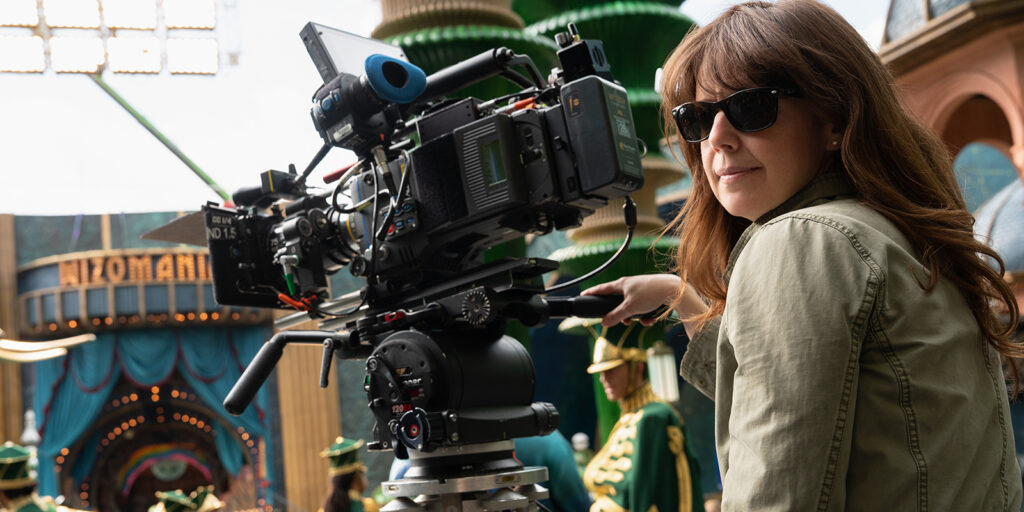
Including some she and Chu drew from, which might surprise viewers, such as Memoirs of a Geisha, Empire Strikes Back and the films of Hong Kong director Wong Kar-wai, and Terrence Malick. “[Jon] wanted it to feel like a ‘Terrence Malick of Oz’,” she says of the latter. “We have a lot of these beautiful sunsets,” but, she hastens to add, “they’re not Badlands sunsets.”
Taking cues
And while the midwestern plains of Badlands may belong more to Dorothy’s Kansas, capturing Elphaba’s own “outlaw” journey through Oz required an inventive approach. The filmmakers retained the spontaneity of live lighting cues, like the stage version, which Brooks also describes as having a “massive influence” on how they approached the film.
“There’s something about live theatre that’s hard to replicate with movies,” she acknowledges, but one of the ways “we tried to make it feel like [it had] a live visual element to it” was to do the lighting cues… live. While Cynthia Erivo and Ariana Grande were singing.
“Often,” she says, “you programme the lighting off the tracks time code. But here “we played off recording completely live music”. Knowing the entirety of the soundtrack would be recorded on set made the camera department think “maybe we can do everything live, too”.
Brooks is quick to credit the “brilliance” of both her console programmer, Daniel Bocking, and her gaffer, David Smith, who executive live lighting cues in every scene, working in conjunction with Steadicam and A camera operator Karsten Jacobsen DFF. “Some scenes have hundreds of lighting cues that you might not notice, but you can feel.”
Both Wicked films were shot on ARRI 65 with custom Panavision Panatar lenses—modified by Dan Sasaki and dubbed “Unlimited” lenses—and though one might assume the same setup “remained” from part one, both installments were filmed concurrently, sometimes with scenes alternating on the same day and set. “Shooting two movies at one time is really hard,” she adds. Especially since “each movie had its own distinct visual language”.
Meanwhile, lighting equipment – supplied by Universal Production Services – included Astera Titan Tubes; Nanlux 900 and 5000; Cineo BL800 and Quantum II; Creamsource Vortex 8s; Ayrton Domino; ARRI S-360; Dinos; MBS Aquabats and Vulcans; Par Cans, candy lights, pipe lights and 200-watt Soft Suns.
But distinct languages and all, Universal, Brooks acknowledges, “took a huge chance on us” by greenlighting production on both without waiting for box office on the first one – meaning the crew then needed to “prep two movies for over five (total) hours of total screen time”. But it paid off: “when you do two movies separated by a couple of years, they aren’t nearly as seamless”. “There is a visual heartbeat that intricately weaves the two movies into one through lighting and camera,” she says. “When you step back and look at both films as a whole, every intention and choice is clear and vibrant and beautiful.”
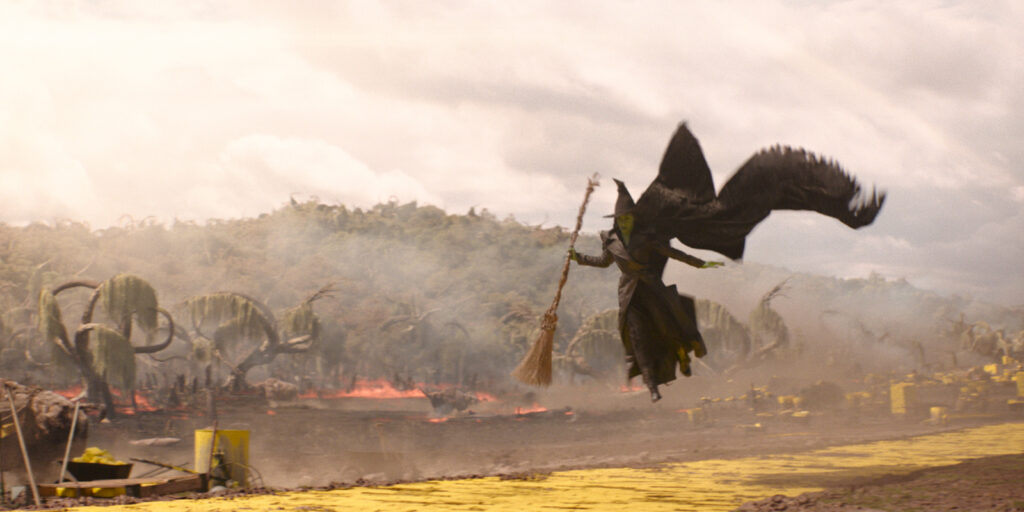
That seamlessness could sometimes be challenged by something as simple as a hat, such as Elphaba’s brim, which required its own lighting adjustments.
Her “wicked” character normally got “rich light, with deep blacks” Brooks says, with shadows positioned so “the brim of her hat fell right around her nose”. The brim was “built slightly larger for the second movie, which made things trickier in some ways,” though it inspired “new creative way[s] to express things in shadow”.
This included changing things as needed when swapping between costumes and scenes, on the same day. “Every lighting cue, every lens choice, every movement was rooted in emotional intentions. As the creative discussions deepened, it became clear that the first film would be effervescent, and the second would carry weight and density.”
In the frame
For the song ‘Wonderful,’ Chu wanted the sequence to “feel like the Peter Pan ride [at Disneyland],” so special effects “built a real ride, [and] the pink light starts to grow as they’re on this track”. Other changes, subtle and otherwise, also insinuate themselves as the story unfolds. One came from the framing.
“Framing is a huge difference between both movies,” Brooks recounts. In the first, they “split the 2:39 aspect ratio perfectly” between the two witches. In For Good, “they’re rarely together, which gave me an opportunity to treat each character differently.”
And while she underscores that they used “the same lens package for both movies… there is one [key] difference. In the first movie we shot Elphaba with a 65mm lens, and […] Glinda with a 75mm. And we do that throughout the second movie, but for the very last scene I shot Glinda with Elphaba’s lens. They’re different lenses [and] when I see it, I feel a difference between them.”
A difference that has left each of them changed “for good”, as Glinda finally comes into her own power, and Elphaba learns to marshal hers.
Glinda makes a decided step in that journey in “Girl in the Bubble” – a new song written for the film. Brooks said the scene was done as “a perceived oner”. Shot in Glinda’s two-storey “apartment suite” set, she and Chu “talked about it (being) about identity and the choices we make – the stories we tell that turn us into who we are – for Glinda it is being trapped in a bubble.”
For the number, “Jon wanted us to have a scene where we go into the mirror,” she says, which had them collecting “tons and tons of mirror shots,” from Robert Zemeckis’ in Contact, Orson Welles’ in Lady From Shanghai, or done by numerous YouTubers uploading DIY effects from their own laptops.
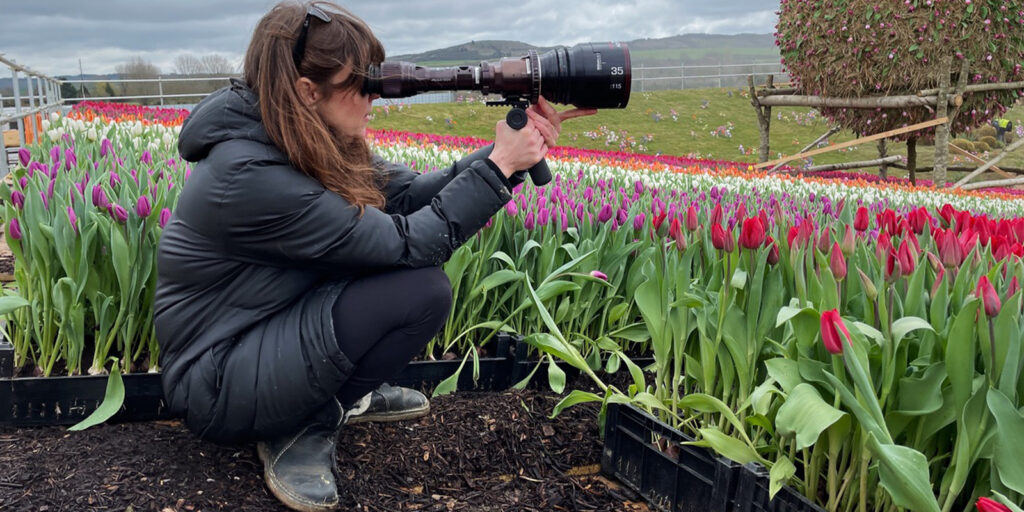
But classic sequences aside, Brooks went the “handmade” route “the night before our big production meeting”, waking up at 2am and “grabbing two bananas, my husband’s shaving mirror and my daughter’s princess bath toys. On my iPhone I did a stop-motion of the whole thing.”
She then brought “all the props into the production meeting, and that was only the beginning.” The storyboard artist drew it, and in the final sequence, done as “practically” as possible, “walls had to fly while the camera was pointing away and then come back in as our camera pivoted toward the wall again, so our camera could go back far enough. We needed to pull back through the mirror.,” By the time it was completed, it involved “four Steadicam, one dolly, and two crane shots.”
“We worked with VFX to know the exact distance to the centimeter where the camera needed to be. Talk about every single department working together!”
A magical legacy
Much of that working together, of course, took place long before cameras rolled. “We needed lots of practicals to do our live lighting,” Brooks says, and “it was a constant conversation with (production designer) Nathan [Crowley]” in how those lights could be incorporated into his designs.
One clear example of that partnership came with his use of clear resin in particular sets, including in columns “next to both mirrors on either side of Glinda’s suite. [We] put Astera tubes in those,” she says, “and I had control of what colour it became.”
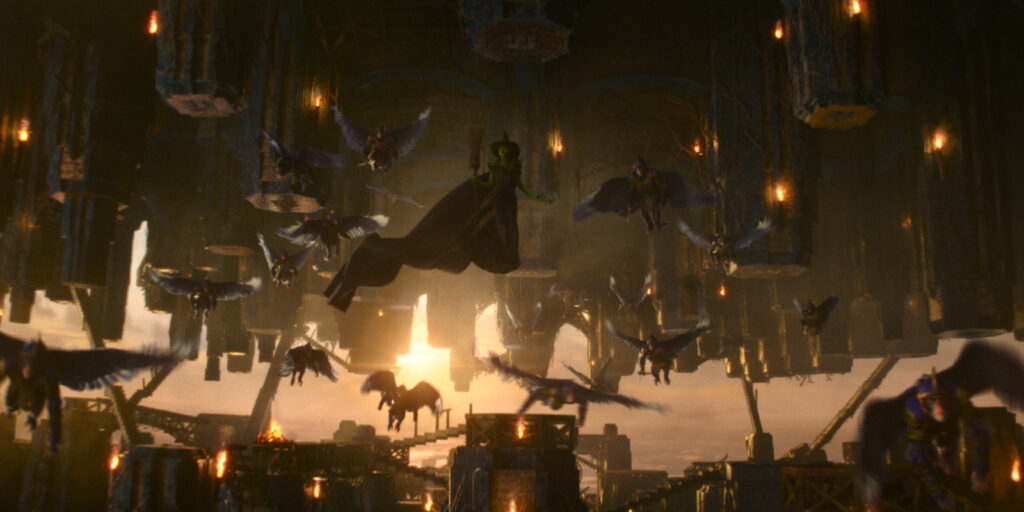
It’s a bit of practical magic that perhaps the Wizard might appreciate – though the intention is far more sincere. Brooks says she’s proud seeing “all these young people who come to me, who are inspired, and see the world differently because of Wicked”, along with “seeing the legacy” of the film, which now joins the canon of other tellings – like the original books, the original film, and The Wiz – of “this great American fairytale”.
Brooks also recounts “lots of end-of-life requests from children to see Wicked.” Perhaps the most poignant example of how the story, and its journey to screen, have touched both filmmakers and audiences alike – in the words of the story’s culminating song – changed us all for good.