SPY HARD
The Night Manager returns, plunging Jonathan Pine into espionage. DP Tim Sidell BSC’s precise lens choices, lighting and camera movement render shifting identities, tension and global intrigue with striking clarity.
Former MI6 operative Jonathan Pine (Tom Hiddleston), now living as Alex Goodwin, must confront his past when a chance sighting of an associate of Richard Roper (Hugh Laurie) draws him into a deadly conspiracy spanning Colombia to MI6’s core. Pine teams with businesswoman Roxana Bolaños (Camila Morrone) to infiltrate a mercenary-led arms operation linked to Teddy Dos Santos (Diego Calva). With shifting loyalties, betrayal and international intrigue, season two, guided by BAFTA-winning director Georgi Banks-Davies, raises the stakes beyond John le Carré’s original novel. The Night Manager is back.
DP Tim Sidell BSC (Flux Gourmet) relies almost exclusively on the Sony Venice. “I find it offers a more painterly image,” he explains. “It may not have quite the highlight range of the Alexa 35, but I find the detail in the shadows, which is where I like to work, to be more rich and organic. The Venice can get a bit excited with reds, but somehow this results in beautifully rendered skin tones that carry an emotional quality.”
Sidell predominantly used Leitz Hugo primes, after testing a wide range of lenses. Both he and Banks-Davies were keen to incorporate free and extensive camera movement to heighten subjectivity and maintain proximity to the cast.
“I find this approach works well on a kind of medium to medium-wide lens,” he says. “We knew a lot would be handheld and Steadicam, so we knew something physically light, small and technically fast would be more conducive. They’re also less intimidating for the artists than bigger lenses. I prefer older lenses, with some inherent softness,” Sidell adds. “Georgi prefers a bit more snap. We found a compromise with the Leitz Hugos, which also offer a good range of focal lengths. We had two sets and shot around two-thirds of the series with those. One set had the super-fast 50mm Noctilux, which I’m sure our wonderful focus pullers Joseph Mastrangelo, David Agha-Rafei and Lara Blanco enjoyed.”
Pine’s shifting identities were something Sidell was keen to explore visually. As an undercover operative playing multiple roles, Sidell subtly reinforced this through camera movement and lens choice.
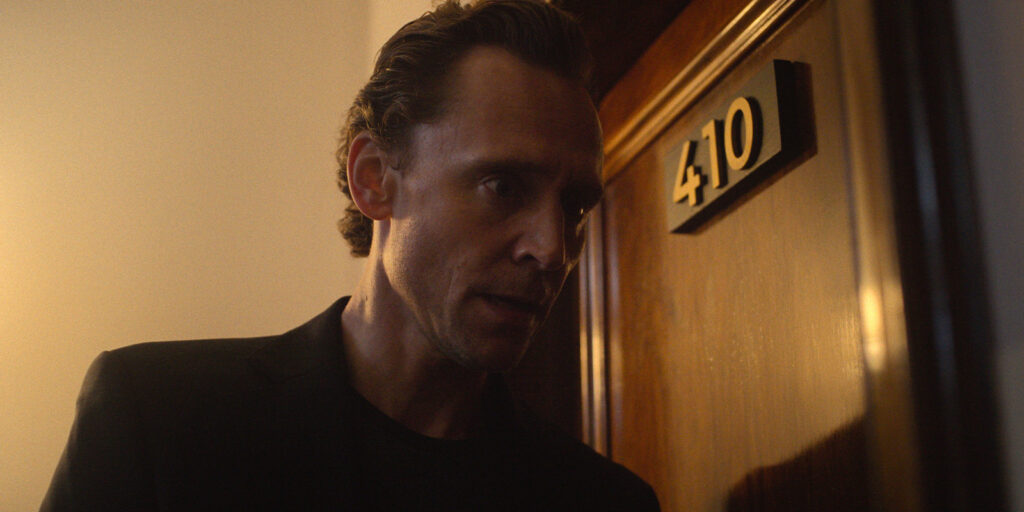
He points to Matthew Ellis, a swaggering city banker, as a character he wanted to reflect visually through a switch in glass. To match Ellis’s bombast, Sidell introduced Mamiya 645 lenses, rehoused and fitted with speedboosters (by TLS) to both widen each focal length and increase their speed: “The speedbooster introduces a subtle anamorphic quality, the result is slightly warped and three-dimensional, with softer edge contrast and rapid focus fall-off.” Paired with low angles and sweeping camera moves, the approach elevated Pine’s presence, making the Mamiya 645’s the defining look for Ellis.
The team also carried a TLS re-housed Yashica 45mm, which was used for highly subjective sequences with Pine, and macros which were on hand for ECU screen and phone shots.
Zooms played a key role in evoking the visual language of espionage. Referencing The Conversation (1974), the team embraced long lenses and obstructed viewpoints, limiting what the audience could realistically see as a distant observer.
“For a few key sequences, we leaned into that visual language, complementing our workhorse Angénieux Optimo 37–102 with Angénieux EZ’s with doublers and an Angénieux 12x 36-435,” Sidell says. The camera package was provided by Sunbelt Film & TV for the UK leg of the shoot, and the entire lens package was retained for the rest of the shoot, so travelled to all territories.
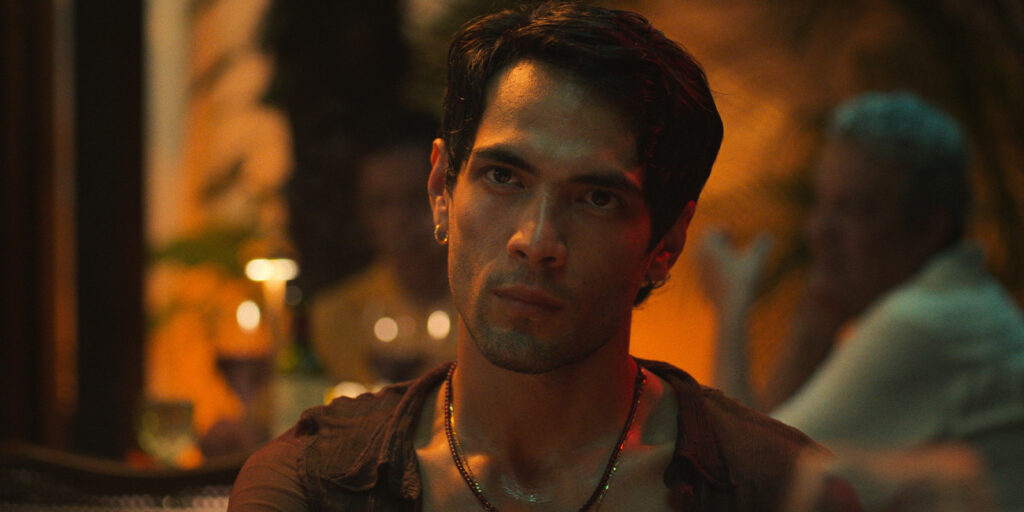
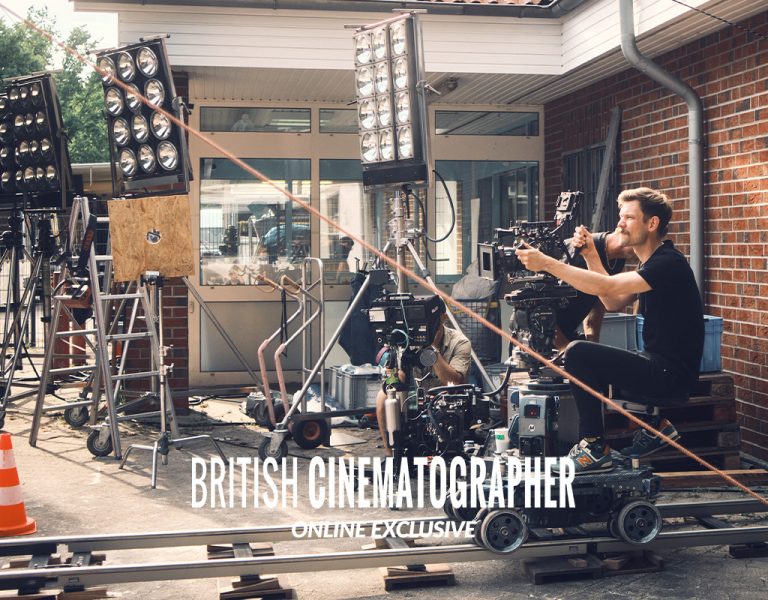
The series shot over 100 days across London, Colombia and Spain, each requiring distinct lighting setups, with only essential portable gear moving between territories. Working with gaffer Sam Alberg throughout brought strong continuity to the lighting across the series, aided by best girl Marina Lewin Richter and desk ops Johnathan Massena de Camin in London, Colombia and Barcelona and Tuck Linehan in Tenerife.
“For speed, we relied heavily on LEDs for interiors, especially LiteGear Litemat Spectrums, Aladdins or Creamsource Vortexes if we needed additional punch,” Sidell continues. “In addition to being a more sustainable option, LEDs are quick, adjustable and increasingly colour accurate, though on the later, tungsten does still edge them. I’d often rely on Lowel Rifa lights which are small, light and quick to rig, especially when running on Instagrid batteries, and introduce a gorgeous warmth when dimmed.
“All interior lights were managed via dimmer boards or iPads for on-the-fly adjustments. For exterior daylight setups we used traditional HMIs and bigger LED sources for night sequences. Sustainability, speed and control guided our approach, balancing modern LED technology with classic tungsten and HMI solutions.”
Challenging situations
Sidell says “there were quite a few challenges, often relating to locations”. One example was the Gold Museum sequence in episode two. “The location was dull — a dusty municipal building in Barcelona — but the sequence called for gloss, glamour and exuberance,” he continues. “Sam and I discussed projection onto the building. We shot some abstract colour and movement, using gelled Dedolights with projector lenses to create coloured patterns through glass objects, shooting close up and slo-mo. Lighting designer Matt Button refined this material for projection onto the building and the team complemented this with SkyPanel 360s and tungsten profiles for some added shape and drama.
Inside was another challenge. “It’s a silent auction — a fundraising campaign for Teddy’s Aurora Foundation,” Sidell adds. “We had eight or nine pages to get through over two nights. Georgi, Tom and I love long continuous takes, so we shot on two Steadicams, following the cast improvising laps around the space. Sam set us up for 360 degrees with strong soft backlight sources a balloon and some profile sources while Johnny dimmed on the fly, as the actors and camera ops moved, to maintain soft backlight. This let us shoot continuously and maintain those long uninterrupted takes.
“I usually operate the camera myself, enjoying the connection with cast and sharing freedom of movement, informed by my Capoeira background. Tom, Diego and Hugh are all tall, and I am not, so I needed someone with a similar physicality and approach to movement, but taller. On Night Manager I worked closely with Dan Nightingale ACO GBCT across the whole series. His understanding of our visual language and his contribution to executing it were exemplary. We would often leapfrog between set ups or move around each other during combined takes, which gave the scenes a real fluidity.”
Sidell says it was important to develop the visual language of season one. “This is a thriller full of espionage, so we leant on those long lenses inspired by The Conversation and The Day of the Jackal and played this against wide architectural frames inspired by The Parallax View and The Conformist. But perhaps even more so, the series was so much about identity, which was a central theme for Georgi and the associated subjectivity is something I really relate to. We got in close to heighten this, sharing their experience. We knew this would primarily be about Pine – and the central framing of Triple Frontier and Oppenheimer were a reference here, but others’ identities also countered this, particularly Teddy and Roxy. But it’s broader too, looking even at the identity of Britain itself. We were also mindful that we’re in the realm of a thriller and Sicario and The Hurt Locker were key references too. Across territories we balanced these approaches, creating tension, a sense of the unknown and release, particularly in Colombia. I really enjoyed that. The creativity and collaboration throughout was rich and invigorating, with Georgi, the cast, other HoDs, plus Sam and Dan. All phenomenal collaborators.”