
BURNING BRIGHT
With Avatar: Fire and Ash, the Pandora saga continues, as cinematographer Russell Carpenter ASC details his work on the film, stereoscopic cinematography and a decades-long collaboration with James Cameron.
With the release of Avatar: Fire and Ash – the third in the multi-billion dollar grossing sci-fi saga by director James Cameron, all set on the fictional planet of Pandora – it brings to a close a remarkable, long-gestating chapter in the life of many who worked on it. Among them, cinematographer Russell Carpenter ASC, who first collaborated with Cameron over three decades ago on True Lies. Following this with 1997’s Titanic, for which he won an Oscar, they reunited for 2022’s Avatar: The Way of Water.
Shooting this and Fire and Ash back-to-back, Carpenter began the exhaustive process a year before the commencement of live-action photography. “I started in 2018, doing initial research and tests of certain things,” he explains. “A month or two later, I came on and did lighting for the better part of a year. Eight or nine months. And by that time, it’s 2019 and we basically started scouting in February and shooting in May of 2019.” Then Covid-19 hit, the virus putting the film – like everything else in the world – on pause.

Although largely filmed in New Zealand, primarily at Wētā Digital (now Wētā FX) and Stone Street Studios in Wellington, at the time, Cameron was in Los Angeles shooting the extensive underwater scenes for The Way of Water at Lightstorm Entertainment’s facility in Manhattan Beach, California. As the pandemic gripped, the borders were shut, deeply affecting the production. “New Zealand just wasn’t letting anybody back into the country,” says Carpenter. “I know it took [Avatar producer] Jon Landau and Jim a long time to say, ‘Let us be your test case.’”
Going fourth (and fifth?)
When Carpenter finally returned to work, the plan was to shoot scenes from both The Way of Water and Fire and Ash concurrently. “We had these huge soundstages in Wellington. The idea was, ‘Oh, my God, you can’t just keep an actor around. Let’s try to shoot out all the main actors and get any big scenes with human beings done as quickly as possible.’So that meant a lot of work, especially on the lighting side, getting stages ready for both movies [The Way of Water and Fire and Ash] and then getting some shooting done for Avatar 4.”
Whether a fourth Avatar movie will take shape – and whether Carpenter will be involved – remains to be seen. Cameron has scripts ready for fourth and fifth chapters in the series but has said he may step aside and let another director take the helm. Yet, judging by the Fire and Ash box office tally – $1.5 billion at the time of writing – audiences remainexcited by the continuing adventures of Jake Sully (Sam Worthington), the former US marine who becomes a leader for Pandora’s blue-skinned Na’vi after his consciousness is permanently transferred into his avatar.
In Fire and Ash, he and his family – including the human character Spider (Jack Champion) – continue to lead the fight against the destructive forces of the RDA, the human-led Research Development Administration looking to colonise Pandora. The story takes viewers deeper into the planet than ever before, and into the orbit of the primal, volcano-dwelling Mangkwan clan – the Ash People – and their aggressive leader Varang (Oona Chaplin). Once again created with fully CGI-realised worlds and actors using performancecapture suits, Carpenter calls the Avatar films an “outlier” compared to the traditions of live-action shooting.
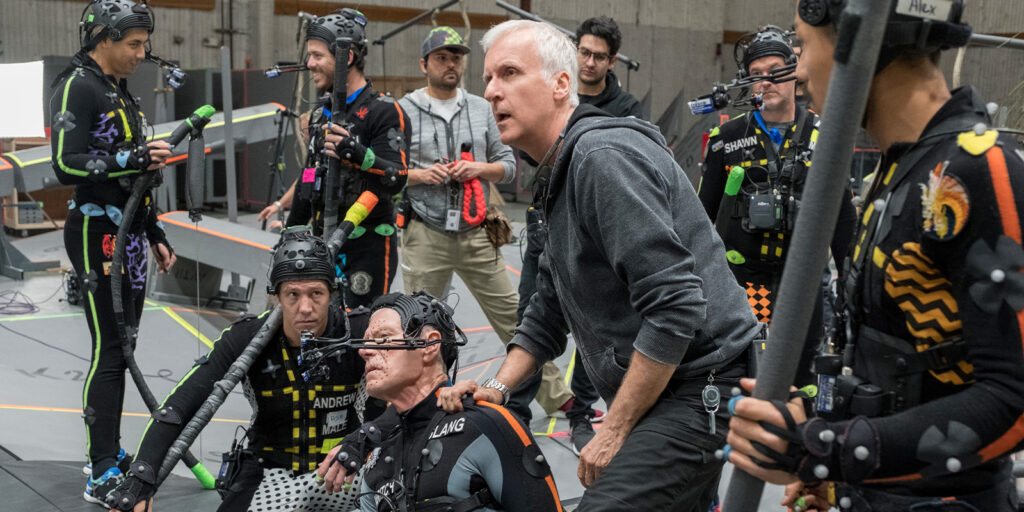
“Here’s a film that gets made at least two or three times before I come into the mix,” he notes. After the CG environments are designed, Cameron undertakes a virtual location scout, blocking out scenes with a group of performers he calls “the troupe” before editing it. Only then does he bring in the actors, all wearing performance capture suits. “The cinematographer, who is coming in from the live-action world, is kind of a stranger in a strange land here,” says Carpenter, who had to undergo a steep learning curve. “[I was] supervising the lighting for many of the CGI scenes. And a lot of those scenes I’d later be introducing human elements.”
Primarily using the Fujinon MK18-55mm T2.9 lens, Carpenter paired it with the Sony Venice, a camera he felt was “perfectly suited” to their needs. “The colour space is terrific. Also, the contrast range.” With the folks at New Zealand’s Wētā creating Avatar’s computer-generated ecosphere, the camera more than serviced their needs. “Wētā’s bread and butter is having information – good information and good colour to work with. So, they’re not taking something that’s subpar and working with that. So, it [the Venice] made for images that were…I mean, technically, they were fine, but also aesthetically, they could be bent and shaped in post.”
Weight loss, precision
Among the many technological advances that occurred across the second and third Avatar chapters was the Sony Venice Rialto stereoscopic system. Images were captured using two sensors, which combined as a synchronised stereo pair – ultimately creating a 3D image, just as the human eye does. Key to this was the Sony Rialto camera extension. The Venice sensor block and lens is physically separated from the main camera body, connected by an 18-foot cable – meaning the only part of the Venice on the Steadicam rig was the image sensor optical blocks. “The rest of the camera was basically resting on the back of a grip,” explains Carpenter.
Significantly reducing on-board camera weight to about three pounds per sensor block, it allowed a much greater flexibility when shooting in virtual environments and creating realistic 3D images that don’t distort. “The problem was [originally] that the length of cable that Sony had come up with was not really long enough,” says Carpenter. “If somebody made a sudden move…there was no wiggle room. So we needed a longer cable. And eventually Sony was able to accommodate us on that and that really made things flow in a natural way.”
For Carpenter, the “holy grail” came with the development of the Simulcam, a real-time compositing system that marries the virtual imagery to the live-action camera footage. “There was no lag. So I could see my actor in the real environment and know for sure that the light that I was putting on the actor was totally in sync with what was happening in the CGI world. The computer system knows exactly where everything is in relationship to the camera, either the virtual camera or the live camera.”
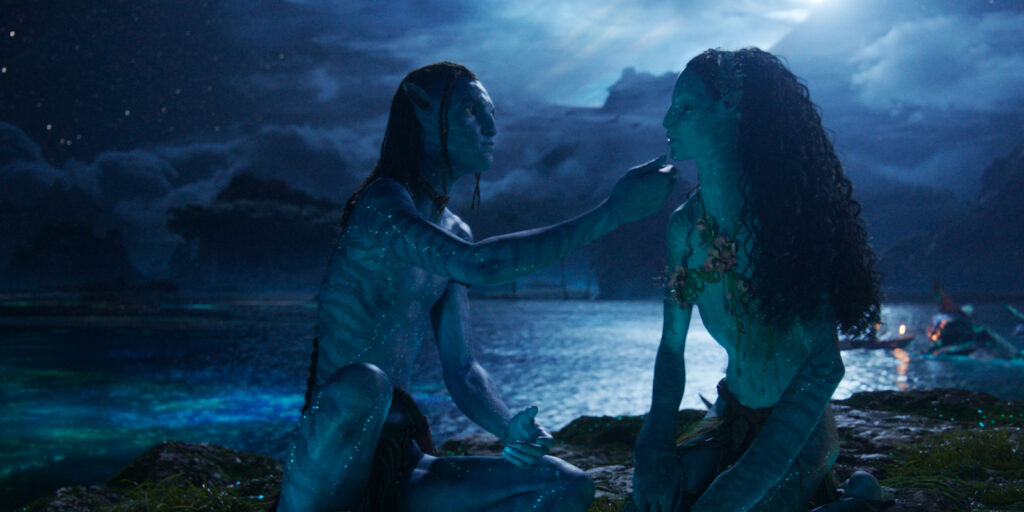
At the beginning of each scene, the two are married together. “So now whatever the live camera points [at], the virtual world will point with that. So you can even do handheld. As a cinematographer, it was great because it knows how far away everything is.” He uses an example of Spider, who might move in front of a Na’vi character. “Instantaneously, that makes the Na’vi disappear, as though they would if they walk behind Spider. And if a Na’vi is four feet away and Spider’s seven feet away, and the Na’vi walks in front, Spider disappears. I mean, that was a godsend.”
Lighting fire, virtually
When it came to lighting the virtual environments, Carpenter cites Len Levine and Daniel Riffle, his gaffers – or chief lighting technicians, as they are credited – as his “life support”. “Len and Dan had to do so many unusual things, come up with so many unusual situations, because every scene was really different. You couldn’t just say, ‘Okay, one size lighting fits all.’ I mean, they would come up with wonderful stuff for Jake and Spider flying through the air. We knew we wanted hard sunlight, and then we needed something that looked like cloud, and we needed it to be moving, and they would just come up with it. Amazingly, [we had] situations where we just programmed lights to do that.”
As the title suggests, Fire and Ash was always going to require a lot of on-screen fiery eruptions. “The whole aesthetic and technological weight of that fell to Wētā,” says Carpenter. And yet the cinematographer still had to light the fire, so to speak, from flaming arrows to campfires. For the latter, LED tubes were married together to simulate the inviting look of the flames. “It came down to working with – and watching over and over again – what was going on in the CG world and being ready to simulate that on the day of the shoot. And I guess a lot of my work was…just attention to detail.”

Crucially, the native stereo image had to be readied for the IMAX format. “There are 60 different versions of the film made,” says Carpenter. “And the first two large camps are…okay, this is going to be seen in a 2D theatre, and the format is going to be 2:39…basically 2:40. We’d frame for the IMAX and we’d also make sure that the 2:40 frame worked also. Of course, that’s where we knew our premier screenings would be. So of course, we made that work and then made sure that the 2:40 worked also.”
With the technological advances made via the Avatar films likely to become industry standards in years to come, Carpenter takes a moment to recognise Cameron’s achievements at this point in the franchise’s cycle. “I don’t know if you call it bravery, but there’s a fierce optimism that somehow he’s going to overcome whatever technological challenge that gets thrown to him,” he says. “A lot of times, he’ll turn around and say, ‘We’ve got to do this.’ And I think that’s one thing that people enjoy, who work for him…those challenges can come anytime.”