
MEGALOPOLIS NOW
When Megalopolis, Francis Ford Coppola’s self-funded project decades in the making, was finally given the green light, Oscar-nominated director Mike Figgis jumped on board to shoot fly-on-the-wall documentary Megadoc all about the filmmaking process. Speaking to British Cinematographer from Stockholm International Film Festival, Figgis explains how he discovered his story organically behind the camera…
When did you decide that this was a story that you had to explore, and why did you want to explore it?
I sent Francis a letter of congratulations on the film going into production and said, ‘If you need a fly on the wall, let me know.’ And then a couple of months later, he let me know, so I just cancelled everything else. I had no idea what the film was going to be like, but I was pretty sure it was going to be interesting, because it’s Francis, you know? And the project was so extraordinary, it had to be interesting. But I had no idea how it was going to go. I had a completely open attitude, clean ears, and jumped in.
In an era of quite flashy documentaries, this largely takes a more straightforward fly-on-the-wall approach. Why did you opt for this?
I went for that approach selfishly, because that’s what I found interesting. And as a filmmaker, that’s a style that I’ve developed over the years – trying to reduce the footprint of the film crew. I find that as soon as it gets to more than two or three people on the crew, it’s an artificial environment and people start responding to that in a specific way. When you have somebody with a boom and somebody with lights and all of that, they start performing in a different way. So I wanted to have as small a footprint and as low a profile as possible in order to get what I got, a more intimate response to each situation.
On that note, you’re your own cinematographer throughout this project. Was that part of the thinking to keep the team as small as possible?
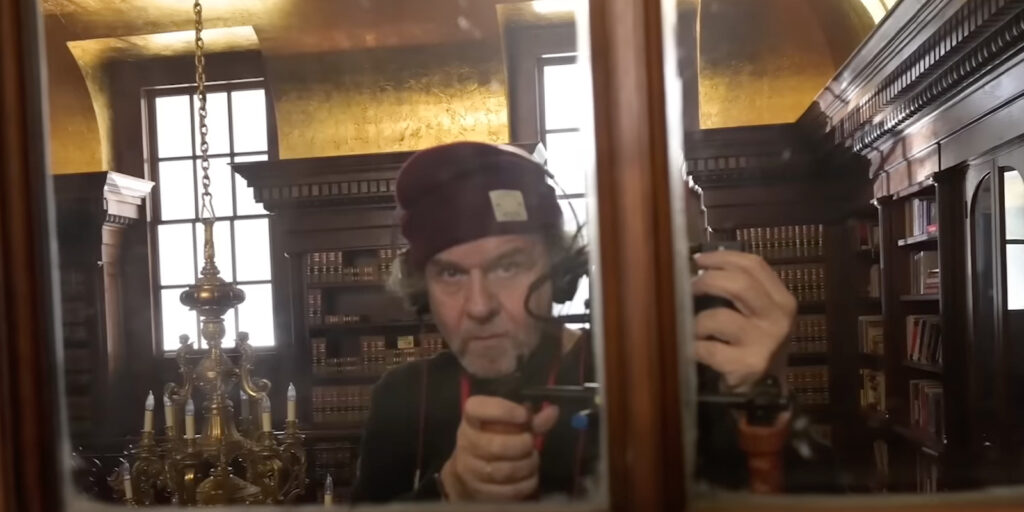
Yeah, but also because, actually, after Leaving Las Vegas, I made a decision that I would shoot films myself. There’s a strong difference between holding the camera and not holding the camera. If you’re holding the camera and you’re also the director and you’re also, let’s say, asking the questions, the response is going to be very different from if I’m the director away from the camera, and they’re talking to me away from the lens, and they say, ‘What’s my eyeline? Where shall I look?’ and so on. They’re already making an artificial response to a question because of the camera. So you may as well hold the camera and try to keep it as organic as possible. But yes, it also means one less person on the crew. And I love shooting. I’ve always taken photographs. I’ve always been a cinematographer. I love it.

What was your camera and lens choice for the production?
Well, I started off with two cameras. One was bigger, which was a Sony, a more ‘documentary’ kind of camera. It was a fine camera, but I just found it too slow to operate. By the time it was up and running and you checked everything, the moment had maybe passed. So I was much more comfortable with a smaller Nikon – I recently bought one of their earlier Z series. A shorter zoom and a longer zoom would cover most shots, but then in certain situations I’d rather use a prime lens. My favourite would either be a 30mm or 24mm, which gave you enough frame without distortion to play with later on.
You take the audience with you on this journey, directly explaining your thinking to the camera at certain points – why did you decide on this approach?
There’s so much downtime on a film like this. I would say the ratio is probably 10% shooting and 90% waiting for the shot. So there’s a lot of time, which was great because that was when Francis would get frustrated, so he’s happy to talk. Likewise for the actors, they were more likely to want to talk. And me too. So there were certain times when something was going on, and I’d just comment on it. I did a lot of that and then cherry-picked afterwards what I thought would give a window for the audience to let them in on what’s going on. It’s almost a Shakespearean device, if you like, of talking to the audience. I wasn’t sure how that was going to play, but the response seemed to be that people liked the invitation to drop in in that way, through me as the director, so I stayed with it.
What is it like to try and capture the filmmaking process?
For the most part, I was blessed in the sense that Francis would let me film him anywhere, at any time. Not only that, he was actually happy to talk because he was frustrated and he was waiting. He likes to talk anyway, so I had a mic on him pretty much all the time. I was a bit cautious at first, not wanting to break his focus, but he was cool about it.
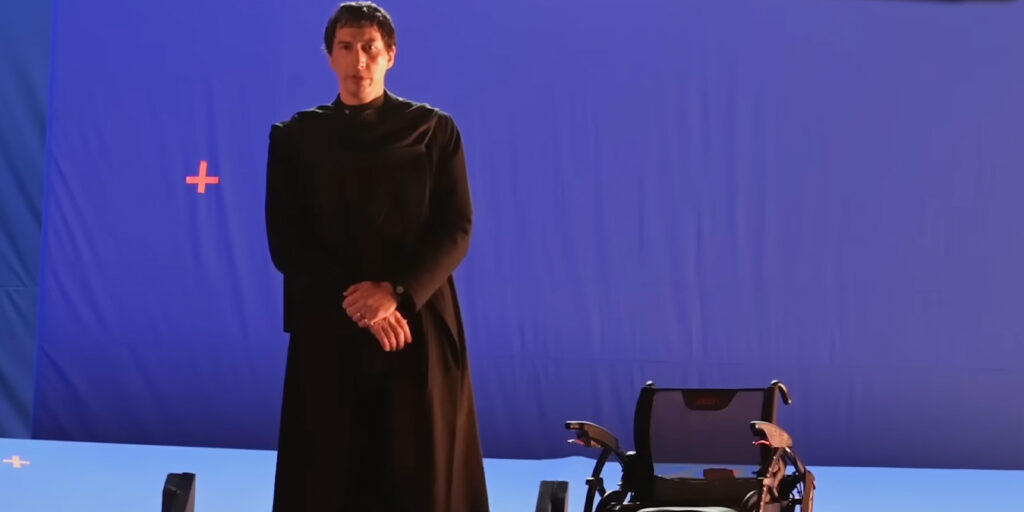
With everybody else, you find out very quickly, sensitively, who is up for what. Shia LaBeouf was happy to talk; Adam Driver doesn’t want to talk. Maybe Nathalie Emmanuel will talk but she doesn’t really want her privacy to be invaded. Whereas Aubrey Plaza wants to act, she wants to perform. John Voight wants to perform at all times. So once I’d established some kind of trust, that they believed that I was respecting them in that respect, I would just tentatively ask, ‘Is it okay? Can I ask you some questions?’ And then usually the answer was yes. So I was lucky. I think because of my small footprint, just me and an assistant most of the time, it gave me a much wider passport.
Obviously you’re a very experienced and successful filmmaker in your own right, but did you learn anything about either feature filmmaking or documentary filmmaking during your time on this film, and if so, what?
Something solidified in my mind, which is my distrust of most documentaries – which is that they’re preconceived and then they’re filmed. The question for me regarding these films would be, what was the exploration? What was your journey? It wasn’t a journey. You were just shooting scenes to justify the deck that you’d submitted in order to get the budget to make the documentary. That’s wrong. That’s not documentary. So I was pleasantly encouraged, if you like, to continue in the opposite way. That makes sense and works for me, to find the story from the documentary process.
That process was very gratifying for me. I like that it was ultimately organic, that I went with a blank canvas approach. I was, I think, alert and awake enough to pick up on what’s happening, and then ask, ‘What is the documentary going to be about? What’s the narrative?’ In the documentary, I talk about, ‘Am I just looking for disasters? Is there a theme?’ And then my instinct was to follow that through as much as I could, and I’m glad I did – it started writing itself, which I’d always hoped it would. I would encourage other people to go into something with a much more open mind. Don’t go in with a prejudiced preconception of what you think you’re going to be seeing, because you’re probably going to lose all kinds of opportunities if you do that.