MAKING IT COUNT
Director Cal McMau’s debut feature, Wasteman, follows Taylor (David Jonsson), an inmate who is up for early release. His chances are jeopardised when he gets a new cellmate, Dee (Tom Blyth), who threatens to drag him into his world of violence and prison rivalry. DP Lorenzo Levrini runs through the visual language of the film…
When I got the script for Wasteman I felt like I had been preparing my whole career to shoot this project. The intersection of visceral handheld and action with a more quiet, meditative and character driven sensibility really spoke to me, so I was thrilled when I was asked to shoot it.
There is nothing I love more than the “soft prep” process of dissecting a script with the director in extreme detail, asking about story, subtext, character, and mood. I feel I do my best work when I can absorb the material in a deep way so that in prep and on set, I can make every decision in an intentional way, with full awareness of what the cinematography and the visuals need to convey in that specific scene or moment. Cal embraced this process, and we spent hours talking through the script.
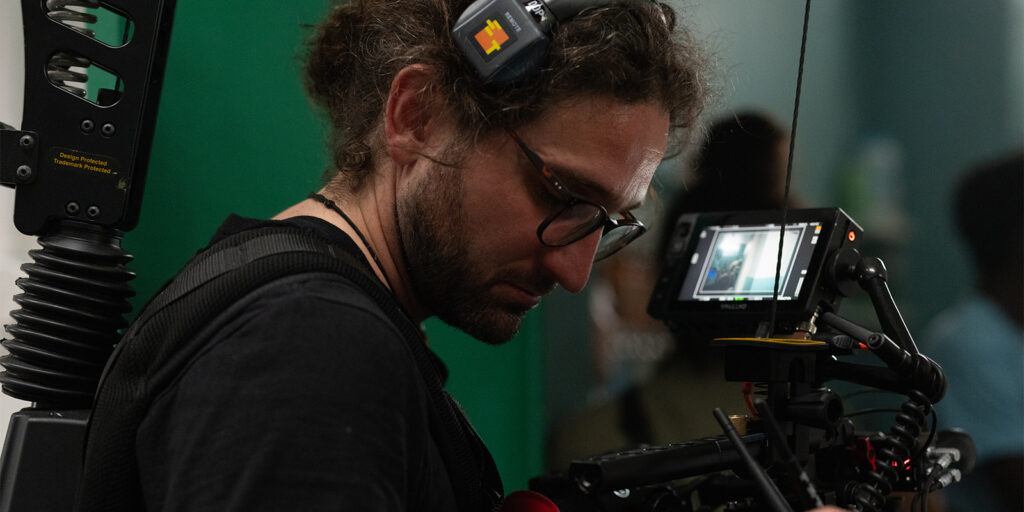
Cal really wanted the film to feel authentic and raw. We worked mostly handheld, dancing the camera around the characters in our tiny cell to immerse the viewer in the pressure cooker of prison life. This was bolstered by moments shot vertically on a cell phone, inspired by Cal’s short film Bossman, shot entirely in a prison cell on a mobile phone. These sections were operated by Cal or by the actors themselves. Although we made a shot list, the reality of working in a tight cell with such incredible performers meant that I had to be alive to how the actors needed to move, and become part of their movement without getting in their way.
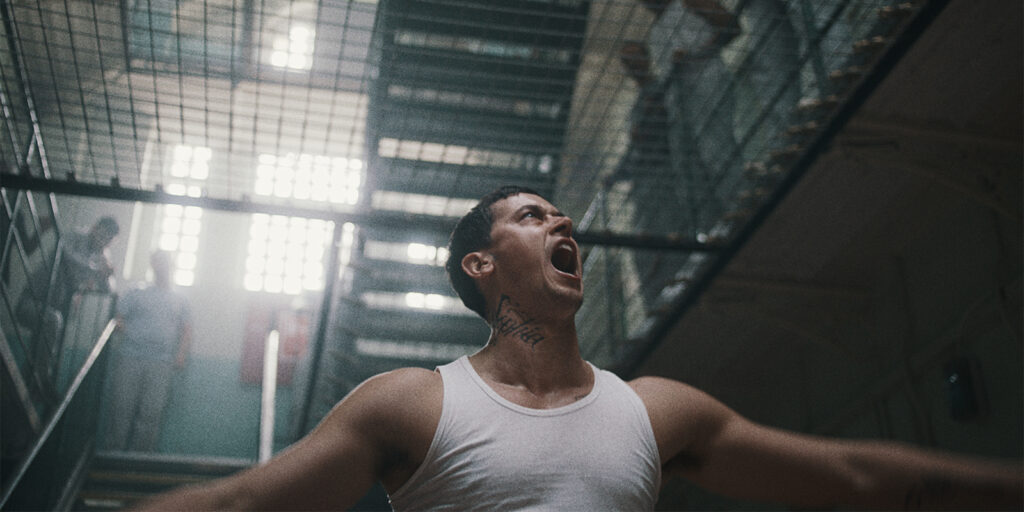
It was really important to Cal that the action scenes be visceral and hectic. Rather than choreograph the action without the camera and then cover it from multiple angles, as would be more traditional, we would involve the movement of the camera in the choreography from the start and make sure the camera was always incredibly close and part of the action.
Lay of the land
Looking at the geometry and the architecture of the prison, and considering the way we wanted to compose, we opted for a 3:2 or 1.5:1 aspect ratio. Cal and I felt 1.85:1 was too wide and 4:3 felt slightly self-conscious and a little narrow for framing what is essentially a two-hander. 1.5:1 offered a perfect middle ground. It’s the aspect ratio of a traditional still photograph, and so offers amazing compositional possibilities. Since our shoot, a few big films have come out in this aspect ratio, but at the time we didn’t know of any other English language film that had used it. Our producer Sophia Gibber and the team at Lionsgate UK were wonderfully supportive in seeing the potential of this format and allowing us to go ahead with it.
We shot Mini LF with Canon FD lenses and a Cooke Varotal with 1.6x expander, all provided by Focus Canning. We planned a few crucial zoom shots, including one where Dee (Tom Blyth) is in the middle of the wing and we zoom from his closeup out to a wide from the opposite end of the wing, for which we used the Canon 50-1000.
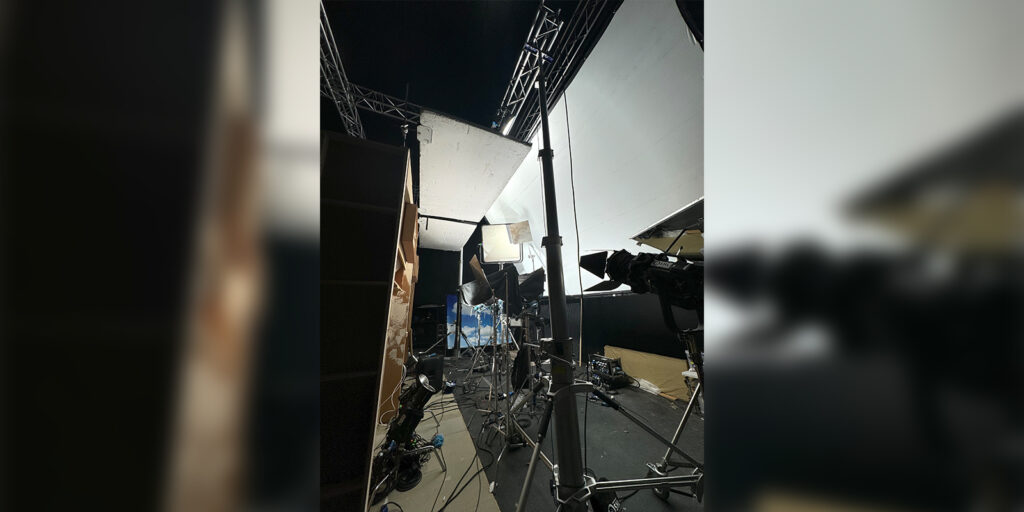
It was decided early on that shooting everything in a real prison was financially and logistically prohibitive. Since so much of the story unfolds inside two or three cells, we built two cells and a facing corridor in the studio, and shot mostly in these, only going to the prison location for four days. Production designer Phoebe Platman and construction manager Phill Welch created something amazing with very limited resources. We chose a specific cell in our prison location, Shepton Mallet, to be Taylor’s cell, and recreated it very closely in the studio so that we could cut between location and studio without drawing attention to the artifice. The other built cell was used for all the other cells in the story. As well as operating, a lot of my focus was lighting in a way that would blur the lines between studio and location, and I’m very happy with the result. Reviewers and audiences alike are often shocked to hear there was a studio involved at all.
We discussed the possibility of making the cell build 20% larger than the real cell to allow more freedom of movement for camera and cast but ultimately decided that sticking approximately to the real dimensions would aid the sense of claustrophobia and realism that we were after. To enhance this, we also decided not to include any wild walls. We had three small camera traps, which were sections of wall that could be opened to poke a camera through, but we used these sparingly.
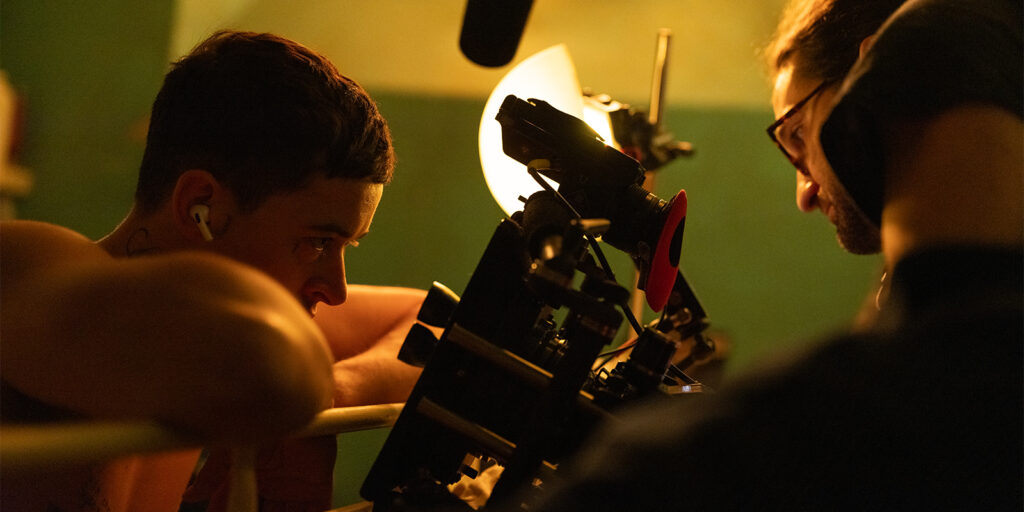
It’s hard to convey how small the cell was, but somehow David Jonsson, Tom Blyth, boom op Tom Wilkin and I managed to squeeze in there for every setup without getting on each other’s nerves. We even did fight scenes with four characters in long takes, carefully choreographing the movement of the camera and the boom to not get in each other’s way. My focus puller Anil Duru was an invaluable part of this equation, working from outside the cell, I felt like he always knew where the focus needed to be and what I was going to do next.
The real cells in our location offered a variety of colour palettes, and I think one of the most important decisions we took for the visual signature of the film is to model Taylor’s cell after one with a greeny-teal wall colour and reproduce that for our build. Phoebe sampled this colour as well as the colours of the doors and corridors, and provided wooden boards painted with these tones for our camera test. We dressed a supporting actor in the real costume and put him in front of these colours, and took the footage to our amazing colourist Jax Harney, who created a LUT for us to use on set.
Lighting the lock-up
Gaffer Vini Curtis was a crucial collaborator in co-designing and executing the lighting plan. To be true to our mandate of visceral naturalism, we decided we would only light from outside the cells, and use only practicals inside: the main fluorescent cell light, a light above the mirror, and one above the door. The construction team added magnetic strips at the join of wall and ceiling so that we could occasionally clip an Aputure MC to it and bounce it into the ceiling for ambience, and now and then Vini would jump in with a small polyboard or silver for closeups.
To enhance the sense of naturalism in the studio, I was keen that there be a variety of lighting looks in the cell. We wanted subtle variations in the daylight, to reflect different times of day and different levels of overcast. Prison is not just bleak: the entire gamut of human emotion exists in there, and I wanted to reflect this in the lighting, so sometimes the daylight is overcast and muted but sometimes we bring in a shaft of sunlight. At night, we played with different combinations of the in-cell lights and decided there should be a greenish security light outside the cell window.
The build took up most of the studio space so we had very limited space outside the cell window to light from. Vini came up with an excellent rig that included CRLS mirrors, ultrabounce, a sky backing and various LED sources all controlled through desk op Jamie Legge’s GrandMA so that we could quickly cycle between lighting states, which was essential to keep up with the our tight shooting schedule. The corridor outside the cells was lit with two Litestar Airlite 1000W LED balloons to mimic the real prison wing’s skylight. We opted to replace the tube lights on the real wing with cool bulkheads, and carried this through to our studio corridor.
Shooting Wasteman was an incredible experience. We all had to be so in tune with each other to pull this off, and I’m really thrilled with the result.