
DUST, BLOOD AND DEADLINES
How a Brighton couple shot a horror feature in 10 days: Built from nothing. Crafted without outside support.
When Brighton-based filmmakers Lawrence Jacomelli and Victoria Taylor sat down in their kitchen one ordinary morning, they weren’t trying to make a feature film. At their company Beast Films, they typically produce commercials, branded content and global corporate work — filmmaking defined by precision, structure and carefully controlled environments. But that morning, Victoria wrote something entirely different: a raw, instinctive desert nightmare about a young woman hunted by a predator who feels less like a man and more like a pressure front closing in.
“It was a scream on the page,” Lawrence says — fast, unfiltered, not designed for production, but undeniably alive. Suddenly they weren’t discussing agency briefs. They were discussing a serial-killer road-horror. Then came the question that changed everything: Should we make this ourselves? What followed became Blood Star — a lean, brutal horror feature shot in 10 days in the California desert, built without a service company, casting director, or safety net.
The horror beneath the horror
Although the script began as a thriller, it quickly became clear they were making horror — specifically the slow-burn dread of Wolf Creek, the quiet escalation that lulls you before it snaps violently. “We wanted that stillness before the rupture,” Lawrence says. “Not many kills, but the ones we have stay in your body.”
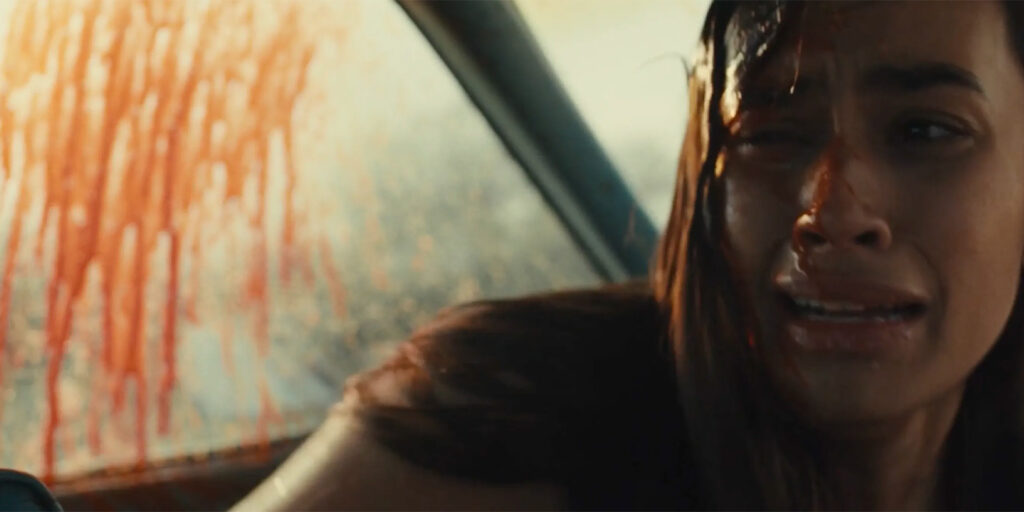
Beneath the genre, the film carries a deeper engine: gendered violence and the erasure of the female voice. “The horror isn’t just the killer,” Victoria explains. “It’s the taking of her voice — metaphorically and literally.” The film’s brutality isn’t spectacle; it’s indictment, culminating in a final act where the protagonist violently reclaims what was taken.
From Brighton to Palmdale: Building a 10-day blueprint
Before hiring a crew or writing schedules, Lawrence fixated on a single guiding idea: 10 days. Knowing Steven Spielberg shot Duel in ten days with massive 35mm cameras, endless rigging and a studio machine behind him, Lawrence wondered if a micro-budget feature could follow that same energy.
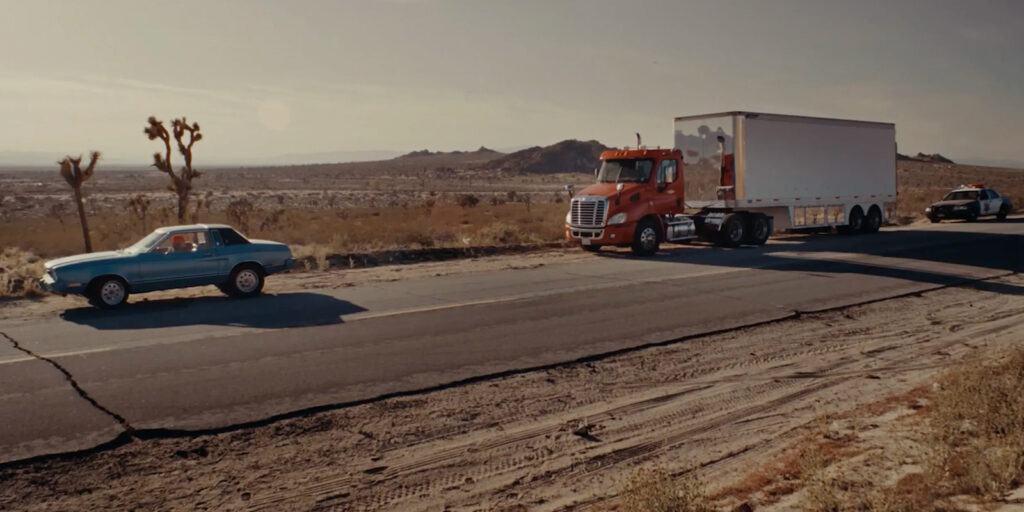
The couple flew to Los Angeles and scouted the original Duel locations in Santa Clarita, but the geography no longer fit their film. They pushed deeper into the desert — through Lancaster and finally into Palmdale — where they discovered 4 Aces Movie Ranch: a diner, a gas station and endless desert, all within a tight radius. It was a natural pressure cooker. Logistics became possible. A 10-day shoot felt real.

The downside: 4 Aces sits outside the LA commuter zone, so the team had to house the entire cast and crew. It was a financial punch, but because the crew was tiny, it was survivable.
When the hero car dies — and saves the film
Two days before the shoot, their hero picture car — a Nissan ZX300 — blew its transmission during drone tests. “We were about to make a road movie… without a car,” Lawrence says. They had hours, not days, to fix the problem.
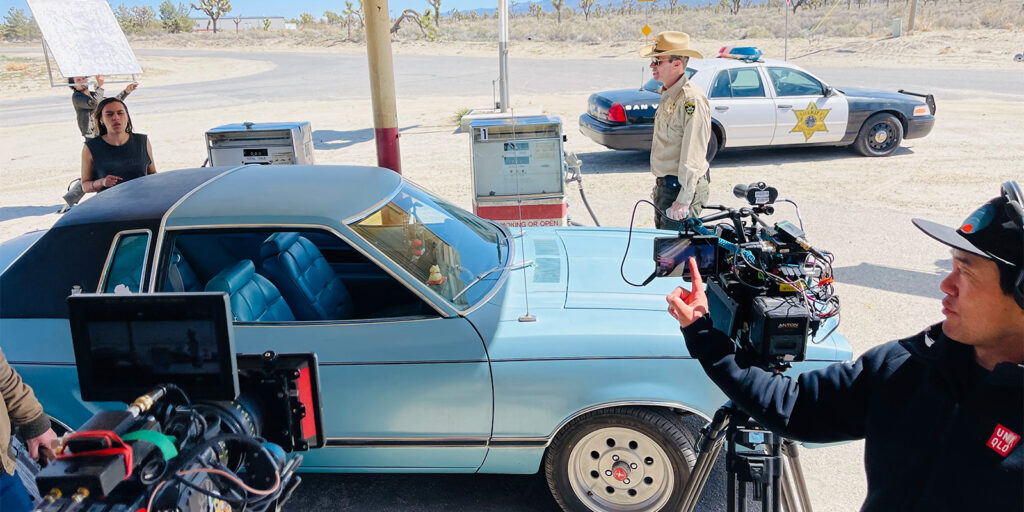
After an exhausting city-wide search, they found a 1977 Ford Mustang II Ghia late that night — immaculate, cinematic, and visually richer than the original car. The catastrophe became a gift. Had the Nissan died during the shoot, the film would have collapsed. Instead, disaster arrived early enough to save them.
Day one: A blood gag in the sand
Filming began with police shutting down their permitted road for a Harley-Davidson shoot. The crew was ordered off. But it was the day they needed to shoot their first blood gag. With police watching from above, Lawrence pushed the picture car a few metres into the desert sand, rolled two cameras, triggered a single blood charge, and captured the moment in one take. The sun, the pressure, the imperfect terrain — all of it is visible in the final cut. “It wasn’t the shot we planned,” Lawrence says. “But it was the shot the film needed.”
Ten days, five scenes a day
The schedule was brutal: five scenes a day, two hours per scene, two takes — sometimes one. Resetting stunts or blood gags was often impossible. To survive, Lawrence and Victoria rehearsed everything on Zoom: blocking, emotional mapping, movement patterns. When the cast arrived in LA, they walked every beat on location. “By Day One, the actors had the movie in their bones,” Victoria says.
Casting by instinct
With no casting director and no infrastructure, casting became intuition. A colleague mentioned he knew John Schwab (The Queen’s Gambit, Jack Ryan). Lawrence assumed he’d say no — but John was in Brighton the next morning and joined immediately. That early certainty from an actor of his calibre became the filmmakers’ first real external validation.
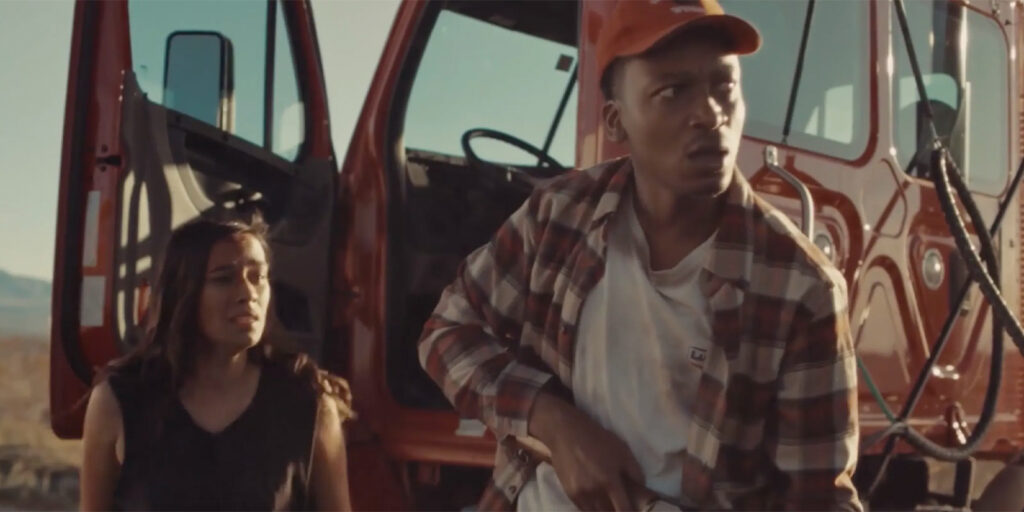
Then came Britni Camacho, discovered on Instagram. No credits. No agent. Just an audition tape with ferocious emotional precision. She became the only choice. “She carries the whole film,” Lawrence says. “She breaks people.” The fact that both actors believed in the film told Lawrence and Victoria that Blood Star wasn’t just possible — it was necessary.
The technical strategy: Three cameras, no safety net
To execute a 10-day horror film with limited takes, Lawrence and Pascal built the entire technical approach around three cameras — two RED Geminis and one Komodo — shooting simultaneously. It wasn’t an indulgence; it was the formula. “People think three cameras is a luxury,” Lawrence says. “It wasn’t. It was our plan.”
Cinematographer Pascal Combes-Knoke approached the film with tactical efficiency. Known for his artistry but also his problem-solving instincts, Pascal designed the shoot around speed, sensitivity and physical practicality. “This wasn’t a camera choice,” Pascal says. “It was a survival choice.” He shot on the RED Gemini primarily for its 2000 ISO low-light mode, using Cooke S4/i lenses at T2 to carve faces out of near-total blackness. Even with 6K and 4K HMIs blasting from an 80-foot condor, the desert swallowed light. “The Gemini held the shadows without killing the fear,” Pascal explains.
Inside the picture car, the camera team often worked shoulder-to-shoulder. Pascal recalls: “Some scenes were three people in a space meant for one. But that claustrophobia is in the film — you feel it.”
The multi-camera setup gave editor Ross Evison the coverage necessary to preserve performance, tighten the pace and build tension despite the limited takes. It became both a structural and aesthetic philosophy.
The road that fights back
The one-mile road used for driving sequences had a brutal bump every 20–30 metres. It punished sound, rigs, actors and camera gear. And yet, it gave the film its pulse. Lawrence explains: “Horror needs truth. You can’t fake a haunted road. You have to drive it.” A green-screen approach would have smoothed everything out — and destroyed the dread.
What Blood Star is really about
More than a desert chase film, Blood Star is a story about erasure — the psychological, emotional and literal theft of a woman’s voice. The killer doesn’t just hurt. He silences. “The violence isn’t gratuitous,” Victoria says. “It’s the truth of what she’s fighting.” Her final act isn’t revenge; it’s a violent reclamation of autonomy — a restoration of the voice that was taken from her.
A film forged in heat, dust and refusal
Shot in 10 days. Built from nothing. Crafted without outside support. Blood Star proves something all independent filmmakers understand intuitively: horror thrives under pressure — and so do the people who make it.