
SPACE ACE
Jess Hall ASC BSC reinvents Marvel’s retro-future aesthetic in The Fantastic Four: First Steps, blending 1960s inspiration with cutting-edge IMAX technology for a unique visual journey.
The story of Marvel Comics began in 1939 with the founding of Timely Publications, which eventually became Marvel Comics. However, it wasn’t until 1961 that the Marvel Universe truly began to take shape, with the launch of The Fantastic Four. Created by Stan Lee and Jack Kirby, it marked the beginning of a new era in superhero storytelling — one that introduced interconnected characters, a shared universe and stories grounded in real-world locations. This era would lay the foundation for the expansive Marvel Cinematic Universe (MCU) we know today.
Now, the next chapter of this iconic team unfolds in The Fantastic Four: First Steps, the film follows the team — Johnny Storm/The Human Torch, Susan “Sue” Storm/The Invisible Woman, Reed Richards/Mister Fantastic, and Ben Grimm/The Thing — as they embark on their first major adventure.
Cinematographer Jess Hall ASC BSC (Chevalier, Ghost in the Shell) had previously collaborated with director Matt Shakman on several projects, starting with all nine episodes of WandaVision and they reunited once again for this film.
“There was connective tissue between this project and First Steps and I was excited to develop our aesthetic and expand it to a large screen,” Hall explains. “Because this film exists in an alternate universe (Earth – 828) from the vast majority of what we have previously seen in the MCU it was a wonderful opportunity to create a unique and distinct visual landscape. That’s a gift to a cinematographer like myself who is constantly looking to reinvent my own methods.”
Hall explains that the universe created by Kirby and Lee in the comics is essentially a retro-future vision, reimagining the year 1968 through a futuristic lens.
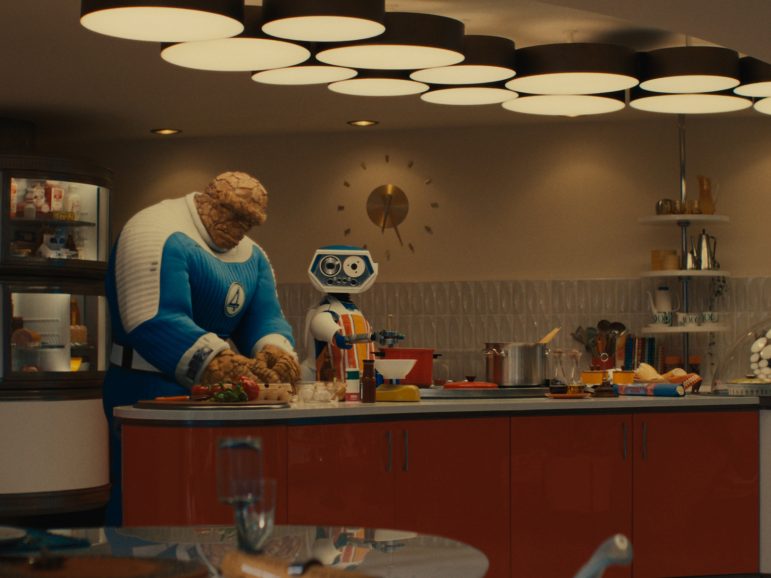
“We were drawing the designs of Charles and Ray Eames, Eero Saarinen, Oscar Niemeyer and the conceptual art of Syd Mead,” he continues. “The vision was expansive in terms of scale, and we wanted the world to be immersive, so IMAX was an early priority. This led me towards the selections of a large format camera, the Alexa 65 as our primary camera. To depict the world, we used three sets of custom lenses that I developed with Panavision’s senior vice president of optical engineering and lens strategy, Dan Sasaki.”
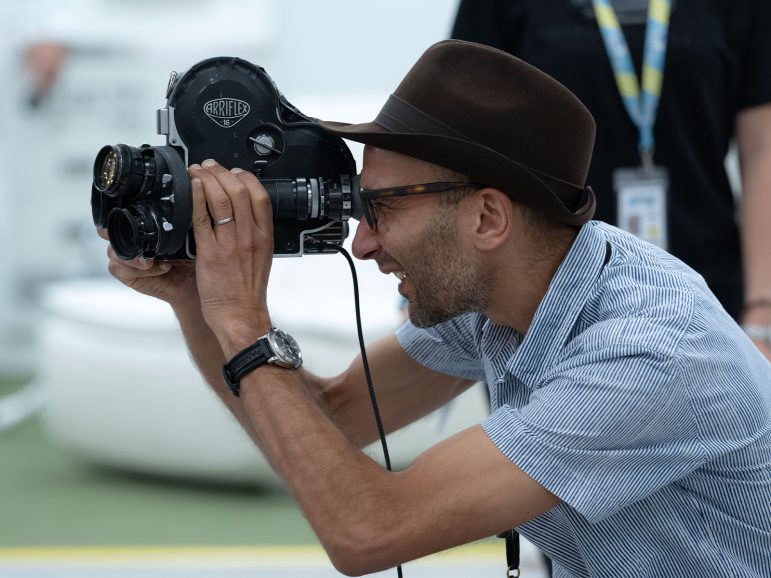
Hall’s first steps, pardon the pun, was to extensively modify a set of Ultra Panatar II 1.3x anamorphic lenses to give them some of the characteristics “we were observing in my late 1960s film references” which included 2001: A Space Odyssey (1968), The Graduate (1968), The French Connection (1972) and Le Samouraï (1967).
“We softened the UP 2s, adjusted the centre to edge fall off in focus, added colour artifacts and chromatic aberration in addition to opening up the T stop,” he explains. “We also added colour fringing and halation. We significantly changed the flare characteristics and the colour of the flares to introduce more of my primary 1960s colour palette in addition to cooling the lenses overall tone. Dan also built a unique 29mm UP2 with wonderful flares.”
Spheres of influence
Hall knew the production would require spherical lenses to accommodate the 1.43:1 aspect ratio for IMAX (the IMAX release also featured a 1.9:1 aspect ratio, with around 85 shots in 1.43:1). Additionally, special techniques, including miniature work and multiple VFX requirements, were better executed using spherical lenses.
“I also knew that the story required some extreme wide angle focal lengths to frame Galactus, who towers above Manhattan at over 1,000 ft tall,” he recalls. “I was inspired by 1960s NASA space photography which had a more classical medium format look and the 70mm [2019] Apollo 11 IMAX film. These references informed the characteristics of what I referred to as our ‘2001’ lenses.”
Following a series of miniature tests projected at IMAX HQ in Playa Vista, CA, Hall determined that he needed to shoot at extreme depths of field to make the scale of both the miniatures and Galactus convincing. “Although we started testing with modified lenses, it soon became apparent that, due to diffraction, we were losing resolution at very deep stops,” he observes. “It became clear, particularly with the wider focal lengths, that we needed to construct a completely new set.”
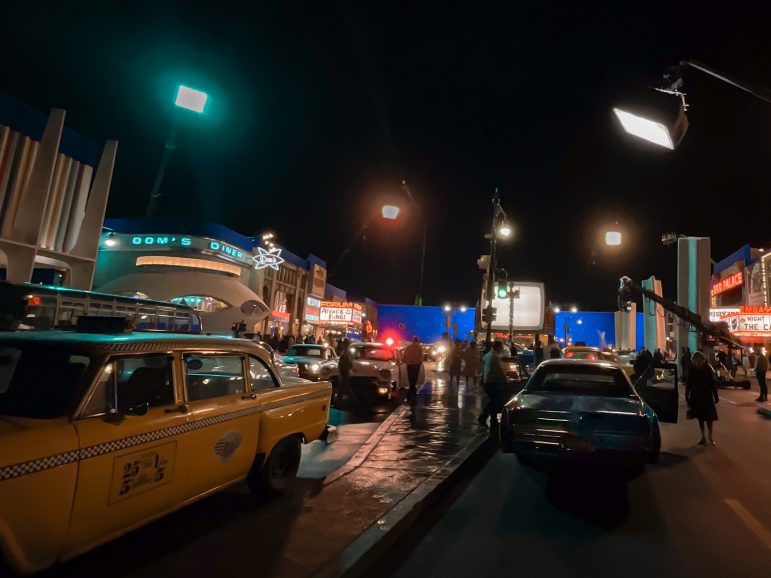
Dan Sasaki, Panavision’s SVP of optical engineering, was able to shift the position of the iris and achieve extreme depths of field with T stops of T45.5 with excellent minimum focus on wide angles; 18mm, 21mm, 24mm & 29mm which was necessary to make the scale of the miniatures convincing on the IMAX screen.
For newsreel and archive footage Hall and his team used a set of Bausch and Lomb Super Baltars, with the original 1960s glass which was rehoused and expanded to cover the Alexa 65. “In addition, we shot super 16mm which was initially intended as an absolute film reference,” he adds. “However Matt really loved the look of that Super 16mm footage, so we ended up using some of it in the film in a 1.66:1 aspect ratio.”
Brutes strength
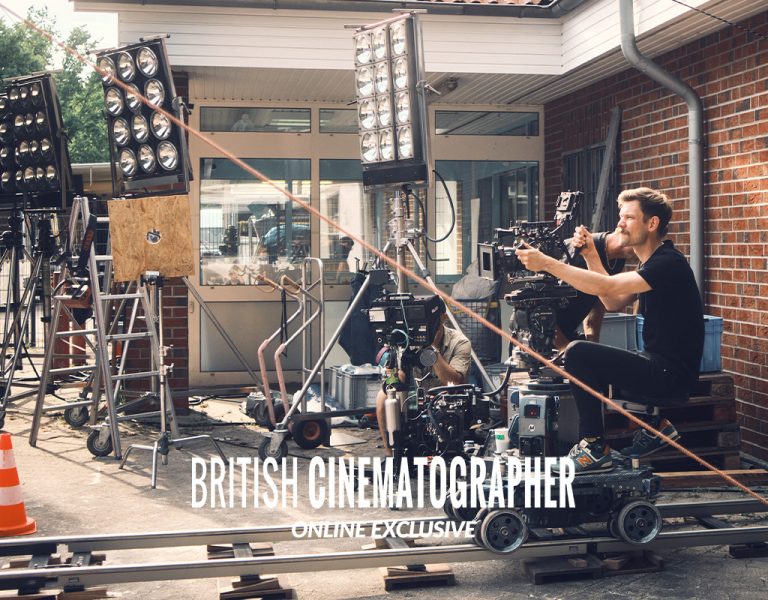
Hall employed a wide range of tools to create the film. For specific scenes, he used “almost entirely traditional” tungsten fixtures, including a variety of tungsten Fresnels, Space lights, Zip lights, Wendy lights, Dinos and Maxi Brutes.
“I see tungsten light as an extremely pure source of light which is in many respects unparalleled,” he adds. “Also, it’s inherent qualities helped create the period look I was striving for. In contrast many sets were 100% LED. The Vortex 8 fixture was probably used in more numbers than anything else because it was my favored tool for light boxes. I like the colour science in RGB mode and the range in Kelvin. Colour was an obsession on this project, and I was working with it in an incredibly precise and subtle way.”
For the Times Square set at night, the team built 24 banks and 36 arrays of Vortex 8s in close formations and rigged them onto 120-foot condors, which Hall describes as “an excellent, versatile and fully controllable night source” at his disposal.
However, “the majority of the light on that immense set” was emanating from practical fixtures. “Gaffer Lee Walters and our practical team lead by Kevin Fitzpatrick did an incredible job rigging that set with what was in total over 2,000 fixtures including film lights and practicals of many varieties including numerous, neon, fluorescents, Asteras and the theatre canopies which were fitted with hundreds of tungsten bulbs,” Hall says.
“All the fixtures were DMX and could be controlled on the iPad, which made the set surprisingly fast to work on.”
Hall also deployed a large variety of wireless, custom-built RGBW fixtures close to the actors because they were fast and lightweight. In addition, a 100K soft sun was deployed extensively, serving as a single-source sunlight for the interior Baxter Apartment set, where the spread of the windows was wide and tall. It was also used for exterior plates of the miniature Excelsior.
“Finally, I used it on our stage work with Galactus for the finale as I required a lot of exposure because I was shooting this at extremely deep stops to make the scale of Galactus work,” he says. “The Nanlite 2400B model was a useful and flexible source for our space work. I used this with the Fresnel attachment and a chapman loom on a Tecnho 50 to amplify the effect of movement on the gimbled Excelsior.”
Retro-future
The concept of retro-future which lies at the heart of this film encouraged a postmodern approach to methodologies, Hall says, with old processes fused with state-of-the-art technique.
“The idea of ‘Cut and Mix’ is applicable here in the sense that DJs sometimes mix two tracks from different eras to create something new,” he continues. “One of the biggest challenges we faced was the third act finale in which our heroes embattle Galactus in New York City. Each shot contained multiple elements created using a multiplicity of techniques.
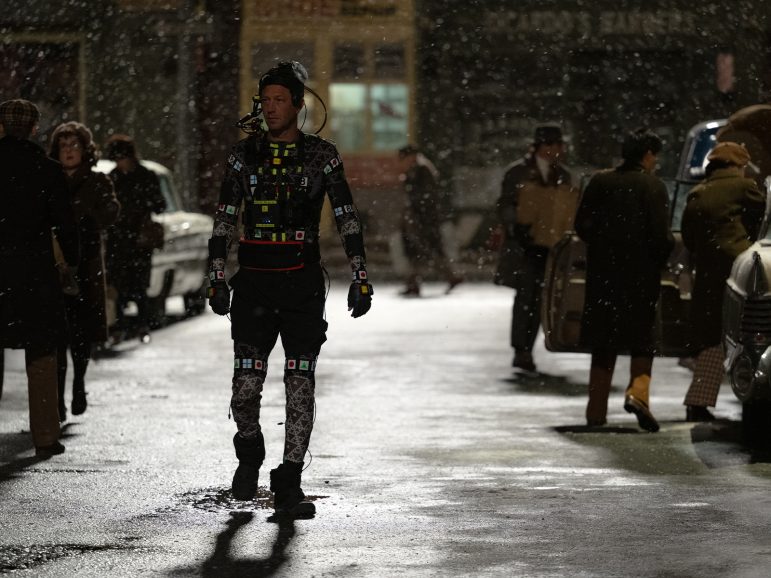
The clear objective laid down early in preproduction was to achieve photographic integrity across every frame and this of course included our VFX work. A single shot in this sequence might be comprised of; a New York background plate or aerial, an exterior NY set piece with actors filmed on the backlot at Pinewood, elements of Ralph Ineson’s Galactus performance shot interior against grey screen, CG characters based on mo-cap either captured live on the set or interior at The Imaginarium in addition to CG extensions or modifications of our Retro Future NY designed by Kasra. To combine all these elements into a coherent whole was a significant undertaking.”
Hall also singles out The Imaginarium’s mo-cap work, describing it as “so critical” to Benn and Silver Surfer.
Lost in space
Hall regards the sequence spanning the departure from the World Ship to Franklin’s arrival as one of the film’s most significant accomplishments
“It was an extremely complicated sequence, and we were largely working in a contained set and in Zero G,” he says. “We spent a lot of time in pre vis and worked with production designer Kasara Farahani to design 12 flyaway sections in the Excelsior interior to allow access for two Alexa 65s on Technocranes and wire rigs so that stunt coordinator Rowley Irlam could simulate zero gravity whilst retaining as much of the real set as possible.”
Hall says that, coming from a theatre background, Shakman prefers to use long takes — a choice that requires intricate choreography between all departments to make each shot work.
Hall consulted with astrophysicist Clifford Johnson, Ph.D., at the University of California, Santa Barbara, to understand some of the parameters around how light would behave in different space environments.
“We also referenced the images from JWST telescope,” Hall says. “My intention was to base the lighting in real physics whilst also creating a dramatic progression to the climactic moment in the narrative. I think our composer Michael Giacchino had the same instinct because his composition brought an incredible build and emotion to the sequence.”
Great Scott
There are approximately 2,300 shots in the film and around 2,150 of those are VFX shots — which Hall says demonstrates the extent of VFX department, led by VFX artist Scott Stokdyk’s contribution.
“I knew Scott’s team would touch almost every shot in the film, so it was essential that we were completely aligned,” he says. “In preproduction I often based myself in the VFX department, equally Scott was present in almost every pre-vis and storyboard session, he also attended the multiple projections of my lens and camera tests at IMAX. In short we worked incredibly closely together starting from a point of mutual respect and an acknowledgement that in some respects we would be co-authors of the image. For Matt and I a film like this can live or die on the success of this collaboration. By that I mean a successful integration of original photography and VFX.”
Furthermore, director and DP were “attempting to achieve a film with great texture and an analogue quality” to boot. Hall says, “with this knowledge” they left little to chance, often testing many strategies to find the best solutions and striving to shoot real elements or photographic reference for CG work at every opportunity.
“The look of this film resides, among other things, in an incredibly sensitive ‘negative,’ with the colour science expressed in the LUT being rather nuanced and thus somewhat fragile,” Hall continues. “Tom Poole (Company 3 colourist on the final DI) remarked prior to the commencement of principal photography, ‘You might as well be shooting Kodak Ektachrome Colour Reversal film!’ Scott’s CG needed to respect both our unique and complex colour palette and the specific optical characteristics of each lens to inhabit our frames successfully. It’s a testament to his commitment and talent that the images work as a coherent whole.”
When reflecting on cinematography as a whole, Hall shares the perspective that it’s an ever-evolving art—one in which you never stop learning.
“I equate it to painting,” he says. “Look at the late works of Picasso, Monet or Hockney, for example — would you ever suggest that their work stopped evolving? I’m not comparing myself to these titans, but if you recognise cinematography as an art form, which I sincerely do, then you accept that there is vast potential to keep developing. We are, after all, working in the medium of light, which is by its very nature an infinitely subtle and complex medium.”
In the context of this project specifically, one vitally important lesson for Hall was to trust the process. “When I look at the key sequences, they are extremely close to the pre vis that Matt and I worked on so intensely and meticulously, refining it right up until the point of shooting,” he says. “Having confidence in the process and in your vision for the film is essential if you are to realise your ambitions. This is a collaborative medium, so it is critical that all roads lead to the desired destination.”
Clear Angle Studios, specialist in 3D scanning and digital doubles, brought photoreal capture to the film.
Locations and new dimensions
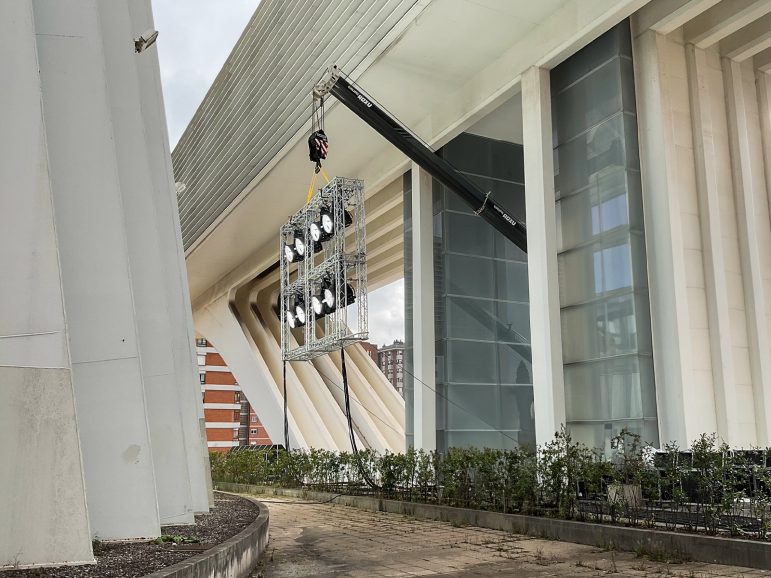
Shooting took place mostly at Pinewood Studios, though Hall recalls filming in Spain at the Palacio de Exposiciones y Congresos in Oviedo — one of the few interiors that matched “our very distinct” architectural grammar.
“There wasn’t a lot that we could find location-wise that really worked with our aesthetic, but we used that for the lobby of the Baxter Building and the United Nations meeting hall,” he recalls. “Middleton Mine, a massive limestone quarry in central England used for Subterranea and Mole Man’s headquarters. Immense scale, tough logistics of shooting underground.”
From pages to IMAX stages — Hall takes Marvel into a bold new dimension.