
HIGH STAKES
Making Ballad of a Small Player meant striking a careful balance between atmosphere and restraint. Cinematographer James Friend ASC BSC reflects on the contrasting challenges of filming in Macau’s tightly controlled casinos and on the open waters of Lamma Bay.
Lawrence Osborne’s haunting novel Ballad of a Small Player reads like a noir, but with a twist: instead of smoky alleys or rain-slicked city streets, the story drifts through the opulent and mysterious casinos of Macau. It’s a world where glamour and decay exist side by side — a setting that feels both seductive and purgatorial, perfectly mirroring the moral and emotional drift of its central character.
In the Netflix adaptation of this book, Colin Farrell plays Lord Doyle, a disgraced British lawyer and compulsive gambler searching for meaning—or perhaps escape—amid the flickering lights of games he can’t quit. He gambles his ill-gotten gains playing baccarat, a high-stakes card game wildly popular in Macau’s casinos and central to the story’s atmosphere.
Doyle receives unexpected help from Dao Ming, a casino worker who harbours her own hidden truths. Meanwhile, Cynthia Blithe (Tilda Swinton), a determined private investigator, is in hot pursuit—prepared to face Doyle with the shadows he’s been avoiding. As Doyle strives for redemption, the boundaries between illusion and reality begin to tighten around him.
Director Edward Berger enlisted long-term collaborator James Friend ASC BSC (The Acolyte), the Oscar and BAFTA-winning cinematographer behind All Quiet on the Western Front, to shape the film’s distinctive visual language. “I love working with Ed and as soon as he pitched this project to me, I was straight on the plane to Macau for a scout,” says Friend. “We landed and the place gave so much visual inspiration. We wanted the film to feel like an operatic, cartoonish fever dream. The images were as superficial and bombastic as the environments we were filming in.”
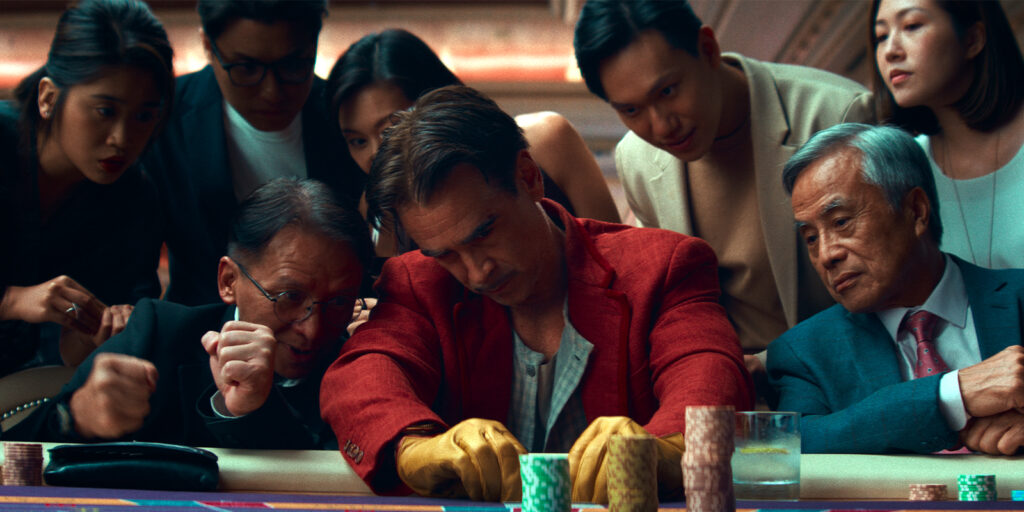
The film was shot “mostly on the Alexa 35 for its remarkable ability of capturing and rendering colour, but we also grabbed a few high-res plates” on his RED Dragon. Friend also “discovered a set of lenses” called the Corals, made by Second Reef. “I believe we were one of the first projects to use them,” he says. “I was invited to a preview at Movie Tech at the time there were only two lenses in existence. They were gorgeous. The Corals are 1.5x anamorphic rather than the usual 2x, which means less distortion, a quality I’ve always wrestled with. It’s part of what makes anamorphic so loved, those beautiful imperfections and that slight unpredictability.”
Friend describes the Corals as “the main workhorse” for the film, adding that, as with any anamorphic movie, some spherical options are typically needed as well.
“I didn’t want to switch to spherical just for technical reasons,” Friend says. “Most of what I’ve done before has been spherical, and I really love that true, human field of view it gives you. But for this, we wanted to blend that realism with the character of anamorphic. So, it became a bit of a mix.“
In one early scene, the protagonist enters a locker room in an anxious state, having just been told he has only a few days to repay his debts or he will be handed to the authorities. Friend wanted to heighten this tension through his choice of lens.
“At first, he’s playing it cool saying his banker in London will wire the money, but he’s buying time and bluffing,” he continues. “It only really hits him once he’s out the door and alone. That’s when the weight of it all sinks in – he’s not just in debt, he’s on the run. We wanted the frame itself to carry his anxiety, to make the space feel over bearing, more suffocating. We used a 17mm fisheye. It had been specially tuned by One Stop Films, so the centre of the image had this really bulbous quality that created a sense of intensity. Everything comes back to his state of mind.”
High rollers
Ballad of a Small Player features rich contrasts in its locations — from luxurious casinos with high rollers and Cristal being served, to the simple, basic life of the Zen Chinese countryside and Lamma Bay, the body of water near Lamma Island in Hong Kong.
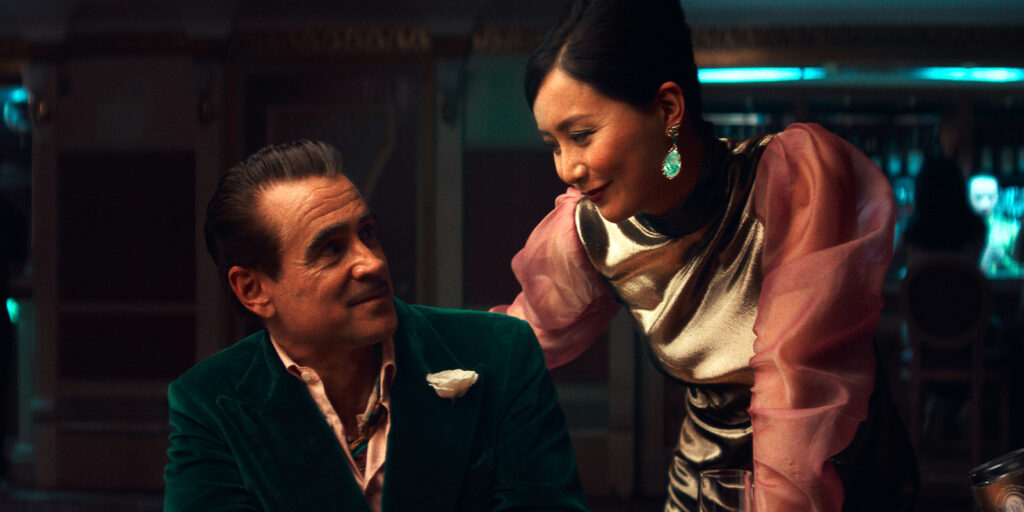
“Logistically, it wasn’t easy,” Friend says. “Access to most of the casinos was extremely limited, even filming in the lobbies had to happen at odd hours, when it would cause the least disruption. But Edward and I pushed through and focused on locations that looked great on camera and made sense for the story, even if they came with logistical headaches. A lot of the time, we were shooting around the High Roller entrances at three in the morning, because those spaces are reserved for billionaires and VIPs and our budget obviously couldn’t compete with that. There was a lot of negotiation involved, but the casinos ultimately supported us and backed the project. “Still, it was a constant juggle — our schedule had us bouncing between hotels, relocating whenever access allowed.”
When the cast and crew shot at Lamma Bay, the bespoke set was built on a barge by production designer Jonathan Houlding. Friend and Berger wanted to take, as he puts it, “a very different filmmaking approach for that segment”, something much more primitive and intimate.
“Not quite documentary style, but close to it,” Friend recalls. “The goal was to really capture the fresh air, the sound of the water to create a sense of release, an escape from all the glitz and chaos. Edward and I treated that section almost like its own short film within the film.”
If you haven’t seen the film yet, no spoilers—but there’s a dramatic temple scene that Friend says was one of his favourite locations to film.
“Despite the challenges, it wasn’t easy getting access to the top of that mountain and lighting it was tough but it was absolutely worth it,” he adds. “We hung hundreds of Chinese lanterns with 60-watt bulbs to create a warm base of illumination. We built a big fire pit right in the middle of the courtyard of the temple. Naturally, we expected them to say no—but surprisingly, they were very accommodating.”
However, it wasn’t just technical, logistical and time constraints that Friend and his team faced. Doyle burns some money in the film, which might sound straightforward, but that was not the case.
“In China, it’s highly illegal to produce fake currency without official supervision,” he explains. “So when the art department created all the money, the entire process had to be done under the watch of a government representative. Every single note had to be logged, counted and tracked at all times. Nothing about it was simple. It’s not like you can just scan a $100 bill and print off a stack of copies; it was actually pretty challenging, especially when you are destroying them! That’s one of the things that never stops surprising me about this business: the things that look easiest on screen are often the hardest to pull off.”
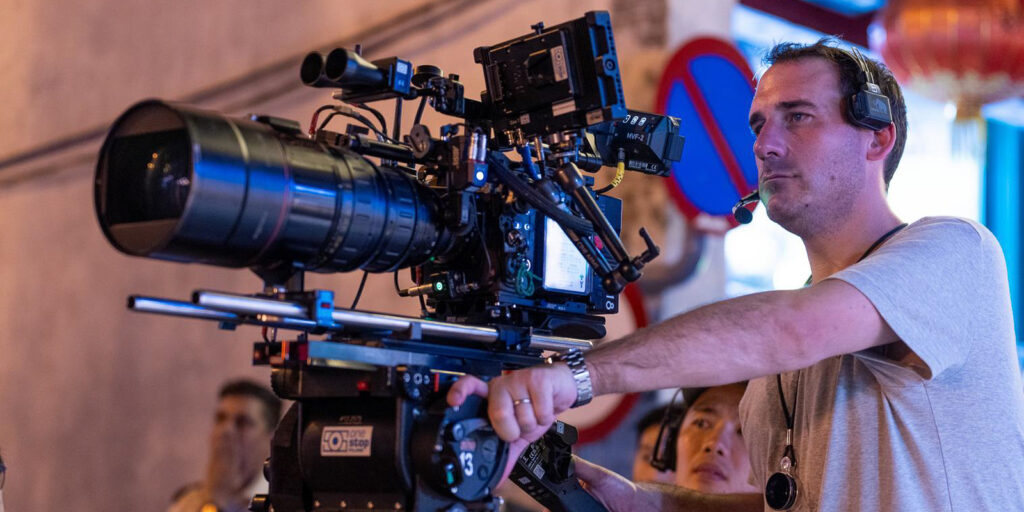
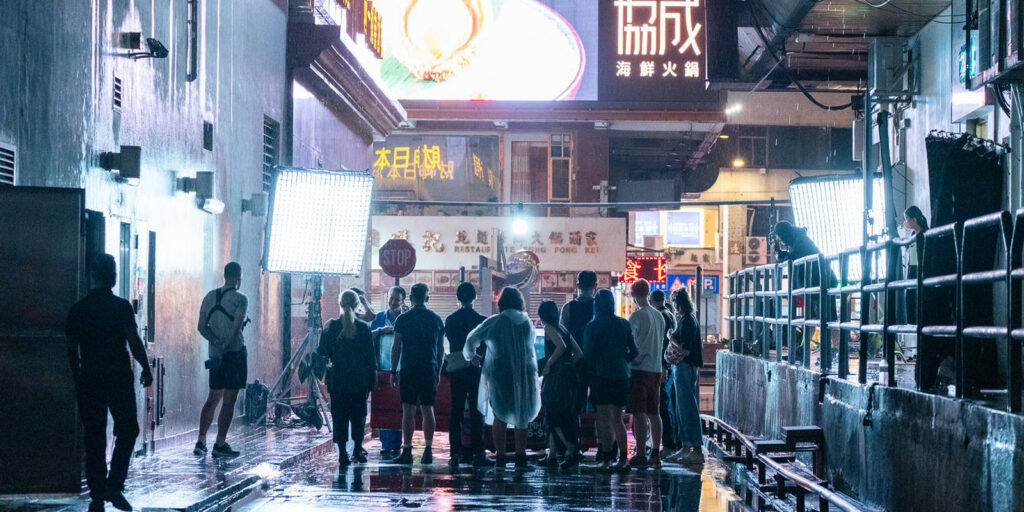
Friend says “every location was a completely fresh challenge” for him.
“I can genuinely say this was one of the more technically demanding films I’ve worked on, even more so than All Quiet on the Western Front,” he explains. “For example, hotel and casino lights flickered on camera, and we couldn’t adjust the shutter angle to find the sweet spot with the electrical frequency without compromising the motion blur so we relied on the Blackmagic DaVinci Resolve DEFlicker tool”
Let there be light
The main lighting package came from Aputure. “I know those guys really well—they often give me lights to test and ask for feedback,” Friend says. “Over the years, I’ve been really impressed with how far their new range has come, so I reached out to them for this project.”
He reserves special praise “for one lamp in particular”: the Infinimat, a large inflatable, mattress-like light that fits onto a 10×10 frame. “You can break it down into 8×8 or 4×4 sections, so it’s incredibly modular,” he explains. “It gave me this big, soft, controllable beauty light that I could mount on two stands and just wheel around. It’s much simpler than rigging up a big bounce or book light, which usually takes multiple high output lamps through layers of diffusion to get the same quality of light.”
Friend says the Infinimat proved especially useful on location, where space and access were often tight. “It became my main workhorse,” he says. “We also used a lot of Aputure’s Infinibars on the exterior set of Dao Ming’s apartment, actually, we ended up using almost every Infinibar available in Hong Kong. To fill the gaps, we brought in some Astera Hyperions and Titans to round out the lighting and give different shapes.”
Spontaneity
The film doesn’t just follow Doyle’s high-stakes gambling and mounting troubles; it also quietly explores the fragile connection growing between him and Dao Ming. Amid the tension and the shadows of the fraudster’s reckless lifestyle, their relationship offers moments of tenderness and human warmth. This emotional undercurrent is beautifully captured in a scene set by the tranquil waters of Lamma Bay.
There was room for some improvisation, too. “Take the houseboat scenes, for example,” Friend says. “In one of the early drafts of the script, that was meant to take place in a small shack in a forest. But when we visited Lamma Island, we took a boat through this little bay filled with floating pontoons where fishermen live that’s where the idea for setting the scenes on the water came from. It was a happy accident, really.”
Here, away from the neon glare of the casinos and the pressures of the city, Doyle and Dao Ming share a rare, carefree moment. They frolic in the water, laughing and splashing, their guards down for once. The gentle sway of the waves and the soft light of the bay frame their playful interaction, symbolising a brief escape from their complicated realities.
This scene isn’t just about fun—it’s a vivid portrayal of connection, vulnerability, and fleeting joy. It gives the audience a glimpse of what could be, beneath the weight of debts and dangers—a tender human bond amid chaos.
Wasn’t he concerned about sharks or other lurking sea creatures or did VFX play its part?
“No, that was all done in-camera,” Friend says. “I wasn’t worried, since I only had my hands in the water, holding a splash bag with my camera in it. And Colin certainly wasn’t, I know that much. He really gave this film everything and it was a privilege to watch him work and be a part of capturing his performance.”
Sustainability—or the lack of it—has long been a criticism levelled at film productions, especially when it comes to location shoots. However, this production was as green as it could reasonably be in a country the size of China.
“Rigging all of those Asteras—I was quite proud of that from a technical standpoint,” he says. “Everything was run off batteries. We couldn’t run power to every single doorway or anything like that, so each night they all had to be de-rigged—we’re talking over a hundred units—charged overnight, and then set up again the next morning. There was quite a lot riding on that sequence.”
Land, sea and air
Despite the film’s opulence—its locations, casinos, and costumes—Friend says it was actually shot in a run-and-gun style, without many of the modern conveniences synonymous with big-budget productions.
“What’s more, there was very little VFX in the film, other than where Doyle sees a ghostly figure—often referred to as a “Hungry Ghost”—in the mirror. It’s a subtle supernatural touch that adds to the film’s eerie and mysterious atmosphere.
“But that was something we actually filmed, and the visual effects simply distorted the image—there was very little CGI involved. Our whole principle was to shoot as much as possible in-camera and on location. Any sets used were built on location, so we really aimed for authenticity throughout.”
The striking aerial shots were all captured with drones. “We had a drone pilot, but we operated the camera ourselves,” Friend says. “I was a bit worried when shooting some drone footage that people might become desensitised to it. It can start to look like stock footage, very ‘droney.’ Once upon a time, aerial shots were a big deal and always impressive, giving a unique vantage point to the audience. But now, with drones so common and accessible, we made sure every shot felt authored and tailored. Every drone shot in the film was us—there was no aerial unit, just Edward and I going out and shooting. Even the shots looking straight down from skyscrapers were drone flights pushing crazy angles—I honestly didn’t know they could reach such insane altitudes, but they can.”
Friend says the challenging schedule wouldn’t have been possible without the team.
“I was lucky enough to bring out some of my UK team,” he adds. “Danny Bishop ACO SOC Assoc. BSC the A camera operator/Steadicam, focus puller Phill Hardy, gaffer Harlon Haveland, grip Guy Bennett and DIT/second unit DP Peter Marsden. It was a big ask for them too as it meant being away from their families for months on end and no real opportunity to leave Macau even for a weekend. I am hugely grateful to them for their professionalism and dedication to the project. The film wouldn’t have been the same without them.”