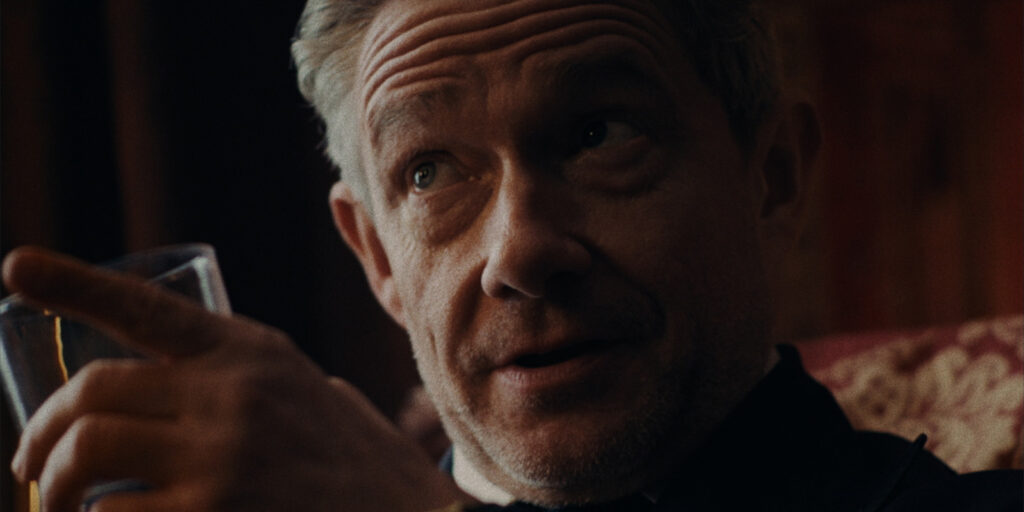
On 3 November 1957, the Soviet Union launched Laika, a stray dog from the streets of Moscow, into the Earth’s orbit. She died just hours into her voyage. Little Bug is the story of the man who took her home for one final night of normalcy. The film is told through her perspective, focusing on the conflict felt by the compassionate space scientist (Martin Freeman) and how Laika’s fate forces him to reflect on his relationship with his daughter, Ana (Alexandra Barredo).
Matt [Branston, director] and I studied at the National Film School at the same time. Our previous project together was a puppet show musical starring a neurodivergent honey badger. I was flattered to have Matt approach me for this project despite the marked tone shift. The point of view excited me, told through the eyes of someone unaware of their fate, and with no possible way of communicating it to them before it happens. There is something so tragic about being within that mind. It was a special place to be with a camera and witness such stirring performances.
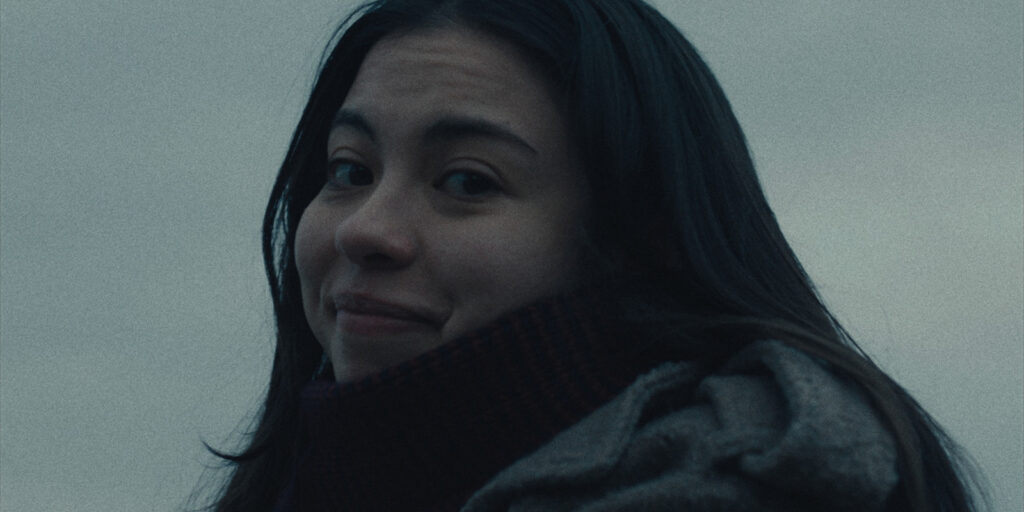
Laika’s fate causes immense guilt in the scientist, muddied with the grief of a recent bereavement. Ana is horrified at what is about to happen, in disbelief that her father would do such a thing. Bursts of emotion are rampant but not easily traceable. We end the film with Ana taking Laika out to a nearby hill to look at the stars, where we first hear about her mother. The last image of the film is of the stars, leaving us to reflect on Laika’s fate and those that have already left us.
The space race
The whole film materialised quite quickly from early conception to shooting. Tonally, we discussed how we were going to make it feel like ‘50s USSR at the beginning of the space race – a time when technological innovation was rapid, but the thriving advances did not reach the mouths and pockets of the general population. We wanted the look to feel like the light sources were attempting to penetrate the gloomy sets from outside but unable to find much success. The idea was that it would aid in creating a feeling of pressure due to their inescapable situation, similar to how Laika’s perspective within the space shuttle would be. We shot at 400 ISO to make the most of the shadows in these dingy scenes.
We shot in 1.37, which we hoped would further push the feeling of entrapment. Our perspective became more focused; Laika’s field of view was restricted. She has no control. There are no options. The brief kindness afforded to her in the form of these two strangers fills her entire perspective. The aspect ratio also matched the period well, both with televisions screening the space race and the films being made at the time.
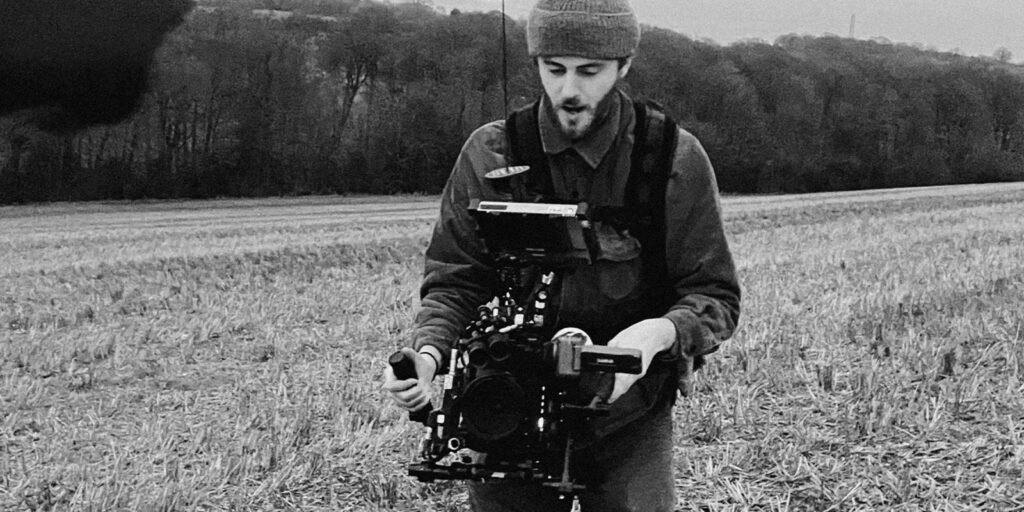
We used three locations in Beaconsfield: a field, a car park (where we hired a vintage car for the opening scene) and the director’s flat. It was a very resourceful project, we worked with what we had in front of us. Our production designer Matthieu Levy did some beautiful work dressing the interiors and wallpapering to make it feel lived in and true to the time. Hawk London were also kind enough to provide us with a really beautiful set of rehoused Leica Rs. The refined look worked as a great foundation for our emulation process in the grade. We also benefited from being recent NFTS graduates and borrowed a lot of our kit from the school.
I lit with very limited sources. We had a few practicals with 100W tungsten bulbs which provided warm fill in the living room. I rigged an Astera tube with a grid cloth belly overhead in the hallway and controlled the sunlight coming in from a small window. This was the first time in years that I shot a film without a gaffer. Because of the access to the interior location the night before and the limited angles due to the language, this didn’t pose any problems. The shoot was very contained. For the outside scenes I just shaped the available light with diffusion, bounce and negative fill.
Pushing the look
We took our film to Harbor Picture Company and graded with the hugely talented Mara Ciorba. I came with a list of references and some descriptions in terms of how I wanted it to feel and ideas with exposure levels and texture. We pushed the look quite a lot, removing sharpness and adding heavy grain. Matt gave us a lot of freedom here; in fact, he was often the one encouraging us to go further.
For the POV shots I kept it quite simple and functional. Not trying to reach too hard for something unmistakably dog-like in my movements. Instead, I was trying to evoke the emotional space of a creature; confused, nervous but resigned and appreciative of the moment of solace and kindness she is afforded. Laika acted as an observer in these people’s lives. Being a dog, she was privy to the conversations that a human would never have witnessed.
You wouldn’t commonly expect a dog to be as focused on people as the POVs in this film, but as this is ultimately a story about the scientist and his daughter as much as it is about Laika, we decided to gamble with the inconsistency. We prioritised the feeling of dog rather than the exactness of dog (otherwise we’d be in ultra-widescreen and shooting in blue, grey and yellow).
Camera movements were done simply, relying on the weight of the camera build to operate with the same fluidity of a dog of similar mass. I used an Easyrig for small sections of the exterior, keeping the camera close to my centre to reduce the floaty quality that sometimes occurs with that particular piece of kit. Mostly I used a Cinesaddle or just held the camera in my hands. We were able to achieve the look with quite simple methods due to the nature of the scenes; we didn’t need to complicate things too much. Our shooting style consisted of full passes of each scene, once on a 28/35mm and again on a 90mm. This further deviated from realism, but we hoped that the cut in would reflect the focus of the POV during moments of significance.
Martin Freeman was a pleasure to work with. He was cast four days before the shoot. He was a big fan of the Laika story and we were so appreciative of his input. He gave a powerful, sensitive performance and was hugely constructive and collaborative with us. Both Alex and Martin were incredible to watch and a pleasure to work with. I’m also hugely grateful to the crew, who were all brilliant and made for wonderful company and a relaxed but focused atmosphere. Nat Rowbotham and Matt Skelton were my 1st and 2nd ACs, who were fabulous. I really hope I can work with them again soon.