
FINDING COMEDY IN THE COLOUR
Sky’s Mr Bigstuff returns for a second season with colourist Grace Weston discussing her method to capturing comedy across diverse locations using DaVinci Resolve Studio.
Sky Max series Mr Bigstuff first hit the screen in 2024 with its genre-bending flair and unconventional tone that quickly drew the attention of UK audiences, earning main actor Danny Dyer, who plays Lee, a BAFTA for his comedy performance.
Back for a second instalment, the season was directed by Matt Lipsey and lensed by director of photography Sarah Bartles-Smith as the storyline expands into new territory with family revelations and more twisted humour.
The Look Post Production handled the grade and finishing in DaVinci Resolve Studio, with colourist Grace Weston leading the way. Having previously worked with Lipsey and Smith on a special episode of Intelligence, there was already a sense of understanding in each other’s creative visions.
“I knew straight away this would be fun,” Weston recalls. “Matt and Sarah had this idea of leaning into a western influence, but still keeping it grounded in these familiar British spaces. That’s a tricky balance to strike.”
While the first season was anchored in two primary locations—the couple’s home and a carpet shop—the second season took the characters to a working men’s club, a residential care home and to the vibrant world of Canvey Island, opening new opportunities for the colour grade to shift and evolve.
“We suddenly had more environments to play with, so the challenge was to make each space feel distinct but still part of the same world,” she begins. “For example, the main characters pink living room from season one was a space that we keep returning to–it’s our bold and bright lynchpin location. Compared to the working men’s club introduced in season two, which is intentionally grubby and dark, with added haze for atmosphere.”
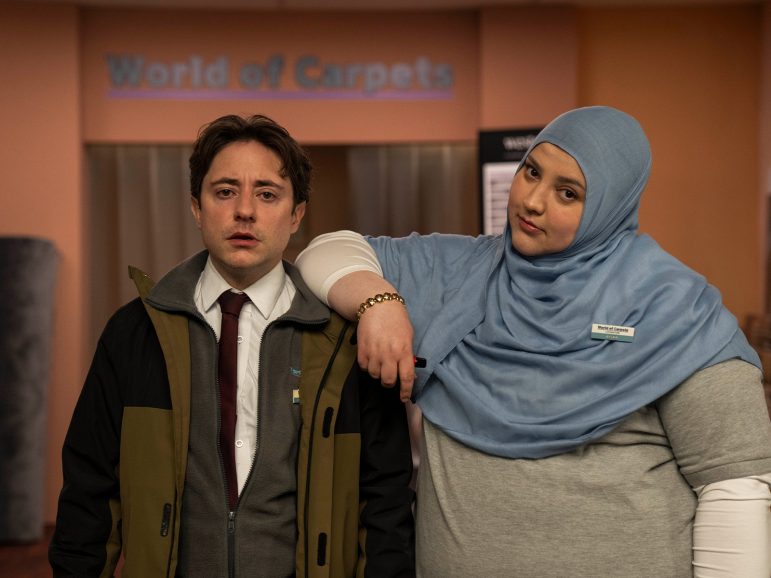
The series rests heavily on grounded, domestic comedy which can be influenced by multiple elements of a scene. Weston’s focus during the grade was often on elevating and enhancing those moments across the locations.
“Comedy often lives in the details you don’t immediately notice. So much of humour is in the eyes,” she says. “If you lose that, the joke can fall flat. We used Resolve’s facial recognition frequently to lift eyes, shape light around faces, and make sure reactions were clear, especially if the actor was looking down or away.”
“In the working men’s club, the set was intentionally dim and hazy. However, using Resolve’s tracking and shaping tools, I was able to preserve the moody atmosphere while subtly brightening faces and directing attention to the action,” she explains.
“Shaping work also extended to the environment—darkening certain pillars, lifting floor tones, or muting distracting background colours so the viewer’s eye landed where it needed to.”
While many of the grading choices were determined by visual cues and creative styles, others came from technical challenges on set. “An experimental shot using a GoPro mounted to a car wheel came in underexposed and noisy,” she reveals. “I was unsure how we were going to get it to match even at a surface level, but using Resolve’s AI denoise, some additional noise reduction, and reapplying film grain, we got it to sit right alongside the main camera footage.”
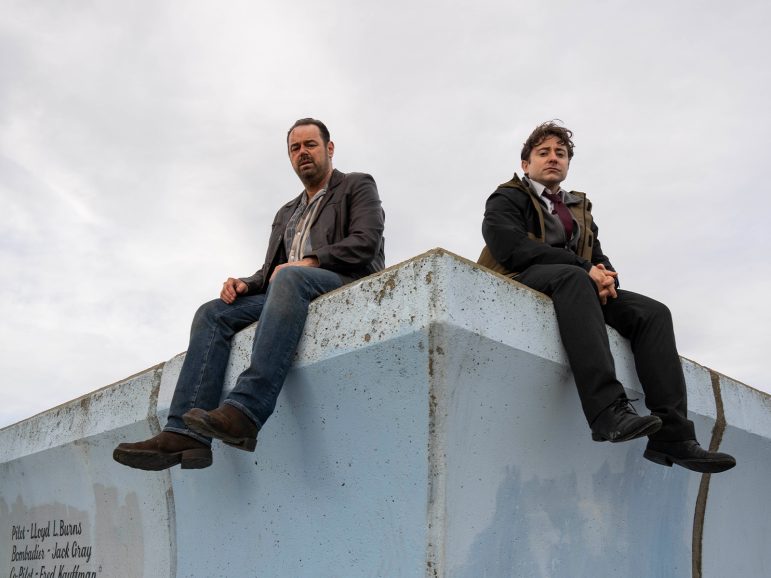
Each episode in season two was graded in a day and a half, with an extra half-day for reviews. Weston worked closely with Smith and producer Hayley Sterling, who attended the sessions in person.
“Sarah and I have a shorthand now,” says Weston. “She can see what I’m doing and know if it’s heading in the right direction. That makes it easier to be bold, even when time is tight.”
Continuing, “For me, the strengths in this project were less about isolated features and more about how my toolset worked in a fast-paced TV schedule.”
“Comedy sometimes gets treated like it doesn’t need a strong visual identity.” But I think if a show looks great, people notice—even if they can’t say why. Resolve let us get there without losing any time,” she concludes.
The season was delivered in HDR for streaming with an SDR trim using Dolby Vision.