
BRINGING A CLASSIC TO LIFE
Very few stories are as well-known as Mary Shelley’s Gothic horror Frankenstein, but if any filmmaker can add a fresh twist to the tale, it’s Guillermo del Toro. Longtime collaborator Dan Laustsen ASC DFF explains how his and del Toro’s brotherly bond helped them to pull off a project years in the making.
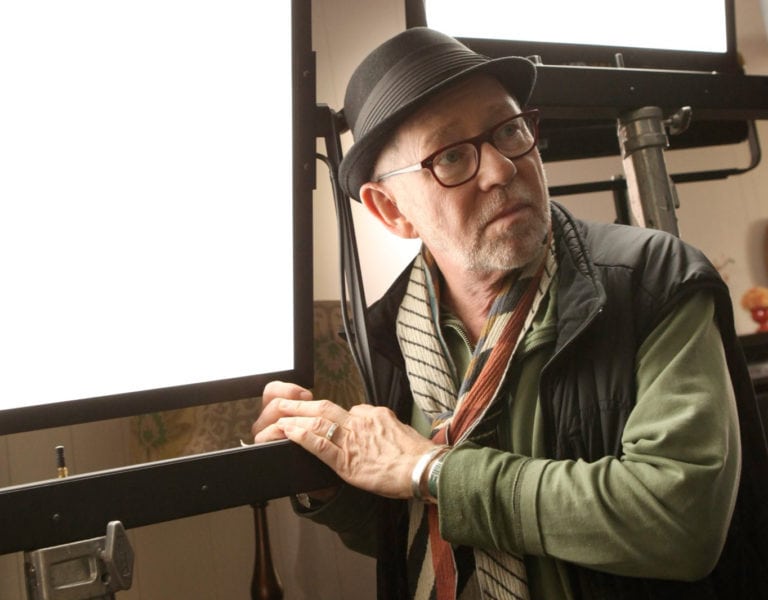
In filmmaking, there’s something to be said for a long-standing relationship and the creativity that fosters. “It seems like a hundred years,” laughs Danish cinematographer Dan Laustsen ASC DFF, thinking about his work with Guillermo del Toro, which stretches back to 1997 and the Mexican filmmaker’s second feature, Mimic. They’ve since made a further four films together, including The Shape of Water (2018) and Nightmare Alley (2022), both of which saw Laustsen nominated for an Academy Award for Best Cinematography.
“Guillermo – he’s my hero. I think he’s fantastic filmmaker,” says the 71-year-old cinematographer, speaking over Zoom. “It’s just a dream to work with him, because he’s so passionate and specific about how a film should look. And we have worked together for so many years, so we have exactly the same ideas and feeling about the contrast in the light, the colour, how the camera should be moving. So it’s really like you’re working together with your brother.”
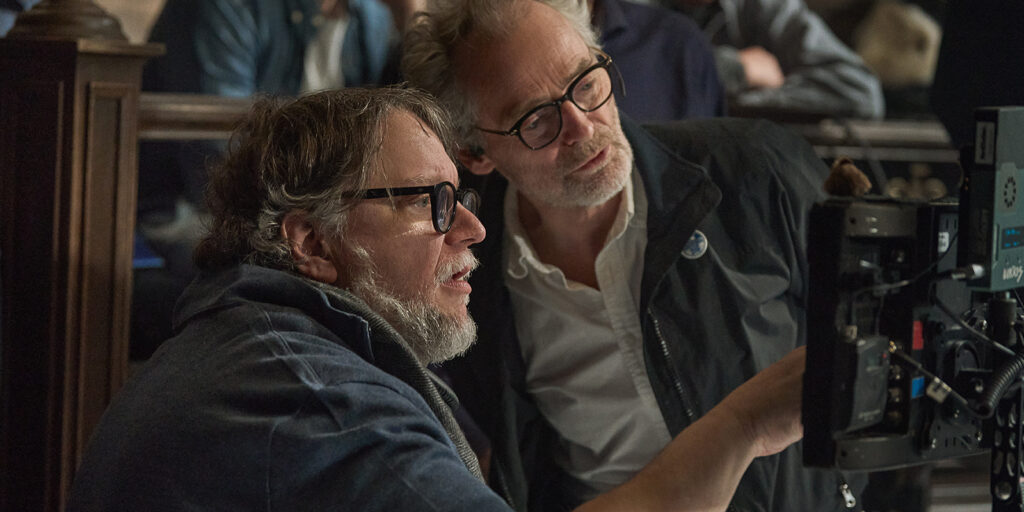
This symbiotic, sibling-like relationship continues into del Toro’s new film, Frankenstein, a lavish take on Mary Shelley’s classic novel about the eponymous scientist (played by Oscar Isaac) who harnesses lightning to bring to life a creature (Jacob Elordi) stitched together from body parts. “As far as I understand, it’s been a dream project for him for many, many years,” says Laustsen, who remembers the director talking fondly about adapting Shelley’s influential Gothic tome when they were on the set of 2015’s Crimson Peak.
Keeping it classic
Dubbing Shelley’s timeless tale “a story about love and forgiveness”, Laustsen acknowledges that the Netflix-backed Frankenstein is a film that feels like the culmination of del Toro’s guile and knowledge, culled from four decades of filmmaking. “What I like about this one is it’s a big classic movie we shot in a very modern way,” he says. Of course, VFX and set extensions – led by visual effects supervisor Dennis Berardi – were deployed to help realise a mid-19th-century story that criss-crosses from Europe to the Arctic. But with fully built sets, animatronics and miniatures, this was also a film steeped in the traditions of classical filmmaking.
Del Toro and Laustsen elected to shoot on digital using the ARRI Alexa 65 camera. “Of course, all the classic movies are shot on film, and I’ve shot a lot of movies on film, but I just think that digital world is so good now, when you have a large format,” says Laustsen, who paired the camera with Leica THALIA lenses. This combination allows “for a close-up to include so much more of the background”, explains Laustsen’s first assistant camera, Doug Lavender. “So even a close-up keeps the context of the surroundings. Large format cameras and lenses also have shallower depth of field which really emphasises the characters even on a wider shot.”
As Lavender notes, del Toro does not favour typical coverage of a scene, where you traditionally go from a wide master to closer shots of the actors delivering their lines. “Every shot moves from wide and always into close, and sometimes very close on the performer. Each shot is a master run from the top of the scene from varying angles. So I react to what the shot presents in each variation of the master; it keeps me on my toes. Guillermo usually is speaking to the dolly grip and camera operator through a headset which I monitor so I can hear in real time what he’s after from the shot in progress.”
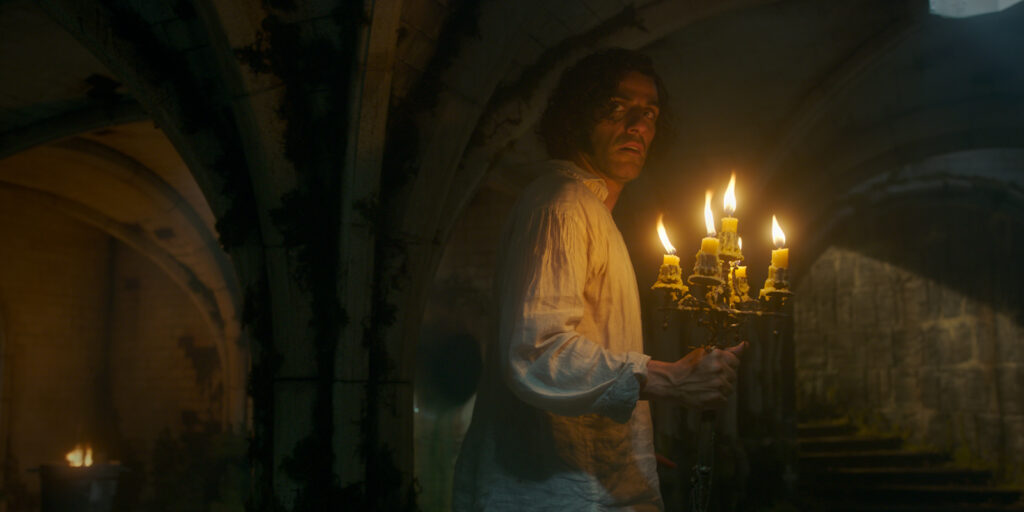
The majority of the images were captured using a Steadicam or with the camera mounted on cranes. “I don’t think we shot one single shot on the dolly,” says Laustsen. “It’s just the way Guillermo likes to tell the story: use the camera as a dramatic tool.” James Frater ACO SOC, responsible for operating the A camera and Steadicam in the UK portion of the shoot, concurs. “The camera never stopped moving,” he says. “This fluidity was vital to the film’s aesthetic, capturing the emotional depth and intensity of the characters.”
No plan B
The Frankenstein shoot began in Toronto in February 2024. “Dan likes to use four camera bodies and shoot just one camera at a time,” explains Lavender. “So I am super busy but organised to jump from the Steadicam to the crane to the jib arm all in one scene or set up. As Guillermo keeps the camera moving at all times, he does not use a B camera. In 110 days of filming, we had two cameras rolling at the same time maybe four times. Anticipating what Dan and Guillermo may want next is key to keeping abreast of a four camera, one focus puller way of filmmaking!”
When it came to illuminating the scenes captured by those wide-angle lenses, Laustsen and he were drawn to using single source lighting. An artistic choice, it was “to go back to the classic way to make movies”, says the cinematographer. “We like this single source lighting, bright highlights and really deep shadows, and we are not afraid of going into the dark side. But again, single source lighting…we’re not a big fan of free light. We really like to have the darkness going into the blackness.”
It’s alight
Del Toro and Laustsen also chose a very defined colour palette. “We wanted to have this golden light through the windows, like a sunset feeling,” says Laustsen. “But we like to have the contrast so it doesn’t look like it’s going to be amber.” Where possible, they deployed a steel-blue backlight – something they’ve done all the way back to Mimic – to act as a contrast. “We just wanted to do a little bit of blue backlight…but not so you see a blue-blue,” he explains. “It’s just a feeling…it’s not getting too monochromatic colour-wise.”

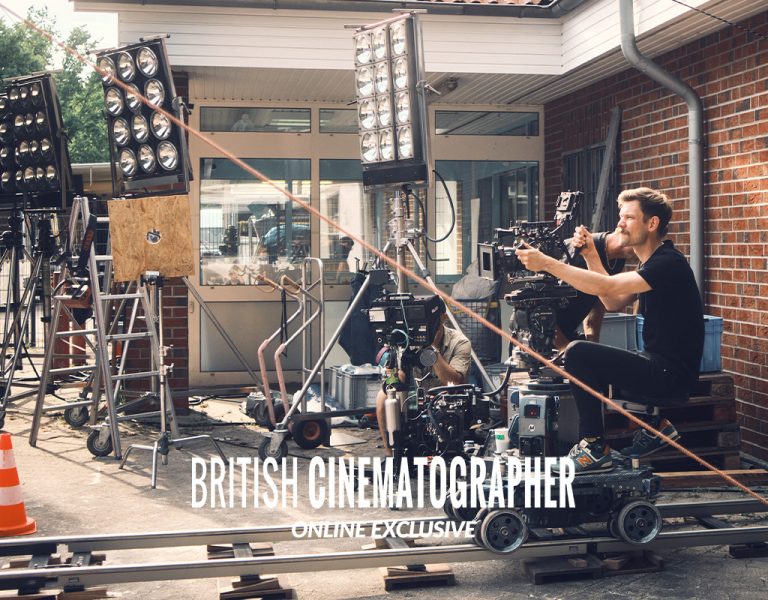
Of course, the sun – the giver of life – is crucial to Frankenstein. “The first time the creature is coming up to the room, he’s opening the windows and the sun is coming in,” says Laustsen. “So we try to do that a lot. We try to shoot into the sun. We wanted to have flare into the lenses a lot of times.” Working closely with two gaffers – Michael L. Hall for the Toronto leg of the shoot, David Sinfield for the UK – Laustsen’s lighting plan was a mix of old and new. “I’m using big old-fashioned lights outside the windows, like 24Ks and Dinos. Of course, all the fill light outside the window is LED lights. But we really try to keep the key light coming through the windows as old-fashioned tungsten. And I think you can see that on the movie. Everything is not LED light.”
Freezing frames
With the first half of the production largely based at Netflix’s studio facility in Toronto (with some scenes shot at Pinewood’s soundstages in the Canadian city), the production immersed the actors in the world of Frankenstein as much as possible. Anchoring the film – no pun intended – are scenes on the ship manned by a Danish crew (changed from British in the book) that’s run aground in the Arctic. It’s here where the creature confronts his creator as he seeks his freedom. Production designer Tamara Deverell and her team built a life-sized boat, mounted on a hydraulic gimbal, to simulate the movement when the creature helps free the vessel from its icy prison.
“The special effects people were able to move the ship,” recalls Laustsen. “And I think that’s a good example for how important it is to have live-action, because you can say everybody’s leaning to the right, or everything leaning to the left, if you don’t have the ship on the gimbal. But when you do it for real, people are losing their balance. And again, the light of the torches is moving a little bit around. It’s just giving a super realistic and dynamic approach. And for the scene, it’s super dramatic. So I really believe, as much as you can, do it in camera.”
Further emphasising the quest for realism, the team shot at a frozen lake in northern Ontario to capture the Arctic seascapes, rather than using digitally rendered backdrops. The beauty of the landscape is there for all to see in one particularly remarkable sunset shot, one that typified Laustsen and del Toro’s relationship. “I was complaining to Guillermo, it’s getting too dark. And he said, ‘Let’s shoot it. Let’s shoot and see how it goes.’ He was right, of course. And he was just pushing me over the edge…and we shot it. And it was fantastic.”
Stately affairs
When the production moved back to the UK, the cast and crew filmed in stately homes, including Burghley House in Lincolnshire and on Edinburgh’s Royal Mile. The experience was fully immersive. “These real locations and full-size set builds cannot help but make the cast and shooting crew feel like we are in the moment of the story, not playing make-believe to a huge blue screen,” says Lavender.
Laustsen was similarly enamoured with this tactile approach. “You see that a lot nowadays, where everything is a CG shot. And I really think you can see the difference. I think when you see Frankenstein, you feel it’s a real movie. It’s like an old-fashioned movie, because all the set is for real. Tamara did an amazing job.” Furthering the film’s so-real-you-can-touch-it quality was del Toro’s insistence on using miniatures to capture some of the bigger set-pieces – notably when Frankenstein’s lab explodes after his clashes with the creature.

The miniatures were shot in London, in a warehouse space, after the Toronto leg wrapped. “That was my first really big miniature shoot,” reveals Laustsen, who worked closely with del Toro, VFX supervisor Dennis Berardi and the miniatures crew. “The collapse [of the lab] was really beautiful. I think that those guys did a fantastic job.” Despite requiring a lot of lighting, “as long as you are able to build a very beautiful miniature set to the right scale,” adds Laustsen, the impressive results perfectly rival any VFX-rendered set.
A film with bite
Even when VFX was used on Frankenstein, it was done so in conjunction with real-life reference points. Take the scene where Elordi’s creature encounters a pack of wolves. “We lit the set for the main sequence, and then those guys [in the VFX team] took over,” informs Laustsen. “They made a dummy with the real wolf. It was super complicated, because a wolf is not a dog. It could be dangerous. So there was a lot of security about that. But they did a fantastic job as a lighting reference.”
Once in post-production, Laustsen worked with the hugely experienced colourist Stefan Sonnenfeld, founder and CEO of American post-production outfit Company 3. “Of course, colour grading is an extremely important part, but our dailies and the final movie are very close to each other,” says Laustsen. “It’s not like we’re changing the colour palette or the contrast…the colour palette is so specific, all the clothes and the wallpapers and the lights coming from the window.” Subtlety was the watchword, albeit in a film that paints its story on the grandest Gothic canvas.