A STORY BY THE SEA
Screening in competition at this year’s Manchester Film Festival, Misper follows the employees of a dying seaside hotel as they have their lives upended when their colleague, Elle, vanishes. Instead of focusing on the police investigation or Elle’s close family, the story delves into the psychological impact on Leonard and his co-workers.
I first heard about Misper from director Harry Sherriff midway through development, right after showcasing our grad film, Jester, from our time at the National Film and Television School. Harry and I had already worked on two shorts together at the NFTS, and I’m very much drawn to his interest in dark comedy. It’s great at carrying complex subject matter, and excites me as a cinematographer, as it opens up a lot of space for playing with tone. For me, comedy isn’t always bright and colourful; in fact, British humour is known at times for being quite dark and off-kilter.
For our first short together, Jeremy: A Nightmare, we shot in a run-down brutalist government building, and found ourselves getting lost in liminal-space aesthetics and the uncanny. When I heard Misper was going to be a missing person story set in a dying seaside town hotel, it sounded like a spiritual follow-up in the same universe. With it being a first feature for us both, it felt great having an established shorthand going into prep.
A grand entrance
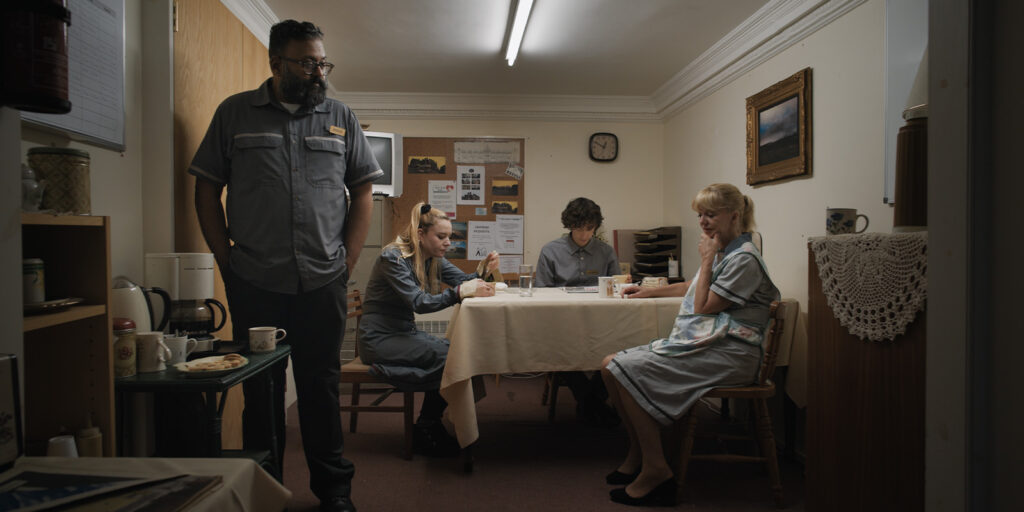
Our primary location for the majority of the shoot was The Grand Hotel in Folkestone. We instantly fell in love with it on an early scout, and on every subsequent recce, we’d discover a new wing or hidden room between rooms. The place felt almost alive, particularly when we stumbled upon the subterranean basement, which gave off strong Barbarian vibes. Misper’s writer and co-producer, Laurence Tratalos, would write in new scenes in response to the space, while I’d be building a lookbook of stills for what parts of the hotel we’d visually stitch together. For me, this kind of inclusion in prep brings a whole new layer of depth to the visual world-building.
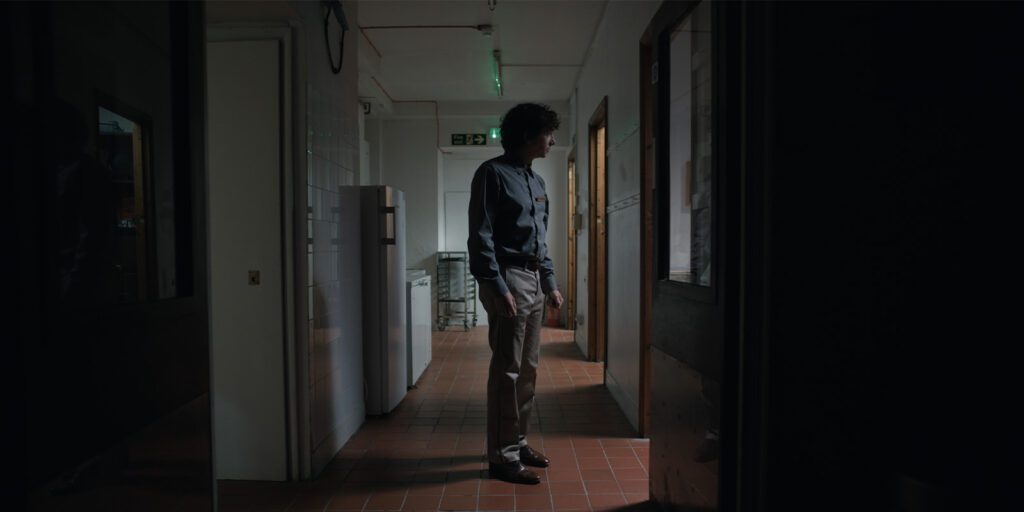
Being an independent micro-budget feature, I was conscious of what camera package we’d shoot on. Mindful of our tight shooting schedule, we needed something flexible to make the most of such an amazing location, particularly with so much ground to cover on the hotel’s many floors.
While in prep, Civil War had recently done the rounds and it was the very start of the Ronin 4D’s rise in popularity. This was before the release of Adolescence, where I believe it was truly accepted as a viable A-cam. I had a very generous offer of a traditional shooting package from one rental house, but my instincts kept telling me to explore the 4D. The pitch I made to Harry was that we could have the freedom of movement, if a scene called for it, but we could also just shoot as we’ve done before, and treat it like a traditional camera. The script encouraged a lot of camera movement with long winding corridors and following the hotel staff going about their day, but we wanted to temper that with a very disciplined, locked-off aesthetic that was more removed and observational. We could also put the 4D in places that were too small for a larger system, or would call for heavier rigging. Having options felt like the best approach.
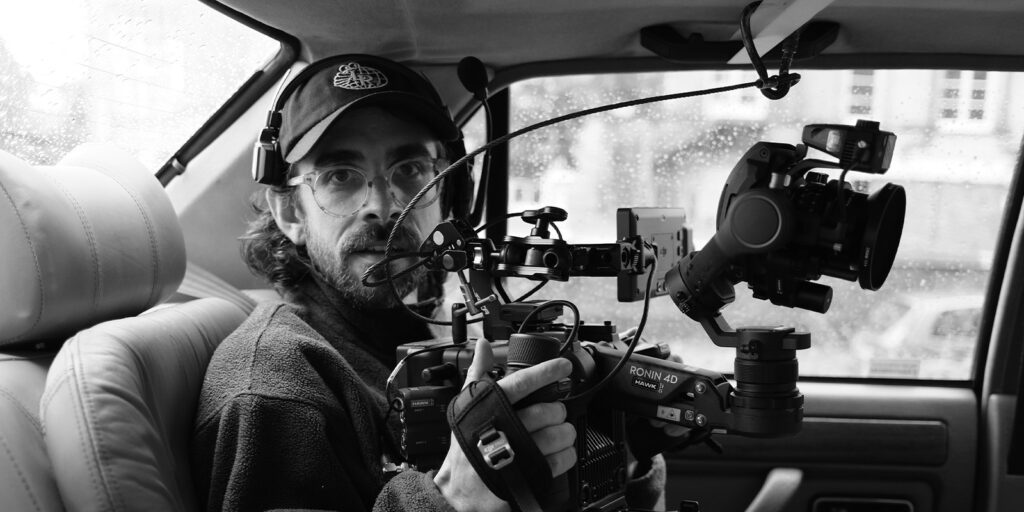
Charles Heales at Hawk London was really excited by the idea of us fully committing to the system as an A-cam, and the whole team were super accommodating in our multiple visits for testing. I‘m usually quite averse to the look and feel of gimbals. My metric was “can it be rock solid following someone in a straight line down a corridor?”, and I was more than happy with what we were able to achieve from our tests. There weren’t a lot of lenses to choose from at the time. With The Zone of Interest being among our early references for its bleak observational approach, the look and form factor of the Leitz M.08s felt like a natural pairing. I loved the look of them both stopped down and wide open, paired with the full large-format sensor on the 4D-8K. On set, I would generally shoot them at a deeper stop, around 5.6, as we wanted to take in our environment, and on very few occasions, I opened up to 1.4 for moments of psychological isolation. Wide open, the lenses have some beautiful field distortion and feel very three-dimensional.
Remaining responsive
My general approach to cinematography is to remain responsive, and this felt more relevant than ever, working to a micro-budget in such large shooting spaces. The Grand was a hotel that “once hosted royalty” (something the real-life manager of the building would remind us of on our multiple visits), and its architecture reflects that. It felt like it was built very sympathetically to natural light, transforming throughout the day. I was captivated by how beautiful some of the spaces looked on the recces, and I wanted to lean into that. This was the same for all the beautiful dressings in the hotel that our amazing production designer, Violette De Laet, and art director, Jessica Hurcombe, did an incredible job at refining and curating, resulting in a backdrop that felt trapped in time.
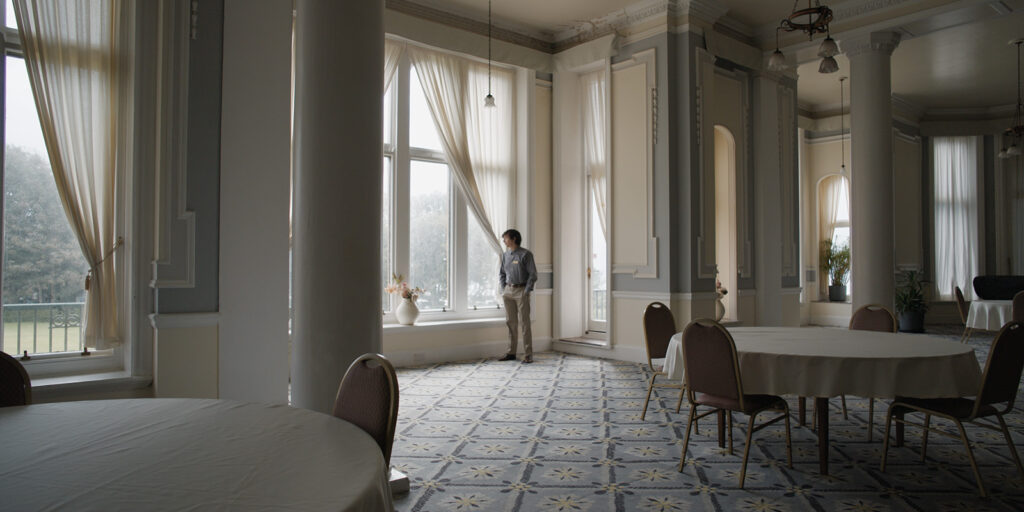
Practically speaking, for continuity, I knew we wouldn’t be able to line the banks of giant windows in the dining hall with big fixtures, so I spoke with my lovely gaffer, Kong Wako, about being more subtractive with walls of 20x neg, or being loose with an HMI on wheels to find an edge on characters from inside the space. We spent more time on our tech recce counting the number of prac bulbs we’d need to buy, to make use of the tungsten practicals in the larger rooms that were fitted with beautiful old chandeliers, and were thankfully already wired up to dimmers. The hallways and more modern built spaces (like the manager’s office) were all lit by lines of less pleasing GU10 halogen spotlight bulbs. Generally, we wanted to frame quite wide and loose, seeing the full extent of the space, so I said to Kong that we needed to, on occasion, lean into the light being ’beautifully ugly’, and let old spotlights and fluorescents do their thing. It felt far more in keeping with the spirit of the place.
It was great having big rooms adjacent to one another, as it meant we could line up HMIs to recreate windows, for rooms trapped between rooms that were naturally positioned away from daylight. The layout of the hotel offered other interesting opportunities for lighting. In the heart of the building is an interior atrium with a glass dome ceiling and a walkway bridge. For one night scene in particular, we were able to use a couple of high-powered LED fixtures boomed over the glass dome, from the atrium roof above as a top moonlight source, and keep the scene free of lights. We used a similar solution for a scene where Leonard takes rubbish out to the bins in an alleyway at the back of the hotel. Above the alleyway was one of the rooms we were staying in during the shoot. This allowed us to boom out a lantern attachment on an LED fixture to dial in a soft top light ambience, as opposed to flying something more costly like a helium balloon.
CCTV mode
Something Harry and I always talk about is frames feeling graphic. I think what we’re touching on is stripping elements away where possible, usually in a wider framing, and shooting very static, which is something that really appeals to me when the project calls for it. There was one image from Better Call Saul that came up in prep depicting a street just down from a crossroads; the camera’s perspective was high, as though it were on a rooftop; there was a yellow car with a single red door parked in the shadow of the building across the street, and a suspicious man stood nearby. I loved how minimal it was, but how it prompted so many questions. This was a big inspiration for a lot of shots in Misper, where we sent the camera up as high as we could to observe a space. My amazing camera team, Joel Rosenberg (1st AC) and Riccardo Garofalo (2nd AC), affectionately coined it CCTV mode.
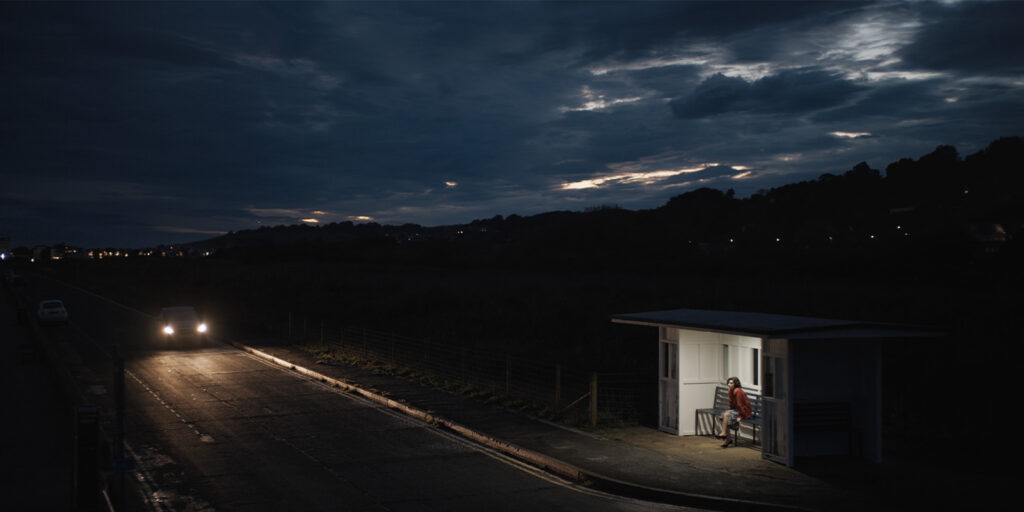
One notable shot is the image used for the poster, of Elle sat waiting at the bus stop. We got lucky with the weather as we weren’t forecast for any break in the clouds, and we just caught the light before it completely faded. I felt confident riding the dual native ISOs in camera, and pushing to higher sensitivities whilst still getting a clean image. As the camera is so lightweight, and is essentially a remote head on a gimbal, it meant we could rig it with a junior pin on a custom plate made at Hawk, mount it on an ASL, and then remotely fine-tune our framing.
One great thing for our production was having our amazing editor, Andy Sowerby, stay with us in the hotel and start assembling during the shoot. As the film follows an ensemble cast through such an expansive location, we were constantly assessing the visual language and tone as we went along. We could see where we were missing a sense of time passing, or if one scene felt too close to another. It prompted exciting opportunities to look at another character in more detail, or flesh out a character moving from point A to point B. With the camera package being so nimble, Andy and I would take trips out on the weekends while we had downtime, and the rest of the crew were back in London. We’d grab additional GVs of the town at dawn to help portray ”Southdown”, where the story takes place.
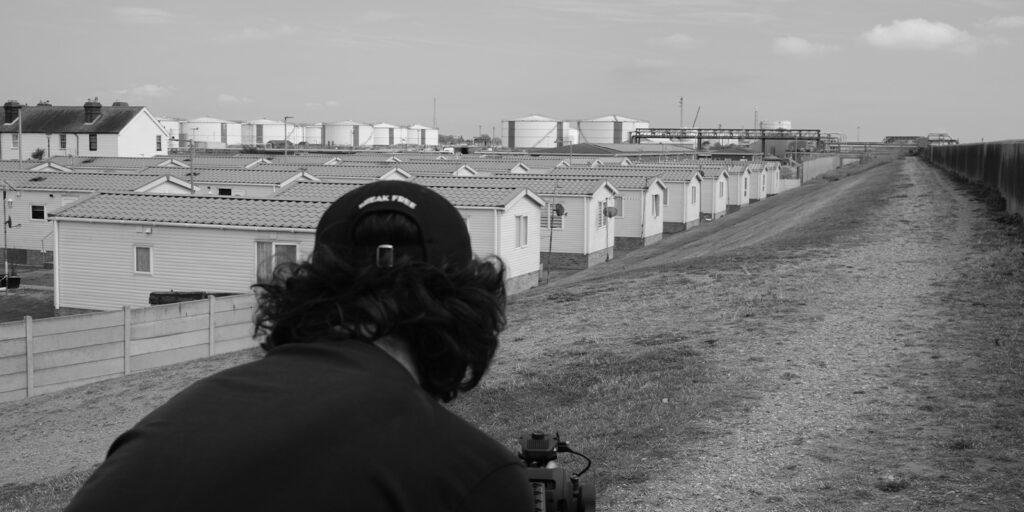
Harry and I discussed wanting to capture the feeling of small-town mid-state-Americana, or the sleepy, remote towns of Korean or Japanese crime thrillers. They’re places of industry, but also rural beauty, whilst being small enough for suburban gossip. As well as the landscapes in Folkestone, we also shot exteriors in Canvey Island and along the seawall in Seasalter, to cobble together our own version of a British seaside town.
During prep, I reached out to Finlay Reid, a wonderful colourist at Goldcrest, with the footage from all my camera testing. He worked with one of the colour scientists at GC and made me some amazing shooting LUTs, combining qualities of a couple film negative and print emulations to bring a look that captured the fading colours of our dying hotel. It made the process of finishing the film much more streamlined.
I had a lot of people warn me away from the 4D in prep, but a cinematographer friend that I studied with at film school reminded me that sometimes feeling inspired by keeping it simple, or shooting with a new tool that gives you freedom on the day, is way better than just following “the done thing” that can leave you weighed down. It’s something I try to consider on every project.