MAKING A SPLASH
In one of Primate’s most tense sequences, its characters try to escape a bloodthirsty chimp by diving into an infinity pool – Stephen Murphy BSC ISC explains how the impressive set and sequence came together.
Most of Primate was shot on stage at Sky Studios in Elstree, and the need for a pool meant our entire set was elevated. That presented certain lighting challenges later on, but it also gave us more control than shooting in an existing pool. I wanted the pool to be its own light source so I tested some off-the-shelf pool lights and found some that I liked the colour of and they were built into the set.

When our characters are in the infinity pool, we used a camera in a splash housing perched on a small inflatable system our key grip Malcolm Huse built, which let my A-camera operator Jon Beacham operate with a huge degree of flexibility, almost like a handheld camera, but he could keep the camera at water level and track around in the water with the actors. We’d complement that with our B-camera on a Scorpio 45 telescopic crane which we could then use to track from the dry set to the water’s edge. Keeping the lens right at the water level with the actors helped build their isolation, because not only could they not touch the edges of the pool but now visually you could see they were stuck treading water in the centre.
Water works
Working around water is always challenging. Nothing stays still, so every shot is slightly different. I kept an electrician in the pool at all times handholding an Astera tube wrapped in heavy diffusion which could act as a mobile fill light as he moved around with the camera. The positions of the pool lights were perfect for a lovely low-key light, but sometimes I’d need the Astera tube to help model the light a bit or to add an eye light. Because we were using a splash housing instead of a full underwater housing, it meant lens changes were quick, my focus puller Luke Cairns could work remotely, and the whole process of shooting in water was much quicker.
We shot the film using Panavision T Series anamorphics and paired them with Sony Venice 2 cameras. I had suggested the anamorphic format because I thought it would work well both for intimate shots and group shots, and because for me Panavision anamorphic is the visual style that I associate most with my childhood films from the ‘80s, especially John Carpenter’s movies like The Thing. I’m also a huge fan of cinematographer Dean Cundey ASC’s work, so I tried to channel some of that luminosity into my work on this film. The 2.39:1 anamorphic format worked really well to help isolate the characters in a dangerous environment. By utilising the full width of the frame on our wider lenses we could choose to always have a sense of the space encroaching in the frame, so the characters were always visually trapped.

I chose the Sony Venice 2 because I love how it responds to darkness at high ISO levels. I used the camera at its 3200 base ASA but rated it back to 1600 ASA on camera and on my meter. I wanted darkness but I still wanted to be able to see the story and I wanted the actors to look good when appropriate, so I designed the moonlight to be more of a lucid or vibrant night rather than a dark gloom, so while I always had a colder soft ambience I could make sure that night ambience was directional and give it shape, but I always made sure I had either a hard kicker or a soft backlight to add a little edge light or to give the eyes a glint.
Night swimming
To achieve a lucid moonlight, I worked with my gaffer Shawn White to build a series of soft boxes into the ceiling of the stages. We filled the soft boxes with Cineo Quantum lights and heavy diffusion, giving me a large ambient source for either moonlight, cloudy daylight or evening. I then surrounded the set with a mixture of large tungsten lights (Dinos and 1/4 Wendys), Quantums and Domino moving lights. This way I had a choice of hard or soft backlight for both night and day/evening work.
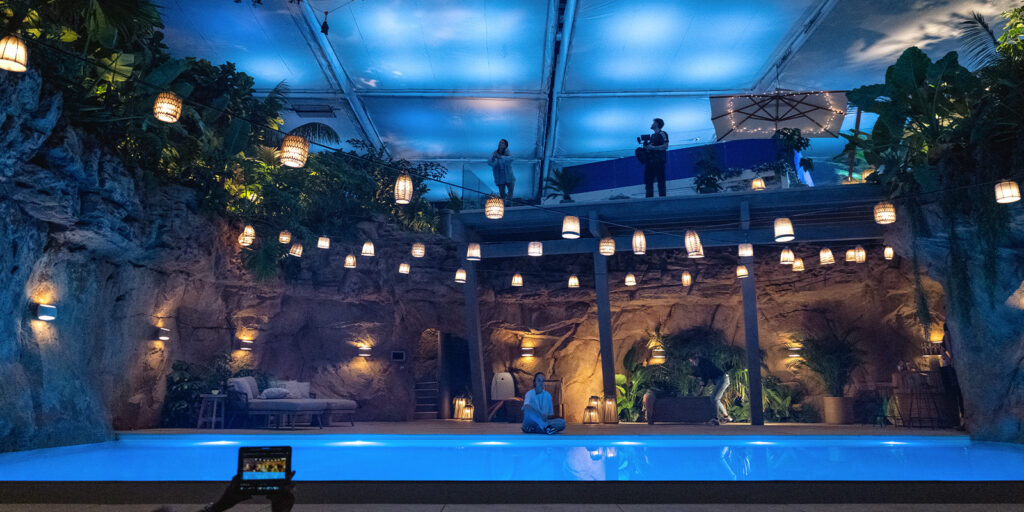
Shawn had built ‘noodle’ lights, an Astera tube covered in the white foam usually used to protect the scaffold tube. These were so effective we used them everywhere and they became one of our main light sources for close-ups. I could hide them behind pieces of the set or rig them anywhere I needed. For close-ups we’d add a 4×4 frame for a very soft key light. To help hide the lights in our glass box set we built Black Correx housings for the noodles and they would disappear in reflections. When our camera was mobile we’d use the Rosco Dash light with a soft dome on the end of a boom pole as a mobile eye light or edge light.
At the edge of our pool we had a huge sky backing with a horizon view of the sea. We used a few old-school tricks to bring it to life like adding LED pea-bulbs for distant light sources but we also had iMAG Displays join us with a series of 4K projectors so we could project a very subtle star field on the night sky backing to help give it some depth, and that worked incredibly well.