
A NEW YORK MINUTE
Premiering at Sundance Film Festival, The Only Living Pickpocket in New York sees DP Sam Levy team up with Noah Segan and John Turturro for a race against time through the Big Apple.
At what point in the process did the film truly “find itself” in the edit and how different did it look from the version you imagined on set?
I anticipate the edit while shooting — we planned each setup methodically with an eye toward narrative drive once the film was assembled. The images were designed not just to function individually, but to speak to one another across time. That approach meant the film was always heading toward a very specific rhythm.
The film truly found itself after watching an early cut with Noah and our producers, when we had an open, organic conversation about pacing. I love working with Noah [Segan, director] and our team — those discussions were deeply collaborative. The next cut landed with a sense of confidence and clarity that was thrilling to experience, even watching it without the final score or sound design. At that point, the film’s internal rhythm felt locked, and the visual language revealed itself as more restrained, elastic, and self-assured than I could have anticipated during production.
Was there a specific scene or sequence where the cinematography became the storytelling engine rather than the script or performances?
The script and the cinematography were inextricably linked — you couldn’t have one without the other. I was deeply inspired by Noah Segan’s noir-inflected love letter to New York, a city that has been my home for many years. There’s a favourite scene of mine between John Turturro and Steve Buscemi. John comes to visit Steve in a pawn shop, and we staged the entire scene largely in a single shot, with John held in silhouette. For me, that image is the beating heart of the film’s aesthetic. The blocking and the lighting converge in a way that’s inseparable from the story itself, and from the precision and restraint of John and Steve’s performances.
How did you manage rhythm and pacing when balancing emotional intimacy with narrative momentum in the cinematography?
For me, the film’s rhythm lives in restraint — and that began with very deliberate blocking. We worked carefully to design movement within the frame so that scenes could play with clarity and intention, rather than being shaped later through coverage. We avoided overcoverage and instead committed to shots that could hold emotional weight without rushing.
Lens choice was central to that approach. I chose the Bausch & Lomb Super Baltar primes, famously used by Gordon Willis ASC on The Godfather. I’ve tested them many times over the years, but I’d never found the right film for them until this one. Their ability to let faces exist in space — textured, dimensional, and slightly imperfect — allowed performances to breathe without being overly isolated.
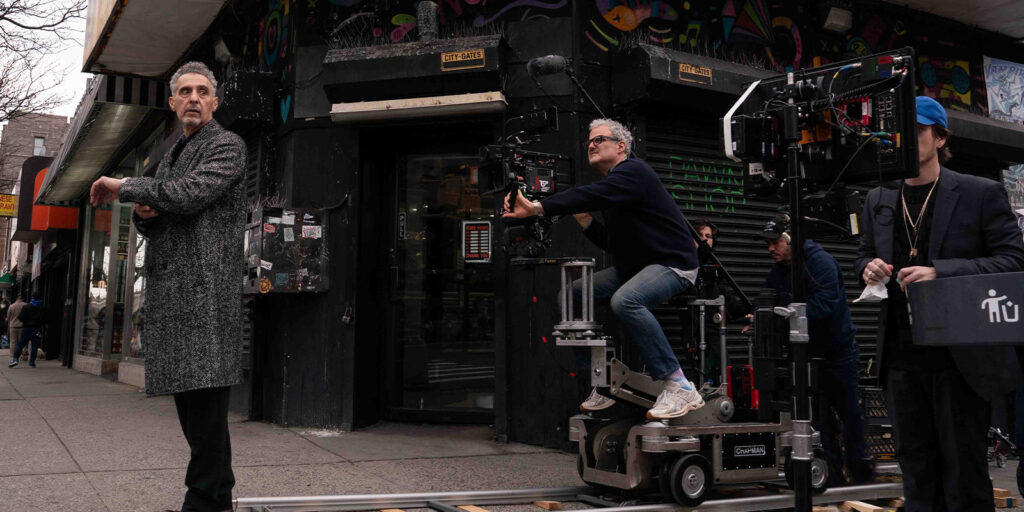
When momentum was needed, we leaned on blocking and camera movement, or subtle optical shifts, rather than cutting. Reframing within a shot, in-shot zooms, or asking John to adjust his body movements — these choices carried energy forward while preserving intimacy. John happens to be an incredible dancer and he has a very natural sense of movement and space.
How early were cinematography decisions influencing other post-production elements like sound design, music, or visual effects?
Very early on, from prep onward, Noah and I talked about the film as a unified sensory experience. We were also incredibly fortunate to have a wonderful VFX supervisor, Giles Harding, who was an invaluable creative partner throughout the process. Giles was an incredible support and helped me greatly in contextualising the aesthetic within the story, ensuring that visual effects were never ornamental but deeply integrated into the film’s emotional and tonal language.
Cinematography decisions — especially regarding texture, contrast, and negative space — directly informed sound design and music. Our aesthetic created room for sound to carry psychological weight, and our approach to camera movement often dictated where sound could expand or recede. The image was never meant to dominate, but to create an ecosystem that other elements could inhabit.
Did the cinematography reveal anything unexpected about the characters or themes that wasn’t apparent during production?
It revealed just how virtuosic a performer John Turturro truly is. His face, his hair, the way he carries himself — cinema runs through his veins. My responsibility as a cinematographer was largely to stay out of his way, while offering him absolute support and carefully interpreting his character’s emotional state.
That kind of work requires a great deal of study in prep. John is a cinephile, deeply attuned to the history and language of cinema. I realised that there are moments when it’s worth constructing something formally beautiful and simply allowing him to inhabit it — because he can. And if my approach was off, all it took was a glance or a nod from John for me to quickly adjust. That level of trust and responsiveness became one of the film’s quiet strengths.
I adore Noah Segan. I met him and immediately trusted him
John and I have known each other for a long time, and we share a deep connection through the late, great Harris Savides. I was Harris’s assistant early in my career, and Harris photographed John’s film Illuminata. That shared lineage created an unspoken shorthand between us on set — a way of silently communicating.
How did collaboration between cinematographer and director evolve over the course of post-production, particularly when difficult decisions had to be made?
I adore Noah Segan. I met him and immediately trusted him. We come from similar backgrounds, and early on I remember thinking, this is someone I can call after wrap and talk things through. There were many moments in prep and production where I called Noah at night simply to ask him to articulate the emotional subtext of a scene — not to talk about coverage or technique, but about what the scene was really doing beneath the surface.
That kind of conversation is what ultimately shows up on screen, even if the audience can’t consciously identify it. It’s not about lamps, equipment, light levels, or which diffusion was used — those things matter, of course — but they’re secondary. What I try to impart to my crew is a clear understanding of the emotional content of the story: what the characters are experiencing, where they’re headed, and why the moment matters. Sometimes that meant playing a piece of music for the team and simply sitting with it, letting the feeling guide the work. And I trust them to pick equipment and tools that are best suited for the project and are within our budget.
My vocation — and my craft — is to interpret the director’s vision and translate it into a visual language that feels seamless, dynamic, and alive, without ever becoming crude or obtrusive.
What were the biggest technical or creative challenges you faced and how did your camera tools help you work through them efficiently?
One of the biggest challenges was fitting a film with many locations spread across all five boroughs into a schedule that still allowed the work to feel intentional and expressive. That required planning in an intuitive way. I pride myself on creating a comprehensive shot list so that when we walk onto a location, the entire team feels confident, prepared, and free to respond creatively rather than reactively.
Another major challenge was maintaining optical cohesion across very different tools. We paired the ARRI Alexa 35 with vintage glass — TLS Rehoused Super Baltars, original Baltars, and Canon Rangefinder primes from my rental house in New York, TCS Camera, owned by brothers Oliver and Erik Schietinger. We also used a modern Angénieux Optimo zoom. Oliver detuned the Optimo 28–340 and helped it sit comfortably alongside the vintage lenses, taking the edge off its modern sharpness and preserving visual continuity. That flexibility allowed us to move quickly across the city while maintaining a consistent visual language from borough to borough.
The goal was empathy, not emphasis — images that bear witness without imposing interpretation
For films dealing with memory, trauma, or complex social realities, how did you approach ethical responsibility in the cinematography?
One of our characters lives with a disability, and that reality shaped our approach in a very conscious way. As someone with disabled family members, I consider myself an advocate for the disabled, and it was important to me that the cinematography neither aestheticize nor marginalize that experience. The camera observes rather than explains, allowing the character to exist fully within the world of the film rather than being defined by condition or circumstance.
The goal was empathy, not emphasis — images that bear witness without imposing interpretation, and that honour complexity by trusting the audience to meet the film where it is.
Looking back, what’s one cinematography decision you now see as pivotal to the film’s final emotional impact?
Looking back, the most pivotal cinematography decision was taking the leap of faith to join Noah Segan on the journey in the first place. I had never shot a crime thriller before, and that unknown was exactly what excited me. I was eager to step into a lineage of films I’d long admired — The Friends of Eddie Coyle, Out of the Past, Naked City and so many other crime films that understand mood, character, and moral ambiguity as inseparable. For me, cinematography isn’t just a craft, it’s a way of life, and this felt like a chance to grow that life in a new direction.
This is a story about people who are overlooked — individuals down on their luck, struggling to survive, moving through a city that rarely slows down for them. It felt essential that the images reflect that reality without polish or condescension. That philosophy guided every visual choice we made, especially our decision to embrace imperfect glass.
The softness, the falloff, the unevenness in our lenses allowed us to observe rather than embellish — to elevate without patronizing. They don’t simply record the story; they interpret it, lending the images a sense of humanity and dignity. In retrospect, that decision quietly shaped everything that followed.